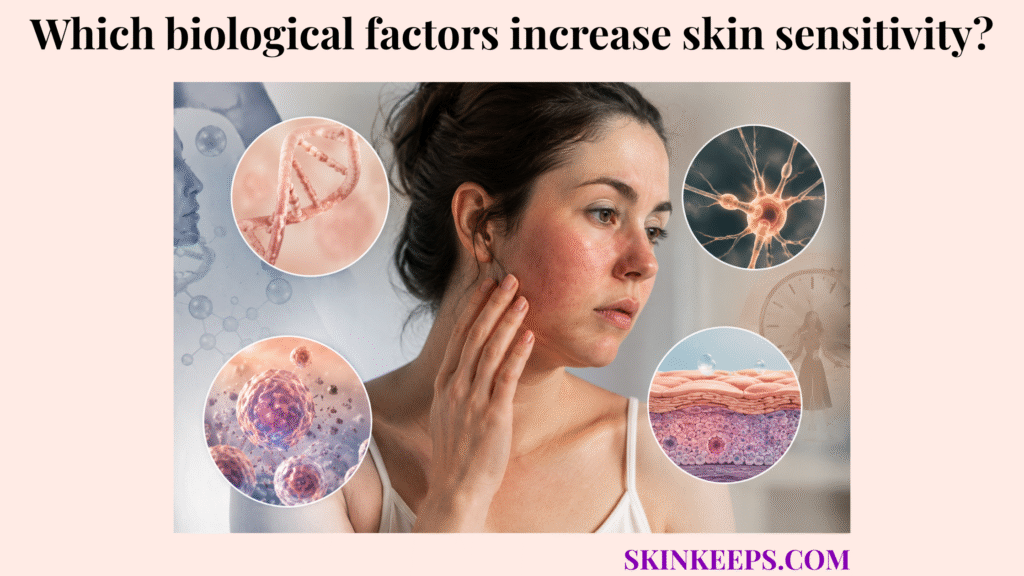
Biological factors that can increase skin sensitivity include a weaker skin barrier, inherited sensitivity, higher nerve reactivity, stronger inflammatory response, dryness-prone skin, age-related barrier changes, hormonal shifts, and skin conditions such as eczema, rosacea, dermatitis, or allergy-prone skin.
These internal factors can make the skin react more easily to products, heat, cold, friction, sweat, fragrance, or cleansing, but outside triggers are not the same as biological causes. This article explains barrier weakness, genetics, nerve response, inflammation tendency, age, hormones, naturally dry skin tendency, condition overlap, the difference between biological factors and external triggers, pattern recognition, support direction, mistakes, warning signs, and final takeaways.
Why Do Biological Factors Make Some Skin More Sensitive?
Biological factors make some skin more sensitive by changing barrier strength, sensory nerve response, inflammation tendency, moisture balance, and recovery after irritation. These factors should be understood inside the broader pattern of sensitive skin, where barrier weakness, trigger response, and product intolerance can overlap.
Sensitivity often appears when internal vulnerability meets an external trigger. Biology explains why the skin is easier to irritate, while products, weather, sweat, fragrance, heat, cold, and friction often reveal that reactivity.
How Barrier Weakness Increases Sensitivity
Barrier weakness increases sensitivity because the outer skin layer may hold less moisture, block irritants less effectively, and recover more slowly after stress. Barrier weakness is one of the strongest internal explanations for reactivity because sensitive skin can have a compromised barrier that loses comfort more easily.
Possible signals include stinging, burning, itching, tightness, dryness, flakes, or product intolerance. Not every sensitive person has obvious barrier damage, but barrier function is a major part of the sensitivity picture.
How Nerve and Immune Responses Affect Skin Discomfort
Nerve and immune responses affect skin discomfort because sensitive skin may feel and show reactions more strongly than less reactive skin. Nerve reactivity can amplify stinging, burning, itching, heat, tenderness, or raw feeling.
Inflammation response can make the skin react with redness, darker irritation, swelling, bumps, or rash-like texture. Discomfort can appear even when visible signs are mild.
| Biological Factor | How It May Increase Sensitivity |
|---|---|
| Weak skin barrier | Allows irritants and moisture loss to affect skin more easily. |
| Genetics | May increase tendency toward reactive or dryness-prone skin. |
| Nerve reactivity | Can make stinging, burning, itching, or heat feel stronger. |
| Inflammation tendency | Makes skin respond more visibly or uncomfortably. |
| Age-related changes | Can reduce barrier resilience and moisture support. |
| Hormonal shifts | May change oil balance, dryness, and reactivity. |
| Skin conditions | Can make the skin barrier more reactive or inflamed. |
How Does a Weak Skin Barrier Increase Skin Sensitivity?
A weak skin barrier can increase skin sensitivity because the outer layer becomes less effective at holding moisture and blocking irritants. When the barrier is weak, basic products may feel stronger than expected.
Barrier weakness can show as stinging, burning, itching, tightness, redness, darker irritation, flaking, roughness, or discomfort. These clues are not a diagnosis, but they can explain why the skin reacts to many products or exposures.
| Barrier Issue | Sensitive-Skin Effect |
|---|---|
| Poor moisture retention | Tightness, dryness, discomfort. |
| Reduced surface protection | Easier irritation from products. |
| Faster water loss | More roughness and reactivity. |
| Barrier cracks or microdamage | Stinging or burning with basic products. |
| Slow barrier recovery | Reactions last longer or return often. |
Can Genetics Increase Skin Sensitivity?
Genetics can increase skin sensitivity by influencing barrier strength, dryness tendency, inflammatory response, allergy tendency, and how easily the skin reacts to triggers. Inherited patterns matter because genetics can predispose someone to sensitive skin through barrier strength, dryness tendency, or inflammation patterns.
Family patterns of sensitive skin, eczema-prone skin, allergy-prone skin, dryness-prone skin, or reactive skin may suggest inherited influence. Genetics can contribute, but sensitivity is not always inherited and external triggers still matter.
How Does Nerve Reactivity Contribute to Sensitive Skin?
Nerve reactivity contributes to sensitive skin by making stinging, burning, itching, prickling, heat, tenderness, or rawness feel stronger after triggers. This can make products, heat, sweat, wind, or friction feel harsher than expected.
Visible signs may be mild while discomfort feels strong. That gap is one reason sensitive skin can feel intense even when the surface does not look dramatically inflamed.
Nerve-Reactivity Clues
How Does Inflammation Increase Skin Sensitivity?
Inflammation can increase skin sensitivity by making the skin respond more strongly to irritation, friction, heat, allergens, or barrier stress. It can make reactions faster, more visible, or more uncomfortable.
Redness, darker irritation, swelling, itching, burning, tenderness, bumps, and rash-like texture can all appear in inflammatory patterns. These signs should be described carefully because they do not diagnose dermatitis, rosacea, allergy, eczema, or infection by themselves.
| Pattern | What It May Suggest |
|---|---|
| Quick redness or darker irritation | Strong visible response. |
| Swelling with discomfort | Stronger inflammatory reaction. |
| Itching with rash-like texture | Possible dermatitis or allergy-like pattern. |
| Burning with tenderness | Barrier stress or inflammation. |
| Recurring same-area reactions | Ongoing sensitivity pattern may need evaluation. |
Does Naturally Dry or Low-Oil Skin Increase Sensitivity?
Naturally dry or low-oil skin can increase sensitivity because dryness weakens comfort and can make the barrier more reactive. Dryness can increase sensitivity, but it does not define all sensitive skin.
A person can have both dry and sensitive skin. A person can also have oily-sensitive or combination-sensitive skin because sensitivity is mainly about reactivity, not oil level alone.
Dry vs Sensitive Key Distinction
- Dry skin is mainly about moisture and oil balance.
- Sensitive skin is mainly about reactivity.
- A person can have both dry and sensitive skin.
- A person can also have oily-sensitive or combination-sensitive skin.
Can Age-Related Skin Changes Increase Sensitivity?
Age-related skin changes can increase sensitivity when skin becomes drier, thinner, slower to recover, or less resilient after irritation. Products, weather, cleansing, and friction may begin to feel harsher over time.
This is not an anti-aging claim. It simply means barrier resilience, moisture support, and recovery can change over time.
Age-Related Sensitivity Clues
Can Hormones Affect Skin Sensitivity?
Hormonal shifts can affect skin sensitivity by changing oil production, dryness, inflammation, and barrier comfort. Sensitivity may fluctuate when hormonal changes affect skin sensitivity through oil balance, dryness, or inflammation shifts.
Monthly changes, pregnancy, postpartum changes, menopause, or other hormone-related periods can change how the skin feels and reacts. This section is educational only and does not provide hormone treatment advice.
Hormone-Related Sensitivity Patterns
Which Skin Conditions Can Increase Sensitivity?
Some skin conditions can increase sensitivity because they involve inflammation, barrier disruption, flushing, itching, dryness, or allergy-like reactions. Condition overlap needs caution because underlying skin conditions can increase sensitivity through inflammation, itching, flushing, or barrier disruption.
Skin-condition references should stay non-diagnostic. The goal is to show patterns that may overlap with sensitivity, not label the reader’s skin.
| Condition Pattern | How It May Relate to Sensitivity |
|---|---|
| Eczema-prone skin | Often involves barrier weakness and itching. |
| Rosacea-prone skin | May involve flushing, burning, and facial reactivity. |
| Contact dermatitis | Can cause itching, rash, swelling, or irritation. |
| Allergy-prone skin | May react strongly to specific ingredients. |
| Very dry or cracked skin | Can sting or burn more easily. |
| Inflamed acne-prone skin | May become sensitive to strong treatments. |
How Are Biological Sensitivity Factors Different From External Triggers?
Biological sensitivity factors are different from external triggers because biology explains why skin is easy to trigger, while external triggers explain what starts the reaction. Both can work together, but they are not the same thing.
Biology explains why skin is easy to trigger, while external triggers can worsen sensitive skin reactions once the underlying reactivity is present. This distinction protects the page from becoming only a product, weather, or skincare-mistake article.
| Category | Meaning | Example |
|---|---|---|
| Biological factor | Internal reason skin is more reactive. | Weak barrier, genetics, nerve reactivity, hormones. |
| External trigger | Outside exposure that sets off symptoms. | Fragrance, cleanser, wind, heat, sweat, friction. |
| Reaction | What the skin does after exposure. | Stinging, burning, itching, tightness, redness, bumps. |
What Signs Suggest Skin Sensitivity Is Biologically Influenced?
Skin sensitivity may be biologically influenced when reactions are long-standing, multi-trigger, family-linked, or connected with barrier weakness, hormonal shifts, slow recovery, or condition-like patterns. This checklist supports pattern recognition, not self-diagnosis.
Biological influence becomes more likely when the skin reacts to many different triggers, not just one obvious product. Reactions that happen even with careful skincare can also point toward internal vulnerability.
Sensitive-Skin Pattern Checklist
How Can Biologically Sensitive Skin Be Supported?
Biologically sensitive skin can be supported by keeping care simple, protecting the barrier, reducing avoidable irritation, and tracking patterns across products, weather, hormones, and flare-ups. This support section is not a full skincare routine.
The goal is to respect lower tolerance instead of forcing the skin through repeated irritation. A simple approach helps the reader see whether biology, triggers, or both are shaping the reaction pattern.
Support Direction
- Keep skincare simple.
- Choose gentle, fragrance-free products.
- Avoid harsh cleansing.
- Avoid over-exfoliation.
- Introduce new products one at a time.
- Moisturize consistently if the barrier feels dry or tight.
- Protect skin from heat, wind, cold, sweat, and friction.
- Track patterns across products, weather, hormones, and flare-ups.
- Seek professional guidance if reactions are frequent or severe.
What Mistakes Make Biologically Sensitive Skin Worse?
Biologically sensitive skin can worsen when the response adds harsh products, friction, heat, too many actives, or repeated trigger exposure instead of respecting the skin’s lower tolerance. The biggest mistake is trying to “train through” sensitivity with more irritation.
Ignoring repeat reactions can also hide biological patterns. If the skin reacts to many basic products, the issue may be more than one product mismatch.
| Mistake | Why It Backfires |
|---|---|
| Treating sensitivity as weakness to “train through” | Can worsen irritation. |
| Using many actives together | Increases barrier stress. |
| Scrubbing reactive skin | Adds friction and inflammation. |
| Ignoring repeated product reactions | Allows triggers to continue. |
| Using hot water often | Can worsen tightness and dryness. |
| Skipping moisturizer when the barrier feels stressed | Leaves skin unsupported. |
| Assuming sensitivity is only product-related | May miss biological or medical patterns. |
When Should Biological Skin Sensitivity Be Evaluated Professionally?
Biological skin sensitivity should be evaluated professionally when reactions are frequent, severe, painful, persistent, sleep-disrupting, eye-area related, infected-looking, or involve swelling, blisters, oozing, crusting, or bleeding. These signs deserve review rather than repeated product guessing.
Professional review becomes important when sensitive skin needs a dermatologist instead of repeated product guessing. Evaluation can help separate ordinary sensitivity from eczema, rosacea, dermatitis, allergy, infection, acne, or another concern.
Professional Evaluation Checklist
What Should You Remember About Biological Factors and Skin Sensitivity?
Biological factors can make skin more sensitive before any product, weather, or skincare trigger appears. External triggers do not create the whole problem; they often reveal an underlying sensitivity pattern.
Final Takeaways
- Biological factors can make skin more sensitive before any product or weather trigger appears.
- A weak barrier is one of the most important sensitivity factors.
- Genetics, nerve reactivity, inflammation tendency, age, hormones, dryness tendency, and skin conditions can all increase sensitivity.
- External triggers do not create the whole problem; they often reveal an underlying sensitivity pattern.
- Frequent, severe, painful, swollen, blistering, or persistent reactions should be professionally evaluated.
Frequently Asked Questions
Is Sensitive Skin Genetic?
Sensitive skin can be partly genetic because inherited factors may influence barrier strength, dryness tendency, inflammation response, and allergy-prone patterns. Genetics may contribute, but it is not the only cause because external triggers and skincare habits can still affect reactions.
Does a Weak Barrier Always Mean Sensitive Skin?
A weak barrier can increase sensitivity, but it does not automatically diagnose sensitive skin or a skin condition. Barrier weakness is one important pattern, especially when products sting, burn, itch, or tighten easily.
Can Hormones Make Skin More Sensitive?
Hormones can make skin more sensitive by changing oil balance, dryness, inflammation, and barrier comfort. Monthly changes, pregnancy, postpartum changes, menopause, or other hormonal periods may affect sensitivity patterns, but this does not replace professional evaluation.
Can Oily Skin Still Be Biologically Sensitive?
Oily skin can still be biologically sensitive because sensitivity is mainly about reactivity, not oil level alone. Oily skin may still sting, burn, itch, flush, or react if the barrier or nerve response is reactive.
Are Skin Conditions a Cause of Sensitive Skin?
Some skin conditions can increase sensitivity because they involve inflammation, barrier disruption, flushing, itching, dryness, or allergy-like reactions. Frequent, severe, swollen, blistering, oozing, crusted, or persistent reactions should be professionally evaluated.
When Should Biological Skin Sensitivity Be Checked?
Biological skin sensitivity should be checked when reactions are frequent, severe, painful, persistent, sleep-disrupting, eye-area related, infected-looking, or involve swelling, blisters, oozing, crusting, or bleeding. Evaluation helps separate ordinary sensitivity from another concern.
Conclusion
Biological factors can increase skin sensitivity by making the barrier weaker, the nerves more reactive, the inflammatory response stronger, or the skin slower to recover after irritation. Genetics, dryness tendency, age-related changes, hormonal shifts, and skin conditions can all make the skin easier to trigger.
Biology explains why the skin is easy to trigger, while external triggers explain what starts the reaction. If sensitivity is frequent, severe, painful, swollen, blistering, oozing, crusted, bleeding, eye-area related, infected-looking, sleep-disrupting, or persistent, professional evaluation is safer than repeated product guessing.