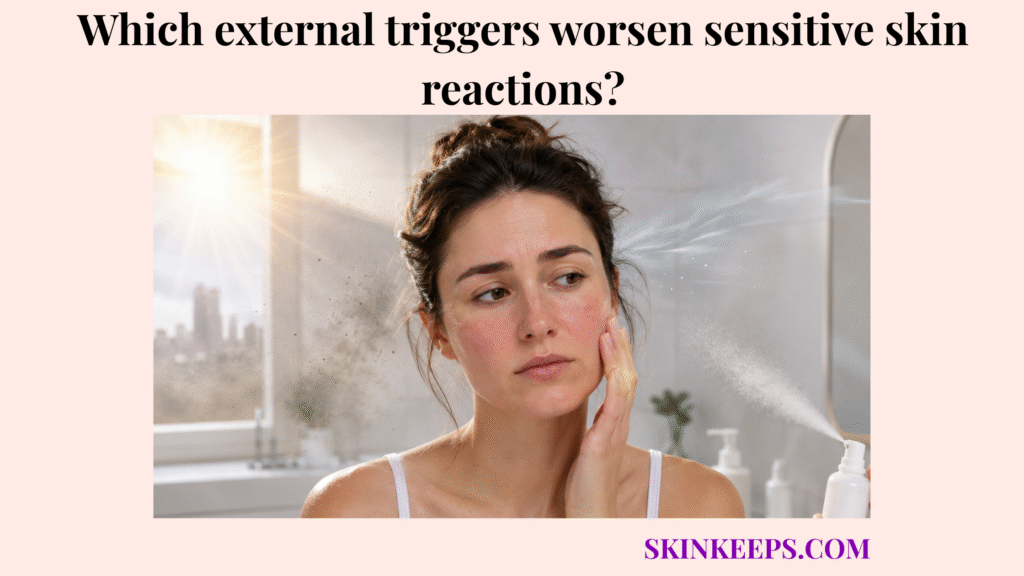
External triggers that can worsen sensitive skin reactions include harsh cleansers, fragrance, exfoliating acids, retinoids, alcohol-rich formulas, hot water, cold wind, heat, sweat, sun exposure, shaving, friction, rough fabrics, makeup, sunscreen, pollution, and frequent product switching.
These triggers do not always cause sensitivity by themselves, but they can make reactive skin sting, burn, itch, feel tight, flush, flake, form bumps, or develop rash-like irritation. This article explains why external triggers worsen sensitive skin, which skincare products commonly trigger reactions, how weather, hot water, sweat, heat, friction, shaving, fabrics, pollution, and trigger stacking affect skin, how external triggers differ from biological causes, how to reduce and track reactions, and when professional evaluation is safer.
Why Do External Triggers Worsen Sensitive Skin Reactions?
External triggers worsen sensitive skin reactions because they can stress the barrier, increase moisture loss, irritate the surface, or make sensory nerves feel triggers more strongly. External triggers should be interpreted inside the broader pattern of sensitive skin, where barrier weakness, trigger response, and product intolerance can overlap.
External triggers explain what worsens a reaction, while biological factors can increase skin sensitivity before the trigger appears. Both can work together, which is why the same exposure may bother one person and not another.
How External Triggers Stress the Skin Barrier
External triggers stress the skin barrier by stripping moisture, increasing friction, disrupting surface comfort, or exposing the skin to irritating ingredients and environmental conditions. Many triggers become stronger when sensitive skin has a compromised barrier that loses comfort easily.
Harsh cleansers, hot water, wind, strong actives, fragrance, sweat, and friction can all make the surface feel tight, dry, raw, or stingy. Barrier stress is a practical clue, not a diagnosis.
Why Sensitive Skin Reacts Faster Than Less Reactive Skin
Sensitive skin reacts faster than less reactive skin because it often has lower tolerance for products, weather, heat, sweat, friction, or repeated exposure. The reaction may appear as stinging, burning, itching, tightness, flushing, bumps, flaking, or rash-like irritation.
Fast reactivity does not prove allergy, dermatitis, rosacea, infection, acne, or chemical irritation. It means the trigger pattern needs to be tracked carefully.
| External Trigger Type | How It May Worsen Sensitive Skin |
|---|---|
| Harsh skincare products | Can irritate or strip the barrier. |
| Fragrance | Can trigger itching, stinging, or rash-like reactions. |
| Hot water | Can increase tightness, dryness, and burning. |
| Cold wind | Can make skin feel raw, tight, or chapped. |
| Heat and sweat | Can increase flushing, prickling, itching, or bumps. |
| Friction | Can create localized irritation and tenderness. |
| Shaving | Can trigger stinging, bumps, or rawness. |
| Pollution | May worsen irritation in already reactive skin. |
Which Skincare Products Commonly Trigger Sensitive Skin Reactions?
Skincare products that commonly trigger sensitive skin reactions include harsh cleansers, fragrance-heavy products, strong exfoliants, retinoids, alcohol-rich toners, some heavy creams, sunscreen, and makeup. Product categories matter because skincare ingredients can commonly irritate sensitive skin when the formula is too strong or poorly tolerated.
A product category does not guarantee a reaction. Formula strength, skin state, timing, weather, and trigger stacking all matter.
| Product Category | Possible Sensitive-Skin Reaction |
|---|---|
| Harsh cleansers | Tightness, dryness, stinging. |
| Fragrance-heavy products | Itching, rash-like irritation, burning. |
| Strong exfoliants | Peeling, burning, shiny tightness. |
| Retinoids | Dryness, flaking, stinging, burning. |
| Alcohol-rich toners | Dryness, tightness, irritation. |
| Heavy creams | Bumps or congestion in some sensitive skin. |
| Sunscreen | Stinging, itching, or eye-area discomfort. |
| Makeup | Bumps, itching, friction, or formula intolerance. |
How Do Weather and Climate Worsen Sensitive Skin?
Weather and climate worsen sensitive skin by increasing moisture loss, heat stress, wind exposure, sweat, dryness, flushing, or seasonal barrier adjustment. Cold air, wind, heat, sun, humidity shifts, and sudden temperature changes can all change how the skin feels.
This is weather-trigger guidance, not a climate-only page. A reaction may become stronger when weather combines with products, hot water, or friction.
| Weather Condition | Possible Reaction |
|---|---|
| Cold air | Tightness, roughness, stinging. |
| Wind | Rawness, chapping, redness or darker irritation. |
| Heat | Flushing, burning, prickling. |
| Low humidity | Dryness, tightness, flaking. |
| High humidity | Sweat irritation, bumps, itching. |
| Sudden temperature shifts | Stinging, flushing, tightness. |
| Sun exposure | Heat, redness, dryness, irritation. |
Can Hot Water Worsen Sensitive Skin Reactions?
Hot water can worsen sensitive skin reactions by increasing dryness, tightness, flushing, burning, and barrier discomfort. Hot showers, hot face washing, and steam exposure can make the skin feel clean at first but stripped later.
The “squeaky clean” feeling is not a good target for sensitive skin. Hot water should not be used to soothe irritation because it can add heat and moisture loss.
Hot-Water Reaction Clues
- Skin feels tight after washing.
- Burning appears after a hot shower.
- Redness or darker irritation increases.
- Moisturizer stings afterward.
- Flaking or roughness appears later.
- Skin feels warm, raw, or over-cleansed.
Can Sweat and Heat Trigger Sensitive Skin Discomfort?
Sweat and heat can trigger sensitive skin discomfort by increasing prickling, itching, burning, flushing, or friction-related irritation. Sweat may feel more irritating when the barrier is dry, shaved, inflamed, over-treated, or already uncomfortable.
Heat and sweat do not prove acne, infection, or allergy. They are exposure clues that should be tracked with location, timing, friction, and recurrence.
| Pattern | What It May Suggest |
|---|---|
| Prickling after sweating | Heat or sweat sensitivity. |
| Itching in sweaty areas | Friction or sweat irritation. |
| Burning after exercise | Barrier stress or heat reactivity. |
| Bumps after sweating | Heat, friction, or clogged reaction pattern. |
| Flushing after heat | Temperature-sensitive reactivity. |
How Do Friction, Shaving, and Rough Fabrics Worsen Sensitive Skin?
Friction, shaving, and rough fabrics worsen sensitive skin by disrupting surface comfort and creating localized irritation. Mechanical triggers include shaving, tight clothing, rough towels, masks, collars, helmets, textured fabrics, repeated touching, and scrubbing.
Mechanical irritation often appears where rubbing, scraping, pressure, or shaving happened. This location pattern can make trigger tracking easier.
| Mechanical Trigger | Possible Reaction |
|---|---|
| Shaving | Stinging, bumps, tenderness. |
| Rough towels | Rawness or friction irritation. |
| Tight clothing | Heat, rubbing, localized irritation. |
| Face masks | Friction bumps, redness, itch. |
| Wool or rough fabrics | Itching, prickling, discomfort. |
| Repeated touching | Inflammation and barrier stress. |
| Scrubbing | Burning, peeling, tightness. |
Can Pollution or Environmental Exposure Worsen Sensitive Skin?
Pollution, dust, smoke, and environmental residue may worsen sensitive skin in some people, especially when the barrier is already irritated. Environmental exposure can leave the skin feeling uncomfortable, itchy, tight, or reactive.
Over-cleansing after exposure can make symptoms worse. Gentle removal is safer than scrubbing the skin aggressively after commuting, dust, smoke, or outdoor exposure.
Environmental Exposure Clues
- Skin feels irritated after outdoor exposure.
- Itching or tightness appears after dust or smoke exposure.
- Skin feels uncomfortable after commuting or city exposure.
- Cleansing too aggressively afterward worsens symptoms.
- Reactions improve when exposure and cleansing are gentler.
What Is Trigger Stacking in Sensitive Skin?
Trigger stacking happens when several mild triggers combine and create a stronger sensitive-skin reaction than any one trigger might cause alone. A single product or exposure may not explain the whole flare.
Trigger stacking can include internal pressure because stress can make sensitive skin more reactive during flare-prone periods. Cleansing, heat, fragrance, sweat, friction, stress, and weather can stack close together.
| Trigger Combination | Possible Result |
|---|---|
| Hot shower + harsh cleanser | Tightness, burning, dryness. |
| Exfoliant + sun exposure | Stinging, redness, peeling. |
| Sweat + friction | Itching, bumps, rawness. |
| Retinoid + cold wind | Flaking, burning, tightness. |
| Fragrance + damaged barrier | Itching, rash-like reaction. |
| Stress + strong product | Increased product intolerance. |
How Are External Triggers Different From Biological Sensitivity Factors?
External triggers are different from biological sensitivity factors because external triggers are outside exposures, while biological factors are internal reasons the skin is easier to irritate. Hormonal timing should be separated from external exposures because hormonal changes can affect skin sensitivity through oil, moisture, flushing, and product tolerance.
Both can work together. Biology explains why the skin is reactive; external triggers explain what sets off or worsens the reaction.
| Category | Meaning | Example |
|---|---|---|
| Biological factor | Internal reason skin is easier to irritate. | Genetics, weak barrier, hormones, skin conditions. |
| External trigger | Outside exposure that starts or worsens a reaction. | Fragrance, cleanser, hot water, wind, sweat. |
| Sensitive reaction | What the skin does after exposure. | Stinging, burning, itching, tightness, redness, bumps. |
Simple rule: Biological factors explain why skin is reactive. External triggers explain what sets off or worsens the reaction.
What Signs Suggest an External Trigger Is Causing the Reaction?
An external trigger may be causing the reaction when symptoms begin after a specific product or exposure, appear where the trigger touched, return with repetition, or improve when the trigger is removed. Timing, location, recurrence, and trigger removal are the main clues.
Weather, sweat, wind, friction, routine changes, workplace exposure, exercise, clothing, and trigger stacking can all shape the pattern. One reaction is less useful than a repeated exposure-reaction link.
External Trigger Pattern Checklist
How Can Sensitive Skin Reduce External Trigger Reactions?
Sensitive skin can reduce external trigger reactions by lowering avoidable irritation, keeping routines stable, and removing repeated triggers before they stack. This is trigger-reduction guidance, not a full routine.
Gentle cleansing, fragrance reduction, slow active introduction, no scrubbing, weather and sun protection, gentler sweat rinsing, softer fabrics, and routine stability can reduce avoidable exposure. Products that repeatedly sting, burn, itch, or tighten should not be forced.
Trigger-Reduction Checklist
- Use a gentle, fragrance-free cleanser.
- Avoid hot water.
- Reduce fragrance-heavy products.
- Introduce strong actives slowly.
- Avoid scrubbing or rough towels.
- Protect skin from wind, heat, cold, and sun.
- Rinse sweat gently instead of over-cleansing.
- Choose softer fabrics when friction triggers reactions.
- Keep the routine stable during flare-prone periods.
- Stop products that repeatedly sting, burn, itch, or tighten the skin.
What Mistakes Make External-Trigger Reactions Worse?
External-trigger reactions often worsen when the response adds more heat, friction, actives, fragrance, over-cleansing, or product switching. The goal is to lower the trigger load, not keep testing the irritated skin.
Blaming one product too quickly can also miss trigger stacking. Several mild exposures close together can create one stronger reaction.
| Mistake | Why It Backfires |
|---|---|
| Using hot water to soothe irritation | Can worsen dryness and burning. |
| Scrubbing after pollution or sweat | Adds friction and barrier stress. |
| Adding more actives during a flare | Can intensify irritation. |
| Ignoring fragrance reactions | Allows repeated trigger exposure. |
| Over-cleansing after sweating | Can increase tightness and dryness. |
| Wearing rough fabrics during irritation | Can worsen itching and rawness. |
| Switching many products at once | Makes the true trigger harder to identify. |
| Blaming one product when several triggers stacked together | Misses the full reaction pattern. |
How Should Someone Track External Triggers for Sensitive Skin?
Someone should track external triggers for sensitive skin by recording products, weather, temperature, hot water, sweat, friction, shaving, fabrics, sun, pollution, symptoms, location, timing, and whether multiple triggers happened together. Tracking is pattern recognition, not diagnosis.
Photos can help if visible changes appear. The most useful record connects the exposure, location, timing, symptom, recurrence, and what improved or worsened the reaction.
Sensitive-Skin Trigger Tracking Worksheet
When Should External-Trigger Sensitive Skin Reactions Be Professionally Evaluated?
External-trigger sensitive skin reactions should be professionally evaluated when they become severe, persistent, painful, swollen, blistering, oozing, crusted, bleeding, spreading, eye-area related, infected-looking, sleep-disrupting, or recurring. These signs should not be treated as ordinary trigger irritation.
Professional review becomes important when sensitive skin needs a dermatologist instead of repeated trigger guessing. Evaluation helps separate ordinary trigger irritation from dermatitis, allergy, rosacea, infection, acne, or another condition.
Professional Evaluation Warning Signs
What Should You Remember About External Triggers and Sensitive Skin?
External triggers can worsen sensitive skin reactions, especially when the skin barrier is already reactive or several triggers happen close together. Trigger tracking helps separate one-time irritation from repeat exposure patterns.
Final Takeaways
- External triggers can worsen sensitive skin reactions.
- Common triggers include harsh products, fragrance, hot water, weather, heat, sweat, friction, shaving, rough fabrics, sun exposure, pollution, and frequent product changes.
- External triggers do not always explain the whole problem; they often reveal an already reactive barrier.
- Trigger stacking can make a reaction stronger than any single trigger alone.
- Tracking timing, location, products, weather, sweat, and friction helps identify the real pattern.
- Severe, persistent, painful, swollen, blistering, oozing, or recurring reactions should be professionally evaluated.
Frequently Asked Questions
What Are the Most Common Sensitive Skin Triggers?
The most common sensitive skin triggers include harsh cleansers, fragrance, strong actives, hot water, cold wind, heat, sweat, friction, shaving, rough fabrics, sunscreen, makeup, and frequent product switching. Triggers vary by person, so repeat patterns matter.
Can Hot Water Trigger Sensitive Skin?
Hot water can trigger sensitive skin by increasing dryness, tightness, flushing, burning, and barrier discomfort. Skin may feel clean at first but later feel stretched, stingy, itchy, or raw.
Can Sweat Make Sensitive Skin Itch or Burn?
Sweat can make sensitive skin itch or burn when heat, salt, friction, or a weakened barrier makes the skin more reactive. This is a sweat, heat, and friction overlap pattern, not proof of infection, acne, or allergy.
Is Fragrance a Sensitive Skin Trigger?
Fragrance can be a sensitive skin trigger because it may irritate reactive skin or contribute to allergy-like reactions in some people. Not every fragrance reaction is allergy, but repeated reactions should be tracked.
What Is Trigger Stacking in Sensitive Skin?
Trigger stacking in sensitive skin means several mild triggers happen close together and create a stronger reaction than one trigger alone. Examples include hot water plus harsh cleanser, sweat plus friction, or retinoid plus cold wind.
When Should Sensitive Skin Triggers Be Checked?
Sensitive skin triggers should be checked when reactions are severe, persistent, painful, swollen, blistering, oozing, crusted, bleeding, spreading, eye-area related, infected-looking, sleep-disrupting, or recurring. Evaluation helps separate ordinary trigger irritation from another concern.
Conclusion
External triggers can worsen sensitive skin reactions when they stress the barrier, increase sensory discomfort, or stack with other exposures. Harsh products, fragrance, hot water, weather, heat, sweat, friction, shaving, rough fabrics, sun exposure, pollution, and frequent product switching can all make reactive skin sting, burn, itch, feel tight, flush, flake, form bumps, or develop rash-like irritation.
External triggers are clues, not diagnoses. If reactions are severe, persistent, painful, swollen, blistering, oozing, crusted, bleeding, spreading, eye-area related, infected-looking, sleep-disrupting, or recurring, professional evaluation is safer than repeated trigger guessing.