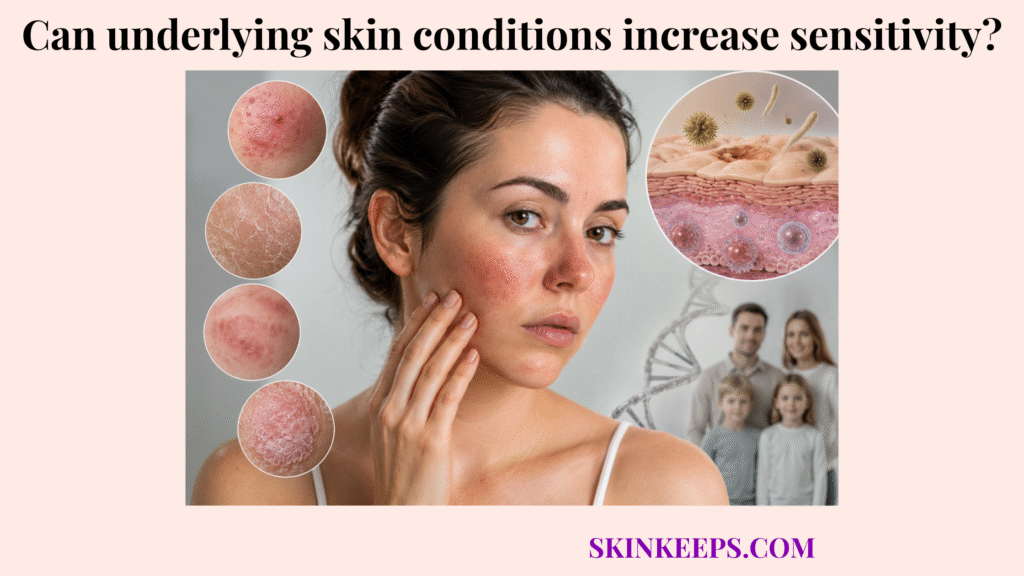
Yes, underlying skin conditions can increase skin sensitivity by weakening the barrier, increasing inflammation, changing moisture balance, triggering itching or burning, or making the skin react more strongly to products and environmental exposures.
Conditions such as eczema-prone skin, rosacea-prone skin, contact dermatitis, allergy-like reactions, very dry or cracked skin, and inflamed acne-prone skin can make sensitivity more frequent, intense, recurring, or difficult to calm. This article explains the barrier and inflammation link, condition-specific patterns, ordinary sensitivity versus condition-linked sensitivity, condition versus trigger differences, support direction, mistakes, tracking, warning signs, and final takeaways.
Why Can Skin Conditions Make Sensitivity Worse?
Skin conditions can make sensitivity worse when they weaken the barrier, increase inflammation, intensify itching or burning, or make the skin respond more strongly to normal exposures. Underlying conditions should be interpreted inside the broader pattern of sensitive skin, where barrier weakness, trigger response, and product intolerance can overlap.
Skin conditions belong to the internal-cause layer because biological factors can increase skin sensitivity before an outside trigger appears.
This section explains the broad mechanism before the condition-specific patterns. A condition-linked pattern can make sensitivity more frequent, more intense, more location-based, or slower to calm.
How Inflammation Makes Skin More Reactive
Inflammation makes skin more reactive by increasing redness, darker irritation, swelling, heat, tenderness, itching, burning, or rash-like texture after triggers. Visible signs may vary across skin tones, so texture, swelling, heat, or discomfort can matter even when redness is subtle.
Inflammation is a reaction amplifier. It does not diagnose rosacea, dermatitis, allergy, eczema, infection, or another condition by itself.
How Barrier Disruption Increases Discomfort
Barrier disruption increases discomfort because a weaker or irritated surface loses moisture more easily and tolerates products, weather, sweat, friction, or cleansing less well. Many condition-linked reactions involve barrier stress, especially when sensitive skin has a compromised barrier that loses comfort easily.
Barrier disruption may show as dryness, cracking, stinging, burning, itching, tightness, flaking, or rawness. This section stays broad; the condition-specific sections explain how each pattern may appear.
| Condition Pattern | How It May Increase Sensitivity |
|---|---|
| Eczema-prone skin | Barrier weakness, itching, dryness, flare-ups. |
| Rosacea-prone skin | Burning, flushing, heat, facial reactivity. |
| Contact dermatitis | Rash, itching, swelling, irritation after exposure. |
| Allergy-prone reactions | Strong itch, rash, swelling, or delayed reactions. |
| Very dry or cracked skin | Stinging, tightness, burning, and roughness. |
| Inflamed acne-prone skin | Irritation from acne lesions or strong treatments. |
How Does Eczema-Prone Skin Increase Sensitivity?
Eczema-prone skin can increase sensitivity because the barrier may lose moisture more easily and react strongly to irritants. This can create itching, tightness, dryness, rough patches, stinging, burning, and recurring flare-like patterns.
Products, weather, sweat, friction, and cleansing may all reveal the pattern, but they do not prove eczema by themselves. The boundary is important: this is condition-overlap education, not a diagnosis.
Eczema-Prone Sensitivity Clues
- Skin becomes itchy and dry easily.
- Rough or scaly patches return.
- Products sting or burn during flare-ups.
- Fragrance or harsh cleansers worsen discomfort.
- Scratching makes irritation worse.
- Sensitivity appears in recurring patch-like areas.
How Does Rosacea-Prone Skin Increase Sensitivity?
Rosacea-prone skin can increase sensitivity because the face may react strongly with flushing, burning, warmth, stinging, or tenderness after triggers. This is a facial reactivity pattern, not a rosacea diagnosis.
Heat, sun, spicy foods, alcohol, exercise, skincare products, wind, and temperature changes can be examples of exposures that reveal rosacea-prone sensitivity. Recurring facial burning or flushing should be evaluated instead of guessed from symptoms alone.
Rosacea-Prone Sensitivity Clues
- Repeated facial flushing.
- Burning or warmth on the central face.
- Stinging from skincare products.
- Sensitivity after heat or sun exposure.
- Bumps with redness or irritation.
- Triggers cause repeated facial reactions.
Can Contact Dermatitis Make Skin More Sensitive?
Contact dermatitis can make skin more sensitive when the skin reacts to an irritant or a specific ingredient that touches the skin. A contact pattern may show through rash, itching, burning, swelling, peeling, dryness, bumps, or repeat reactions where a product touched.
This does not diagnose irritant or allergic contact dermatitis. A repeated reaction in the same contact area is a pattern to assess, not a label to self-assign.
| Pattern | What It May Suggest |
|---|---|
| Rash where product was applied | Contact reaction may be involved. |
| Itching with swelling | Allergy-like reaction is possible. |
| Burning after repeated exposure | Irritant reaction may be present. |
| Peeling or cracking after product use | Barrier stress may be involved. |
| Reaction returns with the same product | Trigger pattern should be assessed. |
Can Allergy-Prone Skin Increase Sensitivity?
Allergy-prone skin can increase sensitivity when specific ingredients, fragrances, preservatives, dyes, metals, or topical products trigger stronger reaction patterns. Family patterns can matter because genetics can predispose someone to sensitive skin through barrier, inflammation, or allergy-prone tendencies.
Allergy-like sensitivity often involves stronger itch, rash, swelling, bumps, blisters, spread, or reactions that return after repeated exposure. These patterns should be evaluated if they are strong, recurrent, spreading, or difficult to explain.
Can Acne-Prone Skin Become More Sensitive?
Acne-prone skin can become more sensitive when inflammation is active or when strong acne treatments are overused or poorly tolerated. Acne-related sensitivity needs careful wording because breakouts on sensitive skin can differ from other skin types when irritation and product intolerance overlap.
Inflamed lesions can feel tender, and strong actives can cause burning, peeling, tightness, or product reactivity. This is not an acne treatment plan and does not recommend product brands.
Acne-Related Sensitivity Clues
- Acne treatments cause burning or peeling.
- Skin feels tight after actives.
- Inflamed pimples feel tender.
- Harsh cleansers worsen irritation.
- Scrubbing increases redness or darker irritation.
- Breakouts and sensitivity happen together.
How Is Condition-Linked Sensitivity Different From Ordinary Sensitive Skin?
Condition-linked sensitivity differs from ordinary sensitive skin because it is more likely to be recurring, persistent, location-patterned, or linked with rash, swelling, flushing, scaling, lesions, flare-ups, or stronger discomfort. Ordinary sensitivity is more often trigger-based discomfort that calms after the trigger is removed.
The difference is not always obvious at home. Recurring, persistent, or stronger signs deserve a more cautious interpretation than simple one-time irritation.
| Feature | Ordinary Sensitive Skin | Condition-Linked Sensitivity |
|---|---|---|
| Pattern | Trigger-based discomfort. | Recurring or persistent symptom pattern. |
| Symptoms | Stinging, burning, itching, tightness. | Symptoms plus rash, swelling, flushing, scaling, lesions, or flare-ups. |
| Duration | Often improves after trigger removal. | May return or persist without clear routine changes. |
| Location | Often where trigger touched. | May follow condition-specific areas. |
| Response | Calms with simpler routine. | May need professional diagnosis or treatment. |
| Risk | Irritation pattern. | Underlying inflammation, dermatitis, allergy, rosacea, eczema, or acne involvement. |
What Signs Suggest Sensitivity May Be Linked to an Underlying Condition?
Sensitivity may be linked to an underlying condition when it keeps returning, affects the same areas, appears with rash, swelling, bumps, scaling, cracking, flushing, pain, or takes a long time to calm. This checklist is pattern recognition, not a self-diagnosis tool.
A recurring same-area pattern is more concerning than one brief reaction. Symptoms that remain despite a simple routine deserve careful documentation and professional review when they persist or worsen.
Condition-Linked Sensitivity Checklist
How Are Underlying Conditions Different From External Triggers?
Underlying conditions are different from external triggers because conditions explain why skin is more reactive, while triggers explain what starts or worsens the reaction. Conditions explain why the skin is more reactive, while external triggers can worsen sensitive skin reactions once the condition pattern is present.
Conditions and triggers can work together. A condition pattern may make the skin easier to trigger, while fragrance, cleanser, heat, sweat, wind, or friction may set off the symptoms.
| Category | Meaning | Example |
|---|---|---|
| Underlying condition | Ongoing skin pattern that increases reactivity. | Eczema-prone skin, rosacea-prone skin, dermatitis. |
| External trigger | Outside exposure that starts or worsens symptoms. | Fragrance, cleanser, heat, sweat, wind. |
| Sensitive reaction | What the skin does after exposure. | Itching, burning, tightness, rash, redness, bumps. |
Simple rule: Underlying conditions explain why skin is more reactive. Triggers explain what sets off the reaction.
How Can Condition-Linked Sensitive Skin Be Supported?
Condition-linked sensitive skin can be supported by keeping care simple and consistent, reducing avoidable irritation, tracking patterns, and seeking guidance when symptoms are recurring, severe, or unclear. This is general support, not a treatment plan.
Fragrance avoidance, gentle cleansing, no scrubbing, pausing strong actives during flare-ups, moisturizing when dry or tight, tracking, and professional evaluation can all reduce avoidable confusion. The goal is not to replace diagnosis.
Support Direction
- Keep skincare simple and consistent.
- Avoid fragrance-heavy products.
- Use gentle cleansing.
- Avoid scrubbing irritated skin.
- Pause strong actives during flare-ups.
- Moisturize if the barrier feels dry or tight.
- Track repeated trigger and symptom patterns.
- Avoid assuming every reaction is ordinary sensitivity.
- Seek professional guidance when symptoms are recurring, severe, or unclear.
What Mistakes Make Condition-Linked Sensitivity Worse?
Condition-linked sensitivity can worsen when recurring symptoms are treated as simple irritation, strong actives are used during flare-ups, or warning signs are ignored. The main problem is treating repeated, stronger, or location-patterned symptoms like ordinary one-time sensitivity.
Scrubbing rash-like or bumpy skin, reusing triggering products, ignoring swelling or blistering, switching many products at once, and delaying evaluation can prolong discomfort. The safer response is to simplify, track, and escalate when warning signs appear.
| Mistake | Why It Backfires |
|---|---|
| Treating all sensitivity as simple irritation | May miss an underlying condition. |
| Using strong actives during flare-ups | Can worsen burning, peeling, or rash. |
| Scrubbing rash-like or bumpy skin | Adds friction and inflammation. |
| Reusing products that repeatedly trigger reactions | Keeps the cycle active. |
| Ignoring swelling or blistering | May miss dermatitis or allergy-like reactions. |
| Switching many products at once | Makes patterns harder to understand. |
| Delaying evaluation when symptoms persist | Can prolong discomfort. |
How Should Someone Track Sensitivity Linked to Skin Conditions?
Someone should track sensitivity linked to skin conditions by recording the main symptom, location, possible trigger, recurrence, duration, visible changes, and what improves or worsens the reaction. Tracking is pattern recognition, not diagnosis.
Photos can help if visible changes appear. Family history or a previous diagnosis can be useful context, but neither proves the current reaction pattern by itself.
Symptom Tracking Checklist
When Should Condition-Related Sensitivity Be Professionally Evaluated?
Condition-related sensitivity should be professionally evaluated when symptoms are persistent, worsening, severe, painful, sleep-disrupting, eye-area related, infected-looking, or involve swelling, blisters, oozing, crusting, bleeding, recurring rash, or repeated facial burning. These signs are stronger than ordinary temporary sensitivity.
Professional review becomes important when sensitive skin needs a dermatologist instead of repeated product guessing. Evaluation helps separate ordinary irritation from eczema, dermatitis, allergy, rosacea, infection, acne, folliculitis, or another concern.
Professional Evaluation Warning Signs
What Should You Remember About Underlying Conditions and Sensitive Skin?
Underlying skin conditions can increase sensitivity by weakening the barrier, increasing inflammation, intensifying itching or burning, or making reactions more frequent and harder to calm. The key is recognizing recurring or stronger symptom patterns without self-diagnosing.
Final Takeaways
- Underlying skin conditions can increase sensitivity.
- They may weaken the barrier, increase inflammation, intensify itching or burning, or make the skin react more easily.
- Eczema-prone skin, rosacea-prone skin, contact dermatitis, allergy-like reactions, very dry skin, and inflamed acne-prone skin can all make sensitivity worse.
- Condition-linked sensitivity often has recurring, persistent, or stronger symptom patterns.
- Frequent, severe, painful, swollen, blistering, oozing, or recurring reactions should be professionally evaluated.
Frequently Asked Questions
Can Eczema Make Skin More Sensitive?
Eczema-prone skin can make skin more sensitive because it may involve barrier weakness, dryness, itching, rough patches, and recurring flare-like patterns. Persistent itching, rash, oozing, crusting, swelling, or recurring patches should be evaluated professionally.
Can Rosacea Make Skin More Sensitive?
Rosacea-prone skin can make facial skin more sensitive by increasing flushing, warmth, burning, stinging, tenderness, or repeated facial reactions. This does not diagnose rosacea, but recurring facial flushing, burning, or heat deserves professional review.
Is Contact Dermatitis the Same as Sensitive Skin?
Contact dermatitis is not the same as ordinary sensitive skin because it may involve rash, itching, swelling, peeling, blisters, or a repeat reaction after exposure. Strong, spreading, swollen, blistering, oozing, or recurring reactions should be evaluated.
Can Acne-Prone Skin Become Sensitive?
Acne-prone skin can become sensitive when inflammation is active or when strong acne treatments irritate the barrier. Acne-related sensitivity may include burning, peeling, tightness, tenderness, or product intolerance.
How Do I Know If Sensitivity Is More Than Ordinary Irritation?
Sensitivity may be more than ordinary irritation when symptoms are recurring, persistent, location-patterned, painful, swollen, rash-like, scaly, flushing, or difficult to calm. Pattern matters, and professional evaluation is safer than guessing when symptoms keep returning.
When Should Condition-Linked Sensitivity Be Checked?
Condition-linked sensitivity should be checked when symptoms are persistent, worsening, painful, sleep-disrupting, eye-area related, infected-looking, swollen, blistering, oozing, crusted, bleeding, or recurring. Evaluation helps separate ordinary sensitivity from another concern.
Conclusion
Underlying skin conditions can increase sensitivity when they weaken the barrier, increase inflammation, intensify itching or burning, or make the skin react more strongly to products and environmental exposures. Eczema-prone skin, rosacea-prone skin, contact dermatitis patterns, allergy-like reactions, very dry or cracked skin, and inflamed acne-prone skin can all make sensitivity more frequent, intense, recurring, or difficult to calm.
Condition-linked sensitivity is a clue, not a diagnosis. If symptoms are persistent, worsening, painful, swollen, blistering, oozing, crusted, bleeding, spreading, eye-area related, infected-looking, sleep-disrupting, or recurring, professional evaluation is safer than repeated product guessing.