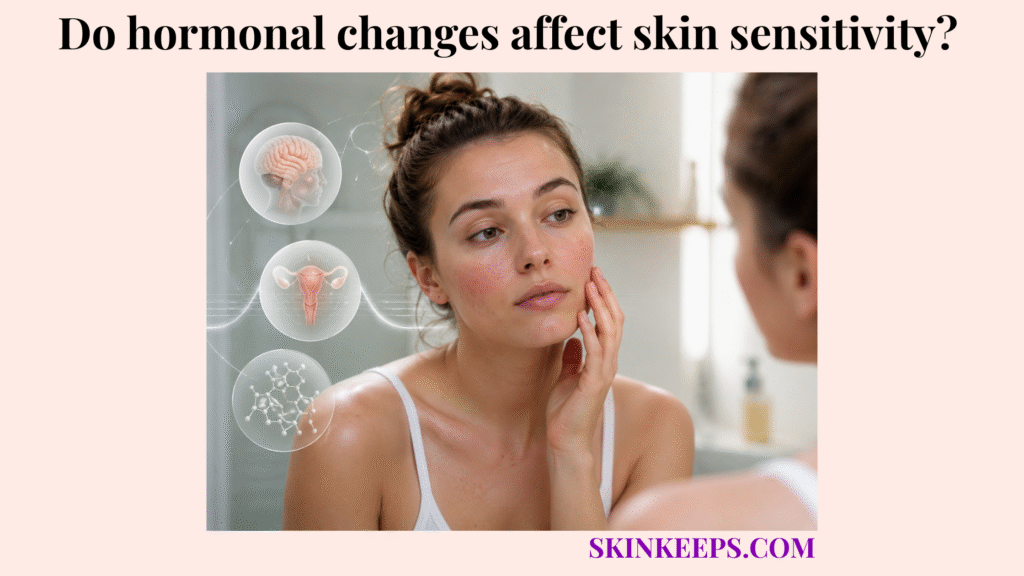
Yes, hormonal changes can affect skin sensitivity by changing oil production, moisture balance, inflammation, barrier comfort, flushing tendency, and how well the skin tolerates products.
Some people notice more stinging, burning, itching, tightness, redness, breakouts, dryness, or product sensitivity during menstrual-cycle changes, puberty, pregnancy, postpartum changes, perimenopause, menopause, or other hormone-related shifts. This article explains why hormonal changes affect sensitive skin, how oil and moisture balance shift, why products may suddenly feel uncomfortable, which life stages matter, how hormone-linked sensitivity differs from product irritation, how breakouts overlap, how to track timing patterns, and when professional evaluation is safer.
Why Can Hormonal Changes Affect Sensitive Skin?
Hormonal changes can affect sensitive skin because they may shift oil production, moisture balance, barrier comfort, inflammation, flushing tendency, and product tolerance. Hormonal timing should be interpreted inside the broader pattern of sensitive skin, where barrier weakness, trigger response, and product intolerance can overlap.
Hormonal changes belong to the internal-cause layer because biological factors can increase skin sensitivity before an outside trigger appears. The skin may become easier to irritate during certain timing windows, even if the product or weather exposure is what starts the reaction.
How Hormones Can Change Oil, Moisture, and Barrier Comfort
Hormones can change oil, moisture, and barrier comfort by making skin feel oilier, drier, tighter, rougher, more congested, or less tolerant of familiar products. Product tolerance can shift when sensitive skin has a compromised barrier that loses comfort more easily.
Some people notice oiliness and breakouts, while others notice dryness, tightness, flaking, or product discomfort. Mixed oiliness and dryness can happen together, so the skin may look shiny but still feel tight or reactive.
Why Hormone Shifts May Increase Inflammation or Reactivity
Hormone shifts may increase inflammation or reactivity by making redness, darker irritation, flushing, swelling, tenderness, bumps, itching, or burning appear more easily. Visible signs can vary across skin tones, so warmth, tenderness, swelling, texture, or discomfort may matter even when redness is subtle.
This does not diagnose rosacea, acne, dermatitis, allergy, hormone imbalance, or infection. Hormones can lower tolerance, but the reaction still needs context.
| Hormonal Influence | How It May Affect Sensitive Skin |
|---|---|
| Oil production changes | Skin may feel oilier, drier, or more congested. |
| Moisture-balance changes | Skin may feel tighter, rougher, or more easily irritated. |
| Barrier comfort changes | Products may sting, burn, or itch more than usual. |
| Inflammation shifts | Redness, darker irritation, swelling, or tenderness may appear more easily. |
| Breakout tendency | Sensitive skin may react with bumps or inflamed spots. |
| Flushing tendency | Skin may feel warmer, redder, or more reactive. |
| Product tolerance changes | Products that usually work may feel uncomfortable temporarily. |
How Can Hormone Shifts Change Oil and Moisture Balance?
Hormone shifts can change oil and moisture balance, making skin feel oilier, drier, tighter, rougher, more breakout-prone, or more reactive than usual. The change can look like more shine, more congestion, more dryness, more itch, or a combination of several signals.
Some people notice more oil and breakouts, while others notice dryness, tightness, itching, or burning. This is why hormone-linked sensitivity should be read as a timing pattern, not as one fixed skin type.
| Skin Change | Sensitive-Skin Effect |
|---|---|
| More oil | Breakouts, shine, congestion, or formula intolerance. |
| Less oil | Dryness, tightness, roughness, or flaking. |
| Moisture loss | Stinging, itching, or discomfort after products. |
| Barrier stress | Products may feel harsher than usual. |
| Mixed oil and dryness | Oily areas may still feel tight or reactive. |
Can Hormonal Changes Make Skincare Products Sting, Burn, or Itch?
Hormonal changes can make skincare products sting, burn, or itch when sensitive skin temporarily tolerates formulas less well than usual. A familiar cleanser, moisturizer, sunscreen, makeup, retinoid, exfoliant, or active ingredient may suddenly feel stronger during a reactive timing window.
This does not mean the product is always wrong or that hormones are the only cause. It means timing, product type, barrier comfort, and repeat pattern should be assessed together.
Product Tolerance Clues
- A familiar product starts to sting or burn.
- Skin feels tighter after cleansing than usual.
- Moisturizer suddenly feels uncomfortable.
- Actives cause more peeling or burning than before.
- Sunscreen or makeup feels itchy or heavy.
- Sensitivity appears around the same time each cycle or life stage.
- Symptoms calm when the skin becomes more stable again.
Which Hormonal Stages Can Increase Skin Sensitivity?
Hormonal stages that can increase skin sensitivity include puberty, menstrual-cycle shifts, pregnancy, postpartum changes, perimenopause, menopause, and hormonal medication changes. These are possible patterns, not guarantees.
The same life stage can affect people differently. Some notice oiliness, others notice dryness, and some notice mainly product intolerance, flushing, tenderness, or breakouts.
| Hormonal Stage | Possible Sensitive-Skin Pattern |
|---|---|
| Puberty | Oil changes, breakouts, irritation from acne treatments. |
| Menstrual-cycle shifts | Temporary breakouts, flushing, tenderness, product sensitivity. |
| Pregnancy | Changes in dryness, pigmentation, flushing, itch, or product tolerance. |
| Postpartum changes | Dryness, breakouts, sensitivity shifts, slower routine tolerance. |
| Perimenopause | Dryness, flushing, irritation, reduced barrier comfort. |
| Menopause | Lower moisture support, tightness, dryness, and increased reactivity. |
| Hormonal medication changes | Possible shifts in oil, dryness, breakouts, or sensitivity. |
Can Menstrual-Cycle Changes Make Sensitive Skin More Reactive?
Menstrual-cycle changes can make sensitive skin more reactive when symptoms repeat around similar cycle timing and affect oiliness, dryness, breakouts, flushing, tenderness, or product tolerance. A repeated timing pattern is more meaningful than one isolated reaction.
This does not diagnose hormonal acne or hormone imbalance. It only suggests that timing may be part of the sensitivity pattern.
Cycle-Linked Sensitivity Clues
- Sensitivity returns around the same time each month.
- Skin feels more tender or reactive before breakouts.
- Products sting more during certain days.
- Tightness, flushing, or itching appears cyclically.
- Acne treatments feel harsher during sensitive periods.
- The reaction pattern improves after the cycle phase passes.
Can Menopause or Perimenopause Increase Skin Sensitivity?
Perimenopause and menopause can increase skin sensitivity for some people by making skin feel drier, thinner-feeling, tighter, itchier, slower to recover, or more reactive. This section is about skin comfort, not anti-aging or hormone therapy.
Moisture support, barrier comfort, flushing, product tolerance, and recovery speed may change during this stage. Severe, sudden, or unusual changes should be evaluated rather than assumed to be ordinary hormonal sensitivity.
Menopause-Related Sensitivity Clues
- Skin feels drier than before.
- Tightness appears more often.
- Products that once worked become irritating.
- Flushing or warmth becomes more noticeable.
- Recovery after irritation takes longer.
- Skin feels less comfortable after cleansing.
How Are Hormonal Sensitivity and Product Irritation Different?
Hormonal sensitivity and product irritation are different because hormone-linked sensitivity usually follows timing patterns, while product irritation usually repeats after a specific product or formula. Hormone-linked symptoms need boundaries because underlying skin conditions can increase sensitivity and sometimes mimic ordinary reactive skin.
Both can overlap. Hormones can make skin easier to irritate, while external triggers can worsen sensitive skin reactions once that timing window is present.
| Feature | Hormone-Linked Sensitivity | Product Irritation |
|---|---|---|
| Main clue | Repeats during hormone-related timing. | Starts after a specific product or formula. |
| Pattern | May affect oil, dryness, breakouts, flushing, and tolerance. | Usually appears where product touched. |
| Duration | May fluctuate over days or life stages. | Often improves after stopping the trigger. |
| Trigger relationship | Products may feel worse during sensitive windows. | Product itself is the main trigger. |
| Best clue | Timing pattern plus recurring symptoms. | Same product causes repeat reaction. |
Simple rule: Hormones can make the skin easier to irritate, while products or environment often explain what sets off the reaction.
Can Hormonal Changes Worsen Breakouts on Sensitive Skin?
Hormonal changes can worsen breakouts on sensitive skin, and aggressive breakout care can make the skin more irritated, tight, peeling, burning, or reactive. Breakout overlap needs careful wording because breakouts on sensitive skin can differ from other skin types when irritation and product intolerance appear together.
Acne treatments, active ingredients, peeling, tightness, burning, and redness or darker irritation can all overlap with sensitive skin. This is not an acne-treatment plan and does not recommend product brands.
Hormone-Breakout Sensitivity Clues
- Breakouts appear with tenderness or irritation.
- Acne treatments sting or peel the skin.
- Skin feels oily and tight at the same time.
- Breakouts repeat around hormone-related timing.
- Harsh treatment worsens redness, darker irritation, or burning.
- Sensitive skin needs slower, gentler acne-care adjustments.
What Signs Suggest Sensitivity May Be Hormone-Linked?
Sensitivity may be hormone-linked when it repeats around the same cycle timing, life stage, medication change, or internal shift even when the skincare routine has not changed. This is timing-pattern recognition, not hormone self-diagnosis.
The strongest clue is repetition. If the same symptoms appear during similar timing windows and calm when the phase stabilizes, hormonal timing may be part of the pattern.
Hormone-Related Sensitivity Pattern Checklist
How Can Hormone-Linked Sensitive Skin Be Supported?
Hormone-linked sensitive skin can be supported by keeping care simple during reactive periods, avoiding avoidable irritation, and tracking timing patterns. This is support direction, not hormonal treatment.
A gentle cleanser, moisturizer when dry or tight, avoiding hot water and scrubbing, reducing exfoliation when stinging or peeling appears, changing one product at a time, and getting guidance for persistent symptoms can all reduce avoidable irritation.
Support Direction
- Keep the routine simple during reactive periods.
- Avoid introducing strong actives during flare-prone windows.
- Use a gentle, fragrance-free cleanser.
- Moisturize when skin feels tight, dry, or irritated.
- Avoid hot water and scrubbing.
- Reduce exfoliation if the skin stings, burns, or peels.
- Introduce new products one at a time.
- Track symptoms with cycle or life-stage timing.
- Seek professional guidance for persistent, painful, or severe changes.
What Mistakes Make Hormone-Linked Sensitivity Worse?
Hormone-linked sensitivity can worsen when every hormonal change is treated with stronger products, more acne actives, heat, scrubbing, or constant routine switching. A reactive timing window is not the best moment to overload the skin.
Ignoring repeated timing patterns can make hormone-linked sensitivity harder to understand. Assuming skincare cannot help is also a mistake because barrier support may still reduce discomfort even when hormones are part of the pattern.
| Mistake | Why It Backfires |
|---|---|
| Treating every hormonal change with stronger products | Can worsen irritation. |
| Overusing acne actives during sensitive periods | May increase burning, peeling, and tightness. |
| Ignoring repeated timing patterns | Makes hormonal links harder to notice. |
| Switching many products at once | Confuses trigger tracking. |
| Scrubbing breakout-prone sensitive skin | Adds friction and inflammation. |
| Using hot water on already reactive skin | Can increase dryness and flushing. |
| Assuming hormones mean skincare cannot help | Barrier support may still reduce discomfort. |
How Should Someone Track Hormonal Skin Sensitivity?
Someone should track hormonal skin sensitivity by recording timing, relevant cycle or life-stage changes, symptoms, products, oil or dryness level, flushing, tenderness, duration, and what improves or worsens the reaction. Tracking is pattern recognition, not hormone diagnosis.
Photos can help if visible changes appear. The most useful record connects when the symptom appeared, what the skin felt like, what products were used, and whether the pattern repeated during the same timing window.
Hormonal Sensitivity Tracking Checklist
When Should Hormone-Related Skin Sensitivity Be Professionally Evaluated?
Hormone-related skin sensitivity should be professionally evaluated when symptoms are severe, persistent, worsening, painful, sudden, unusual, sleep-disrupting, eye-area related, infected-looking, or involve swelling, blisters, oozing, crusting, or bleeding. These patterns should not be treated as ordinary hormonal sensitivity.
Professional review becomes important when sensitive skin needs a dermatologist instead of repeated product guessing. Evaluation helps separate ordinary timing-related sensitivity from acne, eczema, dermatitis, allergy, rosacea, infection, or another concern.
Professional Evaluation Warning Signs
What Should You Remember About Hormonal Changes and Sensitive Skin?
Hormonal changes can affect skin sensitivity by shifting oil balance, moisture support, inflammation, flushing, breakouts, and product tolerance. Hormones can make skin easier to irritate, while products or environment may trigger the visible or sensory reaction.
Final Takeaways
- Hormonal changes can affect skin sensitivity.
- Hormone shifts may change oil balance, moisture support, inflammation, flushing, breakouts, and product tolerance.
- Sensitive skin may feel more reactive during menstrual-cycle changes, puberty, pregnancy, postpartum changes, perimenopause, menopause, or hormonal medication changes.
- Hormones can make skin easier to irritate, while products or environment may trigger the visible or sensory reaction.
- Tracking timing patterns helps separate hormone-linked sensitivity from one-time product irritation.
- Severe, persistent, painful, swollen, blistering, oozing, or recurring symptoms should be professionally evaluated.
Frequently Asked Questions
Can Hormones Make Sensitive Skin Worse?
Hormones can make sensitive skin worse for some people by changing oil balance, moisture support, inflammation, flushing, breakouts, or product tolerance. Hormones do not affect everyone the same way, so timing patterns matter.
Why Does My Skin Get More Sensitive Before My Period?
Skin may get more sensitive before a period when cycle-related shifts make the skin oilier, drier, more tender, more breakout-prone, or less tolerant of strong products. Tracking recurring timing patterns can help clarify whether the pattern is repeated.
Can Menopause Make Skin More Sensitive?
Menopause can make some skin feel more sensitive by reducing moisture support and making the skin feel drier, tighter, thinner-feeling, itchier, or slower to recover. This is not hormone therapy advice; severe or unusual changes should be reviewed professionally.
Can Hormonal Breakouts Make Sensitive Skin React More?
Hormonal breakouts can make sensitive skin react more when inflammation and strong acne products add irritation, peeling, burning, or tightness. This does not prescribe acne treatment, and painful or scarring acne should be evaluated.
How Do I Know If Sensitivity Is Hormonal or Product-Related?
Sensitivity may be more hormone-linked when it repeats during similar timing windows, while product irritation usually repeats after the same product or formula. Both can overlap because hormones can lower tolerance while products set off the reaction.
When Should Hormone-Related Skin Sensitivity Be Checked?
Hormone-related skin sensitivity should be checked when symptoms are severe, persistent, worsening, painful, sudden, unusual, sleep-disrupting, eye-area related, infected-looking, swollen, blistering, oozing, crusted, bleeding, or recurring. Evaluation helps separate ordinary fluctuation from another concern.
Conclusion
Hormonal changes can affect skin sensitivity by changing oil production, moisture balance, inflammation, barrier comfort, flushing tendency, breakouts, and product tolerance. Sensitive skin may feel more reactive during menstrual-cycle changes, puberty, pregnancy, postpartum changes, perimenopause, menopause, or hormonal medication changes.
Hormones can make skin easier to irritate, while products or environment often explain what sets off the reaction. If symptoms are severe, persistent, painful, swollen, blistering, oozing, crusted, bleeding, eye-area related, infected-looking, sudden, unusual, sleep-disrupting, or recurring, professional evaluation is safer than repeated product guessing.