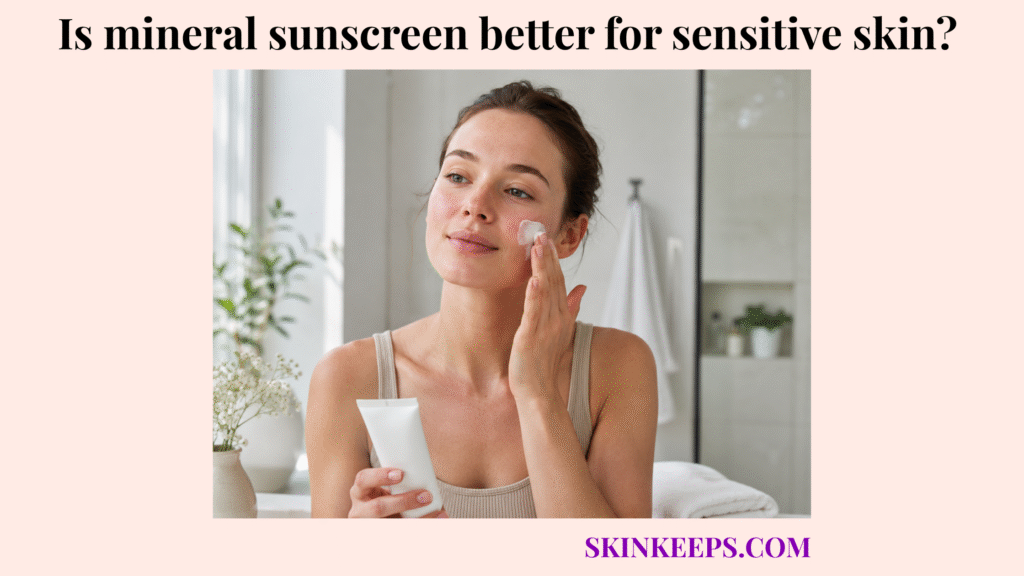
Mineral sunscreen is often a good starting point for sensitive skin because zinc oxide and titanium dioxide formulas may be better tolerated by some reactive users than certain chemical sunscreen formulas. Mineral sunscreen is not automatically better for everyone because fragrance, alcohol content, texture, preservatives, tint, heaviness, added actives, eye-area comfort, heat response, and sweat response still matter.
This article explains what mineral sunscreen is, why zinc oxide and titanium dioxide matter, how mineral, chemical, and hybrid sunscreens compare, when mineral sunscreen can still irritate, which formula features matter, how tinted mineral sunscreen fits, how to test and track sunscreen tolerance, and when professional evaluation is needed.
What Is Mineral Sunscreen?
Mineral sunscreen is sunscreen that uses zinc oxide, titanium dioxide, or both as active UV filters.
Why Are Zinc Oxide and Titanium Dioxide Called Mineral Filters?
Zinc oxide and titanium dioxide are called mineral filters because they are inorganic sunscreen filters used to protect skin from ultraviolet radiation.
How Does Mineral Sunscreen Differ From Chemical Sunscreen Filters?
Mineral sunscreen uses zinc oxide or titanium dioxide, while chemical sunscreen uses organic UV filters that can feel lighter but may sting some sensitive skin.
| Sunscreen type | Main filter style | Sensitive-skin relevance |
|---|---|---|
| Mineral sunscreen | Zinc oxide, titanium dioxide, or both | Often a good starting point for reactive skin. |
| Chemical sunscreen | Organic UV filters | May feel lighter, but can sting some sensitive skin. |
| Hybrid sunscreen | Mineral plus chemical filters | May balance texture and tolerance. |
| Tinted mineral sunscreen | Mineral filters plus tint pigments | May reduce white cast and improve wearability. |
| Fragrance-free sunscreen | Any filter type without added fragrance | Often helpful when fragrance triggers reactions. |
Mineral, Chemical, and Hybrid Sunscreen Fit
This visual shows that sunscreen suitability depends on filter type, broad-spectrum protection, formula comfort, and real repeated tolerance.
Figure 1. Mineral sunscreen is a useful starting point, but the final decision depends on the whole formula and repeated tolerance.
Why Is Mineral Sunscreen Often Recommended for Sensitive Skin?
Mineral sunscreen is often recommended for sensitive skin because zinc oxide and titanium dioxide formulas may be less likely to sting some reactive skin. Sun protection belongs within the broader care tips that help calm and protect sensitive skin because repeated UV, heat, and product discomfort can make reactive skin harder to manage.
Readers who notice burning, flushing, or irritation after sunlight may also need to understand how sun exposure can increase skin sensitivity over time.
| Sensitive-skin concern | Why mineral sunscreen may help |
|---|---|
| Stinging after sunscreen | Mineral filters may feel less irritating for some users. |
| Eye-area burning | Some mineral formulas migrate less, depending on texture. |
| Heat-related discomfort | Mineral options may be preferred when chemical filters sting. |
| Fragrance sensitivity | Mineral sunscreens are often available fragrance-free. |
| Barrier stress | Gentle mineral formulas may be easier to tolerate. |
| Rosacea-prone sensitivity | Mineral formulas are commonly used as a cautious starting point. |
| Post-procedure sensitivity | Mineral sunscreen may be suggested depending on clinician guidance. |
Is Mineral Sunscreen Always Better Than Chemical Sunscreen?
No, mineral sunscreen is not always better than chemical sunscreen. Some sensitive skin tolerates chemical or hybrid sunscreens well, while some mineral sunscreens feel drying, heavy, chalky, itchy, or clogging.
| Feature | Mineral sunscreen | Chemical sunscreen |
|---|---|---|
| Common filters | Zinc oxide, titanium dioxide | Organic UV filters |
| Sensitive-skin reputation | Often considered a gentle starting point | May sting some users, but not all |
| Texture | Can be thicker or leave white cast | Often lighter or more invisible |
| Eye-area comfort | Often better for some users | Can sting eyes in some formulas |
| Formula risk | Still may irritate if fragranced or heavy | Still may be tolerated if gentle |
| Best decision factor | Real skin tolerance | Real skin tolerance |
Simple Rule
Mineral sunscreen may be a better starting point for sensitive skin, but the best sunscreen is the one the skin tolerates and the person will actually wear.
Which Mineral Sunscreen Ingredient Is Better: Zinc Oxide or Titanium Dioxide?
Both zinc oxide and titanium dioxide can support mineral sunscreen protection, but many formulas use zinc oxide or a zinc oxide and titanium dioxide combination. Coverage, texture, cast, and tolerance depend on the full formula.
| Mineral filter | Sensitive-skin relevance |
|---|---|
| Zinc oxide | Common in sensitive-skin mineral sunscreens. |
| Titanium dioxide | Often used with zinc oxide or in mineral blends. |
| Zinc oxide + titanium dioxide | Common combination in many mineral formulas. |
| Non-nano or nano claims | Texture and cast may differ, but tolerance still depends on full formula. |
| Coated mineral filters | May improve formula feel or stability. |
When Can Mineral Sunscreen Still Irritate Sensitive Skin?
Mineral sunscreen can still irritate sensitive skin when the full formula contains fragrance, drying alcohols, heavy textures, irritating preservatives, added actives, or ingredients the person does not tolerate.
| Possible benefit | Possible limitation |
|---|---|
| May sting less for some sensitive skin | Can feel thick or heavy. |
| Often available fragrance-free | Some formulas still contain fragrance. |
| May be better around eyes for some users | Can still migrate or irritate eyes. |
| Good option for reactive skin | May leave white cast. |
| Useful for cautious product testing | Can cause bumps or clogged-feeling buildup. |
| Often paired with soothing bases | Formula still needs tolerance testing. |
What Formula Features Should Sensitive Skin Look for in Mineral Sunscreen?
Sensitive skin should look for mineral sunscreen formulas that are fragrance-free, comfortable, broad-spectrum, non-stinging, and matched to the skin’s dryness or oiliness pattern. Fragrance-free formulas may be better starting points for readers whose sensitive skin reacts to fragrances and dyes.
| Helpful feature | Why it may matter |
|---|---|
| Fragrance-free | Reduces optional irritation risk. |
| No essential oils | Avoids scent-related botanical triggers. |
| Comfortable texture | Improves consistent daily use. |
| Non-stinging around eyes | Important for facial sunscreen tolerance. |
| Moisturizing base | Helps dry or tight sensitive skin. |
| Lightweight finish | May suit oily-sensitive or acne-prone sensitive skin. |
| Broad-spectrum label | Helps protect from UVA and UVB exposure. |
| No unnecessary strong actives | Reduces cumulative irritation burden. |
Is Tinted Mineral Sunscreen Better for Sensitive Skin?
Tinted mineral sunscreen can be helpful for sensitive skin when plain mineral sunscreen leaves a white cast or looks uneven. Tint may improve wearability, but the formula can still irritate if the base is not tolerated.
| Potential advantage | Caution |
|---|---|
| Reduces white cast | Tint shade may not match all skin tones. |
| May improve cosmetic comfort | Pigments may bother some users. |
| Can replace some makeup steps | Formula still needs testing. |
| May encourage consistent use | Texture may feel heavy for some. |
| Useful for visible wearability | Not automatically gentler than untinted formulas. |
Which Sensitive-Skin Patterns May Benefit Most From Mineral Sunscreen?
Sensitive-skin patterns that may benefit most from mineral sunscreen include frequent sunscreen stinging, eye-area burning, redness-prone sensitivity, and poor tolerance of some chemical formulas. Dry-sensitive skin may need a sunscreen base that works well with moisturizer ingredients that support sensitive skin.
| Skin pattern | Mineral sunscreen relevance |
|---|---|
| Sunscreen stings frequently | Mineral may be worth trying. |
| Eye-area burning from sunscreen | Mineral formula may be better tolerated. |
| Dry-sensitive skin | Look for moisturizing mineral formulas. |
| Oily-sensitive skin | Look for lightweight mineral or hybrid textures. |
| Acne-prone sensitive skin | Avoid heavy formulas that feel clogging. |
| Redness-prone sensitive skin | Fragrance-free mineral may be a cautious starting point. |
| Makeup-wearing sensitive skin | Tinted mineral may reduce layering. |
| Deep skin tones | Tinted or sheer mineral formulas may reduce cast concerns. |
Can Chemical Sunscreen Still Work for Sensitive Skin?
Yes, chemical sunscreen can still work for sensitive skin if the formula is well tolerated. Chemical or hybrid sunscreens may feel lighter, blend better, and be easier to wear consistently for some people.
Signs a Chemical or Hybrid Sunscreen May Still Work
- It does not sting or burn.
- It does not irritate the eyes.
- It feels comfortable after repeated use.
- It does not trigger rash-like changes.
- It does not worsen flushing or itching.
- It is easier to wear daily than a heavy mineral formula.
How Should Sensitive Skin Test a Mineral Sunscreen?
Sensitive skin should test a mineral sunscreen slowly on a small area before applying it widely, especially if past sunscreens caused reactions. Readers may patch test new products before applying sunscreen widely, especially if past sunscreens caused burning, itching, or rash-like changes.
Mineral Sunscreen Testing Guide
- Test when the skin is calm.
- Apply a small amount to a limited area first.
- Keep the rest of the routine stable.
- Watch for stinging, burning, itching, bumps, rash, swelling, or eye discomfort.
- Test facial use cautiously because the face may react differently than the arm.
- Try normal wear conditions, including heat or sweat, only after initial tolerance looks good.
- Stop if symptoms are strong, persistent, or spreading.
- Do not assume a mineral label guarantees tolerance.
What Signs Show a Mineral Sunscreen Is Not Right for Sensitive Skin?
A mineral sunscreen is not right for sensitive skin when it repeatedly causes burning, eye stinging, itching, rash-like bumps, swelling, tightness, flushing, or clogged-feeling discomfort.
| Reaction | What it may suggest |
|---|---|
| Burning after application | Formula may not be tolerated. |
| Eye stinging | Product migration or formula sensitivity. |
| Itching | Irritation or sensitivity reaction. |
| Rash-like bumps | Poor formula fit or possible dermatitis concern. |
| Swelling | Allergy-like or inflammatory reaction. |
| Tightness or dryness | Formula may be too drying. |
| Heavy clogged feeling | Texture may not suit skin pattern. |
| Increased flushing | Skin may be reacting to formula or heat. |
| Symptoms stop after discontinuing | Sunscreen may be a trigger. |
What Application Mistakes Can Make Mineral Sunscreen Feel Irritating?
Application mistakes can make mineral sunscreen feel irritating when they add friction, layering, heat, or trigger confusion.
| Mistake | Why it backfires |
|---|---|
| Rubbing aggressively to remove white cast | Adds friction to sensitive skin. |
| Applying over irritated active products | Can make sunscreen sting. |
| Using too many layers underneath | Creates heat, heaviness, and trigger confusion. |
| Choosing fragranced mineral sunscreen | Adds optional irritation risk. |
| Using a very drying formula on dry-sensitive skin | Increases tightness or flaking. |
| Using a very heavy formula on oily-sensitive skin | May cause bumps or discomfort. |
| Testing during a flare | Makes tolerance harder to judge. |
| Keeping sunscreen that repeatedly burns | Ignores a clear mismatch signal. |
How Can Sensitive Skin Choose Between Mineral, Chemical, and Hybrid Sunscreen?
Sensitive skin should choose between mineral, chemical, and hybrid sunscreen by comparing real tolerance, protection, texture, eye comfort, and daily wearability.
| If your skin pattern is… | Consider starting with… |
|---|---|
| Chemical sunscreens often sting | Fragrance-free mineral sunscreen |
| Mineral sunscreen feels too heavy | Lightweight mineral or hybrid sunscreen |
| Eye burning is the main issue | Mineral formula tested carefully around face |
| White cast prevents daily use | Tinted or sheer mineral sunscreen |
| Oily-sensitive skin feels clogged | Lighter mineral, hybrid, or tolerated chemical formula |
| Dry-sensitive skin feels tight | Moisturizing mineral formula |
| Several sunscreens cause reactions | Patch test carefully and consider professional advice |
Sensitive-Skin Sunscreen Decision Loop
This visual shows the practical decision loop: choose a filter type, check formula features, test tolerance, and keep only what is comfortable enough to wear consistently.
Figure 2. The right sunscreen for sensitive skin is the one that protects well and remains tolerable in real use.
How Should Mineral Sunscreen Tolerance Be Tracked?
Mineral sunscreen tolerance should be tracked by recording filter type, formula features, application area, products underneath, eye comfort, wear conditions, and symptoms.
Mineral Sunscreen Tolerance Worksheet
- Sunscreen name and type.
- Filters: zinc oxide, titanium dioxide, chemical, or hybrid.
- Fragrance-free, scented, tinted, or active-added status.
- Texture: cream, lotion, gel, fluid, stick, balm.
- Application area.
- Products used underneath.
- Immediate sensation after application.
- Eye comfort.
- Skin feel after several hours.
- Heat, sweat, or sun exposure during wear.
- Symptoms: burning, stinging, itching, tightness, bumps, rash, swelling, flushing.
- Whether symptoms stop after discontinuing.
- Photos of visible reactions if needed.
When Should Sunscreen Reactions Be Professionally Evaluated?
Sunscreen reactions should be professionally evaluated when symptoms are severe, persistent, spreading, swollen, blistering, eye-area related, recurring, or interfere with daily sun protection. Severe, spreading, swollen, blistering, painful, eye-area, or recurring sunscreen reactions are reasons to see a dermatologist.
Professional Evaluation Warning Signs
- Skin swells, blisters, oozes, crusts, or bleeds.
- Rash spreads beyond the application area.
- Burning, pain, or itching is severe or persistent.
- Eye or eyelid reactions occur.
- Several sunscreens cause similar reactions.
- Skin reacts to very basic products or water.
- Symptoms continue after stopping the sunscreen.
- Sunscreen reactions interfere with daily sun protection.
- A specific ingredient allergy is suspected.
- Eczema, dermatitis, rosacea, infection, or another condition may be involved.
Urgent Safety Note
Breathing difficulty, throat tightness, faintness, or rapid facial, lip, or tongue swelling requires emergency medical care.
What Should You Remember About Mineral Sunscreen and Sensitive Skin?
Mineral sunscreen is often a good starting point for sensitive skin, but the full formula and real tolerance matter most.
What Should You Remember?
- Mineral sunscreen uses zinc oxide, titanium dioxide, or both.
- Mineral sunscreen is often a good starting point for sensitive skin.
- Mineral sunscreen is not automatically better for everyone.
- Chemical or hybrid sunscreen can still work if tolerated.
- Fragrance, texture, alcohol content, tint, heaviness, and added actives matter.
- Tinted mineral sunscreen may reduce white cast and improve wearability.
- Dry-sensitive skin may need a moisturizing mineral base.
- Oily-sensitive skin may need a lighter mineral, hybrid, or tolerated chemical formula.
- The best sunscreen is protective, comfortable, and realistic to wear consistently.
- Severe or recurring sunscreen reactions need professional evaluation.
Frequently Asked Questions
Is Mineral Sunscreen Usually Better for Sensitive Skin?
Mineral sunscreen is often a good starting point for sensitive skin because zinc oxide and titanium dioxide may be better tolerated by some reactive users. However, mineral sunscreen is not automatically better for everyone.
Can Mineral Sunscreen Still Irritate Sensitive Skin?
Yes. Mineral sunscreen can still irritate if the formula contains fragrance, drying alcohols, heavy texture, added actives, irritating preservatives, or ingredients the person does not tolerate.
Is Zinc Oxide Better Than Titanium Dioxide for Sensitive Skin?
Zinc oxide is common in sensitive-skin mineral sunscreens and is often valued for broad coverage. Titanium dioxide can also be useful, especially in formulas that combine both mineral filters.
Can Chemical Sunscreen Work for Sensitive Skin?
Yes. Chemical sunscreen can work for sensitive skin if it does not sting, burn, irritate the eyes, trigger rash-like changes, or worsen itching or flushing.
Is Tinted Mineral Sunscreen Good for Sensitive Skin?
Tinted mineral sunscreen can help if white cast prevents consistent use. It is not automatically gentler, so the full formula still needs testing.
What Should Someone Do If Every Sunscreen Burns?
If several sunscreens burn, sting, cause rash, affect the eyes, or interfere with daily sun protection, the reaction pattern should be professionally evaluated.
Conclusion
Mineral sunscreen is often a useful starting point for sensitive skin, but it is not automatically the best choice for every person. Mineral sunscreen uses zinc oxide, titanium dioxide, or both; it may sting less for some sensitive-skin users; fragrance-free mineral formulas can be good starting points; and tinted formulas may improve wearability.
Chemical and hybrid sunscreens can still work if tolerated. The full formula matters, sunscreen should be tested carefully, and severe or recurring reactions need professional evaluation. The best sunscreen for sensitive skin is not simply mineral or chemical; it is the sunscreen that protects well, feels comfortable, and can be worn consistently without repeated irritation.
Sources & Evidence
American Academy of Dermatology — Sunscreen Label Guidance
Supports broad-spectrum sunscreen use and notes zinc oxide and titanium dioxide as less likely to irritate very sensitive young skin.
[AAD]FDA — Sunscreen: How to Help Protect Your Skin From the Sun
Supports official sunscreen-label guidance, broad-spectrum protection, and current sunscreen active ingredient context.
[FDA]FDA — OTC Sunscreen Proposed Order Questions and Answers
Supports current regulatory wording that zinc oxide and titanium dioxide have sufficient safety data for the FDA’s proposed GRASE status.
[FDA]DermNet — Sunscreen Allergy
Supports sunscreen reaction patterns and the role of zinc oxide and titanium dioxide sunscreens for people with sunscreen allergy concerns.
[DermNet]DermNet — Topical Sunscreen Agents
Supports sunscreen filter categories and mineral sunscreen agent context.
[DermNet]Keyes et al., 2019 — Potential Allergenicity of High-SPF Sunscreens
Supports the idea that sunscreens can contain ingredients capable of causing allergic or photoallergic contact dermatitis in some users.
[PMC]Smijs and Pavel, 2011 — Titanium Dioxide and Zinc Oxide Nanoparticles in Sunscreens
Supports mineral filter context, UV attenuation, particle-size considerations, and sunscreen formulation complexity.
[PMC]Disclaimer: This article provides general educational information and does not diagnose or treat sunscreen allergy, irritant contact dermatitis, allergic contact dermatitis, eczema, rosacea, acne, infection, sunburn, or another skin condition. Stop using clearly irritating sunscreen and seek professional advice for severe, persistent, recurrent, spreading, blistering, swollen, oozing, bleeding, painful, or eye-area reactions. Breathing difficulty, throat tightness, faintness, or rapid facial, lip, or tongue swelling requires urgent medical care.