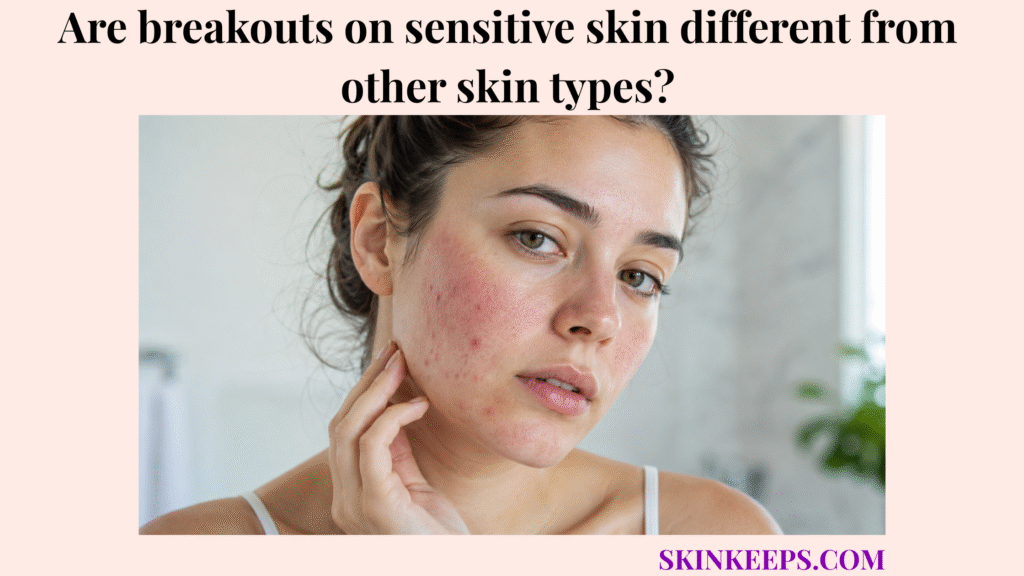
Yes, breakouts on sensitive skin can be different from breakouts on other skin types because they are often driven by irritation, barrier weakness, product reactions, friction, heat, sweat, or inflammation rather than only excess oil.
Sensitive-skin breakouts may appear as small bumps, rash-like irritation, redness or darker inflammation, stinging, itching, peeling, swelling, or sudden texture changes after a trigger. This article explains sensitive-skin breakout differences, sensitive vs oily and dry breakouts, true acne, acne vs irritation bumps, common triggers, product mistakes, calming-first care, acne-treatment caution, warning signs, tracking, and final takeaways.
Why Are Sensitive-Skin Breakouts Different From Ordinary Acne Breakouts?
Sensitive-skin breakouts are different from ordinary acne breakouts because they often begin with irritation, barrier stress, or a trigger reaction instead of only clogged pores and excess oil. Breakouts should be interpreted inside the broader pattern of sensitive skin, where irritation and reactivity can make bumps appear after otherwise ordinary exposures.
Sensitive skin can still overlap with true acne, so the answer is not “all irritation” or “all acne.” The safer approach is to read the bump pattern, trigger timing, sensation, and barrier condition before escalating treatment.
How Sensitive-Skin Breakouts Often Start With Irritation
Sensitive-skin breakouts often start with irritation when products, fragrance, heat, sweat, shaving, friction, or strong actives trigger small bumps or rash-like texture. Irritation bumps may appear quickly after exposure and may come with stinging, burning, itching, redness, darker irritation, peeling, or swelling.
These bumps are not automatically separate from acne. A sensitive-skin breakout can be irritation-driven, acne-driven, or a combination of both.
Why Barrier Weakness Can Make Bumps Appear After Triggers
Barrier weakness can make bumps appear after triggers because a reactive outer layer is easier to inflame, dry, sting, peel, or roughen. Irritation bumps often begin with barrier behavior, especially when sensitive skin has a compromised barrier that reacts quickly to products or friction.
Barrier stress also changes how skin tolerates acne treatments. Over-cleansing, strong acids, retinoids, and harsh acne products can create peeling, burning, and more reactive bumps when the skin is already irritated.
| Breakout Pattern | What It May Suggest |
|---|---|
| Small bumps after product use | Irritation or product reaction. |
| Bumps with stinging or burning | Barrier sensitivity. |
| Bumps with redness or darker irritation | Inflammatory reaction. |
| Bumps with peeling or dryness | Over-treatment or barrier stress. |
| Deep painful pimples | True acne may also be present. |
| Rash-like bumps | Dermatitis, allergy, or irritation pattern may need evaluation. |
How Are Sensitive-Skin Breakouts Different From Oily-Skin Breakouts?
Sensitive-skin breakouts differ from oily-skin breakouts because sensitive bumps are often trigger-linked and reactive, while oily-skin breakouts more often involve sebum, shine, congestion, and clogged pores. Oily skin can also be sensitive, so the comparison is about the dominant breakout driver, not a fixed skin identity.
The mistake is treating every sensitive bump as oil congestion. If the bump appears with burning, itching, peeling, rash-like texture, or product timing, irritation may be part of the pattern.
| Feature | Sensitive-Skin Breakout | Oily-Skin Breakout |
|---|---|---|
| Main driver | Irritation, barrier stress, product reaction. | Excess sebum and clogged pores. |
| Skin feel | Stingy, itchy, tight, reactive. | Greasy, heavy, shiny. |
| Common appearance | Small bumps, redness/darker irritation, rash-like texture. | Blackheads, whiteheads, pimples, oily congestion. |
| Trigger pattern | Often appears after products or exposure. | Often builds with oil and congestion. |
| Treatment risk | Easy to over-irritate. | Easy to over-strip if treated aggressively. |
How Are Sensitive-Skin Breakouts Different From Dry-Skin Breakouts?
Sensitive-skin breakouts differ from dry-skin breakouts because sensitive bumps often react quickly to triggers, while dry-skin breakouts more often involve dryness, flakes, tightness, or heavy product buildup. Dry skin can also be sensitive, but the driver is not always the same.
Peeling with bumps needs caution because dryness and flakiness can be common in sensitive skin after over-treatment or product irritation. The first focus should be trigger clarity, not simply heavier products or harsher acne care.
| Feature | Sensitive-Skin Breakout | Dry-Skin Breakout |
|---|---|---|
| Main clue | Reacts quickly to triggers. | Appears with dryness, flakes, or heavy product use. |
| Sensation | Stinging, burning, itching, or heat. | Tightness, roughness, flaking. |
| Visible pattern | Bumps plus irritation signs. | Bumps plus dry patches or clogged heavy creams. |
| Common mistake | Treating reaction bumps like acne. | Using very heavy products everywhere. |
| Best first focus | Calm barrier and identify trigger. | Moisturize without clogging. |
Can Sensitive Skin Get True Acne Too?
Sensitive skin can still get true acne, including blackheads, whiteheads, pimples, pustules, nodules, or deeper painful spots. Sensitive skin and acne-prone skin can overlap, so sensitive skin should not be treated as automatically acne-free.
The key is not choosing between “sensitive skin” and “acne” as if only one can exist. A breakout can be acne-based, irritation-based, or mixed, which is why the pattern, trigger timing, lesion type, and treatment reaction matter.
How Can You Tell Acne Breakouts From Irritation Bumps on Sensitive Skin?
Acne breakouts and irritation bumps can be separated by looking at lesion type, trigger timing, sensation, rash-like spread, peeling, and whether bumps appear where a product was applied. This comparison helps pattern recognition, but it does not diagnose the breakout.
Blackheads, whiteheads, pustules, and deep painful pimples are more acne-like. Sudden bumps after products, burning, peeling, rash-like spread, and same-area product patterns are more irritation-like.
| Clue | More Like Acne | More Like Irritation Reaction |
|---|---|---|
| Blackheads or whiteheads | Common. | Less typical. |
| Deep painful pimples | Common. | Possible but less specific. |
| Sudden bumps after new product | Possible. | Strong clue. |
| Stinging or burning | Less central. | Strong clue. |
| Rash-like spread | Less typical. | Strong clue. |
| Peeling with bumps | Treatment irritation possible. | Strong clue. |
| Same-area product pattern | Less likely. | Strong clue. |
Which Triggers Commonly Cause Sensitive-Skin Breakouts?
Triggers that commonly cause sensitive-skin breakouts include fragrance, harsh cleansers, strong acids, retinoids, heavy creams, heat, sweat, shaving, friction, sunscreen, makeup, and product formulas that do not suit the barrier. Trigger repetition is often more useful than one bump because external triggers can worsen sensitive skin reactions in recognizable patterns.
Retinoid purging and irritation should be separated carefully rather than assumed. A breakout that comes with burning, peeling, swelling, rash-like spread, or worsening sensitivity should not be pushed harder without reassessing tolerance.
| Trigger | Possible Breakout Pattern |
|---|---|
| Fragrance | Rash-like bumps, itching, irritation. |
| Harsh cleanser | Tightness plus small bumps. |
| Strong acids | Peeling, burning, bumpiness. |
| Retinoids | Purging or irritation; needs careful distinction. |
| Heavy creams | Congestion or closed bumps. |
| Heat and sweat | Small bumps or flare-like irritation. |
| Shaving | Localized bumps and redness/darker irritation. |
| Friction | Bumps where skin is rubbed. |
| Sunscreen or makeup | Product-pattern bumps if formula does not suit skin. |
What Product Mistakes Make Sensitive-Skin Breakouts Worse?
Product mistakes make sensitive-skin breakouts worse when they add more irritation before the skin has been calmed or the trigger has been identified. This is not a blame issue; it is a barrier-tolerance issue.
Strong acne products, scrubbing, fragrance-heavy formulas, rapid product switching, skipped moisturizer, and overused acids can all backfire. Breakout texture matters because sensitive skin texture can become rough, bumpy, peeling, or swollen-looking after irritation.
| Product Mistake | Why It Backfires |
|---|---|
| Using strong acne products immediately | Can inflame the barrier. |
| Scrubbing bumps | Adds friction and irritation. |
| Switching many products at once | Makes the trigger hard to identify. |
| Using fragrance-heavy products | Can worsen reactivity. |
| Skipping moisturizer | Leaves the barrier unsupported. |
| Treating all bumps as clogged pores | Misses irritation or dermatitis clues. |
| Overusing acids | Can create peeling, burning, and more bumps. |
How Should Sensitive-Skin Breakouts Be Calmed First?
Sensitive-skin breakouts should be calmed first by stopping the likely trigger, simplifying care, reducing friction, and supporting the barrier before adding stronger acne treatment. Calming first prevents the common mistake of attacking irritation bumps with more irritation.
The goal is not to build a full acne routine here. The goal is to reduce trigger load, protect the barrier, and watch whether the same bump pattern returns with the same exposure.
Calming-First Checklist
When Might Sensitive-Skin Breakouts Need Acne Treatment?
Sensitive-skin breakouts may need acne-focused treatment when bumps include blackheads, whiteheads, pustules, recurring clogged pores, or deeper painful pimples. Acne care should be introduced cautiously because sensitive skin can become irritated quickly.
This section is not a prescription plan. It is a caution: if acne is likely, treat slowly and avoid stacking multiple strong actives on a reactive barrier.
Acne-Care Caution
When Are Sensitive-Skin Breakouts More Than Ordinary Sensitivity?
Sensitive-skin breakouts are more than ordinary sensitivity when bumps are painful, deep, cystic, scarring, spreading, swollen, blistering, oozing, crusted, eye-associated, or repeatedly triggered by many basic products. These signs need professional evaluation instead of repeated product switching.
Professional review becomes important when sensitive skin needs a dermatologist instead of repeated acne-product guessing. Rash-like bumps belong to the wider group of visible sensitive-skin reactions when they appear with stinging, itching, swelling, peeling, or darker irritation.
Dermatologist Warning Checklist
How Should Someone Track Breakouts on Sensitive Skin?
Someone should track breakouts on sensitive skin by recording the product or exposure before bumps appeared, timing, bump type, location, sensation, visible irritation, repeat triggers, photos, and what improved or worsened the breakout. Tracking is pattern recognition, not diagnosis.
Photos can help because bumps may change before an appointment. The strongest notes connect the bump type, the exposure before it, the sensation that came with it, and whether the same trigger caused the same pattern before.
Breakout Tracking Checklist
What Should You Remember About Breakouts on Sensitive Skin?
Breakouts on sensitive skin can be acne-based, irritation-based, product-triggered, barrier-related, or mixed, so the first job is to identify the pattern before escalating treatment. Stronger acne products are not always the safest first move when the breakout includes burning, peeling, swelling, or rash-like spread.
Final Takeaways
- Breakouts on sensitive skin can differ from other skin types.
- Sensitive-skin breakouts are often irritation-linked, trigger-linked, and barrier-related.
- They may look like small bumps, rash-like texture, peeling, redness, darker irritation, or acne-like spots.
- Sensitive skin can still get true acne.
- Aggressive acne treatment can worsen irritation.
- The first step is usually calming the barrier and identifying triggers.
- Painful, scarring, spreading, blistering, oozing, or persistent breakouts need professional evaluation.
Frequently Asked Questions
Can Sensitive Skin Have Acne?
Sensitive skin can have acne because sensitivity and acne-prone skin can overlap. Blackheads, whiteheads, pustules, recurring clogged pores, and deeper painful spots are more acne-like, but acne care should be introduced carefully because sensitive skin can irritate quickly.
How Do I Know If Bumps Are Irritation or Acne?
Bumps are more likely irritation-linked when they appear suddenly after a product or exposure and come with stinging, burning, itching, peeling, or rash-like spread. Blackheads, whiteheads, pustules, and deep pimples are more acne-like, but the comparison is not a diagnosis.
Why Do Acne Products Make My Sensitive Skin Worse?
Acne products can make sensitive skin worse when strong actives, acids, retinoids, or frequent use overload the barrier. Burning, peeling, swelling, and more irritation may mean the product is too strong, too frequent, or poorly timed for the skin’s tolerance.
Can Sunscreen or Makeup Cause Bumps on Sensitive Skin?
Sunscreen or makeup can cause bumps on sensitive skin when the formula irritates the barrier, traps congestion, or repeatedly triggers product-pattern breakouts. Timing, location, and repeat reaction matter more than one isolated bump.
When Should Sensitive-Skin Breakouts Be Checked?
Sensitive-skin breakouts should be checked when they are painful, cystic, scarring, spreading, swollen, blistering, oozing, crusted, eye-associated, or persistent. Evaluation helps separate acne, irritation, dermatitis, allergy, infection, folliculitis, rosacea, or eczema.
Conclusion
Breakouts on sensitive skin can differ from other skin types because bumps may be irritation-driven, product-triggered, barrier-related, acne-based, or mixed. Oily-skin breakouts often lean toward sebum and congestion, while sensitive-skin breakouts often show trigger timing, stinging, burning, peeling, rash-like texture, or darker irritation.
Sensitive skin can still get true acne, but aggressive acne treatment can make irritation worse when the barrier is already reactive. The safest first step is to identify whether the breakout pattern looks acne-based, irritation-based, or mixed, then calm the barrier and seek professional evaluation when bumps are painful, cystic, scarring, spreading, swollen, blistering, oozing, crusted, eye-associated, or persistent.