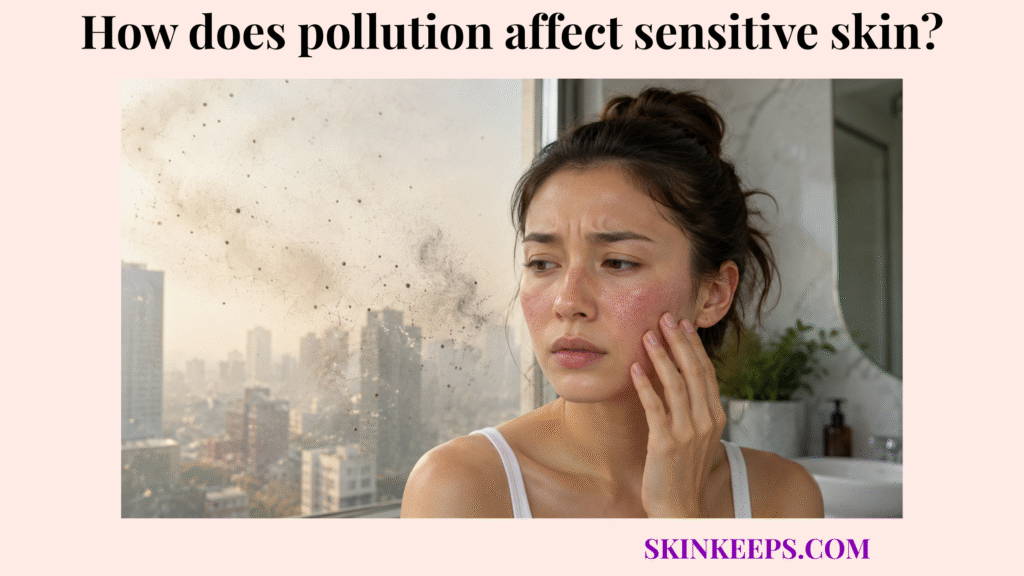
Pollution can affect sensitive skin by leaving airborne particles, smoke, dust, and environmental residue on the skin surface, where they may worsen irritation, dryness, itching, burning, tightness, roughness, flushing, dullness, or barrier discomfort.
Sensitive skin may react more easily after traffic exposure, smoke, dust, urban air, construction dust, workplace particles, indoor fumes, poor ventilation, or airborne fragrance, especially when sweat, heat, wind, friction, or harsh cleansing are also involved. This article explains why pollution can irritate sensitive skin, which reactions it can worsen, which pollution sources matter, how pollution affects barrier comfort, how pollution-related sensitivity differs from product irritation, how pollution and sweat combine, which cleansing mistakes to avoid, how to protect and track the skin, and when professional evaluation is safer.
Why Can Pollution Irritate Sensitive Skin?
Pollution can irritate sensitive skin when airborne particles, smoke, dust, fumes, or environmental residue settle on the skin surface and add barrier stress. Pollution-related reactions should be interpreted inside the broader pattern of sensitive skin, where barrier weakness, trigger response, and product intolerance can overlap.
Pollution belongs to the environmental layer of external triggers that worsen sensitive skin reactions, rather than the internal biological-cause layer. It can worsen skin comfort without proving that pollution is the only cause of the flare.
How Airborne Particles Can Stress the Skin Surface
Airborne particles can stress the skin surface by leaving residue that may increase discomfort, roughness, dullness, itching, or irritation in already reactive skin. Traffic particles, dust, smoke, urban air, workplace particles, and indoor residue may matter most when exposed areas react more than covered areas.
This pattern does not prove pollution is always the cause. The reaction may also overlap with products, sweat, weather, friction, or barrier condition.
Why a Sensitive Barrier May React More Strongly to Environmental Residue
A sensitive barrier may react more strongly to environmental residue because reactive skin often has a lower tolerance for surface stress, friction, sweat, heat, and cleansing. Pollution may feel worse when sensitive skin has a compromised barrier that loses comfort more easily.
Tightness, stinging, burning, itching, and roughness can appear after exposure or after cleansing the exposed skin. Over-cleansing afterward can worsen the barrier and make the reaction feel stronger.
| Pollution Exposure | How It May Affect Sensitive Skin |
|---|---|
| Traffic particles | May leave irritating residue on the skin surface. |
| Smoke | Can increase dryness, discomfort, or visible irritation. |
| Dust | May trigger itching, roughness, or friction-like irritation. |
| Urban air exposure | May worsen dullness, tightness, or sensitivity. |
| Workplace particles | May irritate exposed areas repeatedly. |
| Indoor pollution | May contribute to dryness, itch, or discomfort. |
| Pollution plus sweat | May increase prickling, itching, or bumps. |
What Sensitive-Skin Reactions Can Pollution Worsen?
Pollution can worsen sensitive-skin reactions such as itching, burning, tightness, roughness, flushing, bumps, dullness, or stinging after cleansing. These reactions are not diagnoses and should be read as exposure-linked clues.
The pattern may reflect pollution exposure, barrier condition, sweat, friction, heat, wind, or the way the skin was cleansed afterward. The strongest clue is whether symptoms return after similar environments.
| Reaction | How Pollution May Contribute |
|---|---|
| Itching | Dust or residue may increase surface discomfort. |
| Burning | Already irritated skin may feel more reactive after exposure. |
| Tightness | Pollution plus dryness may reduce comfort. |
| Roughness | Surface residue and dryness may make texture feel uneven. |
| Flushing | Heat, urban exposure, or irritation may increase warmth. |
| Bumps | Sweat, particles, and friction may combine. |
| Dullness | Surface buildup may make skin look less fresh. |
| Stinging after cleansing | Over-cleansing pollution-exposed skin may weaken the barrier. |
Which Pollution Sources Commonly Affect Sensitive Skin?
Pollution sources that may affect sensitive skin include traffic-heavy areas, smoke, dusty environments, construction dust, workplace particles, indoor smoke or fumes, poor indoor ventilation, and airborne fragrance or sprays. These sources should be considered exposure patterns, not automatic causes.
Exposed areas such as the face, neck, hands, chest, and mask-contact zones may react more than covered skin. Outdoor exposure can stack with weather because wind can irritate sensitive skin by increasing dryness, roughness, and barrier stress.
| Source | Possible Sensitive-Skin Effect |
|---|---|
| Traffic-heavy areas | Surface residue, irritation, dullness. |
| Smoke exposure | Dryness, burning, itch, visible irritation. |
| Dusty environments | Itching, roughness, discomfort. |
| Construction dust | Local irritation on exposed skin. |
| Industrial or workplace particles | Repeated irritation pattern. |
| Indoor smoke or fumes | Dryness, itch, sensitivity. |
| Poor indoor ventilation | Skin may feel dry, irritated, or uncomfortable. |
| Airborne fragrance or sprays | Itching, stinging, or allergy-like discomfort in some people. |
Can Pollution Weaken the Sensitive-Skin Barrier?
Pollution may worsen barrier discomfort when sensitive skin is already dry, irritated, over-cleansed, or inflamed. It may make the skin feel tighter, rougher, itchier, or more reactive after repeated exposure.
Harsh cleansing afterward is a common worsening factor. Cleansing after exposure needs caution because harsh cleansing habits can trigger sensitive skin when the surface is already reactive.
Barrier Stress Clues
- Skin feels tight after being outdoors.
- Itching increases after dusty or smoky exposure.
- Skin feels rough after traffic-heavy environments.
- Cleanser stings more after pollution exposure.
- Skin feels uncomfortable even when the routine did not change.
- Symptoms improve when exposure and cleansing are managed gently.
How Is Pollution-Related Sensitivity Different From Product Irritation?
Pollution-related sensitivity is different from product irritation because it usually worsens after environmental exposure, while product irritation usually repeats after a specific formula or application pattern. Timing, location, and repeat exposure help separate the two.
Both can overlap if pollution exposure makes a familiar product sting afterward. The product may still matter, but the environment may have lowered the skin’s tolerance first.
| Feature | Pollution-Related Sensitivity | Product Irritation |
|---|---|---|
| Main clue | Worsens after environmental exposure. | Starts after using a specific product. |
| Location | Often exposed areas like face, neck, or hands. | Usually where product was applied. |
| Timing | May build through the day. | Often appears soon after application. |
| Pattern | Worse after dust, smoke, traffic, or outdoor exposure. | Repeats with the same formula. |
| First step | Gentle cleansing and exposure reduction. | Stop the suspected product. |
Simple rule: Pollution often explains environment-linked irritation, while product irritation usually follows a specific formula or application pattern.
Can Pollution and Sweat Worsen Sensitive Skin Together?
Pollution and sweat can worsen sensitive skin together because sweat, heat, particles, and friction may build up on the skin surface. This can create prickling, itching, stinging, bumps, or discomfort around the face, neck, chest, mask area, or clothing-rubbed areas.
Gentle rinsing and barrier support are safer than aggressive washing. Pollution and sweat may feel worse when certain fabrics irritate sensitive skin through rubbing, heat, and trapped residue.
Pollution-Sweat Reaction Clues
- Itching after commuting or outdoor activity.
- Prickling in sweaty areas.
- Bumps after heat and pollution exposure.
- Burning after wiping or rubbing the skin.
- Irritation where masks, collars, or helmets touch.
- Skin feels better after gentle rinsing and barrier support.
What Cleansing Mistakes Worsen Pollution-Exposed Sensitive Skin?
Cleansing mistakes worsen pollution-exposed sensitive skin when they add friction, hot water, harsh surfactants, frequent washing, strong exfoliation, or barrier neglect. Scrubbing pollution off can backfire because it adds mechanical irritation to already reactive skin.
“Detox” exfoliation language is not useful for sensitive skin. The safer goal is residue removal without stripping the barrier.
| Mistake | Why It Backfires |
|---|---|
| Scrubbing to remove pollution | Adds friction and irritation. |
| Using harsh cleansers after exposure | Can strip barrier comfort. |
| Washing with hot water | Increases dryness and tightness. |
| Cleansing too many times daily | Can make skin more reactive. |
| Using strong exfoliants to “detox” skin | May worsen burning, peeling, or tightness. |
| Rubbing with rough towels | Adds mechanical irritation. |
| Skipping moisturizer after cleansing | Leaves the barrier unsupported. |
How Can Sensitive Skin Be Protected From Pollution-Related Irritation?
Sensitive skin can be protected from pollution-related irritation by cleansing gently after heavier exposure, avoiding friction, and supporting the barrier without over-cleansing. This support direction should stay practical and non-product-specific.
Pollution reactions cannot always be fully prevented, especially when exposure is frequent or unavoidable. The goal is to reduce avoidable irritation without turning exposure into a harsh cleansing routine.
Protection Direction
- Cleanse gently after heavy exposure.
- Avoid scrubbing or harsh exfoliation.
- Use lukewarm water instead of hot water.
- Keep the routine simple after pollution-heavy days.
- Moisturize if skin feels tight, dry, or irritated.
- Avoid fragrance-heavy products during flare-prone periods.
- Reduce rubbing from masks, collars, helmets, or rough fabrics.
- Rinse sweat gently when pollution and heat combine.
- Track whether symptoms worsen after specific environments.
What Signs Suggest Pollution Is Worsening Sensitive Skin?
Pollution may be worsening sensitive skin when symptoms rise after traffic, smoke, dust, outdoor exposure, indoor fumes, or environment changes while the skincare routine stays the same. Exposed-area reactions can be especially useful clues.
High-exposure days, sweat, heat, wind, friction, and cleansing response all matter. A harsh cleanser that stings after exposure may reflect pollution plus barrier stress, not a simple product-only pattern.
Pollution Reaction Pattern Checklist
How Should Someone Track Pollution-Related Sensitive Skin Reactions?
Someone should track pollution-related sensitive skin reactions by recording exposure type, exposure time, weather, sweat, friction, symptoms, location, cleansing method, and what improved or worsened the reaction. Tracking is pattern recognition, not diagnosis.
Photos can help if visible changes appear. The strongest record connects the environment, the exposed area, the symptoms, the cleansing response, and whether the same pattern returned later.
Pollution Reaction Tracking Checklist
When Should Pollution-Related Sensitive Skin Be Professionally Evaluated?
Pollution-related sensitive skin should be professionally evaluated when reactions are severe, persistent, worsening, painful, swollen, blistering, oozing, crusted, bleeding, eye-area related, infected-looking, sleep-disrupting, or recurring. These signs are stronger than ordinary environment-linked discomfort.
Professional review becomes important when sensitive skin needs a dermatologist instead of repeated trigger guessing. Evaluation helps separate ordinary environmental irritation from dermatitis, allergy, rosacea, infection, acne, chemical irritation, or another concern.
Professional Evaluation Warning Signs
What Should You Remember About Pollution and Sensitive Skin?
Pollution can worsen sensitive skin reactions by leaving particles, smoke, dust, fumes, or environmental residue on exposed skin. The pattern is strongest when symptoms repeat after similar pollution-heavy environments.
Final Takeaways
- Pollution can worsen sensitive skin reactions.
- Dust, smoke, traffic particles, indoor fumes, and environmental residue may increase irritation, itching, burning, tightness, roughness, or dullness.
- Pollution often affects exposed areas and may worsen when combined with sweat, heat, wind, or friction.
- Over-cleansing pollution-exposed skin can make sensitivity worse.
- Gentle cleansing, barrier support, and trigger tracking are safer than harsh scrubbing.
- Severe, persistent, painful, swollen, blistering, oozing, or recurring reactions should be professionally evaluated.
Frequently Asked Questions
Can Pollution Make Sensitive Skin Worse?
Pollution can make sensitive skin worse in some people by leaving particles, smoke, dust, fumes, or residue on the skin surface. It may worsen itching, burning, tightness, roughness, dullness, flushing, or barrier discomfort, especially when the skin is already reactive.
Why Does My Skin Feel Itchy After Being Outside?
Skin may feel itchy after being outside when dust, smoke, traffic particles, sweat, wind, or environmental residue irritate already sensitive skin. Track the exposure type, weather, sweat, and cleansing response before assuming one cause.
Is Pollution-Related Sensitivity the Same as Product Irritation?
Pollution-related sensitivity is not the same as product irritation because pollution reactions usually follow environmental exposure, while product irritation usually repeats after a specific formula. Both can overlap if pollution exposure leaves the barrier more reactive and a familiar product stings afterward.
Can Pollution and Sweat Cause Bumps on Sensitive Skin?
Pollution and sweat can contribute to bumps on sensitive skin when heat, particles, friction, and surface buildup combine. This does not diagnose acne, infection, or allergy, and mask, collar, helmet, or clothing friction can overlap.
Should Sensitive Skin Be Scrubbed After Pollution Exposure?
Sensitive skin should not be scrubbed after pollution exposure because scrubbing can add friction and worsen barrier irritation. Gentle cleansing is safer than harsh exfoliation, hot water, or “detox” scrubbing.
When Should Pollution-Related Skin Reactions Be Checked?
Pollution-related skin reactions should be checked when they are severe, persistent, worsening, painful, swollen, blistering, oozing, crusted, bleeding, eye-area related, infected-looking, sleep-disrupting, or recurring. Evaluation helps separate ordinary environmental irritation from another concern.
Conclusion
Pollution can affect sensitive skin by leaving airborne particles, smoke, dust, fumes, and environmental residue on exposed skin. These exposures may worsen irritation, dryness, itching, burning, tightness, roughness, flushing, dullness, or barrier discomfort, especially when combined with sweat, heat, wind, friction, or harsh cleansing.
Pollution-related sensitivity is a clue, not a diagnosis. If reactions are severe, persistent, worsening, painful, swollen, blistering, oozing, crusted, bleeding, eye-area related, infected-looking, sleep-disrupting, or recurring, professional evaluation is safer than repeated trigger guessing.