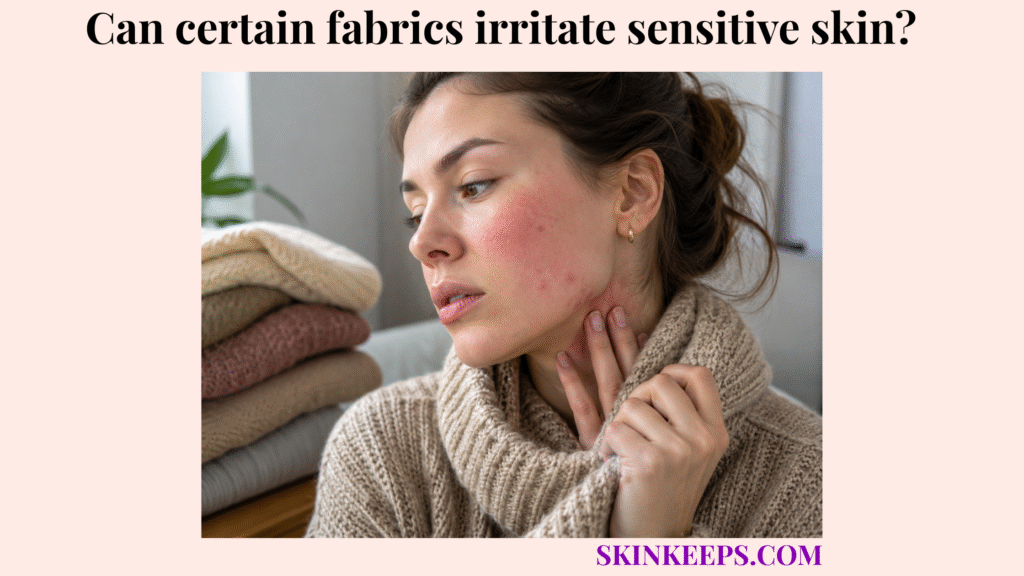
Yes, certain fabrics can irritate sensitive skin when rough fibers, repeated rubbing, tight construction, trapped heat, retained sweat, textile treatments, or laundry residue exceed the skin’s contact tolerance. The reaction may appear as itching, prickling, burning, tenderness, rawness, bumps, redness, deeper discoloration, or rash-like changes, but a material name alone does not determine whether a garment will be tolerated.
Fabric-related reactions can come from mechanical friction, garment pressure, dampness, heat, dyes, finishes, detergent, fragrance, or several exposures acting together. This guide explains why fabric contact becomes irritating, how wool and synthetic clothing differ, how to separate friction from a possible contact reaction, how to reduce exposure, and when professional evaluation is safer.
Why Can Fabric Contact Irritate Sensitive Skin?
Fabric contact can irritate sensitive skin when the material repeatedly rubs, presses, heats, moistens, or chemically exposes the skin surface. Clothing normally protects and insulates the body, but the same covering can create a stressful contact environment when roughness, pressure, movement, heat, sweat, and residue accumulate.
Roughness and garment movement create mechanical stimulation, meaning repeated physical contact that activates the skin surface and nearby sensory nerves. Clothing contact belongs among the controllable external triggers that can expose sensitive skin to friction, heat, moisture, pressure, and chemical residue.
Heat and dampness can increase friction, while textile or laundry residue can create a separate chemical-contact pattern. Sensitive skin can feel prickly, hot, itchy, or tender without obvious redness; on deeper skin tones, irritation may appear as darker patches, grayness, ashiness, texture change, or less visible inflammation.
How Do Rough Fibers Create Friction Against Reactive Skin?
Rough fibers create friction by repeatedly bending, pressing, and moving against the skin during normal body movement. Fiber diameter, stiffness, surface roughness, garment fit, and movement all influence how strongly the fabric stimulates the skin.
A fabric that feels soft to one person can feel prickly to another because sensory tolerance and skin condition differ. Rough contact may feel more intense when a compromised skin barrier already has reduced tolerance to friction and environmental exposure, although fabric discomfort alone does not prove barrier damage.
Mechanical prickling is not the same as allergy. It often begins at direct contact points, becomes stronger during movement, and improves after the garment is removed or covered by a smooth underlayer.
Why Can Heat and Trapped Moisture Intensify Fabric Discomfort?
Heat and trapped moisture can intensify fabric discomfort by increasing skin warmth, sweat accumulation, dampness, and friction during movement. Occlusion means reduced airflow and evaporation beneath a covering, such as tight clothing or dense fabric.
Prolonged dampness can soften the outer skin, a process called maceration, and make repeated rubbing more uncomfortable. Moisture does not act as an allergen, but wet fabric and movement can increase chafing and localized rawness.
Laboratory and clinical skin-friction research shows that moisture changes the friction between skin and textiles, supporting the practical observation that damp clothing can rub more aggressively than dry clothing. [PMC: Moisture and Skin–Textile Friction]
| Fabric-related factor | Possible sensitive-skin effect |
|---|---|
| Rough fibers repeatedly press against skin. | Itching, prickling, rawness, or tenderness may develop. |
| Repeated rubbing concentrates friction. | Localized redness, darker irritation, tenderness, or bumps may appear. |
| Tight clothing combines pressure and movement. | Heat, rubbing, and discomfort may increase in covered zones. |
| Low-airflow clothing retains warmth. | Itching, prickling, flushing, or rash-like discomfort may intensify. |
| Damp fabric moves against softened skin. | Chafing and persistent mechanical irritation become more likely. |
| Rough seams or labels focus contact. | Scratching, burning, or irritation may trace a narrow line. |
| Textile or laundry residue remains on clothing. | An irritant or allergy-like contact pattern may occur. |
Which Fabric Characteristics Are Most Likely to Cause Irritation?
The fabric characteristics most likely to cause irritation are coarse texture, stiffness, low airflow, moisture retention, heavy construction, chemical treatment, and repeated contact with rough garment features. These attributes change how the material presses, moves, warms, and retains moisture against the skin.
Fiber name alone is an unreliable shortcut. A smooth, loose synthetic garment may be more comfortable than a stiff natural-fiber garment, while a soft cotton item can still irritate if it is tight, heavily treated, rough-seamed, or washed in a poorly tolerated product.
Labels such as “soft,” “breathable,” “natural,” or “hypoallergenic” do not guarantee tolerance. Garment construction, finish, fit, wear duration, sweat exposure, and individual skin response still determine the real contact conditions.
| Fabric characteristic | Irritation relevance |
|---|---|
| Coarse or scratchy surface | Creates direct mechanical stimulation during movement. |
| Stiff construction | Resists bending and may press or rub more strongly. |
| Low airflow | Can retain heat and sweat against the skin. |
| Heavy material | May increase garment pressure and movement. |
| Rough seams and labels | Concentrate irritation at specific contact points. |
| Heavy dye or textile treatment | May expose skin to a poorly tolerated residue. |
| Smooth, flexible, breathable construction | Usually lowers contact stress but cannot guarantee tolerance. |
Why Can Wool Feel Itchy on Sensitive Skin?
Wool can feel itchy when coarse or stiff fibers bend and press repeatedly against sensitive skin, producing mechanical prickling rather than a true wool allergy. The sensation is linked more closely to fiber dimensions and stiffness than to the word “wool” itself.
Individual response varies because wool garments contain different fiber sizes, constructions, finishes, dyes, and surface characteristics. A finer, flexible wool may feel comfortable, while a rougher garment may stimulate cutaneous nerve endings and cause immediate prickling during movement.
A smooth underlayer can reduce direct contact and help distinguish fiber prickling from a broader contact reaction. Persistent rash, swelling, blistering, or delayed symptoms may involve lanolin, dye, finish, detergent, another allergen, or an underlying skin condition and deserve a wider assessment.
A dermatology review found that coarse, larger-diameter wool is more likely to provoke itching, while finer wool can be better tolerated; this supports avoiding blanket claims that every wool garment is allergenic. [PubMed: Fabric Selection in Atopic Dermatitis]
Wool-Related Reaction Clues
- Itching begins where wool directly touches the skin.
- Discomfort increases during movement.
- A smooth underlayer reduces the reaction.
- Symptoms improve after removing the garment.
- Prickling occurs without a widespread rash.
- Rougher wool causes more discomfort than a finer or softer garment.
Can Synthetic Fabrics Worsen Sensitive-Skin Reactions?
Synthetic fabrics can worsen sensitive-skin reactions when the garment traps heat, retains sweat, fits tightly, or repeatedly rubs the same skin area. The fiber category does not determine the outcome by itself.
Knit, weave, finish, thickness, fit, moisture behavior, and movement matter. Tight athletic wear can combine pressure, occlusion, perspiration, and repetitive motion, creating a high-friction environment even when the fabric is designed to move moisture.
A loose, smooth synthetic garment may be tolerated better than a rough natural material. Moisture-wicking claims also have limits because a garment that moves sweat can still create pressure or chafing if it is tight, bunched, or left damp for a prolonged period.
| Clothing condition | Possible reaction |
|---|---|
| Tight athletic wear combines friction, sweat, and pressure. | Bumps, burning, tenderness, or localized rawness may develop. |
| Low-airflow fabric retains heat. | Itching, prickling, or flushing may increase. |
| Damp synthetic clothing remains against the skin. | Chafing and friction may intensify. |
| Repeated rubbing occurs during exercise. | High-contact areas may become sore or raw. |
| Loose, smooth, moisture-managing fabric stays dry. | Wear tolerance may improve, but comfort is not guaranteed. |
How Do Heat and Sweat Trapped Under Clothing Affect Sensitive Skin?
Heat and sweat trapped under clothing can increase skin warmth, moisture, friction, and chafing, especially in skin folds and tightly covered areas. The reaction often reflects the combination of occlusion, damp fabric, movement, and prolonged contact rather than sweat acting alone.
Skin folds and tight contact zones are vulnerable because evaporation is limited and opposing surfaces or garment edges move repeatedly against damp skin. Readers who experience flushing or burning under warm clothing may also notice broader temperature-related skin reactions outside fabric-contact situations.
Cooling the area, changing out of damp clothing, and reducing pressure may improve symptoms, but improvement does not identify the diagnosis. Persistent fold irritation, painful bumps, drainage, odor, or spreading changes need assessment because infection and inflammatory conditions can resemble simple chafing.
Common Reaction Areas
- Neck and collar line
- Underarms
- Waistband
- Under the breasts
- Inner thighs
- Groin folds
- Behind the knees
- Areas beneath tight sportswear
- Feet inside damp socks or shoes
Can Textile Dyes, Finishes, or Laundry Residue Trigger Sensitive Skin?
Yes, textile dyes, chemical finishes, detergent residue, fragrance, and fabric-softener residue can irritate sensitive skin or contribute to an allergy-like contact-reaction pattern. A garment can feel smooth and still expose the skin to a poorly tolerated chemical.
Irritant contact reactions come from direct chemical or physical stress, while allergic contact dermatitis is a delayed immune response to a specific substance after sensitization. Both patterns can itch, burn, discolor, or produce a rash, so symptoms alone cannot confirm the mechanism.
Reactions linked to laundry products may involve fragrances and dyes rather than the fabric fiber itself. A shared laundry product becomes more suspicious when several unrelated garments cause a similar reaction, while a new garment that improves after rewashing may point toward loose dye, finish, or residue.
DermNet identifies dyes, formaldehyde finishing resins, glues, and other textile additives as recognized causes of clothing-related contact dermatitis. Patch testing is a clinician-supervised method used to investigate delayed contact allergens; it should not be improvised on already irritated skin. [DermNet: Textile Contact Dermatitis]
| Pattern | What the pattern may suggest |
|---|---|
| A new garment triggers symptoms. | Dye, finish, manufacturing residue, or fit may be involved. |
| Several different fabrics washed together cause itching. | A shared detergent, fragrance, or fabric-softener exposure may be responsible. |
| Symptoms follow tight garment edges. | Friction, pressure, or concentrated residue may contribute. |
| Strong itching occurs with a visible rash. | Contact dermatitis may require consideration. |
| Symptoms improve after rewashing. | Loose dye or residue may have contributed. |
| The reaction extends beyond rubbing points. | More than simple mechanical friction may be involved. |
Can Seams, Labels, and Tight Clothing Irritate Sensitive Skin?
Yes, seams, labels, elastic, cuffs, waistbands, and tight clothing can irritate sensitive skin by concentrating pressure and repeated rubbing in small contact zones. These reactions often follow a narrow line or match the exact shape of the garment feature.
A tight edge presses against a smaller area, and movement repeatedly drags that edge across the same skin. Heat and perspiration beneath waistbands, bra edges, collars, socks, or athletic wear can intensify the mechanical load.
Pressure marks alone do not prove dermatitis. The stronger clues are itching, burning, tenderness, rawness, bumps, or discoloration that repeatedly match the seam, tag, cuff, or elastic and improve after the feature is removed, covered, or loosened.
Clothing-Construction Warning Signs
- Irritation follows a seam or label line.
- Waistband or bra edges leave itchy patches.
- Tight cuffs produce redness or darker marks.
- Skin burns where fabric repeatedly rubs.
- Bumps develop beneath tight clothing.
- Symptoms improve with looser or flat-seamed garments.
How Is Fabric Friction Different From Fabric Allergy or Contact Dermatitis?
Fabric friction usually causes symptoms at pressure and rubbing points, while contact dermatitis is more closely linked to a chemical exposure that can produce persistent itching, rash, swelling, or blistering. Timing, distribution, movement, and recurrence offer clues but do not establish a diagnosis.
A mechanical pattern often builds during wear, exercise, or repeated movement. Prickling, burning, tenderness, or rawness tends to be strongest at seams, waistbands, folds, or other high-friction zones and may improve after the clothing is loosened or removed.
A possible contact-reaction pattern may be delayed, strongly itchy, persistent, or less limited to rubbing points. A clinician may use patch testing to identify delayed allergens when the history suggests allergic contact dermatitis. [DermNet: Patch Testing]
| Feature | Mechanical fabric irritation | Contact dermatitis or allergy-like reaction |
|---|---|---|
| Main driver | Roughness, pressure, rubbing, heat, or sweat | A specific dye, finish, fragrance, preservative, or residue |
| Location | High-friction or pressure points | Contact area and sometimes surrounding skin |
| Sensation | Prickling, rawness, tenderness, or burning | Strong itching, rash, swelling, or blistering |
| Timing | Often builds during wear or movement | May occur during exposure or appear later |
| Improvement | Often improves with looser, smoother clothing | May recur with the same chemical exposure |
| Next step | Reduce friction, heat, and pressure | Seek assessment if severe, persistent, or recurrent |
Symptom overlap prevents reliable self-diagnosis, and a garment may create both mechanical and chemical exposure at the same time.
What Signs Suggest Clothing Is Triggering Sensitive-Skin Irritation?
Clothing is a more likely trigger when symptoms repeatedly begin in garment-contact areas, worsen with movement or sweating, and improve after the clothing is removed or modified. Prickling, itching, burning, tenderness, and rawness are forms of sensitive-skin discomfort that become more informative when they follow a repeatable clothing-contact pattern.
One isolated episode provides weak evidence because skincare, heat, exercise, detergent, infection, and underlying skin conditions can produce similar symptoms. Repeated matching location and timing strengthen the clothing-trigger hypothesis, especially when seams, tight sections, sweat, or a new laundry exposure align with the reaction.
Improvement after removing a garment is called a dechallenge response. It can support the hypothesis but does not prove the cause, and a severe reaction should never be deliberately reproduced by re-wearing the suspected item.
Fabric Trigger Checklist
- Symptoms begin after wearing a specific garment.
- Irritation follows clothing-contact areas.
- Symptoms worsen with movement or sweating.
- Tight sections produce stronger symptoms.
- Seams, labels, cuffs, or elastic match the affected area.
- Skin improves after changing clothing.
- The reaction returns during normal, non-deliberate use of the same garment.
- Rewashing changes the reaction.
- A smooth underlayer reduces discomfort.
- Symptoms occur without a recent skincare-product change.
Which Fabric and Clothing Choices Are Usually Easier on Sensitive Skin?
Smooth, flexible, breathable, dry, and comfortably fitted clothing is usually easier on sensitive skin because these characteristics reduce friction, heat, moisture, and concentrated pressure. No single fiber is universally best.
Garment attributes are more useful than marketing labels. A suitable item has a smooth contact surface, enough airflow for the conditions, minimal bunching, comfortable seams, manageable moisture, and no repeatable residue-related reaction.
Extremely loose clothing can still fold and rub, while tight clothing can increase pressure and heat. The practical target is a stable, comfortable fit that does not scrape, compress, trap sweat, or repeatedly shift across sensitive areas.
Sensitive-Skin Clothing Guide
- Choose smooth fabrics with minimal surface roughness.
- Prefer breathable garments when heat and sweat trigger reactions.
- Use loose or comfortably fitted clothing.
- Place a soft layer between skin and a coarse outer garment.
- Remove or cover irritating tags.
- Look for flat seams in high-friction areas.
- Change out of damp clothing promptly.
- Wash new garments before wearing them.
- Avoid strongly fragranced laundry products when they repeatedly trigger symptoms.
- Judge suitability by the skin’s actual response rather than a marketing label.
The American Academy of Dermatology advises washing new clothing and reducing tag, fragrance, and fabric-softener exposure in eczema-prone children, illustrating how construction and laundry residue can matter as much as fiber name. [AAD: Clothing and Laundry Tips]
How Can Fabric-Related Sensitive-Skin Reactions Be Reduced?
Fabric-related sensitive-skin reactions can often be reduced by removing the suspected garment, lowering heat and friction, changing into dry clothing, and isolating one possible fabric or laundry trigger at a time. The goal is exposure control, not aggressive treatment.
Changing one major variable at a time makes the pattern easier to interpret. A smoother underlayer can test direct-fiber contact, looser clothing can test pressure, rewashing can reduce loose residue, and changing laundry products can test a shared chemical exposure.
A simple moisturizer may support comfort when the product is already well tolerated, but severe burning, swelling, blistering, or a rapidly spreading rash should not be managed through repeated home experiments. Persistent symptoms may reflect another trigger or an underlying condition.
Fabric-Irritation Reduction Checklist
- Remove the suspected garment when discomfort begins.
- Gently rinse sweat when necessary.
- Avoid scratching or scrubbing the affected area.
- Change into loose, dry, smooth clothing.
- Apply a simple moisturizer if the skin feels dry and the product is tolerated.
- Rewash a new garment before considering another wear trial.
- Change the laundry product when several garments produce the same reaction.
- Wear a smooth underlayer beneath coarse outer fabric.
- Avoid tight clothing over actively irritated skin.
- Keep the area cool and dry without over-cleansing.
What Mistakes Make Fabric Irritation Worse?
Fabric irritation often worsens when the garment remains in contact with the skin, sweat and friction continue, or several new fabric and laundry variables are tested at once. Continued exposure prolongs the same physical or chemical stress that started the reaction.
Scratching, scrubbing, and tight clothing add mechanical stress to already uncomfortable skin. A confounding variable is a second change that makes the original trigger harder to identify, such as switching fabric, detergent, moisturizer, and skincare at the same time.
| Mistake | Why the mistake backfires |
|---|---|
| Continuing to wear an itchy garment | Extends friction and contact exposure. |
| Scratching through clothing | Adds mechanical injury and may worsen inflammation. |
| Remaining in sweat-soaked clothing | Increases moisture, heat, and chafing. |
| Assuming the fiber is always responsible | May overlook detergent, dye, finish, seams, or fit. |
| Adding strongly fragranced fabric softener | Introduces another possible chemical trigger. |
| Wearing tight clothing over irritated skin | Increases pressure and rubbing. |
| Scrubbing the skin after changing clothes | Can intensify rawness and burning. |
| Testing several fabrics or laundry products at once | Obscures which variable changed the reaction. |
How Should Someone Track Fabric-Related Sensitive-Skin Reactions?
Fabric-related reactions are easier to identify when the reader records the garment, fit, wear conditions, laundry products, symptom location, and response after removing or rewashing the clothing. Tracking organizes observations; it does not diagnose fabric allergy or contact dermatitis.
Record the actual garment rather than relying on memory, and photograph visible changes in similar lighting when useful. Changing one major variable at a time reduces confusion, but severe reactions should never be deliberately reproduced.
The pattern may suggest that mechanical contact is more likely, a chemical-contact reaction is possible, the trigger remains unclear, or professional evaluation is needed. Correlation can guide the next step without proving causation.
Fabric Tolerance Tracking Guide
When Should Fabric-Related Irritation Be Professionally Evaluated?
Fabric-related irritation should be professionally evaluated when the reaction is severe, persistent, recurrent, spreading, blistering, swollen, infected-looking, or unresponsive to basic exposure reduction. Severe, spreading, blistering, swollen, painful, infected-looking, or repeatedly recurring reactions are reasons to see a dermatologist.
Repeated reactions across many fabric types may point to a shared laundry product, broad contact sensitivity, eczema, another inflammatory condition, or a cause unrelated to clothing. A clinician can review the distribution and exposure history and may consider patch testing when delayed contact allergy is suspected.
Routine evaluation is different from urgent care. Breathing difficulty, throat tightness, faintness, rapid facial swelling, or another severe immediate reaction requires urgent medical attention.
Professional Evaluation Checklist
- The rash is severe, persistent, or spreading.
- Skin swells, blisters, oozes, crusts, or bleeds.
- Itching disrupts sleep.
- Burning or pain continues after clothing removal.
- Reactions occur with many different fabrics.
- Eye, face, or genital-area swelling develops.
- Skin becomes cracked or infected-looking.
- The same garment repeatedly causes a strong reaction.
- Symptoms persist after changing laundry products and reducing friction.
- Contact dermatitis, eczema, infection, or another condition is suspected.
What Should You Remember About Fabrics and Sensitive Skin?
Fabric-related sensitive-skin irritation depends more on contact characteristics, fit, heat, moisture, residue, and individual tolerance than on the fabric name alone.
What Should You Remember?
- Certain fabrics and garment features can irritate sensitive skin.
- Rough fibers, stiffness, pressure, and repeated rubbing create mechanical irritation.
- Tight or low-airflow clothing can trap heat and sweat.
- Damp fabric can increase friction and chafing.
- Wool itching often reflects mechanical prickling rather than a confirmed allergy.
- Synthetic fabric is not automatically irritating; fit, construction, moisture, and airflow matter.
- Dyes, textile finishes, detergent residue, fragrance, and fabric softener can create a separate contact-reaction pattern.
- Reactions that follow seams, labels, cuffs, or waistbands suggest concentrated friction or pressure.
- Improvement after changing clothing supports a contact-trigger hypothesis but does not prove the diagnosis.
- One major fabric or laundry variable should be changed at a time where practical.
- Severe reactions should not be deliberately reproduced.
- Persistent, spreading, swollen, blistering, oozing, painful, or recurrent reactions require professional evaluation.
Frequently Asked Questions
Which Fabric Is Best for Sensitive Skin?
No single fabric is best for everyone with sensitive skin. Smooth texture, flexible construction, adequate airflow, comfortable fit, effective moisture handling, and minimal chemical residue usually matter more than the fiber name printed on the label.
Is Cotton Always Safe for Sensitive Skin?
Cotton is not automatically safe for every person. A cotton garment can still irritate skin when it is stiff, tightly woven, heavily dyed, treated with finishes, washed in a poorly tolerated detergent, or constructed with rough seams and elastic.
Does Itching From Wool Mean a Wool Allergy?
Not necessarily. Wool commonly causes mechanical prickling when coarse fibers bend and press against the skin. A persistent rash, swelling, blistering, or delayed reaction may involve a different exposure and should not be diagnosed as wool allergy without professional assessment.
Can Laundry Detergent Make Clothing Irritate Sensitive Skin?
Yes. Detergent, fragrance, preservatives, and fabric-softener residue may remain on clothing and contribute to irritation or contact-reaction patterns. A shared laundry product becomes more suspicious when several different garments produce similar symptoms.
Can Tight Clothing Cause Sensitive-Skin Bumps?
Tight clothing can contribute to bumps by combining pressure, friction, heat, sweat, and occlusion. Bumps may have several causes, so persistent, painful, spreading, or infected-looking lesions require professional evaluation rather than repeated clothing experiments.
Should New Clothes Be Washed Before Wearing?
Washing new clothing may remove some loose dye, finishing residue, dust, or manufacturing residue. Washing cannot guarantee tolerance, but it is a practical precaution for readers who frequently react to new garments.
Conclusion
Certain fabrics can irritate sensitive skin, but the reaction usually depends on the complete contact environment rather than the material name alone. Fiber roughness, garment pressure, seams, movement, heat, moisture, dyes, finishes, and laundry residue can create distinct or overlapping reaction patterns.
Identifying the relevant variable allows targeted changes instead of avoiding every natural or synthetic fabric. The most suitable clothing is the clothing that remains smooth, dry, comfortably fitted, and consistently well tolerated by the individual wearer.