
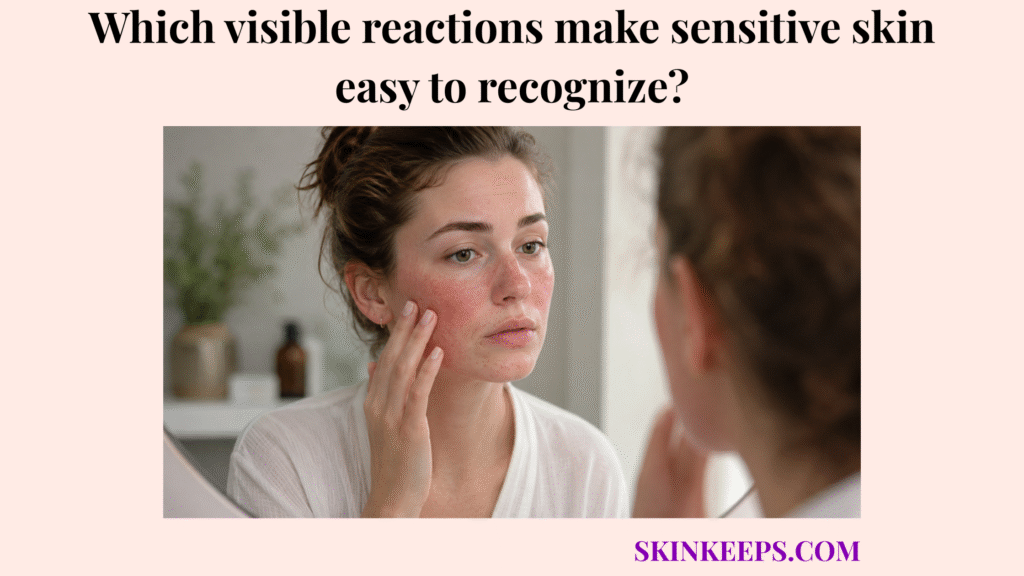
Sensitive skin is easy to recognize when the skin repeatedly reacts with visible redness, flushing, blotchy patches, rash-like irritation, small bumps, peeling, swelling, darker irritated patches, or shiny tight texture after skincare products, fragrance, heat, sun, shaving, cold wind, or friction.
Sensitive skin is not always visible, because some people mainly feel burning, stinging, itching, or tightness even when the surface looks normal. This article explains visible reaction patterns, redness and flushing, blotchy or rash-like areas, bumps and peeling, skin-tone differences, trigger clues, acne/rosacea/dermatitis confusion, warning signs, reaction tracking, and final takeaways.
Why Can Sensitive Skin Show Visible Reactions?
Sensitive skin can show visible reactions because a reactive skin barrier may respond quickly to products, weather, heat, fragrance, shaving, or friction. Visible reactions should be understood inside the broader pattern of sensitive skin, where products, weather, friction, and heat can trigger faster reactivity. These reactions are surface clues, not diagnoses.
A visible reaction often becomes more meaningful when the same trigger causes a similar pattern more than once. A visible reaction often starts with barrier behavior, especially when sensitive skin has a compromised barrier that reacts more easily to contact triggers. The pattern may suggest sensitivity, but it does not identify acne, rosacea, dermatitis, allergy, or infection by itself.
How a Reactive Skin Barrier Makes Visible Irritation Easier to Trigger
A reactive skin barrier makes visible irritation easier to trigger because the outer layer has lower tolerance for contact, heat, friction, or active ingredients. Visible irritation may appear as redness, blotchiness, bumps, peeling, swelling, or darker irritated patches. A reactive barrier can be one explanation, but it should not be treated as the only possible cause.
Why Sensitive Skin May React Faster Than Balanced Skin
Sensitive skin may react faster than balanced skin because the same trigger can create visible irritation or uncomfortable sensations sooner. A fast reaction after a product, heat, wind, shaving, or friction can be a useful clue. Reaction speed alone is still not a diagnosis because visible signs can overlap with several skin patterns.
| Visible Reaction | What It May Suggest |
|---|---|
| Redness or flushing | Irritation, heat response, or reactivity |
| Blotchy patches | Uneven inflammatory response |
| Rash-like irritation | Product, friction, or environmental trigger |
| Small bumps | Irritation bumps or clogged/reactive response |
| Peeling | Barrier stress or product overuse |
| Swelling | Stronger irritation or allergic-type response |
| Darker irritated patches | Inflammation on deeper skin tones |
How Do Redness and Flushing Make Sensitive Skin Easier to Recognize?
Redness and flushing make sensitive skin easier to recognize when color change appears quickly after products, heat, sun, exercise, spicy food, shaving, or friction. Redness and warmth need their own context because sensitive skin frequently shows redness or flushing after products, heat, sun, or friction. Redness is a visible clue, not proof of one condition.
Flushing that fades slowly, returns often, or appears with burning, stinging, itching, or tightness is more meaningful than ordinary warmth after exercise or heat. Temperature clues matter when sensitive skin reacts visibly to temperature changes such as heat, sun, exercise, or cold wind. Repeated trigger-linked flushing may overlap with rosacea-like patterns, so it should not be self-diagnosed.
Why Sensitive Skin May Redden Quickly After Triggers
Sensitive skin may redden quickly after triggers because the barrier and surface blood vessels can react strongly to irritation, heat, or product contact. Products, fragrance, heat, sun, and shaving can all create visible redness in a reactive pattern. Rosacea can also involve flushing, so repeated facial redness deserves context rather than assumption.
How Flushing Differs From Normal Temporary Warmth
Flushing differs from normal temporary warmth when it appears repeatedly, lasts longer than expected, looks irritated, or comes with burning, stinging, itching, or tightness. Normal warmth after heat or exercise can happen to many people. Repeated trigger-linked flushing is a stronger sensitive-skin clue than one ordinary warm episode.
Redness and Flushing Clues
- Redness appears after product use.
- Skin flushes after heat, sun, spicy food, or exercise.
- Cheeks, nose, chin, or around the mouth react quickly.
- Redness fades slowly or returns often.
- Skin looks irritated rather than simply warm.
How Do Blotchy Patches or Rash-Like Areas Suggest Sensitive Skin?
Blotchy patches or rash-like areas suggest sensitive skin when uneven irritation appears after a trigger and follows a repeatable product, friction, weather, or contact pattern. Blotchy reactions are more meaningful when they match where a product touched the skin, where fabric rubbed, or where wind, heat, or shaving affected the surface. They still remain clues, not diagnoses.
Rash-like irritation can overlap with contact dermatitis, allergy, eczema, or infection-looking change when symptoms are persistent, severe, swollen, oozing, or crusted. Product-shaped reactions and recurring same-area patches deserve careful tracking. The safest interpretation is trigger-linked sensitivity until a clinician evaluates severe or persistent reactions.
| Pattern | Possible Meaning |
|---|---|
| Patchy redness | Local irritation |
| Uneven darker patches | Inflammation on deeper skin tones |
| Rough rash-like areas | Barrier irritation |
| Product-shaped reaction | Contact irritation or allergy clue |
| Recurring same-area patches | Possible underlying sensitivity pattern |
Can Sensitive Skin Show Bumps, Swelling, or Peeling?
Sensitive skin can show bumps, swelling, or peeling when the barrier is irritated, overloaded by a product, rubbed by friction, or exposed to a trigger the skin does not tolerate well. Texture changes should be read carefully because sensitive skin texture can become rough, bumpy, peeling, or swollen-looking after irritation. Bumps and peeling need trigger context because they can overlap with acne, rosacea, shaving irritation, or product overuse.
Tiny irritation bumps may appear after fragrance, shaving, strong actives, or friction. Peeling may appear after harsh cleansers, strong acids, retinoids, or overuse of active products. Swelling is a stronger reaction clue, especially when it affects the face, lips, eyelids, or throat.
Visible Texture Reactions
- Tiny irritation bumps.
- Rough raised patches.
- Peeling after strong products.
- Puffy or swollen-looking areas.
- Dry-looking reactive patches.
- Shiny, tight, over-irritated skin.
How Can Visible Sensitivity Look Different Across Skin Tones?
Visible sensitivity can look different across skin tones because irritation does not always appear as bright redness on every complexion. Lighter skin may show pink or red flushing, while medium and deeper skin may show red-brown, purple-brown, grayish, darker, ashy, or uneven irritated patches. Deeper skin should not be treated as less irritated just because bright redness is less obvious.
Swelling, bumps, peeling, roughness, warmth, and texture change may be easier to notice than color alone. Skin-tone aware observation matters because redness-only thinking can miss visible irritation in medium and deeper skin tones. Trigger timing and sensation can also help confirm that a visible change belongs to a reaction pattern.
| Skin Tone Context | Sensitive Reaction May Look Like |
|---|---|
| Lighter skin | Pink, red, flushed, or inflamed |
| Medium skin | Red-brown, dusky, or uneven patches |
| Deeper skin | Purple-brown, grayish, darker, or ashy irritation |
| Any skin tone | Swelling, bumps, peeling, roughness, or warmth may be easier to notice than color alone |
Which Triggers Make Sensitive Skin Reactions Easier to Identify?
Triggers make sensitive skin reactions easier to identify when the same product, weather condition, heat exposure, shaving habit, or friction pattern repeatedly causes visible irritation. Trigger patterns are stronger than one isolated patch because external triggers can worsen sensitive skin reactions in repeatable ways. The repeated pattern helps separate sensitivity clues from random, one-time changes.
Fragrance, harsh cleanser, strong acids, retinoids, heat, sun, shaving, cold wind, and friction can each create different visible signs. The goal is not to make a full trigger article. The goal is to connect the visible reaction to the exposure that repeatedly appears before it.
| Trigger | Common Visible Reaction |
|---|---|
| Fragrance | Redness, rash-like irritation, itching marks |
| Harsh cleanser | Tight, red, dry, or peeling areas |
| Strong acids or retinoids | Peeling, flushing, burning-looking irritation |
| Heat or sun | Flushing and redness |
| Shaving | Bumps, redness, or rough patches |
| Cold wind | Redness, roughness, or stinging-looking patches |
| Friction | Localized irritation in rubbed areas |
How Is Sensitive Skin Different From Acne, Rosacea, or Dermatitis?
Sensitive skin differs from acne, rosacea, or dermatitis by its trigger-linked reactivity pattern, but visible reactions can overlap enough that persistent or severe symptoms should not be self-diagnosed. Acne is usually more follicle or pore-based, while sensitive reactions are often connected to products, heat, wind, shaving, fragrance, or friction. The same face can also have more than one pattern.
Rosacea-like patterns often involve recurring central-face flushing, persistent redness, bumps, burning, stinging, or sensitivity. Contact dermatitis can involve rash, swelling, blistering, oozing, crusting, strong itch, or product/contact-linked reactions. Dry barrier irritation is usually more moisture-barrier focused with roughness, flakes, cracks, and tightness.
| Condition Pattern | What It Often Looks Like | Key Distinction |
|---|---|---|
| Sensitive skin reaction | Redness, flushing, stinging-looking irritation, blotchiness | Triggered easily by products or environment |
| Acne | Comedones, pimples, pustules, cysts | More follicle/pore-based |
| Rosacea pattern | Persistent flushing, visible redness, bumps, facial sensitivity | Often recurring on central face |
| Contact dermatitis | Rash, swelling, blistering, oozing, crusting, strong itch | Often linked to irritant or allergen exposure |
| Dry barrier irritation | Roughness, flakes, cracks, tightness | More moisture-barrier focused |
When Are Visible Sensitive-Skin Reactions More Than Ordinary Sensitivity?
Visible sensitive-skin reactions are more than ordinary sensitivity when swelling, blistering, oozing, crusting, severe pain, rapid spreading, infection-looking changes, or repeated same-area reactions appear. These signs deserve professional evaluation instead of repeated product switching. They do not diagnose allergy, infection, eczema, dermatitis, or rosacea, but they raise the concern level.
Professional review becomes important when sensitive skin needs a dermatologist instead of repeated product guessing. A reaction that keeps worsening after a new product, spreads quickly, or does not improve after the trigger stops should not be handled by testing stronger products. Safety comes before routine tweaking.
Dermatologist Warning Checklist
- Swelling of the face, lips, eyelids, or throat.
- Blistering.
- Oozing or crusting.
- Severe burning or pain.
- Rash spreads quickly.
- Reaction appears after a new product and keeps worsening.
- Skin becomes infection-looking.
- Reactions keep returning in the same areas.
- Visible irritation does not improve after stopping the trigger.
- You suspect rosacea, eczema, contact dermatitis, allergy, infection, or another condition.
How Should Someone Track Visible Sensitive-Skin Reactions?
Someone should track visible sensitive-skin reactions by recording the trigger, timing, exact visible sign, location, sensation, duration, and whether the same pattern has happened before. Tracking helps identify patterns before the reaction fades. It should guide observation, not replace diagnosis.
Photos can be useful because redness, swelling, blotchiness, and bumps may change before an appointment. The strongest notes connect what touched the skin, what the skin looked like, what it felt like, and how long the visible reaction lasted. Repeat patterns are more useful than isolated reactions.
Reaction Tracking Checklist
- Product used before the reaction.
- Time between exposure and reaction.
- Exact visible sign: redness, bumps, swelling, peeling, blotches.
- Location of reaction.
- Weather, heat, sweating, shaving, or friction exposure.
- Whether the skin also burned, stung, or itched.
- How long the visible reaction lasted.
- Photos of the reaction before it fades.
- Whether the same trigger caused the reaction before.
Use the Skin Sensitivity Analyzer for Pattern Review
For a structured check, the Skin Sensitivity Analyzer can help organize visible reactions, trigger timing, location, sensations, and repeated patterns before the reaction fades. It is best used as an observation tool, not as a diagnosis.
What Should You Remember About Visible Sensitive-Skin Reactions?
Visible sensitive-skin reactions are best understood as repeatable trigger-linked clues, not standalone diagnoses. Redness, flushing, blotchiness, rash-like irritation, bumps, peeling, swelling, and darker irritated patches become more meaningful when they repeat after products, heat, fragrance, shaving, wind, or friction. Skin-tone differences and sensation-dominant sensitivity also matter.
Final Takeaways
- Sensitive skin can be recognized by visible redness, flushing, blotchiness, rash-like irritation, bumps, peeling, or swelling.
- Sensitive skin does not always look irritated; sometimes the sensation is stronger than the visible sign.
- On deeper skin tones, irritation may appear darker, grayish, purple-brown, or ashy instead of bright red.
- Trigger patterns matter: reactions after products, heat, fragrance, shaving, wind, or friction are important clues.
- Swelling, blistering, oozing, severe pain, spreading rash, or repeated reactions need professional evaluation.
Frequently Asked Questions
Can Sensitive Skin Look Normal but Still React?
Sensitive skin can look normal but still react because some sensitivity is felt as burning, stinging, itching, or tightness without obvious visible changes. Lack of redness does not always mean lack of irritation, especially when the same trigger repeatedly causes discomfort.
Does Redness Always Mean Sensitive Skin?
Redness does not always mean sensitive skin because redness can come from heat, exercise, rosacea, acne inflammation, sun exposure, or dermatitis. Repeated redness after specific products, fragrance, wind, heat, shaving, or friction is more meaningful than one isolated red episode.
Can Sensitive Skin Cause Small Bumps?
Sensitive skin can cause small irritation bumps, but bumps can also come from acne, rosacea, clogged pores, shaving irritation, or dermatitis. Trigger pattern, location, recurrence, and whether bumps appear with burning, stinging, itching, or swelling help clarify the concern.
How Does Sensitive Skin Look on Darker Skin Tones?
Sensitive skin on darker skin tones may look darker, grayish, purple-brown, red-brown, ashy, uneven, swollen, bumpy, peeling, or rough instead of bright red. Texture, warmth, swelling, and trigger timing may be more reliable than redness alone.
When Should Visible Sensitive-Skin Reactions Be Checked?
Visible sensitive-skin reactions should be checked when they involve swelling, blistering, oozing, crusting, severe pain, spreading rash, infection-looking changes, or repeated same-area reactions. Evaluation helps separate sensitivity from rosacea, dermatitis, allergy, infection, or acne.
Conclusion
Sensitive skin is easiest to recognize when visible reactions repeat after clear triggers such as skincare products, fragrance, heat, sun, shaving, cold wind, or friction. These reactions may appear as redness, flushing, blotchy patches, rash-like irritation, bumps, peeling, swelling, darker irritated patches, or shiny tight texture.
Visible reactions are clues, not diagnoses. Sensitive skin can overlap visually with acne, rosacea, dermatitis, allergy, infection, or dry barrier irritation, so swelling, blistering, oozing, crusting, severe pain, spreading rash, infection-looking changes, or repeated same-area reactions should be evaluated professionally.