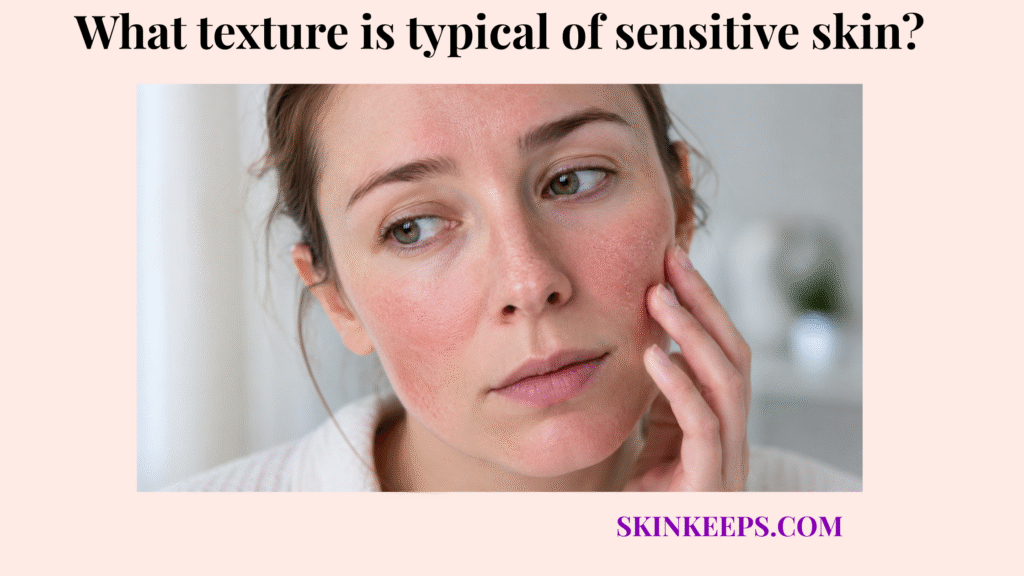
Sensitive skin does not have one fixed texture. When calm, it may look and feel smooth or normal, but during irritation it can become rough, tight, bumpy, flaky, shiny, swollen, uneven, or rash-like.
The most typical sensitive-skin texture pattern is a repeated texture change after triggers such as skincare products, fragrance, heat, cold, shaving, wind, sweat, exfoliation, hot water, or friction. This article explains calm texture, reactive texture, roughness, bumps, tight shine, comparison with dry skin, acne, rosacea, and dermatitis, trigger clues, skin-tone differences, tracking, calming direction, warning signs, and final takeaways.
Why Does Sensitive Skin Not Have One Fixed Texture?
Sensitive skin does not have one fixed texture because it can look normal when calm and change texture only when the barrier reacts to triggers. Texture changes should be understood inside the broader pattern of sensitive skin, where products, weather, heat, shaving, and friction can trigger faster reactivity.
The trap is assuming sensitivity must always look rough, red, flaky, or bumpy. In reality, texture changes after triggers are more useful than baseline texture alone.
Why Sensitive Skin Can Look Normal When Calm
Sensitive skin can look normal when calm because sensitivity may exist as lower tolerance rather than constant visible roughness, redness, or bumps. Calm sensitive skin may feel smooth, soft, or ordinary until a product, weather shift, or friction trigger starts a reaction.
Invisible sensitivity is not fake or less valid. Some people mainly notice stinging, burning, or tightness only after exposure, while the surface looks normal between reactions.
Why Texture Changes Appear Mainly After Triggers
Texture changes appear mainly after triggers because products, fragrance, heat, cold, wind, shaving, sweat, exfoliation, hot water, or friction can stress a reactive barrier. Rough or tight texture often begins with barrier behavior, especially when sensitive skin has a compromised barrier that reacts quickly to contact or environmental stress.
The texture change may show as roughness, bumps, flaking, tight shine, swelling, or uneven patches. That pattern may suggest sensitive-skin reactivity, but it does not diagnose acne, rosacea, dermatitis, allergy, infection, or eczema.
| Texture Pattern | What It May Suggest |
|---|---|
| Smooth when calm | Sensitive skin can look normal between reactions. |
| Rough after triggers | Barrier irritation, dryness, or friction response. |
| Tight or shiny | Over-cleansing, over-exfoliation, irritation, or barrier stress. |
| Bumpy | Irritation bumps, clogged reaction, heat response, or product sensitivity. |
| Flaky or peeling | Barrier disruption, dryness, or over-treatment. |
| Puffy or swollen | Stronger inflammatory or allergic-type reaction. |
| Uneven patches | Localized reactivity, shaving, friction, or contact irritation. |
What Texture Does Sensitive Skin Have When It Is Calm?
Calm sensitive skin may feel smooth, soft, or normal because sensitive skin does not always show visible irritation between reactions. A normal-looking surface does not rule out sensitive skin if the skin repeatedly reacts after triggers.
Some sensitive skin feels slightly delicate even when it looks calm. Other sensitive skin looks completely ordinary until it meets stronger skincare products, weather stress, shaving, sweat, or friction.
Calm Sensitive-Skin Texture
What Texture Appears When Sensitive Skin Becomes Irritated?
Irritated sensitive skin may become rough, tight, uneven, flaky, shiny, bumpy, swollen, or rash-like because the barrier is reacting to stress. Texture changes also belong to the wider group of visible sensitive-skin reactions when bumps, swelling, peeling, or uneven patches appear after triggers.
The exact texture depends on the trigger and barrier status. Harsh cleansing may create tight shine, cold wind may create roughness, and product irritation may create bumps, flaking, or uneven patches.
How Roughness Can Appear After Barrier Stress
Roughness can appear after barrier stress because the outer layer loses comfort, moisture support, or smooth surface organization. Harsh cleansing, cold wind, friction, and product irritation can all make the surface feel uneven or dry-looking.
Roughness is a barrier clue, not a diagnosis. It can overlap with dry skin, irritation, weather stress, or contact reactions.
Why Tight Texture Can Signal Irritation Rather Than Cleanliness
Tight texture can signal irritation rather than cleanliness because stripped skin may feel smooth for a moment but uncomfortable, stretched, stingy, or raw. Tightness after cleansing, hot water, strong acids, or over-exfoliation should not be treated as a healthy goal.
Shiny or over-smooth texture can be a warning clue when it comes with stinging, burning, dryness, or raw feeling. Clean skin should not feel stripped.
| Skin State | Texture Pattern |
|---|---|
| Calm sensitive skin | Smooth, soft, or normal-looking. |
| Mildly irritated sensitive skin | Tight, rough, slightly uneven. |
| Product-reactive sensitive skin | Stinging, peeling, shiny, flaky, or bumpy texture. |
| Weather-reactive sensitive skin | Rough, chapped, dry-looking patches. |
| Heat or sweat-reactive sensitive skin | Bumps, flushing, roughness, or rash-like irritation. |
| Strongly irritated sensitive skin | Swollen, rash-like, bumpy, painful, or spreading texture. |
Can Sensitive Skin Feel Bumpy or Uneven?
Sensitive skin can feel bumpy or uneven when irritation affects the surface barrier or when a product, friction, shaving, sweat, or heat triggers small reactive bumps. Bumps are not automatically acne, and treating every bump as acne can make sensitive texture worse.
Trigger timing, location, sensation, and recurrence matter more than the bump alone. A bump that appears exactly where a product touched the skin or after shaving, sweat, heat, or friction may be a reactivity clue.
Bumpy Texture Clues
Can Sensitive Skin Look Tight, Shiny, or Over-Smooth?
Sensitive skin can look tight, shiny, or over-smooth when the barrier has been stripped by harsh cleansing, over-exfoliation, strong actives, retinoids, or hot water. This shine can be misleading because the surface may look smooth while feeling uncomfortable.
Tight shiny sensitive skin is not the same as oily shine. Oily shine usually feels greasy or slick, while stripped sensitive skin may look smooth but feel stretched, stingy, burning, or raw.
How Is Sensitive-Skin Texture Different From Dry Skin, Acne, Rosacea, or Dermatitis?
Sensitive-skin texture is different from dry skin, acne, rosacea, or dermatitis because the main clue is repeatable texture change after triggers, not one permanent surface pattern. Flaky or peeling texture should be separated from ordinary dryness because dryness and flakiness can be common in sensitive skin after barrier disruption.
Overlap is possible, so the comparison should stay cautious. Dry skin centers on moisture loss, acne centers more on follicle patterns, rosacea often involves recurring facial flushing, and dermatitis can look rash-like, swollen, itchy, peeling, or blistered.
| Skin Pattern | Typical Texture Clue | Key Difference |
|---|---|---|
| Sensitive skin | Texture changes after triggers. | Reactivity is the main clue. |
| Dry skin | Rough, flaky, tight, cracked. | Moisture or lipid loss is central. |
| Acne-prone skin | Comedones, pimples, pustules, cysts. | Follicle blockage is central. |
| Rosacea-prone skin | Flushing, bumps, sensitive central face. | Recurrent facial flushing pattern matters. |
| Contact dermatitis | Rash-like, swollen, itchy, peeling, blistered. | Trigger exposure and inflammation are stronger. |
This matrix is for pattern recognition only. It should not be used to diagnose the reader.
Which Triggers Change the Texture of Sensitive Skin?
Triggers that change the texture of sensitive skin often include harsh cleansers, fragrance, strong acids, retinoids, heat, sweat, cold wind, shaving, hot water, exfoliation, and friction. Trigger repetition matters because external triggers can worsen sensitive skin reactions in recognizable texture patterns.
One random texture change is less useful than a repeated trigger-texture pairing. A product that repeatedly creates tight shine, bumps, stinging, or peeling should not be ignored simply because the skin looked normal before use.
| Trigger | Possible Texture Response |
|---|---|
| Harsh cleanser | Tight, rough, stripped texture. |
| Fragrance | Rash-like texture, bumps, itching. |
| Strong acids | Peeling, shiny, irritated surface. |
| Retinoids | Dryness, flaking, sensitivity texture. |
| Heat or sweat | Bumps, flushing, rough irritation. |
| Cold wind | Chapped, rough, dry-looking patches. |
| Shaving | Bumpy, raw, or uneven texture. |
| Friction | Localized rough or irritated patches. |
| Hot water | Tight, shiny, stripped, or stinging texture. |
How Can Sensitive Skin Texture Look Different Across Skin Tones?
Sensitive skin texture can look different across skin tones because irritation may show through roughness, swelling, ashiness, grayish change, purple-brown change, darker patches, bumps, heat, or contour change rather than obvious bright redness. Texture may be easier to notice than color alone.
Deeper skin should not be treated as less irritated just because redness is less visible. The reaction may show through rough, bumpy, ashy, swollen, grayish, darker, or purple-brown texture changes instead.
| Skin Tone Context | Sensitive Texture May Appear As |
|---|---|
| Lighter skin | Red, rough, bumpy, flaky, or shiny-irritated. |
| Medium skin | Uneven, red-brown, rough, or textured patches. |
| Deeper skin | Ashy, grayish, purple-brown, darker, rough, or bumpy patches. |
| Any skin tone | Texture, swelling, heat, stinging, and roughness may be easier to notice than color alone. |
How Should Someone Track Sensitive-Skin Texture Changes?
Someone should track sensitive-skin texture changes by recording what the skin felt like before the reaction, what trigger happened, which texture appeared, where it appeared, and how long it lasted. Tracking is pattern recognition, not diagnosis.
Photos can help because texture may fade before an appointment. Heat, sweat, and cold wind matter because sensitive skin can react visibly to temperature changes with bumps, roughness, flushing, or chapping.
Texture Tracking Checklist
How Can Sensitive-Skin Texture Be Calmed?
Sensitive-skin texture can be calmed by stopping the likely trigger, simplifying care, avoiding heat and friction, and supporting the barrier with gentle fragrance-free basics. This is a calming direction, not a full routine or product-buying section.
A stronger response is not always a better response. During active irritation, scrubs, strong acids, retinoids, hot water, and rapid product switching can make the texture more reactive.
Texture-Calming Direction
When Is Sensitive-Skin Texture Change More Than Ordinary Sensitivity?
Sensitive-skin texture change is more than ordinary sensitivity when it comes with swelling, blistering, oozing, crusting, bleeding, severe burning, severe pain, spreading bumps, eye irritation, or repeated same-area reactions. These signs deserve professional evaluation instead of more product switching.
Professional review becomes important when sensitive skin needs a dermatologist instead of repeated product guessing. The goal is not to diagnose yourself; the goal is to avoid missing patterns that behave beyond simple temporary sensitivity.
Warning Signs Checklist
What Should You Remember About Sensitive Skin Texture?
Sensitive skin does not have one fixed texture, so repeated texture changes after triggers matter more than baseline texture alone. Oily, dry, normal, or combination skin can all be sensitive if the surface repeatedly changes after exposure.
Final Takeaways
- Sensitive skin does not have one fixed texture.
- It may look smooth when calm.
- During reactions, it may become rough, tight, bumpy, flaky, shiny, swollen, or uneven.
- Texture changes after triggers are more important than baseline texture alone.
- Oily, dry, normal, or combination skin can all be sensitive.
- Bumps are not always acne, and roughness is not always ordinary dry skin.
- Persistent, painful, swollen, blistering, oozing, bleeding, or recurring texture changes should be professionally evaluated.
Frequently Asked Questions
Can Sensitive Skin Feel Smooth?
Sensitive skin can feel smooth when calm because sensitivity does not always create visible or touchable texture changes. Texture changes may appear only after triggers, so smooth skin does not rule out sensitive skin if reactions keep returning after exposure.
Can Sensitive Skin Feel Bumpy?
Sensitive skin can feel bumpy when products, shaving, sweat, heat, friction, or barrier irritation trigger small reactive bumps. Bumps are not automatically acne; trigger timing, location, sensation, and recurrence matter more than the bump alone.
Why Does Sensitive Skin Look Shiny but Feel Dry or Tight?
Sensitive skin can look shiny but feel dry or tight when the surface has been stripped by harsh cleansing, hot water, strong actives, or over-exfoliation. This is different from oily shine because stripped skin may feel stretched, stingy, or raw.
Is Rough Texture Sensitive Skin or Dry Skin?
Rough texture can appear in sensitive skin or dry skin, but sensitive-skin roughness is usually more trigger-linked and may come with stinging, burning, itching, or product intolerance. Persistent roughness needs evaluation if it worsens or spreads.
When Should Sensitive-Skin Texture Changes Be Checked?
Sensitive-skin texture changes should be checked when they are swollen, blistering, oozing, crusted, bleeding, painful, spreading, eye-associated, persistent, or repeatedly returning in the same areas. Evaluation helps separate sensitivity from acne, rosacea, dermatitis, allergy, infection, or eczema.
Conclusion
Sensitive skin does not have one fixed texture; it may look smooth when calm and become rough, tight, bumpy, flaky, shiny, swollen, or uneven during irritation. The most useful clue is a repeated texture change after triggers such as products, fragrance, heat, cold, wind, shaving, sweat, exfoliation, hot water, or friction.
Texture changes are clues, not diagnoses. If the texture change is swollen, blistering, oozing, crusted, bleeding, painful, spreading, eye-associated, persistent, or repeatedly returning in the same areas, professional evaluation is safer than repeated product guessing.