
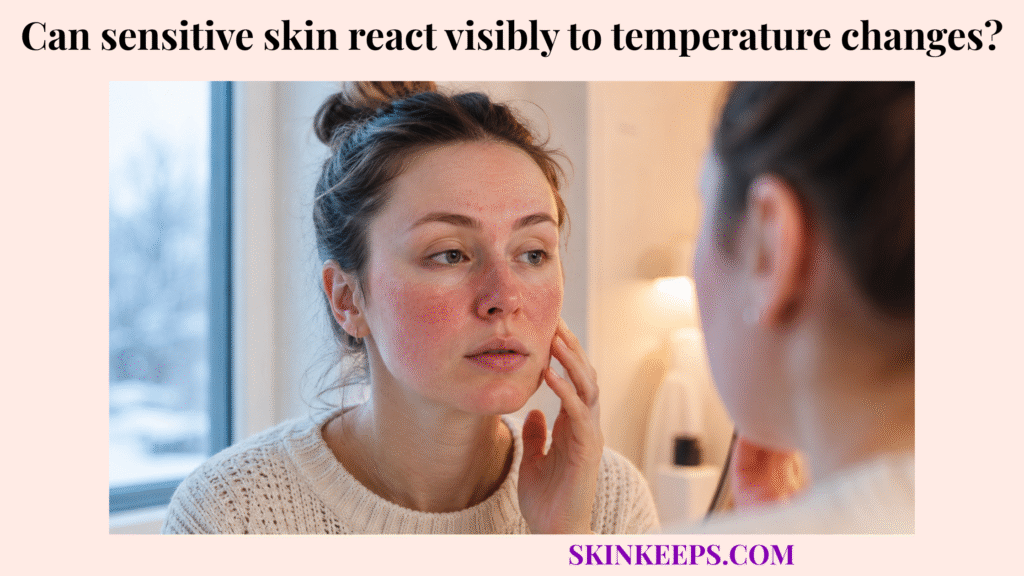
Yes, sensitive skin can react visibly to temperature changes, including heat, cold, wind, hot water, sweating, and sudden shifts from cold outdoor air to heated indoor air.
These reactions may appear as redness, flushing, blotchy patches, darker irritation, roughness, swelling, peeling, bumps, chapping, or rash-like sensitivity because reactive skin can respond faster to environmental stress. This article explains heat reactions, cold reactions, sudden temperature shifts, hot water and sweat triggers, skin-tone differences, normal versus concerning reactions, condition overlap, protection steps, tracking, warning signs, and final takeaways.
Why Can Sensitive Skin React Visibly to Temperature Changes?
Sensitive skin can react visibly to temperature changes because heat, cold, wind, hot water, sweat, and sudden shifts can stress a reactive skin barrier. Temperature reactions should be understood inside the broader pattern of sensitive skin, where environmental triggers can create faster visible reactivity.
Temperature stress can change how the skin looks and feels. The surface may flush, redden, roughen, darken, sting, tighten, peel, swell, or form small bumps when the barrier has lower tolerance for the exposure.
How Temperature Stress Makes Reactive Skin Easier to Irritate
Temperature stress makes reactive skin easier to irritate because the outer skin layer may have lower tolerance for heat, cold, wind, sweat, and hot water. Temperature stress matters more when sensitive skin has a compromised barrier that reacts quickly to environmental changes.
The visible reaction may show as redness, flushing, roughness, darker irritation, swelling, or stinging-looking patches. That pattern may suggest temperature-triggered sensitivity, but temperature stress is not the only possible cause of visible irritation.
Why Sensitive Skin May Show Visible Changes Faster Than Balanced Skin
Sensitive skin may show visible changes faster than balanced skin because its reaction threshold can be lower after environmental stress. A mild shift from cold air to indoor heat, or from air conditioning into sun, may be enough to create visible change in some sensitive-skin patterns.
One brief color change is not enough to label the skin sensitive. The stronger clue is a repeatable reaction that follows the same temperature trigger and appears with discomfort, roughness, swelling, peeling, or rash-like sensitivity.
| Temperature Trigger | Possible Visible Reaction |
|---|---|
| Heat | Flushing, redness, warmth, blotchiness. |
| Cold air | Roughness, redness, darker irritation, stinging-looking patches. |
| Wind | Dry-looking irritation, redness, chapping. |
| Hot water | Redness, tight shine, peeling, barrier irritation. |
| Sweating | Rash-like irritation or bumps. |
| Sudden temperature shift | Quick flushing or patchy color change. |
How Does Heat Trigger Visible Reactions in Sensitive Skin?
Heat can trigger visible reactions in sensitive skin by increasing warmth, flushing, blotchiness, sweat irritation, and stinging-looking redness. Heat reactions often overlap with color-change patterns because sensitive skin frequently shows redness or flushing after certain triggers.
Heat should not automatically be treated as rosacea or a medical diagnosis. The pattern becomes more important when flushing is frequent, central-face focused, persistent, or paired with burning, bumps, eye irritation, or repeated same-area reactions.
Why Heat Can Cause Flushing or Blotchy Redness
Heat can cause flushing or blotchy redness because the skin responds to warmth with visible color change and increased surface reactivity. Hot rooms, exercise, sun exposure, and sudden temperature shifts can all make the face look warmer, redder, darker, or blotchier.
Frequent central-face flushing deserves evaluation if it repeats or persists. The cautious rule is simple: heat-triggered flushing can be a sensitive-skin clue, but it should not be self-diagnosed.
How Sweating Can Worsen Visible Irritation
Sweating can worsen visible irritation when sweat, salt, friction, and heat sit on sensitive skin long enough to trigger bumps, stinging, or rash-like patches. Sweat reactions often appear where skin rubs, where sweat collects, or where clothing traps heat.
Gentle rinsing is usually safer than scrubbing when the skin already looks irritated. Scrubbing can add friction to an already heat-stressed surface.
Heat Reaction Signs
How Does Cold Weather Trigger Visible Reactions in Sensitive Skin?
Cold weather can trigger visible reactions in sensitive skin by increasing dryness, wind exposure, chapping, roughness, stinging-looking patches, and darker or red irritation. Cold air, wind, and low humidity can stress the surface so the reaction looks rougher or tighter than a heat reaction.
This section should not be confused with a full dry-skin weather-damage article. The focus is temperature-triggered sensitivity: a repeatable visible reaction after cold, wind, or cold-to-warm transition.
| Cold Exposure Effect | Visible Skin Response |
|---|---|
| Cold air | Tight, dry-looking patches. |
| Wind exposure | Chapped, rough, irritated areas. |
| Low humidity | Flaking or ashy-looking sensitivity. |
| Cold-to-warm transition | Sudden flushing or blotchy patches. |
| Repeated exposure | Recurring redness, roughness, or irritation. |
Why Do Sudden Temperature Shifts Affect Sensitive Skin?
Sudden temperature shifts affect sensitive skin because the skin has to adjust quickly to changing blood flow, moisture loss, and environmental stress. Moving from cold outdoor air into heated indoor air can trigger flushing, blotchiness, tightness, or stinging-looking irritation.
Moving from air conditioning into strong heat can create the opposite version of the same problem. The skin shifts from cool, dry indoor air to warmth, sweat, and surface reactivity, which can make visible changes appear faster.
Can Hot Water Make Sensitive Skin Look Irritated?
Hot water can make sensitive skin look irritated because it can increase redness, tight shine, peeling, and barrier discomfort after washing. Hot water is a temperature trigger, not just a cleansing habit.
The reaction may appear on the face, hands, around the mouth, cheeks, or body areas that are washed often. Burning sensation with visible redness, darker irritation, tightness, or peeling is a sign to reduce temperature stress rather than scrub harder.
Hot-Water Reaction Signs
How Can Temperature Reactions Look Different Across Skin Tones?
Temperature reactions can look different across skin tones because irritation may appear as red, red-brown, dusky, purple-brown, grayish, darker, or ashy change depending on complexion. This page belongs under the broader group of visible sensitive-skin reactions, but it narrows the focus to temperature-triggered changes.
Warmth, swelling, roughness, peeling, bumps, or stinging may be more noticeable than color alone. Deeper skin is not less reactive because bright redness is less visible; the visible pattern may simply show through texture, tone shift, or swelling instead.
| Skin Tone Context | Temperature Reaction May Look Like |
|---|---|
| Lighter skin | Pink, red, flushed, or blotchy. |
| Medium skin | Red-brown, warm-toned, or dusky patches. |
| Deeper skin | Purple-brown, grayish, darker, or ashy irritation. |
| Any skin tone | Warmth, swelling, roughness, peeling, bumps, or stinging may be more noticeable than color alone. |
How Is a Normal Temperature Response Different From Sensitive-Skin Reactivity?
A normal temperature response is usually brief and mild, while sensitive-skin reactivity tends to last longer, repeat predictably, or appear with stinging, burning, itching, tightness, roughness, swelling, or rash-like irritation. Temporary color change after strong heat or cold can happen without meaning the skin is sensitive.
The reaction becomes more useful as a sensitive-skin clue when mild temperature exposure causes a repeated visible pattern. Repeat patterns are stronger clues because external triggers can worsen sensitive skin reactions in predictable ways.
| Feature | Normal Temporary Response | Sensitive-Skin Reaction |
|---|---|---|
| Duration | Fades quickly. | Lasts longer or returns often. |
| Sensation | Mild warmth. | Stinging, burning, itching, or tightness. |
| Appearance | Light temporary color change. | Blotchy, rash-like, swollen, rough, or irritated. |
| Trigger amount | Strong heat or cold exposure. | Mild temperature change may trigger it. |
| Pattern | Occasional. | Repeated and predictable. |
Which Temperature-Related Patterns May Suggest Rosacea, Dermatitis, or Allergy?
Temperature-related patterns may suggest rosacea, dermatitis, allergy, or another condition when reactions are frequent, central-face recurring, swollen, oozing, crusted, blistered, painful, or repeatedly triggered by mild exposure. This section is a boundary check, not a diagnosis tool.
Rosacea-like patterns can include repeated central-face flushing. Dermatitis-like or allergic-type reactions can look more rash-like, swollen, oozing, crusted, blistered, or strongly itchy. Infection-looking or rapidly spreading changes should not be treated as ordinary temperature sensitivity.
| Pattern | Possible Concern |
|---|---|
| Frequent central-face flushing | Rosacea-like pattern. |
| Redness with burning after skincare | Irritant reaction. |
| Rash after cold or heat exposure | Temperature-triggered dermatitis or sensitivity. |
| Swelling after exposure | Stronger inflammatory or allergic-type reaction. |
| Crusting, oozing, or blistering | Not ordinary sensitivity. |
| Reactions that keep returning | Needs closer evaluation. |
How Can Sensitive Skin Be Protected From Temperature Changes?
Sensitive skin can be protected from temperature changes by avoiding extremes, using lukewarm water, shielding skin from cold and wind, protecting against sun, removing sweat gently, and avoiding strong actives when the skin is already irritated. Protection should reduce trigger load without turning the page into a product routine.
Texture changes matter when temperature reactions include roughness, bumps, peeling, or swelling because sensitive skin texture can become rough, bumpy, peeling, or swollen-looking after irritation. Gentle protection is safer than aggressive exfoliation when the skin is already flushed, rough, or stingy.
Temperature Protection Checklist
How Should Someone Track Temperature-Triggered Sensitive Skin Reactions?
Someone should track temperature-triggered sensitive skin reactions by recording the temperature trigger, visible reaction, location, sensation, duration, products used, and whether the same trigger caused the reaction before. Tracking helps identify repeatable patterns before the reaction fades.
Photos can help when reactions are short-lived or when color change is subtle. Tracking does not diagnose sensitive skin, rosacea, dermatitis, allergy, eczema, or infection; it simply organizes what happened before professional review or care decisions.
Temperature-Trigger Tracking Checklist
When Do Temperature-Related Visible Reactions Need Professional Evaluation?
Temperature-related visible reactions need professional evaluation when flushing happens frequently without a clear reason, reactions persist, skin swells, blisters, oozes, crusts, spreads quickly, becomes severely painful, or involves eye irritation. Professional review becomes important when sensitive skin needs a dermatologist instead of repeated temperature-trigger guessing.
Evaluation is useful when the reaction does not behave like an ordinary temporary temperature response. The goal is not to self-diagnose; the goal is to avoid ignoring patterns that could overlap with rosacea, dermatitis, allergy, eczema, infection, or another condition.
Professional Evaluation Warning Signs
What Should You Remember About Sensitive Skin and Temperature Changes?
Sensitive skin can react visibly to temperature changes, but the trigger, duration, location, sensation, recurrence, skin tone, and warning signs decide how concerning the reaction is. Temperature reactions are clues, not diagnoses.
Final Takeaways
- Sensitive skin can react visibly to temperature changes.
- Heat often triggers flushing, warmth, and blotchiness.
- Cold and wind often trigger roughness, chapping, darker irritation, or redness.
- Sudden temperature shifts can trigger quick visible reactivity.
- On deeper skin tones, temperature irritation may look darker, grayish, purple-brown, or ashy rather than bright red.
- Repeated, painful, swollen, blistering, or persistent reactions should be checked professionally.
Frequently Asked Questions
Can Heat Make Sensitive Skin Flush?
Heat can make sensitive skin flush when warmth, sun, exercise, hot rooms, or sweating triggers quick color change and visible reactivity. Occasional brief flushing can be normal, but frequent or persistent central-face flushing should be evaluated instead of assumed to be ordinary sensitivity.
Can Cold Air Make Sensitive Skin Red or Rough?
Cold air can make sensitive skin red, rough, tight, chapped, darker, or stinging-looking when the barrier reacts to cold, wind, and low humidity. Repeated cold reactions should be managed with moisture support and physical protection, not aggressive exfoliation.
Why Does Hot Water Make Sensitive Skin Look Irritated?
Hot water can make sensitive skin look irritated because it can stress the barrier and trigger redness, tight shine, peeling, burning, or stinging-looking patches. Lukewarm water and gentle cleansing are safer than very hot water when the skin already looks reactive.
Are Temperature Reactions the Same as Rosacea?
Temperature reactions are not the same as rosacea, but frequent central-face flushing after heat, sun, stress, spicy foods, or temperature shifts can overlap with rosacea-like patterns. Evaluation is safer when flushing is frequent, persistent, central-face recurring, or eye-associated.
When Should Temperature-Triggered Sensitive Skin Be Checked?
Temperature-triggered sensitive skin should be checked when reactions persist, spread, blister, ooze, crust, become very painful, involve eye irritation, or keep returning in the same areas. Evaluation helps separate sensitivity from rosacea, dermatitis, allergy, eczema, infection, or another condition.
Conclusion
Sensitive skin can react visibly to temperature changes when heat, cold, wind, hot water, sweating, or sudden indoor-outdoor shifts trigger flushing, redness, roughness, darker irritation, bumps, swelling, or peeling. Heat often causes flushing and blotchiness, while cold and wind more often create chapping, roughness, tightness, or stinging-looking patches.
Temperature reactions are clues, not diagnoses. If reactions are persistent, painful, swollen, blistering, oozing, crusted, spreading, eye-associated, or repeatedly central-face focused, professional evaluation is safer than assuming the reaction is ordinary sensitivity.