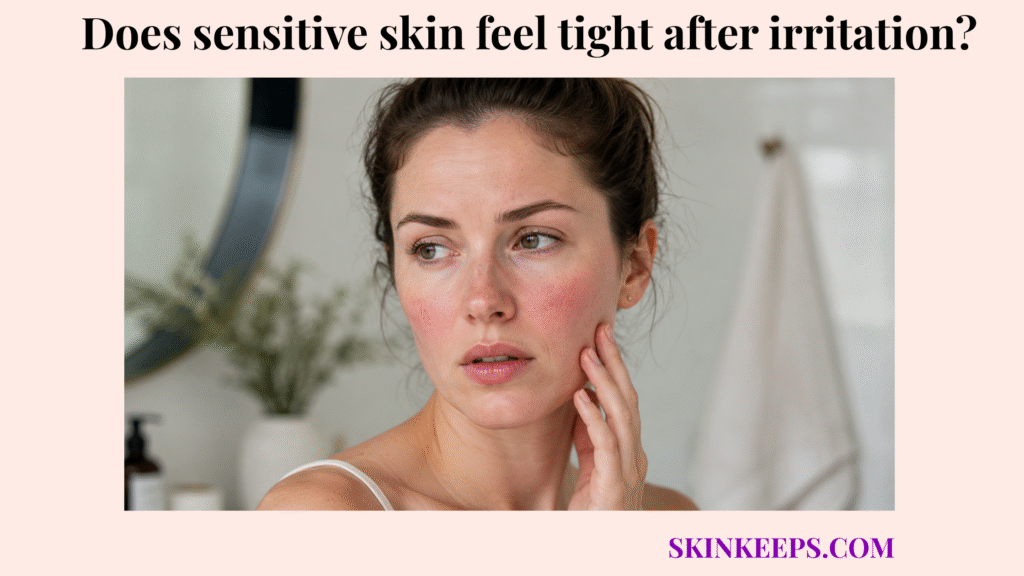
Yes, sensitive skin can feel tight after irritation because a reactive or weakened barrier can lose comfort after exposure to harsh products, hot water, wind, cold air, fragrance, exfoliants, retinoids, shaving, sweat, or friction.
This tight feeling may feel like the skin is stretched, pulled, dry, shiny, raw, or uncomfortable, and it can happen even when the skin is oily or combination. This article explains why post-irritation tightness happens, which triggers commonly cause it, how it differs from ordinary dry-skin tightness, which symptoms can appear with it, how to identify product patterns, how to calm and prevent it, how to track it, and when professional evaluation is safer.
Why Can Sensitive Skin Feel Tight After Irritation?
Sensitive skin can feel tight after irritation because the barrier may lose comfort, moisture support, and tolerance after a trigger. Post-irritation tightness should be interpreted inside the broader pattern of sensitive skin, where barrier weakness, trigger response, and product intolerance can lower comfort.
Tightness is a barrier-comfort signal, not proof that the skin is clean or healthy. The tight feeling may appear as stretching, pulling, shiny tightness, rawness, or discomfort after the skin meets a trigger.
How Irritation Weakens Barrier Comfort
Irritation weakens barrier comfort by making the outer skin layer feel stripped, reactive, dry, shiny, raw, or less able to tolerate contact. Product or weather tightness often begins with barrier behavior, especially when sensitive skin has a compromised barrier that loses comfort after triggers.
Harsh cleanser, hot water, fragrance, acids, retinoids, wind, and friction can all create tightness when the skin’s surface becomes uncomfortable. Barrier damage is not the only possible cause, but it is one of the main patterns to check.
Why Sensitive Skin Can Feel Stretched After a Trigger
Sensitive skin can feel stretched after a trigger because irritation can make the surface feel pulled, tight, or over-smoothed even before obvious peeling appears. Tightness after washing, actives, shaving, sweat, or weather can be a clue that the barrier is not tolerating the exposure well.
Tight shine can suggest stripping or over-exfoliation rather than healthy glow. Tightness should not be treated as a skin goal.
| Tightness Pattern | What It May Suggest |
|---|---|
| Tightness after cleansing | Cleanser may be too stripping. |
| Tightness after skincare products | Barrier irritation or formula mismatch. |
| Tightness after hot water | Moisture loss and heat irritation. |
| Tightness after wind or cold | Environmental barrier stress. |
| Tightness with shine | Stripped or over-exfoliated surface. |
| Tightness with peeling | Barrier disruption or over-treatment. |
| Tightness with burning | Stronger irritation response. |
Which Triggers Commonly Make Sensitive Skin Feel Tight?
Triggers that commonly make sensitive skin feel tight include harsh cleansers, hot water, fragrance, strong acids, retinoids, cold wind, shaving, sweat, over-exfoliation, and friction. Product category matters because skincare ingredients can commonly irritate sensitive skin when fragrance, actives, or harsh formulas are poorly tolerated.
Repeated trigger-tightness pairing matters more than one isolated tight day. The useful question is whether the same product, weather exposure, or friction pattern keeps producing the same stretched feeling.
| Trigger | How Tightness May Appear |
|---|---|
| Harsh cleanser | Squeaky, stretched, dry feeling. |
| Hot water | Tightness after washing or showering. |
| Fragrance | Tightness with itching or irritation. |
| Strong acids | Tightness with peeling or sting. |
| Retinoids | Tight, dry, reactive surface. |
| Cold wind | Tight, raw, exposed feeling. |
| Shaving | Tightness with tenderness. |
| Sweat | Tightness with prickling or itch. |
| Over-exfoliation | Tight, shiny, uncomfortable skin. |
| Friction | Localized tightness in rubbed areas. |
How Is Sensitive-Skin Tightness Different From Ordinary Dry Skin Tightness?
Sensitive-skin tightness differs from ordinary dry skin tightness because it is usually more trigger-linked and reactive, while dry-skin tightness is more often tied to low moisture or low oil. Dry skin and sensitive skin can overlap, but the dominant clue differs.
Tightness belongs to the wider sensory group of sensitive skin discomfort, alongside stinging, burning, itching, heat, tenderness, and rawness. When tightness appears with sting, burn, itch, or fast product reactivity, sensitive-skin behavior becomes more likely than dryness alone.
| Feature | Sensitive-Skin Tightness | Dry-Skin Tightness |
|---|---|---|
| Main clue | Appears after a trigger. | Often tied to low moisture or low oil. |
| Common timing | After products, heat, friction, shaving, or actives. | After washing, cold air, low humidity, or lack of moisturizer. |
| Sensation | Tight with sting, burn, itch, or reactivity. | Tight with roughness, flakes, or dryness. |
| Skin type | Can happen in oily, dry, or combination sensitive skin. | Usually linked to dry skin tendency. |
| Best first step | Remove trigger and calm barrier. | Moisturize and reduce moisture loss. |
Can Sensitive Skin Feel Tight Even If It Is Oily or Combination?
Sensitive skin can feel tight even if it is oily or combination because tightness does not always mean the skin lacks oil. It can mean irritation, over-cleansing, over-exfoliation, or product reaction.
A person can have oily shine and still feel tight if the barrier is stressed. In that case, stronger oil-control products may make the tightness worse if the real problem is stripping, over-treatment, or trigger irritation.
What Other Symptoms Can Appear With Tightness After Irritation?
Other symptoms that can appear with tightness after irritation include stinging, burning, itching, peeling, redness, darker irritation, shiny surface, tenderness, or swelling. These symptom combinations help separate mild tightness from stronger irritation.
Tightness with heat or pain needs a stricter boundary because sensitive skin can burn after certain products when formulas exceed barrier tolerance. Tightness with swelling, rash, or severe pain should not be treated as routine dryness.
| Tightness Appears With | What It May Suggest |
|---|---|
| Stinging | Barrier sensitivity. |
| Burning | Stronger irritation. |
| Itching | Irritation, dryness, or sensitivity reaction. |
| Peeling | Over-treatment or barrier disruption. |
| Redness or darker irritation | Visible inflammation. |
| Shiny surface | Stripped or over-exfoliated skin. |
| Tenderness | Raw or stressed skin. |
| Swelling | Stronger reaction needing caution. |
What Product Patterns Suggest Tightness Is Irritation-Related?
Tightness is more likely irritation-related when it begins after product use, appears where the product was applied, worsens with frequency, or returns after the same product is reused. Product-pattern tightness is a clue, not a diagnosis.
Timing, location, frequency increase, active combinations, changed tolerance, improvement after stopping, and recurrence after reuse all matter. A product that used to feel comfortable can start causing tightness when the barrier is already stressed.
Product-Pattern Checklist
How Should Sensitive Skin Be Managed When Tightness Appears After Irritation?
Sensitive skin should be managed by stopping the suspected trigger, avoiding heat and friction, pausing strong actives, and supporting the barrier when tightness appears after irritation. The goal is to reduce stress, not build a full routine or add more products quickly.
Use gentle fragrance-free basics only if they are already tolerated. Hot water, rubbing, scrubbing, and active layering can make the tight feeling worse.
Barrier-Calming Checklist
What Mistakes Make Post-Irritation Tightness Worse?
Post-irritation tightness gets worse when the response adds more stripping, heat, friction, active ingredients, fragrance, or repeated exposure to the trigger. The “tight means clean” idea is one of the most damaging mistakes.
Skipping moisturizer, switching many products, or continuing a product that repeatedly tightens the skin can also keep the barrier uncomfortable. The better response is to simplify and track the pattern.
| Mistake | Why It Backfires |
|---|---|
| Treating tightness as “clean skin” | May ignore barrier stripping. |
| Adding more active products | Can increase irritation. |
| Scrubbing tight skin | Adds friction damage. |
| Using hot water | Intensifies tightness and dryness. |
| Skipping moisturizer | Leaves the barrier unsupported. |
| Applying fragrance-heavy products | May worsen sensitivity. |
| Switching many products at once | Makes the trigger hard to identify. |
| Continuing a product that repeatedly tightens skin | Prolongs irritation. |
How Can Sensitive Skin Prevent Tightness After Irritation?
Sensitive skin can prevent repeated tightness after irritation by introducing products slowly, avoiding trigger stacking, using lukewarm water, and stopping products that repeatedly tighten the skin. Prevention should stay tied to the tightness pattern, not become a full skincare routine.
Prevention should be cautious because sensitive skin should patch test new products when repeated tightness suggests poor tolerance. One-product-at-a-time changes make it easier to find the trigger.
| Prevention Step | Why It Helps |
|---|---|
| Introduce new products one at a time | Keeps the trigger easier to identify. |
| Patch test when reactions are frequent | Checks tolerance before wider use. |
| Use actives slowly and less often at first | Reduces active overload. |
| Avoid combining strong actives in one routine | Lowers the risk of cumulative irritation. |
| Use lukewarm water instead of hot water | Reduces post-wash tightness. |
| Moisturize before the skin becomes uncomfortable | Supports barrier comfort. |
| Protect skin from harsh weather and friction | Reduces repeated environmental stress. |
| Stop products that repeatedly cause tightness | Prevents repeated trigger exposure. |
How Should Someone Track Tightness After Sensitive-Skin Irritation?
Someone should track tightness after sensitive-skin irritation by recording the trigger, product or exposure, timing, location, related sensations, visible signs, duration, recurrence, and what improved or worsened the tight feeling. Tracking is pattern recognition, not diagnosis.
Photos can help if visible changes appear. The most useful notes connect the exact trigger, when tightness began, what else the skin felt, and whether the tight feeling returned with the same exposure.
Tightness Tracking Checklist
When Does Tightness After Irritation Need Professional Evaluation?
Tightness after irritation needs professional evaluation when it persists after stopping triggers, appears with severe burning or pain, or comes with swelling, blisters, oozing, crusting, bleeding, spreading rash, raw cracks, or eye-area reaction. These signs deserve evaluation instead of repeated product guessing.
Professional review becomes important when sensitive skin needs a dermatologist instead of repeated product guessing. Tightness alone does not diagnose eczema, dermatitis, allergy, rosacea, infection, or another condition.
Professional Evaluation Warning Signs
What Should You Remember About Tightness After Sensitive-Skin Irritation?
Sensitive skin can feel tight after irritation, and the most useful clue is whether tightness follows a repeatable trigger pattern. The trigger pattern matters more than skin type alone because tightness can happen in dry, oily, or combination sensitive skin.
Final Takeaways
- Sensitive skin can feel tight after irritation.
- Tightness may feel like stretching, pulling, dryness, rawness, or uncomfortable shine.
- It can happen even in oily or combination sensitive skin.
- Trigger pattern matters more than skin type alone.
- Tightness after products, heat, wind, friction, or over-treatment suggests barrier stress.
- Persistent tightness with burning, swelling, rash, oozing, bleeding, or pain needs professional evaluation.
Frequently Asked Questions
Is Tightness After Cleansing Normal for Sensitive Skin?
Tightness after cleansing can happen in sensitive skin, but it should not be treated as a sign that the skin is clean. It may suggest stripping, cleanser harshness, hot water, or barrier discomfort, so reassess the trigger instead of scrubbing or cleansing harder.
Can Oily Sensitive Skin Feel Tight?
Oily sensitive skin can feel tight when the barrier is irritated, over-cleansed, over-exfoliated, or reacting to a product. Oily shine and tightness can coexist, so stronger oil-control products may worsen the problem if stripping is the real driver.
Why Does My Skin Feel Tight and Shiny?
Skin can feel tight and shiny when the surface has been stripped, over-exfoliated, or irritated by cleansing, hot water, acids, retinoids, or friction. Tight shine is not the same as healthy glow; it can be a barrier-stress clue.
Is Sensitive-Skin Tightness the Same as Dry Skin?
Sensitive-skin tightness is not always the same as dry skin because it is often more trigger-linked and may happen with stinging, burning, itching, or reactivity. Dry skin and sensitive skin can overlap, but trigger timing and symptom combinations matter.
How Can Tight Sensitive Skin Be Calmed?
Tight sensitive skin can be calmed by stopping the suspected trigger, avoiding hot water and friction, pausing strong actives, and using gentle fragrance-free basics. Keep the response simple and avoid adding many new products while the skin feels tight.
When Should Tight Sensitive Skin Be Checked?
Tight sensitive skin should be checked when tightness persists, becomes painful, or appears with swelling, blisters, oozing, crusting, bleeding, spreading rash, raw cracks, or eye-area reaction. Evaluation helps separate ordinary irritation from another concern.
Conclusion
Sensitive skin can feel tight after irritation when a reactive or weakened barrier loses comfort after products, hot water, weather, shaving, sweat, over-treatment, or friction. The tight feeling may feel stretched, pulled, dry, shiny, raw, or uncomfortable, and it can happen even when the skin is oily or combination.
Tightness is a clue, not a diagnosis. If tightness persists after stopping triggers or appears with severe burning, pain, swelling, blisters, oozing, crusting, bleeding, spreading rash, raw cracks, eye-area reaction, or repeated reactions to basic products, professional evaluation is safer than repeated product guessing.