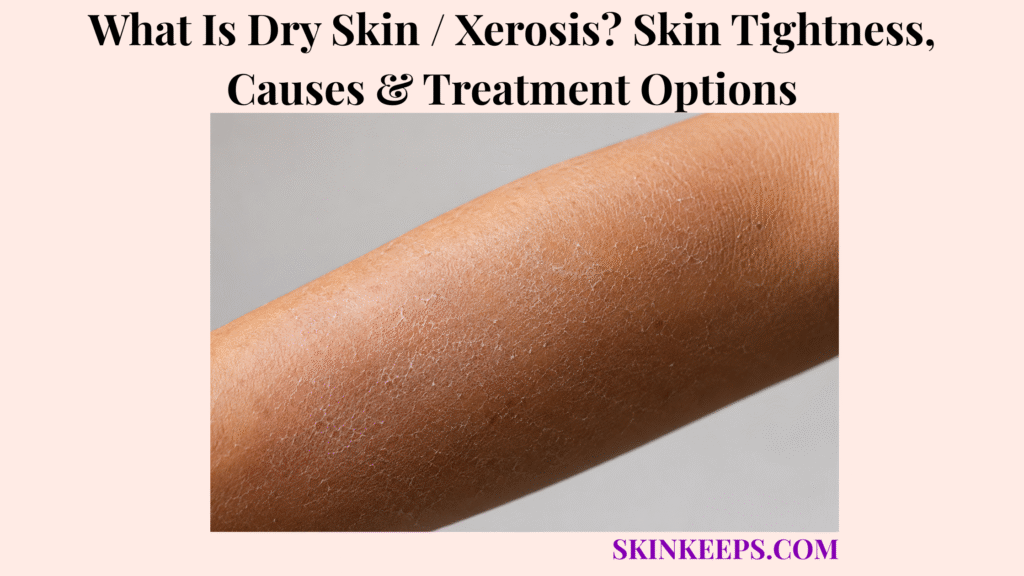
Dry skin, also called xerosis, happens when the outer skin layer loses too much moisture or lacks enough oil and water to stay smooth, flexible, and comfortable.
Dry skin is not dirty skin, and harsh scrubbing can make it worse. This page covers symptoms, locations, causes, risk factors, similar conditions, diagnosis, treatment, moisturizer selection, bathing habits, prevention, mistakes, and doctor-warning signs.
What Is Dry Skin / Xerosis and Why Does Skin Feel Tight?
Dry skin, also called xerosis, happens when the outer skin layer loses too much moisture or lacks enough oil and water to stay smooth, flexible, and comfortable.
Xerosis, xeroderma, and asteatosis are related terms for dry skin. The core issue is moisture loss and barrier disruption in the stratum corneum, the outer protective skin layer.
When this layer loses water and protective lipids, skin may feel tight after washing, look flaky or ashy, sting with products, itch, or crack.
Why Does Xerosis Affect the Skin Barrier?
Xerosis affects the skin barrier because the outer skin layer needs enough water and lipids to stay flexible, smooth, and protective.
When moisture is low, the surface becomes less flexible and more likely to flake, scale, or split.
Moisturizer helps support comfort by adding water, trapping water, smoothing rough scale, and reducing extra water loss.
Why Can Dry Skin Become Itchy or Cracked?
Dry skin can become itchy or cracked because low moisture makes the outer skin less flexible and easier to split.
Tiny cracks can sting, bleed, or allow irritants to enter.
Scratching can worsen barrier damage, and severe cracks can raise concern for irritation or infection when warmth, swelling, oozing, pus, or increasing pain appears.
Practical rule: Dry skin needs barrier repair, not harsh scrubbing, bleaching, or aggressive exfoliation.
What Dry Skin / Xerosis Symptoms Appear on Skin?
Dry skin can cause tightness, rough texture, scaling, flaking, itch, ashiness, cracks, peeling, redness, darker discoloration, lighter scale, or stinging.
Symptoms vary by body site, skin tone, season, washing habits, product exposure, and whether another skin disease is present.
What Does Mild Dry Skin Feel Like?
Mild dry skin often feels tight after washing and may look rough, dull, flaky, or ashy.
Fine scale may appear on legs, hands, elbows, knees, or the face.
Mild dryness usually has no bleeding, oozing, severe inflammation, pus, warmth, or deep painful cracks.
What Does Severe Xerosis Look Like?
Severe xerosis may cause deep cracks, bleeding, pain, severe itch, thick scaling, raw patches, or sleep disruption.
Cracks on fingertips, knuckles, heels, or shins may sting during washing or when moisturizer is applied.
Warmth, swelling, pus, oozing, crust, increasing pain, or fever should be checked because cracked skin can be confused with or complicated by infection.
How Can Dry Skin Look on Darker Skin?
On darker skin, dry skin may look ashy, gray-white, flaky, darker after irritation, or lighter on elbows, knees, legs, hands, and feet.
Redness may be subtle, so texture, fine scale, cracks, itch, stinging, and color contrast can be more useful clues.
Bleaching dry marks or scrubbing ashiness can worsen irritation and pigment change.
| Symptom | What User May Notice | Why It Matters |
|---|---|---|
| Tightness | Skin feels pulled after washing. | Moisture-loss clue. |
| Flaking | Fine white or gray scales. | Outer-layer dryness. |
| Roughness | Sandpaper-like texture. | Barrier dryness. |
| Itch | Scratching or sleep issues. | Barrier irritation. |
| Cracks | Painful splits. | Infection risk. |
| Bleeding / oozing | Open or weeping skin. | Needs medical review. |
| Ashiness | Gray-white scale on darker skin. | Skin-tone-aware dryness clue. |
Where Does Dry Skin Usually Appear?
Dry skin can appear anywhere, but it is often noticeable on the hands, legs, feet, elbows, knees, arms, face, lips, and areas exposed to water, soap, cold air, or friction.
Location helps identify triggers, but it does not diagnose the cause by itself.
Persistent scaling on the scalp with hair loss, ring-shaped scaling, thick plaques, or medication-linked rash should not be treated as simple dryness without review.
| Body Area | Common Dry-Skin Trigger | Care Note |
|---|---|---|
| Hands / knuckles | Washing, sanitizers, gloves, detergents. | Reapply cream after washing. |
| Fingertips | Wet work, soaps, cold air. | Use ointment for cracks. |
| Legs / shins | Low humidity, aging, winter air. | Use cream or ointment after bathing. |
| Feet / heels | Friction, pressure, thick skin. | Protect cracks; rule out fungus if scaling persists. |
| Elbows / knees | Friction and thicker skin. | Moisturize consistently; avoid harsh scrubbing. |
| Face | Weather, cleansing, acne products, retinoids. | Use gentle, noncomedogenic moisturizer if acne-prone. |
| Lips | Wind, licking, sun, irritants. | Use bland lip protection. |
What Causes Dry Skin / Xerosis?
Dry skin develops when water loss increases, skin oils are stripped away, humidity is low, the barrier is irritated, or another skin or medical condition disrupts the outer skin layer.
Dry skin is not caused by dirty skin. Too much cleansing, hot water, harsh soap, fragrance, and scrubbing can make the barrier weaker.
How Do Weather and Indoor Air Cause Dry Skin?
Weather and indoor air can cause dry skin when low humidity pulls moisture from the outer skin layer.
Cold air, dry seasons, indoor heating, air conditioning, and dry climates can all reduce skin comfort.
A humidifier may help selected homes when indoor air is dry, but moisturizer and gentle washing still matter.
How Do Hot Showers and Harsh Soaps Cause Dryness?
Hot showers and harsh soaps can cause dryness by stripping oils and disrupting barrier lipids.
Long hot showers, frequent handwashing, sanitizers, detergents, fragrance-heavy cleansers, and cleaning chemicals can worsen hand or body xerosis.
Wet-work routines may need gloves, gentle cleanser, and moisturizer reapplication after washing.
How Do Aging and Skin Conditions Cause Xerosis?
Aging and skin conditions can cause xerosis because oil production, barrier repair, and inflammation patterns change over time.
Older adults often have drier skin, and dryness may become more noticeable on shins, arms, hands, and feet.
Skin diseases can also create excessive dryness, including dermatitis or eczema, psoriasis, ichthyosis, seborrheic dermatitis, and contact dermatitis.
How Can Medicines or Health Conditions Cause Dry Skin?
Medicines and health conditions can cause or worsen dry skin, especially when dryness is generalized, severe, persistent, or linked with intense itch.
Cancer treatments, acne treatments, retinoids, exfoliants, kidney disease, diabetes, thyroid disease, liver disease, anemia, immune suppression, and some medicines may be relevant depending on the pattern.
Generalized severe itch, sudden new dryness, or dryness with systemic symptoms should not be managed as a cosmetic lotion problem.
| Cause | How It Dries Skin | Care Direction |
|---|---|---|
| Low humidity | Increases water loss. | Add humidity + moisturize. |
| Cold weather | Reduces environmental moisture. | Protect skin outdoors. |
| Indoor heating | Dries indoor air. | Moisturize more often. |
| Hot showers | Strip oils. | Use lukewarm, shorter washes. |
| Harsh soap | Removes barrier lipids. | Use mild cleanser. |
| Frequent washing | Repeated barrier stress. | Reapply moisturizer. |
| Aging | Less oil production. | Use richer moisturizer. |
| Skin disease | Inflammation and scaling. | Diagnose and treat. |
| Medication / health issue | Systemic or treatment-related dryness. | Medical review. |
Who Is More Likely to Develop Dry Skin / Xerosis?
Dry skin is more likely in older adults, people in dry or cold climates, people who wash frequently, people with eczema or psoriasis, and people taking certain medicines or receiving treatments that affect the skin.
Risk context helps guide prevention, but anyone can develop xerosis when the barrier is repeatedly dried or irritated.
Babies, children, older adults, people with diabetes, poor circulation, kidney disease, thyroid disease, immune suppression, cancer treatment, or severe generalized itch should be more cautious.
- Older age.
- Cold or dry climate.
- Indoor heating exposure.
- Frequent handwashing.
- Healthcare, cleaning, food-service, or childcare work.
- Harsh soaps or sanitizers.
- Eczema, psoriasis, ichthyosis, or seborrheic dermatitis.
- Acne treatments, retinoids, exfoliants, or cancer therapy.
- Kidney disease, diabetes, thyroid disease, or severe generalized itch.
- Baby or child with sensitive skin barrier.
How Is Dry Skin Different From Other Skin Conditions?
Dry skin can resemble eczema, psoriasis, ichthyosis, fungal rash, dandruff, contact dermatitis, scabies, and drug reactions, so pattern, itch, scale, location, and response to moisturizer matter.
The safer approach is to treat simple xerosis gently while checking for patterns that do not fit simple moisture loss.
How Is Dry Skin Different From Eczema?
Dry skin can feel tight and flaky, while eczema often adds inflammation, intense itch, recurring flares, cracks, oozing, or thickening.
Dry skin can trigger eczema flares, but eczema may need anti-inflammatory treatment, trigger reduction, and a longer care plan.
If dry, itchy patches keep flaring, cracking, or oozing, moisturizer alone may not be enough.
How Is Dry Skin Different From Psoriasis?
Psoriasis often causes well-defined thick plaques, while simple dry skin is usually more diffuse, fine, flaky, and linked with moisture loss.
Elbows, knees, scalp, nails, and lower back may be involved.
Persistent thick plaques should not be treated as ordinary dryness only.
How Is Dry Skin Different From Ichthyosis?
Ichthyosis causes chronic fish-scale-like scaling that often needs long-term management beyond ordinary dry-skin care.
It may start in childhood, run in families, or cover large areas.
Moisturizers can help comfort, but severe or lifelong scaling needs diagnosis and ongoing management.
How Is Dry Skin Different From Fungal Rash?
Fungal rash may look dry and flaky, but it often has ring-shaped borders, foot/groin involvement, spreading edges, or persistent itch that needs testing or antifungal treatment.
Dry cracked feet are not always simple xerosis; scaling between toes or on the soles can fit athlete’s foot.
Steroid creams can worsen some fungal infections, so persistent foot or ring-shaped scaling should be checked.
How Is Dry Skin Different From Contact Dermatitis?
Contact dermatitis follows product, chemical, glove, metal, fragrance, or workplace exposure and often matches the exposure area.
Allergic contact dermatitis can be triggered by products used to treat dryness, including fragrances, preservatives, topical antibiotics, or certain botanical ingredients.
Moisturizer alone may not fix dryness when an exposure trigger keeps irritating the skin.
| Condition | Main Clue | Why Confusion Happens | Safer Next Step |
|---|---|---|---|
| Dry skin / xerosis | Tight, rough, flaky skin. | Common and widespread. | Moisturize + habit changes. |
| Eczema | Itchy inflamed recurring rash. | Dryness overlap. | Anti-inflammatory plan if needed. |
| Psoriasis | Thick defined plaques. | Scale overlap. | Dermatology review. |
| Ichthyosis | Chronic fish-scale pattern. | Severe scaling. | Long-term management. |
| Fungal rash | Ring/scaly border or foot/groin pattern. | Flakes and itch overlap. | Scraping or antifungal if confirmed. |
| Contact dermatitis | Exposure-site rash. | Dry cracked skin overlap. | Trigger avoidance or patch testing. |
| Drug rash | Rash after medication change. | Itch/redness overlap. | Medication timeline review. |
A new dry-looking rash after a medicine change may fit drug rash rather than simple xerosis, especially if it is widespread, worsening, fever-associated, blistering, or linked with swelling.
How Is Dry Skin / Xerosis Diagnosed?
Dry skin is often diagnosed by looking at the skin and reviewing habits, products, weather exposure, symptoms, medicines, and medical history.
Simple xerosis may be clear from texture, flaking, location, and response to gentle care, but persistent or atypical dryness may need testing.
What Does a Clinician Check?
A clinician checks skin texture, scale, cracks, itch severity, bathing habits, cleanser use, moisturizer use, work exposure, medicines, and medical history.
They may ask whether dryness is localized or generalized, whether it started after new products or medicines, and whether there is eczema, psoriasis, ichthyosis, contact allergy, fungal infection, kidney disease, thyroid disease, diabetes, immune suppression, or cancer treatment history.
They also look for fissures, bleeding, infection signs, thick plaques, ring-shaped rash, scalp scaling with hair loss, or non-healing patches.
When Might Tests Be Needed?
Tests may be needed when dryness is persistent, severe, widespread, intensely itchy, treatment-resistant, atypical, infected-looking, or linked with a possible medical condition.
Testing may include skin scraping for fungus, patch testing for contact allergy, blood tests for thyroid, kidney, liver, diabetes, anemia, or other systemic causes, and biopsy if diagnosis is unclear.
Dermatology review helps when the pattern does not improve with consistent gentle care.
- When dryness started.
- Body areas affected.
- Photos of cracks, scale, or flares.
- Itch severity and sleep impact.
- Bathing temperature and shower length.
- Soap, cleanser, sanitizer, fragrance, and detergent use.
- Moisturizer type and how often it is applied.
- Work exposure to water, gloves, detergents, or chemicals.
- Acne treatments, retinoids, exfoliants, or topical medicines.
- New medicines or cancer treatments.
- History of eczema, psoriasis, ichthyosis, contact allergy, fungal infection, kidney disease, thyroid disease, diabetes, or immune suppression.
- Pain, bleeding, pus, warmth, swelling, oozing, or crust.
What Treatment Options Help Dry Skin / Xerosis?
Dry skin treatment usually starts with frequent moisturizer use, gentle cleansing, shorter lukewarm baths or showers, and avoiding products that strip or irritate the skin.
Treatment should match severity. A light lotion may be enough for mild dryness, while deep cracks often need thicker barrier protection and sometimes medical review.
Why Is Moisturizer the Main Treatment?
Moisturizer is the main treatment for dry skin because it helps add water, trap water, smooth the outer skin layer, and reduce tightness.
Apply moisturizer after washing while skin is slightly damp, then reapply whenever the skin feels dry.
Hands, heels, shins, and cracked areas often need thicker cream or ointment instead of a thin lotion alone.
Which Moisturizer Ingredients Can Help?
Helpful moisturizer ingredients may include humectants that pull in water, emollients that soften rough skin, and occlusives that seal moisture in.
Humectants include glycerin, hyaluronic acid, urea, and lactic acid. Emollients include ceramides, fatty acids, and oils. Occlusives include petrolatum, dimethicone, and mineral oil.
Urea or lactic acid can sting on cracked or inflamed skin, so raw fissures often need bland barrier repair first.
When Are Prescription Treatments Needed?
Prescription treatments may be needed when dryness is inflamed, itchy, cracked, infected-looking, linked with another skin disease, or not improving with consistent gentle care.
Prescription creams, ointments, anti-inflammatory medicines, antifungals, antibiotics, or other treatments depend on the diagnosis.
Antifungals should fit suspected or confirmed fungus, and antibiotics should fit bacterial infection rather than ordinary dryness.
| Dry-Skin Situation | Treatment Direction | Key Caution |
|---|---|---|
| Mild dryness | Moisturizer + gentle cleanser. | Avoid over-scrubbing. |
| Very dry skin | Thick cream or ointment. | Apply often. |
| Cracked skin | Ointment barrier + protection. | Watch infection signs. |
| Itchy inflamed rash | Diagnose eczema/contact dermatitis. | May need prescription. |
| Thick scaling | Keratolytic moisturizer if appropriate. | Can sting if cracked. |
| Foot scaling | Rule out fungus if persistent. | Steroids can worsen fungus. |
| Systemic/medication-related dryness | Treat underlying cause. | Medical review. |
How Should You Choose a Moisturizer for Dry Skin?
The best moisturizer for dry skin is usually fragrance-free, comfortable to use, and thick enough to keep the skin from feeling tight again shortly after application.
There is no single best moisturizer for everyone. The best choice depends on severity, body site, skin sensitivity, acne tendency, cracks, and daily routine.
When Should You Use Lotion, Cream, or Ointment?
Lotion may be enough for mild dryness, cream often fits moderate dryness, and ointment is usually more useful for severe dryness, cracks, hands, heels, or overnight barrier protection.
Lotions feel lighter and are easier for daytime use. Creams are richer and often fit body dryness. Ointments can feel greasy but seal moisture well.
Acne-prone facial skin may need noncomedogenic or oil-free moisturizer rather than heavy occlusive products.
What Labels Are Safer for Sensitive Skin?
Sensitive or cracked skin usually does better with fragrance-free, dye-free, low-irritant moisturizers.
“Hypoallergenic” can help, but it is not a guarantee.
Avoid perfume-heavy products, strong essential oils, harsh acids, and “natural” products used as a safety promise on raw, cracked, or eczema-prone skin.
| Need | Better Option | Avoid |
|---|---|---|
| Mild dryness | Lotion or light cream. | Fragranced body sprays. |
| Moderate dryness | Cream. | Daily harsh exfoliating lotion. |
| Severe cracks | Ointment or petrolatum-type barrier. | Stinging acids on open cracks. |
| Acne-prone face | Noncomedogenic moisturizer. | Heavy pore-clogging products. |
| Sensitive skin | Fragrance-free cream. | Essential oils or perfume. |
| Hands / heels | Thick cream or ointment. | Light lotion only if cracks persist. |
What Bathing and Cleansing Habits Help Dry Skin?
Bathing habits can make dry skin better or worse, so use lukewarm water, wash gently, and moisturize immediately after drying.
Long hot showers and harsh soaps can strip oils from the barrier. The goal is clean skin without over-stripping the protective surface.
Use gentle cleanser, pat dry instead of rubbing, apply fragrance-free moisturizer immediately, reapply after handwashing, and use gloves for wet work or cleaning chemicals.
- Use lukewarm water.
- Keep showers or baths shorter.
- Use gentle cleanser instead of harsh soap.
- Avoid aggressive scrubbing.
- Pat dry instead of rubbing.
- Apply fragrance-free moisturizer immediately.
- Reapply moisturizer after handwashing.
- Use gloves for wet work or cleaning chemicals.
How Can Dry Skin / Xerosis Be Prevented?
Dry skin can often be reduced by protecting the skin barrier before it becomes cracked, itchy, or inflamed.
Prevention is daily and practical: moisturize after bathing, reduce barrier-stripping habits, protect hands, and treat underlying skin disease correctly.
Sunburn can also lead to peeling, so sun protection matters for exposed skin.
- Moisturize daily.
- Moisturize immediately after bathing.
- Use fragrance-free cleanser.
- Reduce long hot showers.
- Use gloves for wet work.
- Protect skin in cold weather.
- Add humidity if indoor air is dry.
- Avoid harsh scrubs and frequent exfoliation.
- Treat underlying eczema, psoriasis, fungus, or contact allergy correctly.
What Dry Skin Treatment Mistakes Should You Avoid?
The biggest dry skin mistake is scrubbing or exfoliating harder when the skin actually needs moisture and barrier repair.
Do not scrub flakes until skin is red, take long hot showers for “cleaner” skin, use fragranced soaps on cracked skin, peel cracks, or apply strong acids and retinoids to raw fissures.
Do not treat every scaly rash as dryness without ruling out eczema, psoriasis, fungus, contact dermatitis, scabies, or medication-related rash when the pattern does not fit simple xerosis.
| Mistake | Why It Fails | Better Action |
|---|---|---|
| Harsh scrubbing | Damages barrier. | Moisturize and soften. |
| Long hot showers | Strip oils. | Lukewarm, shorter baths. |
| Fragranced products | Irritate cracked skin. | Fragrance-free formulas. |
| Light lotion only | May not seal severe dryness. | Cream or ointment. |
| Picking cracks | Delays healing and raises infection risk. | Protect with ointment. |
| Stinging acids on raw skin | More irritation. | Repair barrier first. |
| Ignoring persistent scaling | Misses eczema, psoriasis, fungus, or contact allergy. | Diagnose persistent rash. |
When Should Dry Skin Be Checked by a Doctor?
Dry skin should be checked when it is severe, persistent, painful, bleeding, infected-looking, widespread, sleep-disrupting, or not improving after consistent gentle care.
Medical review is also important when dryness may reflect another skin disease, medication effect, cancer treatment, or systemic health condition.
Which Skin Signs Need Medical Review?
Medical review is needed for deep cracks, bleeding, pain, severe itch, oozing, pus, warmth, swelling, crust, widespread scaling, thick plaques, ring-shaped rash, blisters, non-healing patches, sudden severe dryness, medication-linked rash, or scalp scaling with hair loss.
Warm painful spreading skin can suggest infection such as cellulitis rather than simple dryness.
Dryness that keeps returning despite correct care should be reassessed instead of treated with stronger scrubs.
Which People Should Be More Cautious?
Babies, older adults, people with diabetes, poor circulation, kidney disease, thyroid disease, immune suppression, cancer treatment, eczema, psoriasis, occupational hand dermatitis, or severe itch without visible rash should be more cautious.
These groups may need earlier evaluation because cracks, infection, medication effects, and systemic causes can be more important.
Severe generalized itch without obvious rash should also be discussed with a clinician.
Seek medical review if dry skin is:
- Persistent despite consistent gentle care.
- Painful.
- Bleeding or deeply cracked.
- Oozing, pus-filled, warm, swollen, or crusted.
- Widespread or rapidly worsening.
- Sleep-disrupting because of itch.
- Thick-plaque-like.
- Ring-shaped.
- Blistering.
- Non-healing.
- Linked with a new medicine.
- On scalp with hair loss.
- Present with diabetes, poor circulation, kidney disease, thyroid disease, immune suppression, cancer treatment, or severe generalized itch.
What Should You Remember About Dry Skin / Xerosis?
Dry skin / xerosis is moisture loss in the outer skin barrier, so treatment should focus on restoring moisture, protecting the barrier, and checking for underlying causes when dryness is severe or persistent.
The safest plan is gentle: reduce barrier-stripping triggers, moisturize correctly, use cream or ointment when dryness is severe, and get medical review for cracks, infection signs, severe itch, or atypical scaling.
- Xerosis means dry skin.
- Dry skin can feel tight, rough, flaky, itchy, cracked, or sore.
- Common triggers include low humidity, hot showers, harsh soaps, aging, frequent washing, and skin conditions.
- Moisturizers are the main treatment.
- Light lotion may not be enough for severe dryness.
- Creams and ointments usually help more than thin lotions for severe dryness.
- Apply moisturizer after bathing and whenever skin feels dry.
- Use lukewarm water and gentle cleanser.
- Avoid harsh scrubbing, fragrance, and strong exfoliation on cracked skin.
- Protect hands from wet work and cleaning chemicals.
- Persistent, painful, cracked, bleeding, infected-looking, or widespread dryness needs medical review.
Frequently Asked Questions About Dry Skin / Xerosis
Is xerosis the same as dry skin?
Yes. Xerosis is the medical term for dry skin; xeroderma and asteatosis are related terms used for dry or low-oil skin.
What does dry skin feel like?
Dry skin can feel tight, rough, itchy, flaky, scaly, peeling, cracked, stinging, sore, or painful. Severe dryness can crack and bleed.
What causes dry skin?
Dry skin can be caused by low humidity, cold weather, indoor heating, long hot showers, harsh soaps, frequent washing, aging, skin conditions, medications, cancer treatments, diabetes, thyroid disease, kidney disease, and other health problems when relevant.
What is the best treatment for dry skin?
Most dry skin care starts with frequent moisturizer use, gentle cleansers, shorter lukewarm showers, avoiding irritants, and treating underlying conditions when present. No single moisturizer is best for everyone.
Should I exfoliate dry flaky skin?
Not aggressively. Dry flaky skin often needs moisturizer and barrier repair first; harsh exfoliation can worsen cracks, irritation, and barrier damage.
What moisturizer is best for xerosis?
Fragrance-free creams or ointments often fit moderate-to-severe dryness, while lighter lotions may work for mild dryness. Acne-prone facial skin may need noncomedogenic or oil-free products.
Why is my skin still dry after lotion?
The lotion may be too light, showers may be too hot or long, soap may be harsh, moisturizer may not be applied often enough, or an underlying rash or medical condition may be present.
When should dry skin be checked?
Dry skin should be checked when there is severe itch, pain, bleeding cracks, oozing, warmth, swelling, pus, widespread scaling, thick plaques, ring-shaped rash, sleep disruption, non-healing patches, medication changes, or dryness linked with diabetes, kidney disease, thyroid disease, cancer treatment, immune suppression, or poor circulation.
Sources & Evidence About Dry Skin / Xerosis
DermNet — Dry Skin was used for xerosis, xeroderma, and asteatosis terminology; outer horny layer moisture-loss framing; cracks; complications; and emollient treatment context.
American Academy of Dermatology — Dry Skin Overview was used for low humidity, underlying medical conditions, cancer-treatment-related dry or thickened skin, and excessively dry skin context.
American Academy of Dermatology — Dry Skin Diagnosis and Treatment was used for dermatologist-selected moisturizers, treatment plans, and excessive-dryness management context.
American Academy of Dermatology — Dermatologists’ Tips for Relieving Dry Skin was used for patting skin dry, immediately applying fragrance-free moisturizer after bathing, cream/ointment use, and dermatologist review when dry skin persists.
Mayo Clinic — Dry Skin Symptoms and Causes was used for tightness, roughness, itching, flaking, scaling, peeling, cracks, color changes, and causes including hot water, scrubbing, and cancer-treatment-related dryness.
Mayo Clinic — Dry Skin Diagnosis and Treatment was used for moisturizers, avoiding long hot showers or baths, thicker moisturizers, cleansing cream or shower gel instead of soap, testing for medical causes, and prescription treatment for serious skin disease.
Cleveland Clinic — Dry Skin / Xeroderma was used for xeroderma and xerosis overview, dry-skin symptoms, causes, moisturizing treatment categories, and testing when an underlying condition is possible.
Educational Disclaimer: This SkinKeeps article is for educational purposes only and does not diagnose or replace medical care. Dry, tight, flaky, ashy, rough, cracked, painful, bleeding, itchy, oozing, crusted, warm, swollen, pus-filled, widespread, thick-plaque-like, ring-shaped, blistering, non-healing, scalp-hair-loss-associated, medication-associated, cancer-treatment-associated, diabetes-associated, kidney-disease-associated, thyroid-disease-associated, immune-suppression-associated, poor-circulation-associated, or sleep-disrupting skin symptoms should be checked by a qualified healthcare professional. Do not use harsh scrubs, strong exfoliating acids, retinoids, bleaching products, fragranced products, home acids, leftover steroid creams, antibiotics, or antifungals on severe or unclear dry skin without appropriate medical guidance.