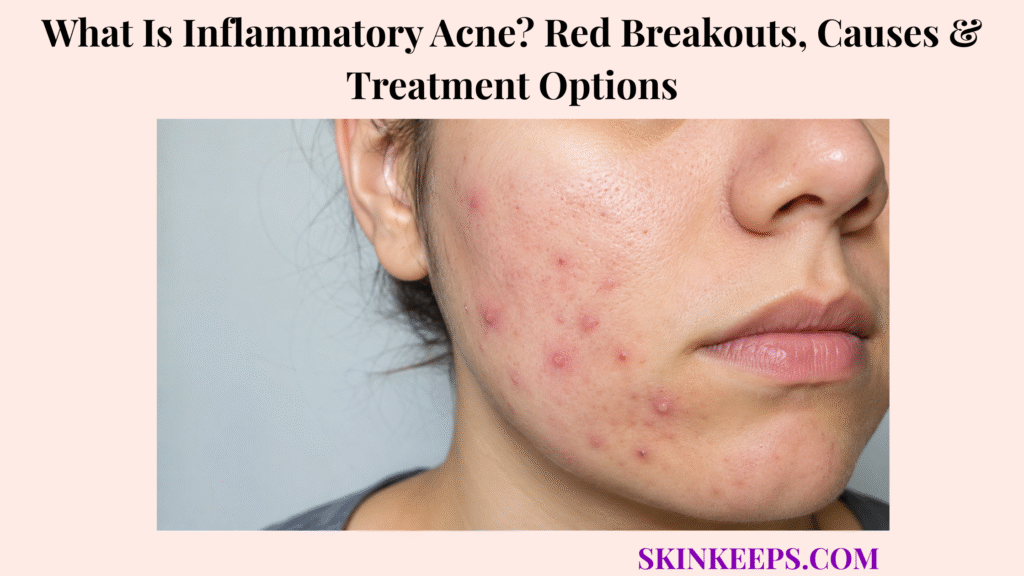
Inflammatory acne is acne that produces swollen, discoloured and sometimes painful papules, pustules, nodules or cysts. Superficial lesions form closer to the skin surface, while nodules and cysts develop deeper and carry a greater risk of permanent scars.
It commonly affects the face, jawline, chest, shoulders and back and often occurs beside blackheads or whiteheads. Treatment usually combines medicines that unblock follicles, reduce inflammation, limit C. acnes activity and prevent relapse while protecting the skin barrier.
How Can You Recognize Inflammatory Acne?
Inflammatory acne usually appears as swollen follicular bumps that may feel tender, painful or warm.
- Raised red, pink, purple, brown-red or skin-coloured bumps.
- Papules without visible pus.
- Pustules with a white or yellow pus-filled centre.
- Deep tender lumps beneath the surface.
- Several lesion types together.
- Blackheads or whiteheads near inflamed lesions.
- Recurrent breakouts in oil-producing areas.
- Flat red, brown or purple marks after lesions settle.
- Depressed or raised scars after deeper disease.
Inflammatory acne is one active lesion group within broader acne vulgaris.
Figure 1. Inflammatory acne includes superficial papules and pustules plus deeper nodules and cysts. It commonly affects the face, chest, shoulders and back, and inflammation may appear pink, red, purple, brown-red or mainly as palpable swelling.
Which Lesions Are Considered Inflammatory Acne?
Inflammatory acne lesions include papules, pustules, nodules and acne cysts.
What Are Acne Papules?
Papules are small solid inflamed bumps without visible pus. They develop when a blocked follicle becomes inflamed and may feel tender.
What Are Acne Pustules?
Pustules are inflamed bumps with a white or yellow pus-filled centre surrounded by red, brown-red, purple or swollen skin.
What Are Acne Nodules?
Nodules are large firm lesions that develop deep in the skin, remain painful for longer and carry a high scar risk.
What Are Acne Cysts?
Acne cysts are deep inflamed lesions containing pus. They are often softer than nodules, slow to heal and likely to leave scars or pigment changes.
Where Does Inflammatory Acne Usually Develop?
Inflammatory acne develops where sebaceous follicles are concentrated, especially on the face and upper trunk.
| Location | Useful Pattern Clue |
|---|---|
| Forehead and hairline | Hair products, sweat and occlusion may aggravate lesions |
| Cheeks and nose | Mixed comedones and inflammatory lesions common |
| Chin and jawline | Menstrual or androgen-pattern flares may cluster here |
| Neck | Friction and shaving may complicate assessment |
| Chest and shoulders | Sweat, clothing and sports equipment can aggravate acne |
| Upper back and arms | Truncal acne and folliculitis should be separated |
Acne does not develop on palms or soles because these sites lack sebaceous follicles.
How Can Inflammatory Acne Look Across Different Skin Tones?
Inflammatory acne may appear pink, red, purple, brown-red, dark-brown, grey-purple or mainly as skin-coloured swelling.
- Inflammation can be easier to feel than see.
- Brown, purple or blue-grey marks can remain after healing.
- Post-inflammatory pigmentation can outlast active lesions.
- Temporary lighter marks may follow inflammation or irritation.
- Raised or depressed scars alter texture rather than colour alone.
Some healed lesions leave temporary lighter patches, which should be separated from broader hypopigmentation disorders.
How Does Inflammatory Acne Develop Inside a Hair Follicle?
Inflammatory acne develops when a blocked sebaceous follicle becomes inflamed.
- Sebaceous glands produce sebum.
- Follicular cells fail to shed normally.
- Sebum and retained cells form a microcomedone.
- The follicular opening becomes blocked.
- C. acnes activity increases in the oil-rich space.
- Microbial products and follicular material activate immunity.
- Superficial inflammation forms papules or pustules.
- Deeper follicular rupture forms nodules, cysts and scars.
Figure 2. Inflammatory acne develops through follicular blockage, sebum retention, C. acnes activity and immune inflammation. Comedones and mixed lesions support acne, while uniform itchy hair-centred bumps, flushing or mouth-centred papules suggest a mimic.
What Causes Inflammatory Acne?
Inflammatory acne results from interacting follicular, hormonal, microbial and immune processes rather than inadequate cleansing.
| Core Process | How It Contributes |
|---|---|
| Increased sebum | Creates an oil-rich follicular environment |
| Abnormal keratinization | Forms microcomedones and blocked follicles |
| C. acnes activity | Contributes microbial signals within the follicle |
| Immune inflammation | Produces swelling, tenderness and tissue injury |
| Hormonal and genetic susceptibility | Influences sebum, lesion pattern and severity |
Inflammatory acne is not contagious and is not simply a skin infection.
How Do Hormones Influence Inflammatory Acne?
Hormones can increase sebaceous-gland activity and create jawline, menstrual or adult flare patterns.
- Androgens increase sebum production.
- Puberty increases sebaceous activity.
- Menstrual changes can precede flares.
- Pregnancy may improve or worsen acne.
- PCOS may occur with irregular periods or excess hair.
- Testosterone or anabolic steroids can cause severe breakouts.
- Lower-face and jawline acne may follow an androgen pattern.
Acne with irregular periods and excess facial or body hair may occur with hirsutism and should prompt endocrine-pattern questions.
Velvety neck or fold darkening may suggest acanthosis nigricans, supporting evaluation for insulin resistance or PCOS when acne is also present.
Which Factors Can Trigger or Worsen Inflammatory Acne?
Aggravators vary between individuals, so repeated personal patterns matter more than universal restrictions.
- Picking and squeezing.
- Tight masks, helmets, straps or sports padding.
- Sweaty clothing and repeated friction.
- Oily hair products and comedogenic cosmetics.
- Menstrual changes.
- Stress and poor sleep.
- High-glycaemic eating patterns in selected people.
- Whey-protein supplements in some patients.
- Inconsistent treatment.
A trigger diary can identify repeatable patterns without blaming every food, product or stressful event.
Which Medicines Can Cause Acne-Like Inflammatory Breakouts?
Some medicines cause sudden uniform acneiform eruptions with few comedones.
- Systemic corticosteroids.
- Testosterone and anabolic steroids.
- Lithium.
- Selected anticonvulsants.
- Isoniazid.
- EGFR inhibitors and other targeted cancer medicines.
- JAK inhibitors.
- Selected hormonal medicines.
A close timeline between medicine exposure and eruption supports the diagnosis. Essential treatment should not be stopped without the prescriber.
How Is Inflammatory Acne Different From Non-Inflammatory Acne?
Inflammatory acne is swollen or tender, while non-inflammatory acne consists of blocked pores without prominent clinical inflammation.
Open comedones such as blackheads lack the same swelling, tenderness and pus seen in inflammatory acne.
| Feature | Inflammatory Acne | Non-Inflammatory Acne |
|---|---|---|
| Lesions | Papules, pustules, nodules and cysts | Blackheads and whiteheads |
| Swelling | Present | Minimal |
| Pain | Possible to marked | Usually limited |
| Scar risk | Higher with deep lesions | Generally lower |
| Shared treatment | Retinoids help prevent new blocked follicles | Retinoids target comedones directly |
How Is Inflammatory Acne Different From Folliculitis?
Inflammatory acne usually has mixed lesion types and comedones, while folliculitis produces uniform hair-centred bumps.
Uniform hair-centred pustules may suggest folliculitis, especially when itching is stronger than pain and comedones are absent.
| Feature | Inflammatory Acne | Folliculitis |
|---|---|---|
| Lesion mix | Comedones, papules, pustules, nodules | Uniform papules or pustules |
| Follicular centre | Not always visibly hair-centred | Commonly centred on a hair |
| Itch | Often mild | Can dominate |
| Comedones | Common | Usually absent |
| Causes | Acne follicular pathway | Bacteria, yeast, friction or medicines |
How Is Inflammatory Acne Different From Malassezia Folliculitis?
Malassezia folliculitis is a yeast-associated follicular disorder rather than acne vulgaris.
| Feature | Inflammatory Acne | Malassezia Folliculitis |
|---|---|---|
| Lesions | Mixed size and type | Numerous similar itchy bumps |
| Comedones | Often present | Usually absent |
| Itch | Often limited | Often prominent |
| Sites | Face and trunk | Chest, back, shoulders and hairline |
| Treatment | Acne regimen | Antifungal treatment when confirmed |
How Is Inflammatory Acne Different From Rosacea?
Inflammatory acne commonly includes comedones, while papulopustular rosacea usually has central facial redness, flushing and no comedones.
| Feature | Inflammatory Acne | Papulopustular Rosacea |
|---|---|---|
| Comedones | Common | Absent |
| Distribution | Face and trunk | Central face |
| Background change | Follicular breakouts | Flushing and persistent redness |
| Visible vessels | Not typical | Possible |
| Burning or eye symptoms | Less typical | Can occur |
How Is Inflammatory Acne Different From Perioral Dermatitis?
Perioral dermatitis usually forms similar small bumps around the mouth and may worsen with topical corticosteroids.
| Feature | Inflammatory Acne | Perioral Dermatitis |
|---|---|---|
| Lesions | Mixed comedones and inflamed lesions | Small similar papules |
| Distribution | Broad face or trunk | Mouth, nose or eye area |
| Lip border | No specific sparing | Often spared immediately beside lip |
| Symptoms | Tenderness possible | Burning or tightness |
| Steroid relationship | Not a treatment | Can trigger or worsen |
How Is Inflammatory Acne Severity Assessed?
Severity depends on lesion depth, body area, pain, scars, pigment change and psychosocial burden.
| Practical Level | Typical Pattern |
|---|---|
| Mild | Limited papules and pustules with a few comedones |
| Moderate | Numerous inflammatory lesions or wider face/trunk involvement |
| Severe | Multiple deep nodules or cysts, extensive inflammation, scars or major burden |
- Count papules, pustules, nodules and cysts.
- Assess face and trunk.
- Record pain, scars and pigment changes.
- Review previous treatment failure.
- Ask about school, work, relationships, anxiety and low mood.
How Do Clinicians Diagnose Inflammatory Acne?
Diagnosis is usually clinical and based on lesion types, distribution, severity, scarring and possible mimics.
- Age and duration.
- Comedones, papules, pustules, nodules and cysts.
- Facial and truncal distribution.
- Menstrual and pregnancy history.
- Medicines and supplements.
- Skin, hair and cosmetic products.
- Previous treatments.
- Family history of severe acne or scars.
- Pigment and psychosocial effects.
When Are Hormone Tests, Cultures or Skin Biopsy Needed?
Testing is reserved for a specific hormonal, infectious, medication-related or atypical diagnostic question.
| Test Direction | When It May Help |
|---|---|
| Hormonal assessment | Irregular periods, hirsutism, scalp thinning, fertility difficulty or virilization |
| Bacterial culture | Uniform pustules, severe infection concern, gram-negative eruption or atypical failure |
| Skin biopsy | Persistent unusual lesions, ulceration or another inflammatory/neoplastic condition |
| Pregnancy assessment | Before pregnancy-incompatible therapy |
| Medication review | Sudden uniform trunk-dominant eruption after a new drug |
Does Inflammatory Acne Require Treatment?
Persistent inflammatory acne should be treated because ongoing inflammation increases pain, pigment change and scar risk.
- A few superficial lesions may respond to non-prescription care.
- Persistent papules and pustules need active treatment.
- Deep nodules and cysts require earlier assessment.
- Early control reduces new lesions and inflammation duration.
- Treatment can lower scar and colour-change risk.
- Maintenance may be needed after control.
Which Daily Skin-Care Routine Supports Inflammatory Acne Treatment?
A useful routine treats the whole acne-prone area while protecting the barrier.
| Time | Routine |
|---|---|
| Morning | Gentle cleanser, prescribed morning active, non-comedogenic moisturizer and broad-spectrum sunscreen |
| Evening | Gentle makeup removal, cleanser, prescribed retinoid or combination medicine and moisturizer |
| After sweating | Rinse or cleanse gently and change wet tight clothing |
| Daily product choices | Oil-free or non-comedogenic products; keep oily hair products away from acne-prone skin |
Avoid abrasive brushes, frequent washing and starting several strong products simultaneously.
How Does Benzoyl Peroxide Treat Inflammatory Acne?
Benzoyl peroxide reduces C. acnes activity, inflammatory lesions and antibiotic-resistance pressure.
- Reduces follicular bacterial activity.
- Helps papules and pustules.
- Has mild comedolytic activity.
- Does not create bacterial resistance.
- Can combine with topical retinoids.
- Should accompany topical or oral antibiotics.
Possible effects include dryness, peeling, burning and irritant dermatitis. It can bleach clothing, towels and bedding but does not biologically bleach skin.
How Do Topical Retinoids Treat Inflammatory Acne?
Topical retinoids prevent the microcomedones that precede inflammatory lesions.
- Adapalene, tretinoin, tazarotene and trifarotene are examples.
- They normalize follicular cell shedding.
- They clear and prevent comedones.
- They reduce inflammatory signalling.
- They support long-term maintenance.
- They can improve selected residual dark marks.
Introduce gradually with moisturizer and sunscreen because early dryness, peeling or burning can occur.
How Are Topical Antibiotics Used Without Promoting Resistance?
Topical antibiotics should be short-term combination therapy rather than indefinite monotherapy.
- Clindamycin is a common option.
- Combine with benzoyl peroxide.
- Use for a defined period.
- Continue a non-antibiotic preventive treatment.
- Avoid repeated unsupervised courses.
- Avoid combining a separate topical antibiotic with an oral antibiotic.
- Reassess if improvement stops.
How Do Azelaic Acid and Salicylic Acid Help Inflammatory Acne?
Azelaic and salicylic acid support acne care through different mechanisms.
| Ingredient | Main Role | Limit |
|---|---|---|
| Azelaic acid | Reduces follicular blockage, inflammation and residual pigmentation | May sting early |
| Salicylic acid | Loosens retained cells within oily follicles | Can irritate when combined with several exfoliants |
| Both | May support mild inflammatory acne | Do not replace severity-matched care |
How Does Clascoterone Treat Inflammatory Acne?
Clascoterone is a topical androgen-receptor inhibitor for eligible acne patients aged 12 years and older.
- Reduces local androgen signalling in sebaceous units.
- Provides a non-antibiotic topical option.
- Can treat inflammatory and non-inflammatory lesions.
- May combine with other acne treatments.
- Can cause local redness, dryness, itching or burning.
- Pregnancy and breastfeeding suitability need review.
When Are Oral Antibiotics Used for Inflammatory Acne?
Oral antibiotics are used for moderate-to-severe inflammatory acne when topical care alone is insufficient.
- Numerous papules and pustules.
- Face and trunk involvement.
- Developing nodules or scars.
- Failure of adequate topical treatment.
- Need for faster inflammatory control while topicals begin working.
- Doxycycline, minocycline and sarecycline are guideline-supported options.
Limit exposure, combine with benzoyl peroxide and another non-antibiotic topical treatment, then transition to maintenance.
When Can Hormonal Treatment Help Inflammatory Acne?
Hormonal treatment can help selected patients with menstrual, jawline, adult or PCOS-pattern inflammatory acne.
| Option | Potential Fit | Safety Review |
|---|---|---|
| Combined oral contraceptive | Menstrual flares or long-term androgen control | Clotting, migraine, blood pressure and smoking risks |
| Spironolactone | Jawline, adult or persistent androgen-pattern acne | Pregnancy avoidance, dizziness, menstrual effects and selected kidney/potassium review |
When Is Isotretinoin Used for Inflammatory Acne?
Isotretinoin is considered for severe, scarring, high-burden or treatment-resistant inflammatory acne.
- Severe nodular or cystic disease.
- Permanent scars developing.
- Substantial psychosocial burden.
- Failure of adequate topical and oral therapy.
- Rapid relapse after other treatment.
- Marked truncal involvement or persistent deep lesions.
It reduces sebaceous activity, sebum, follicular plugging, C. acnes activity and inflammation.
Which Safety Measures Are Required With Isotretinoin?
Isotretinoin requires strict pregnancy prevention, medicine review, laboratory monitoring and adverse-symptom assessment.
- Contraindicated during pregnancy because of severe embryo-fetal toxicity.
- U.S. prescribing and dispensing use the iPLEDGE REMS.
- Baseline fasting lipid profile and liver-function tests are required under current U.S. labelling.
- Dry lips, skin and eyes are common.
- Avoid vitamin A supplements and tetracycline combinations.
- Severe headache, visual change or major mood symptoms need prompt review.
- Blood donation restrictions follow the product and local guidance.
When Are Corticosteroid Injections Used for Deep Acne Lesions?
Intralesional corticosteroid injections may rapidly reduce one large painful nodule or cyst but do not prevent acne elsewhere.
- Used for a selected individual deep lesion.
- Can reduce pain and pressure quickly.
- May lower short-term tissue injury.
- Possible risks include indentation, thinning, visible vessels and colour change.
Can Light, Laser or Chemical Procedures Treat Active Inflammatory Acne?
Procedures may help selected patients but rarely replace preventive topical and systemic treatment.
- Selected light-based therapy.
- Photodynamic therapy.
- Chemical peels.
- Comedone extraction.
- Drainage of selected cysts.
- Intralesional corticosteroid injection.
Results vary, irritation can worsen pigment changes, and scar procedures usually wait until active inflammation is controlled.
How Is Truncal Inflammatory Acne Treated?
Truncal acne requires larger-area treatment and friction control for the chest, shoulders and back.
- Benzoyl-peroxide wash.
- A topical retinoid suitable for trunk use.
- Non-comedogenic body moisturizer.
- Oral therapy for extensive inflammation.
- Treatment of acne-prone areas, not only visible lesions.
- Showering after heavy sweating.
- Changing tight or wet clothing.
- Reducing backpack and sports-equipment pressure.
- Checking for bacterial or Malassezia folliculitis.
How Is Inflammatory Acne Treated During Pregnancy?
Pregnancy care excludes medicines that can harm the fetus while preserving safe control.
- Review every prescription and non-prescription product.
- Avoid oral isotretinoin.
- Avoid topical retinoids.
- Avoid spironolactone.
- Review tetracycline-class antibiotics by pregnancy stage.
- Consider benzoyl peroxide or azelaic acid when clinically appropriate.
- Use selected topical antibiotics only when indicated and combined appropriately.
- Coordinate oral treatment with obstetric and dermatologic clinicians.
How Should Inflammatory Acne Be Managed in Adolescents?
Adolescent acne should be treated early enough to reduce scars while keeping the routine simple and realistic.
- Assess lesion depth rather than dismissing acne as ordinary puberty.
- Check the face and trunk.
- Ask about pain and scars.
- Use a small number of clear daily steps.
- Explain the gradual response timeline.
- Address hair products, sports equipment and picking.
- Ask about bullying, avoidance and mood.
- Escalate deep or scarring disease promptly.
How Can Dark Marks and Scars Be Prevented?
Early inflammation control and avoiding picking are the strongest scar-prevention steps.
Flat brown, purple or grey marks after acne are often hyperpigmentation, not true scars.
| After-Acne Change | What It Means |
|---|---|
| Flat pink or red mark | Post-inflammatory erythema |
| Flat brown, purple or grey mark | Post-inflammatory hyperpigmentation |
| Flat lighter patch | Post-inflammatory hypopigmentation |
| Depressed surface | Atrophic scar |
| Raised firm tissue | Hypertrophic or keloid scar |
- Treat inflammatory lesions early.
- Do not pick, squeeze or scratch.
- Use sunscreen consistently.
- Reduce treatment irritation.
- Control active acne before major scar procedures.
- Refer deep nodular acne before scars accumulate.
Which Inflammatory Acne Treatment Mistakes Should Be Avoided?
Aggressive skin care, antibiotic misuse and delayed escalation can worsen inflammation or scars.
| Mistake | Why It Fails | Potential Harm | Safer Action |
|---|---|---|---|
| Squeeze lesions | Pushes inflammation deeper | Scars and pigment change | Leave lesions untouched |
| Abrasive scrubbing | Damages the barrier | Irritation and worsening acne | Use fingertips and gentle cleanser |
| Start many strong products | Irritation accumulates | Dermatitis and poor adherence | Introduce gradually |
| Topical antibiotic alone | Does not prevent blockage and drives resistance | Relapse and resistance | Combine with benzoyl peroxide |
| Continue oral antibiotic indefinitely | Creates unnecessary exposure | Resistance and adverse effects | Use a planned course |
| Apply topical steroid | Can trigger acneiform or perioral eruptions | Worsening facial rash | Confirm the diagnosis |
| Stop after a few days | Acne responds over weeks | Apparent failure | Complete the planned course |
| Use unmonitored isotretinoin | Misses pregnancy and laboratory safeguards | Severe fetal or medical harm | Use specialist monitoring |
How Long Does Inflammatory Acne Take to Improve?
Inflammatory acne improves over weeks rather than days.
- Early irritation may require routine adjustment.
- Positive effects often take 6 to 8 weeks to become noticeable.
- First-line treatment is generally assessed after 12 weeks.
- Deep nodules can flatten more slowly.
- Pigment marks can remain after active lesions resolve.
- Scars do not disappear when breakouts clear.
- Consistency is more useful than frequent product switching.
Why Is Maintenance Treatment Needed After Inflammatory Acne Clears?
Maintenance prevents acne-prone follicles from becoming blocked again after inflammation settles.
- Oral antibiotics should not be maintenance therapy.
- Topical retinoids prevent new microcomedones.
- Benzoyl peroxide supports non-antibiotic control.
- Retinoid–benzoyl-peroxide combinations may suit recurrent acne.
- Azelaic acid can support acne and residual pigmentation.
- Stable control may allow lower treatment intensity.
- New nodules or scars require reassessment.
When Should Inflammatory Acne Be Checked by a Dermatologist?
Assessment is recommended for deep, painful, scarring, resistant or emotionally burdensome acne.
- Deep nodules or cysts.
- Pain or active scarring.
- Substantial pigment changes.
- Extensive chest or back acne.
- Failure of non-prescription care.
- Little improvement after a 12-week plan.
- Rapid relapse after antibiotics.
- Hormonal symptoms or uncertain diagnosis.
- Significant embarrassment, anxiety or low mood.
- Consideration of isotretinoin or complex hormonal therapy.
Which Inflammatory Acne Symptoms Require Prompt Medical Care?
Prompt care is needed for explosive, systemic, ulcerating, medication-related or psychologically dangerous disease.
- Abrupt severe painful acne.
- Numerous deep nodules developing rapidly.
- Ulcerating or bleeding lesions.
- Fever with joint or muscle pain.
- Extensive facial swelling.
- Eye swelling or vision symptoms.
- Severe headache or visual change during acne medicine.
- Pregnancy during isotretinoin exposure.
- Major mood deterioration.
- Self-harm or suicidal thoughts.
Urgent route: pregnancy during isotretinoin exposure, explosive acne with fever or ulceration, eye or vision symptoms, severe medication-related headache, or self-harm thoughts requires immediate professional help.
Figure 3. Inflammatory acne treatment combines barrier-friendly care with topical therapies, limits antibiotic exposure, escalates according to scarring and burden, reviews response after a 12-week course and continues non-antibiotic maintenance after control.
What Should You Remember About Inflammatory Acne?
Inflammatory acne produces papules, pustules, nodules and cysts when blocked sebaceous follicles become inflamed.
- Sebum, abnormal shedding, C. acnes and immune activity all contribute.
- Deep nodules and cysts carry the greatest scar risk.
- Inflammation can be red, purple, brown-red or skin-coloured.
- Comedones commonly occur beside inflamed lesions.
- Uniform itchy follicular bumps may indicate folliculitis.
- Diagnosis is usually clinical.
- Combination topical treatment is foundational.
- Antibiotics should be limited and paired with benzoyl peroxide.
- Clascoterone is an eligible topical antiandrogen option from age 12.
- Hormonal therapy can help selected patients.
- Isotretinoin requires strict pregnancy and laboratory safeguards.
- Early treatment and maintenance reduce scars and relapse.
Frequently Asked Questions About Inflammatory Acne?
Which pimples are classified as inflammatory acne?
Inflammatory acne includes papules, pustules, nodules and acne cysts. Blackheads and whiteheads are non-inflammatory comedones, but they commonly occur beside inflamed lesions.
What causes inflammatory acne to become red and painful?
Follicular blockage, retained sebum, Cutibacterium acnes activity and immune inflammation swell the follicle. Deeper rupture can create painful nodules or cysts.
Which treatments work best for inflammatory acne?
Treatment usually combines mechanisms, such as benzoyl peroxide, topical retinoids, azelaic acid, salicylic acid, clascoterone, time-limited antibiotics, hormonal therapy or isotretinoin according to severity and patient factors.
How long does inflammatory acne take to improve?
Improvement is gradual. NICE notes that positive effects may take 6 to 8 weeks to become noticeable, and first-line treatment is generally reviewed after a 12-week course.
Can inflammatory acne cause permanent scars?
Yes. Deep nodules and cysts carry the greatest scar risk. Early treatment, avoiding picking, controlling inflammation and prompt assessment for deep acne help reduce permanent scarring.
Which Sources Support This Inflammatory Acne Guidance?
American Academy of Dermatology — Updated Acne Guidelines — Topical and systemic treatment recommendations, combination therapy, antibiotic stewardship, hormonal treatment, injections and isotretinoin.
PubMed — Guidelines of Care for the Management of Acne Vulgaris — 2024 evidence-based recommendations for benzoyl peroxide, retinoids, antibiotics, clascoterone, hormonal therapy and isotretinoin.
American Academy of Dermatology — Acne Signs and Symptoms — Acne lesion recognition, residual marks and mental-health burden.
American Academy of Dermatology — Treating Different Acne Types — Papule, pustule, nodule and cyst distinctions and early scar-prevention advice.
American Academy of Dermatology — Acne Scars and Flat Marks — Flat post-inflammatory pigmentation versus depressed or raised acne scars.
NICE NG198 — Acne Vulgaris Management Recommendations — 12-week treatment courses, 6-to-8-week response expectations, pregnancy cautions, referral and maintenance.
DailyMed — WINLEVI Clascoterone Label — Topical androgen-receptor inhibitor indication for acne vulgaris in patients 12 years and older.
DailyMed — ABSORICA / ABSORICA LD Isotretinoin Label — Severe nodular acne indication, embryo-fetal toxicity, iPLEDGE REMS, fasting lipid and liver-function testing, psychiatric and neurologic warnings.
This SkinKeeps article is educational and does not diagnose or replace dermatology, primary-care, pediatric, pregnancy, gynecology, endocrinology, pharmacy, mental-health or emergency care. Seek prompt care for rapidly developing deep nodules, ulceration, fever, joint pain, major facial or eye swelling, severe headache or vision change during acne medicine, pregnancy during isotretinoin exposure, major mood deterioration, or self-harm thoughts. Do not squeeze lesions, scrub abrasively, use caustic home remedies, start several strong products together, use antibiotic monotherapy, continue oral antibiotics indefinitely, apply topical steroids to acne, stop treatment after days, use unmonitored isotretinoin, or use spironolactone during pregnancy.