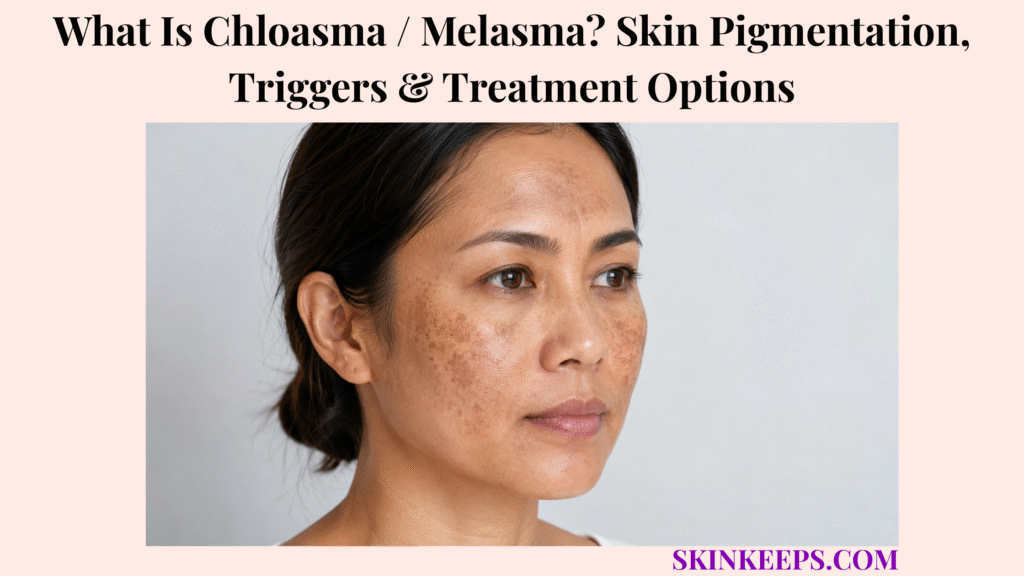
Chloasma, more commonly called melasma, is an acquired pigmentation condition that causes darker patches or spots, usually on the face.
Melasma is chronic and relapse-prone, so treatment focuses on trigger control rather than quick bleaching. This page covers appearance, triggers, diagnosis, treatment options, sun protection, pregnancy context, mistakes, and when pigmentation should be checked.
What Is Chloasma / Melasma and Why Does Skin Pigmentation Change?
Chloasma, more commonly called melasma, is an acquired pigmentation condition that causes darker patches or spots, usually on the face, because pigment-producing skin cells make excess melanin in patterned areas.
Melanin is the pigment that gives skin its brown tones. Melanocytes are the cells that make melanin.
In melasma, those pigment pathways become overactive in certain areas. Light, heat, hormones, genetics, and irritation can keep patches active or bring them back after fading.
Why Are Chloasma and Melasma Often Used Together?
Chloasma and melasma are often used together because chloasma is an older term, especially for pregnancy-related melasma, while melasma is the preferred dermatology term.
Chloasma is sometimes used for the “mask of pregnancy,” but it does not describe a completely separate disease from melasma.
The central condition is melasma: a patterned, acquired hyperpigmentation disorder that usually forms flat darker patches on sun-exposed facial skin.
Why Is Melasma Usually Chronic and Relapsing?
Melasma is usually chronic and relapsing because light, heat, hormones, genetics, and irritation can keep pigment-producing cells reactive over time.
Patches may fade with treatment and then darken again after sun exposure, visible light, heat, hormonal shifts, or irritating products.
That is why maintenance is part of treatment. Melasma care usually controls pigment and relapse risk rather than permanently curing the condition with one product.
Practical rule: Melasma treatment works best when diagnosis, trigger control, UV and visible-light protection, gentle skin care, and maintenance are all handled together.
What Does Melasma Look Like on Skin?
Melasma usually appears as flat tan, brown, gray-brown, blue-gray, or darker patches that are often symmetrical and more noticeable on sun-exposed facial areas.
It usually does not feel raised, crusted, painful, or scaly. The surface often feels like normal skin, but the color is darker than the surrounding area.
What Colors Can Melasma Patches Have?
Melasma patches can look tan, light brown, dark brown, gray-brown, blue-gray, or darker and shadow-like depending on skin tone, pigment depth, light exposure, and inflammation.
On lighter skin, melasma may look tan, brown, or gray-brown. On brown or black skin, it may look deeper brown, blue-gray, slate-gray, or shadow-like.
Color alone does not confirm melasma. Pattern, surface, triggers, symptoms, and change history also matter.
What Shape and Pattern Does Melasma Usually Form?
Melasma usually forms flat, patchy, map-like areas with irregular blended borders and a symmetrical or mirror-like facial pattern.
The pigment may appear on both cheeks, both sides of the forehead, the upper lip, nose bridge, chin, temples, or jawline.
It usually has blended edges rather than a raised mole-like border, and it typically does not itch, hurt, bleed, crust, or ulcerate.
What Symptoms Are Not Typical for Melasma?
Pain, bleeding, crusting, ulceration, scaling, raised texture, rapid growth, or one changing dark spot are not typical features of ordinary melasma.
A dark patch that behaves like a changing mole, becomes raised, bleeds, hurts, crusts, scales, or grows quickly should be checked before lightening treatment.
Melasma can be emotionally distressing, but it should not be assumed for every dark facial patch.
| Feature | Typical Melasma Clue | When to Check |
|---|---|---|
| Surface | Flat patch. | Raised, thick, crusted, or scaly. |
| Pattern | Symmetric facial patches. | One changing spot. |
| Sensation | Usually no pain or itch. | Painful or itchy lesion. |
| Color | Brown, gray-brown, blue-gray, or darker. | Multiple irregular mole-like colors. |
| Course | Flares with light, heat, irritation, or hormones. | Rapid isolated growth. |
| Border | Blended, patch-like edge. | Sharply changing or irregular mole-like border. |
Where Does Chloasma / Melasma Usually Appear?
Melasma most often appears on the face, especially the cheeks, forehead, upper lip, nose bridge, chin, temples, and jawline, but it can also affect sun-exposed areas such as the neck or forearms.
A symmetrical facial pattern is one of the strongest clues, but location alone does not diagnose melasma.
One-sided, raised, painful, crusted, bleeding, rapidly changing, or mole-like pigmentation should be evaluated before pigment treatment begins.
| Area | Common Pattern | Diagnosis Caution |
|---|---|---|
| Cheeks | Symmetric brown or gray-brown patches. | Common melasma site. |
| Forehead | Broad patchy pigmentation. | Check sun and heat exposure. |
| Upper lip | “Mustache-like” shadow. | Avoid waxing irritation. |
| Nose bridge | Central facial pigment. | Usually flat if melasma. |
| Chin | Patchy facial pigment. | Check symmetry and triggers. |
| Jawline | Lateral facial patches. | Can overlap other pigment disorders. |
| Temples | Sun-exposed facial patches. | Track spread and response. |
| Neck / forearms | Sun-exposed extra-facial pigment. | Consider other diagnoses if atypical. |
What Triggers Chloasma / Melasma?
Melasma is triggered or worsened by ultraviolet light, visible light, heat, hormonal changes, pregnancy, hormonal contraception, genetic tendency, skin irritation, and some medications or scented products.
Trigger control is the heart of melasma care. Pigment treatments often fail or relapse when light, heat, hormones, or irritation keep stimulating pigment production.
How Do Sunlight and Visible Light Worsen Melasma?
Sunlight and visible light can worsen melasma because they stimulate pigment production and can darken existing patches or trigger new pigmentation.
Ultraviolet light can activate pigment pathways. Visible light can worsen pigmentation, especially in darker skin tones.
Heat and repeated sun exposure can also contribute to relapse. Daily photoprotection is not an optional add-on; it is the foundation of treatment.
How Do Hormones Trigger Melasma?
Hormones can trigger melasma during pregnancy, birth control use, hormone therapy, and other hormonal shifts that make pigment pathways more reactive.
Some pregnancy-related melasma fades after delivery, but it can persist. Some people notice recurrence with hormonal contraception or hormone therapy.
Medication changes should be discussed with a clinician rather than stopped suddenly.
How Can Irritation and Skincare Worsen Melasma?
Irritation can worsen melasma because inflamed skin can produce more pigment, especially when harsh exfoliation, strong actives, waxing, fragrance, or aggressive procedures disrupt the barrier.
Overusing acids, retinoids, scrubs, peels, lightening agents, or fragranced products can trigger irritation and deepen pigmentation.
Barrier-friendly treatment matters because the goal is controlled pigment fading, not aggressive inflammation.
| Trigger | How It Worsens Pigmentation | Practical Control |
|---|---|---|
| UV light | Stimulates melanin. | Daily broad-spectrum sunscreen. |
| Visible light | Worsens patches, especially darker skin. | Tinted / iron-oxide sunscreen. |
| Pregnancy / hormones | Activates pigment pathways. | Gentle control; clinician guidance. |
| Heat | Can flare pigmentation. | Shade, cooling, lower heat exposure. |
| Irritation | Inflammation deepens pigment. | Gentle barrier-safe routine. |
| Scented products | Irritant or phototoxic risk. | Fragrance-free alternatives. |
| Aggressive procedures | Can trigger PIH or rebound pigment. | Specialist selection only. |
Who Is More Likely to Develop Melasma?
Melasma is more likely in people with darker skin tones, family history, frequent sun exposure, pregnancy, hormonal treatment, or repeated pigment-triggering irritation.
Risk does not mean certainty. It helps explain why some people develop recurring facial pigmentation while others with similar sun exposure do not.
How Is Melasma Different From Other Dark Skin Patches?
Melasma can resemble post-inflammatory hyperpigmentation, freckles, sun spots, drug pigmentation, acanthosis nigricans, ochronosis, and melanoma-like pigmentation, so pattern, surface, symptoms, and change history matter.
Correct diagnosis matters because unsafe lightening, irritation, or aggressive procedures can worsen pigment or delay care for another condition.
How Is Melasma Different From Post-Inflammatory Hyperpigmentation?
Melasma usually follows a symmetrical facial pattern, while post-inflammatory hyperpigmentation appears after acne, rash, burn, bite, injury, irritation, or a procedure.
Both can coexist. A person may have melasma patches and separate dark marks from acne, eczema, waxing, peels, burns, or other inflammation.
Treating irritation or acne matters when post-inflammatory pigment overlaps with melasma.
How Is Melasma Different From Freckles and Sun Spots?
Melasma forms broader blended facial patches, while freckles are usually smaller sun-reactive spots and lentigines are more discrete sun- or age-related brown spots.
Lentigo usually appears as a more distinct sun-related spot rather than a broad symmetrical facial patch.
Sun exposure can worsen melasma, freckles, and lentigines, so photoprotection still matters across pigment patterns.
How Is Melasma Different From Acanthosis Nigricans?
Melasma is flat facial hyperpigmentation, while acanthosis nigricans usually causes darker, velvety, thickened skin in folds such as the neck or armpits.
Texture and location are the key differences. Acanthosis nigricans often feels thicker or velvety, while melasma is usually flat.
Fold darkening may need metabolic or clinical review rather than pigment-fading treatment alone.
How Is Melasma Different From Birthmark-Like Brown Patches?
Melasma is acquired and often facial and symmetrical, while some brown patches are birthmarks or early-life pigment patterns.
Café-au-lait spots are flat brown macules that often appear at birth or in childhood, which is different from acquired adult facial melasma.
Timing helps: a childhood patch, a new adult facial pigment pattern, and a changing mole-like lesion should not be grouped as the same diagnosis.
How Is Melasma Different From Melanoma or Suspicious Pigmentation?
Melasma is usually flat, symmetrical, and patch-like, while melanoma concern rises with a changing single lesion, irregular border, multiple colors, bleeding, pain, ulceration, or rapid growth.
A dark lesion that behaves like a changing mole should not be treated as melasma.
Prompt review is safer when pigmentation is one-sided, raised, crusted, bleeding, painful, ulcerated, multi-colored, or rapidly changing, because melanoma and other diagnoses require different care.
| Condition | Main Clue | Why Confusion Happens | Safer Next Step |
|---|---|---|---|
| Melasma | Symmetric flat facial patches. | Brown pigment overlaps. | Trigger control + diagnosis. |
| PIH | After acne, rash, injury, burn, or procedure. | Dark marks overlap. | Treat original inflammation. |
| Freckles | Small sun-reactive spots. | Sun worsens both. | Photoprotection. |
| Lentigines | Discrete sun/age spots. | Brown facial spots. | Derm exam if changing. |
| Acanthosis nigricans | Velvety fold darkening. | Hyperpigmentation overlaps. | Metabolic/clinical review. |
| Ochronosis | Blue-black/gray discoloration after certain lightening-agent exposure. | Pigment-treatment history overlaps. | Dermatology review. |
| Melanoma | Changing irregular lesion. | Dark pigment overlaps. | Prompt evaluation. |
How Is Chloasma / Melasma Diagnosed?
Melasma is usually diagnosed by its appearance, pattern, trigger history, and skin examination, but a dermatologist may use additional tools or biopsy if the pigmentation is atypical.
Diagnosis is pattern-based. A clinician checks whether pigment is flat, symmetrical, facial, trigger-linked, and consistent with melasma rather than a mimic.
What Does a Dermatologist Check With Melasma?
A dermatologist checks melasma by reviewing patch location, symmetry, color, trigger history, sunscreen habits, skincare products, medicines, pregnancy or hormone exposure, and signs that suggest another diagnosis.
The visit may review sun exposure, heat exposure, outdoor work, pregnancy timing, birth control, hormone therapy, family history, procedures, waxing, peels, lasers, fragranced products, and prior treatment response.
Symptoms such as pain, itch, bleeding, crusting, scaling, raised texture, or rapid change should be mentioned because they are not classic melasma signs.
Is a Wood Lamp Needed for Melasma Diagnosis?
A Wood lamp may help in some melasma evaluations, but it is not reliable enough to be the only basis for prognosis or treatment decisions.
Wood lamp findings can be inconsistent, especially in darker skin phototypes. It should not be used alone to predict treatment response.
Clinical pattern, history, trigger review, and examination remain central.
When Might Biopsy Be Needed?
Biopsy may be needed when pigmentation is one-sided, raised, scaly, crusted, bleeding, painful, rapidly changing, unclear, or not following a classic melasma pattern.
A dermatologist may take a small skin sample when another condition needs to be excluded.
Biopsy is not routine for classic melasma, but it matters when pigment behaves atypically or looks suspicious.
What Treatment Options Are Used for Melasma?
Melasma treatment usually combines daily photoprotection with topical pigment treatments, gentle skin care, and sometimes dermatologist-guided procedures or oral medicines for selected cases.
Treatment should be layered and careful. Irritation can darken pigment, so stronger is not always safer.
Why Is Sunscreen the Foundation of Melasma Treatment?
Sunscreen is the foundation of melasma treatment because UV light and visible light can keep pigment cells active and cause patches to darken or return.
Broad-spectrum sunscreen should be used consistently, and a wide-brim hat and shade help reduce trigger exposure outdoors.
Tinted sunscreen with iron oxides can be especially useful when visible light worsens pigment, particularly in darker skin tones.
Which Topical Treatments Are Commonly Used for Melasma?
Common topical melasma treatments may include hydroquinone, triple-combination creams, azelaic acid, kojic acid, retinoids, cysteamine, topical tranexamic acid, niacinamide, or vitamin C under appropriate guidance.
Hydroquinone and hydroquinone-based combinations may be used under supervision for selected patients.
Do not stack many irritating actives at once. Retinoids and some pigment medicines require pregnancy and sensitivity caution.
When Are Chemical Peels, Lasers, or Light Procedures Considered?
Chemical peels, lasers, or light procedures may be considered for selected stubborn melasma, but they require careful specialist selection because irritation and heat can worsen pigmentation.
Procedures are usually adjuncts, not replacements for sunscreen and maintenance.
Darker skin tones need careful procedure choice because post-inflammatory hyperpigmentation and rebound darkening can occur when treatment is too aggressive.
When Is Tranexamic Acid Considered?
Tranexamic acid may be considered for selected resistant melasma, but oral use requires medical screening because clotting-risk concerns and contraindications must be reviewed.
Oral tranexamic acid is not a casual cosmetic supplement.
Topical or intradermal approaches may be discussed by specialists, but the choice depends on medical history, risk factors, country, availability, and clinician judgment.
| Treatment Option | Best-Fit Use | Main Goal | Key Caution |
|---|---|---|---|
| Daily tinted sunscreen | All melasma. | Prevent darkening and relapse. | Must be consistent. |
| Hydroquinone | Supervised induction. | Fade pigment. | Not for uncontrolled long-term use. |
| Triple combination | Selected active melasma. | Stronger short-course control. | Irritation risk. |
| Azelaic acid | Sensitive or acne-prone overlap. | Pigment support. | Slower results. |
| Retinoids | Pigment + turnover support. | Improve response. | Irritation and pregnancy caution. |
| Cysteamine / kojic acid | Selected topical alternatives. | Pigment support. | Irritation possible. |
| Chemical peel | Selected epidermal cases. | Adjunct fading. | PIH risk. |
| Laser / light | Resistant selected cases. | Cosmetic improvement. | Can worsen melasma. |
| Tranexamic acid | Refractory selected cases. | Pigment pathway control. | Medical screening needed. |
How Should Sun Protection Be Built Into a Melasma Routine?
A melasma routine should protect against ultraviolet light, visible light, heat, and irritation every day because treatment results can fade quickly when triggers continue.
Use broad-spectrum sunscreen every morning. Tinted mineral sunscreen with iron oxides can help when visible light worsens pigment.
Reapply during outdoor exposure, wear a wide-brim hat, use shade, avoid tanning beds, reduce heat exposure when possible, and continue maintenance after pigment improves.
How Is Chloasma / Melasma Managed During Pregnancy?
Pregnancy-related chloasma should be managed carefully because many pigment treatments are avoided during pregnancy, while sun protection and gentle skin care remain the safest foundation.
Chloasma often refers to pregnancy-associated melasma, sometimes called the mask of pregnancy.
Some pregnancy-related melasma fades after delivery, but it can persist. Do not start prescription pigment treatments, retinoids, oral tranexamic acid, aggressive peels, or procedures during pregnancy without obstetric and dermatology guidance.
| Action | Safer Direction | Avoid Without Clinician Approval |
|---|---|---|
| Sun protection | Broad-spectrum + tinted sunscreen, hat, shade. | Skipping sunscreen because pregnancy treatment is limited. |
| Skin care | Gentle cleanser and moisturizer. | Harsh scrubs, peels, or strong actives. |
| Pigment treatment | Dermatology/obstetric guidance. | Prescription lighteners started alone. |
| Procedures | Usually postpone unless medically advised. | Aggressive peels or lasers. |
| Postpartum plan | Reassess triggers and treatments. | Expecting guaranteed clearance. |
What Melasma Mistakes Should You Avoid?
The biggest melasma mistake is using strong lightening products or procedures while skipping daily sun and visible-light protection.
Do not use unregulated bleaching creams, mercury-containing products, or unknown lightening mixtures.
Do not overuse hydroquinone, use it indefinitely without supervision, stack many acids and retinoids at once, wax irritated melasma-prone skin repeatedly, or treat a changing mole-like lesion as melasma.
| Mistake | Why It Fails | Better Action |
|---|---|---|
| Lightening without sunscreen | Pigment returns or darkens. | Daily photoprotection. |
| Overusing hydroquinone | Irritation and complication risk. | Supervised courses. |
| Aggressive procedures | Can worsen PIH or melasma. | Specialist selection. |
| Irritating routine | Inflammation deepens pigment. | Barrier-safe routine. |
| Treating every dark patch as melasma | Misses mimics. | Diagnose first. |
| Stopping sunscreen after fading | Relapse risk remains. | Maintain protection. |
| Pregnancy self-treatment | Safety uncertainty. | Obstetric/dermatology guidance. |
When Should Melasma-Like Pigmentation Be Checked by a Dermatologist?
Melasma-like pigmentation should be checked by a dermatologist when it is one-sided, rapidly changing, raised, painful, itchy, bleeding, crusting, scaly, ulcerated, irregular, treatment-resistant, or not following a typical symmetrical facial pattern.
Atypical pigment should be diagnosed before lightening treatment. This is especially important near the eyes or mucosal areas, after a new medication, during pregnancy treatment decisions, or after repeated treatment failure.
Which Pigmentation Signs Need Faster Review?
Faster review is needed when a dark patch grows quickly, appears as a single changing spot, has irregular borders, contains multiple colors, bleeds, crusts, ulcerates, hurts, itches, thickens, or becomes raised.
Pigment that is mole-like, one-sided, or rapidly evolving should not be handled as routine melasma.
Review also matters when pigmentation appears after a new medication or does not improve despite consistent trigger control.
What Should You Bring to a Melasma Appointment?
A useful melasma appointment includes photos over time, sunscreen details, skincare products, hormone history, pregnancy timing, medication list, procedures tried, irritation history, family history, and sun or heat exposure patterns.
Bring product names if possible, including sunscreen, cleansers, fragrances, exfoliants, acids, retinoids, lightening creams, peels, laser treatments, and cosmetics.
Tell the dermatologist about pregnancy, postpartum timing, birth control, hormone therapy, thyroid history, medication changes, and whether patches worsen with heat or sun.
Seek dermatology review if pigmentation is:
What Should You Remember About Chloasma / Melasma?
The most important thing to remember about chloasma/melasma is that it is a chronic pigment condition, so the safest strategy is trigger control, daily photoprotection, gentle skin care, and dermatologist-guided treatment when patches are stubborn or distressing.
Melasma is usually harmless, but atypical or changing pigmentation needs diagnosis before lightening treatment.
Frequently Asked Questions About Chloasma / Melasma
Are chloasma and melasma the same thing?
Yes in practical use. Chloasma is an older term, often used for pregnancy-related melasma, while melasma is the preferred dermatology term.
What does melasma look like?
Melasma usually appears as flat tan, brown, gray-brown, bluish-gray, or darker patches and freckle-like spots, usually on the face and often in a symmetrical pattern.
What triggers melasma?
Common triggers include sunlight, visible light, heat, pregnancy, birth control pills, hormone therapy, genetics, irritation, and some medications or scented products.
Is melasma dangerous?
Melasma is usually harmless and does not typically cause pain, itch, bleeding, crusting, or raised lumps, but atypical or changing pigmentation should be checked to rule out other conditions.
What is the best treatment for melasma?
There is no one best treatment for every case. The foundation is strict UV and visible-light protection; dermatologist-guided options may include hydroquinone, triple-combination creams, azelaic acid, retinoids, cysteamine, kojic acid, chemical peels, selected procedures, or tranexamic acid in selected cases.
Can melasma come back after treatment?
Yes. Melasma commonly relapses, especially after sun exposure, heat exposure, hormonal triggers, irritation, or stopping maintenance photoprotection.
Is tinted sunscreen better for melasma?
Tinted sunscreen with iron oxides can be useful when visible light worsens melasma, especially in darker skin tones, but it should still be broad-spectrum and used consistently.
When should melasma be checked by a dermatologist?
Melasma-like pigmentation should be checked when it is one-sided or unusual, rapidly changing, raised, bleeding, crusting, painful, itchy, multi-colored, irregular, treatment-resistant, pregnancy-treatment-related, or uncertain in diagnosis.
Sources & Evidence About Chloasma / Melasma
DermNet — Melasma was used for chloasma versus melasma terminology, chronic relapse framing, visible-light-aware photoprotection, triggers, treatment options, and procedural cautions.
American Academy of Dermatology — Melasma Overview was used for flat bilateral facial pattern, common facial sites, sunscreen and wide-brim hat foundation, and the skin-cancer boundary.
American Academy of Dermatology — Melasma Signs and Symptoms was used for color range, freckle-like spots, no typical pain or itch, flat feel, and symmetrical facial pattern.
American Academy of Dermatology — Melasma Causes was used for sunlight, pregnancy, birth control pills, hormone therapy, family history, darker skin tones, and thyroid association context.
American Academy of Dermatology — Melasma Self-Care was used for visible light, tinted sunscreen, and relevance for darker skin tones.
StatPearls / NCBI Bookshelf — Melasma was used for chronic relapse-prone framing, Wood lamp limitations, visible light and iron-oxide context, hydroquinone-based regimens, maintenance therapy, and adjunct procedure caution.
British Association of Dermatologists — Melasma was used for biopsy to exclude other conditions in atypical cases, hydroquinone context, and patient-specific treatment guidance.
Educational Disclaimer: This SkinKeeps article is for educational purposes only and does not diagnose or replace medical care. Melasma-like pigmentation that is one-sided, rapidly changing, raised, painful, itchy, bleeding, crusted, scaly, ulcerated, multi-colored, irregular, mole-like, near the eyes or mucosal areas, medication-associated, pregnancy-treatment-related, treatment-resistant, or not following a typical symmetrical facial pattern should be checked by a qualified healthcare professional or dermatologist. Do not use unregulated bleaching products, mercury-containing creams, aggressive procedures, or prescription pigment treatments without appropriate medical guidance.