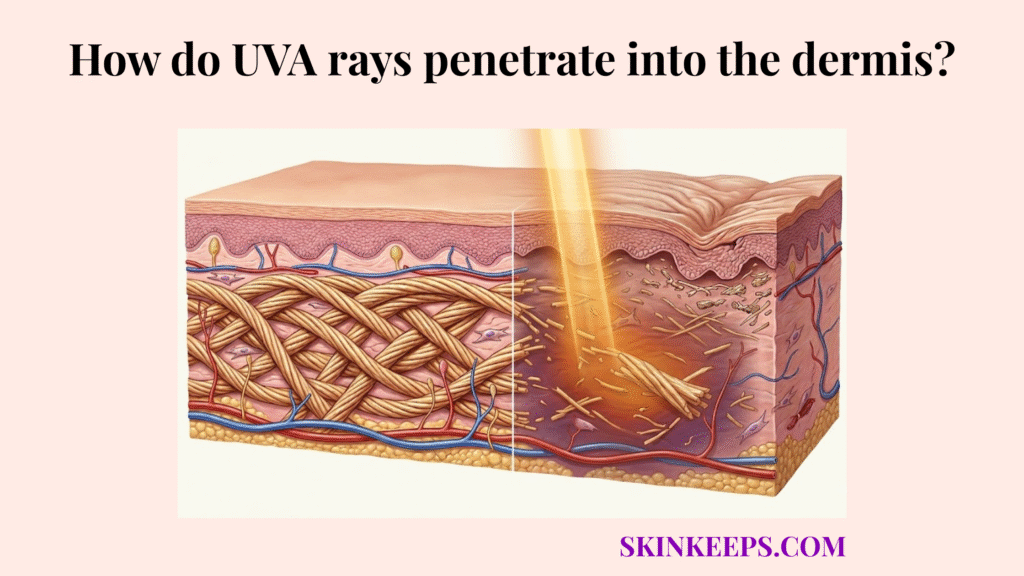
UVA rays penetrate into the dermis because their longer wavelength allows them to move through the epidermis with less surface absorption than UVB.
This deeper travel is exactly why UVA drives collagen damage and photoaging even when the skin does not visibly burn. While UVB is aggressively absorbed by the outer layers—producing the immediate red warning of a sunburn—UVA bypasses that surface trap and silently strikes the underlying structural matrix hour after hour.
Understanding how UVA rays penetrate into the dermis requires mapping wavelength physics, explaining epidermal bypass, examining dermal scattering, separating UVA1 from UVA2, contrasting UVA with UVB, and applying the correct protection markers to prevent long-term structural collapse.
What is the physics behind how UVA rays penetrate into the dermis?
The physics behind how UVA rays penetrate into the dermis is that longer ultraviolet wavelengths travel more deeply in tissue than shorter ones, and UVA occupies the longer UV band at 320–400 nm, with UVA1 at 340–400 nm and UVA2 at 320–340 nm. UVB, by contrast, sits at 290–320 nm and is more surface-limited (Brar et al., 2025 — [PMC]).
The cardinal rule of photobiology is that wavelength dictates depth. Shorter waves carry more intense immediate energy but are rapidly stopped by superficial tissue. Longer waves carry slightly less immediate energy but possess the physical capacity to travel straight through top-level obstructions.
Because UVA sits entirely in the longer 320–400 nm spectrum, it is physically guaranteed to reach deeper tissue than the shorter 290–320 nm UVB band.
| UV Band | Wavelength Range | Relative Tissue Depth |
|---|---|---|
| UVB | 290–320 nm | Surface-limited (Epidermis) |
| UVA2 | 320–340 nm | Intermediate (Upper Dermis) |
| UVA1 | 340–400 nm | Deepest penetrating (Mid to Deep Dermis) |
Reviews consistently describe UVA1 as the deepest-penetrating portion of solar UV relevant to dermal photoaging (Bernerd et al., 2022 — [PMC]) and (Wang et al., 2014 — [PMC]).
How does minimal epidermal absorption allow UVA rays to penetrate into the dermis?
Minimal epidermal absorption allows UVA rays to penetrate into the dermis because UVA is less effectively trapped in the epidermis than UVB, so a larger fraction continues downward into deeper layers where fibroblasts and matrix structures reside.
The epidermis acts like a dense biological filter for short waves. It aggressively absorbs UVB, deploying melanin and cellular mass to catch the radiation before it breaches the basement membrane.
Because UVA interacts less strongly with these surface targets, it essentially sneaks past the epidermal blockade. This dermal penetration guarantees that a substantial volume of radiation successfully accesses the deep connective tissue.
One often-cited clinical estimate is that about 20–30% of UVA may reach the deep dermis, whereas UVB is much more surface-limited. This serves as an approximate physiologic anchor to prove the severity of the deep-wave bypass (Battie et al., 2012 — [IJDVL]) and (Wang et al., 2014 — [PMC]).
How does light scattering facilitate how UVA rays penetrate into the dermis?
Light scattering facilitates how UVA rays penetrate into the dermis because once UVA reaches deeper tissue, it does not move as a perfectly straight beam; instead, dermal structures such as collagen and elastin help redistribute photon energy through a broader matrix zone. That wider spread helps explain why UVA can influence more than a narrow vertical path.
Scattering is a spread process, not a simple mirror-like reflection. As the long-wave photons hit the dense, fibrous dermal matrix, they ricochet and diffuse horizontally and vertically.
This scattering mechanism guarantees that deep UVA exposure bathes entire regions of connective tissue in radiation, multiplying the total cellular volume subjected to oxidative stress.
How do UVA1 and UVA2 differ in how UVA rays penetrate into the dermis?
UVA1 and UVA2 differ in how UVA rays penetrate into the dermis because UVA1 is the longer-wave portion and reaches deeper dermal zones more effectively, while UVA2 is shorter and tends to be relatively more superficial within the UVA band. Long-UVA reviews consistently emphasize UVA1 as especially relevant to dermal photoaging and fibroblast-associated change (Bernerd et al., 2022 — [PMC]).
It is crucial to recognize that not all UVA behaves identically. While both bypass the epidermis, UVA1 represents the absolute extreme of deep-wave penetration.
Because UVA1 spans 340–400 nm, it drives the most profound structural degradation at the deepest levels of the skin, making long-wave protection an absolute necessity for preventing true structural collapse.
How do UVA and UVB compare regarding how UVA rays penetrate into the dermis?
UVA and UVB compare differently because UVA penetrates more effectively into the dermis, while UVB is more concentrated in the epidermis and is more strongly associated with sunburn and acute erythema.
UVA is therefore more strongly associated with deeper connective-tissue photoaging, while UVB is more strongly associated with surface burning and direct epidermal injury.
This does not mean UVB cannot harm the dermis indirectly through inflammation, nor does it mean UVA spares the surface completely. It means their primary zones of destruction sit at fundamentally different depths.
| UV type | Wavelength range | Main penetration depth | Primary target | Typical visible result |
|---|---|---|---|---|
| UVB | 290–320 nm | Mostly epidermal / more surface-limited | DNA and keratinocyte injury | Burn and acute redness |
| UVA | 320–400 nm | Deeper dermal reach | Fibroblasts, collagen, elastin, matrix signaling | Wrinkling, laxity, photoaging |
The FDA states that SPF primarily indicates UVB protection, while broad spectrum indicates protection against both UVA and UVB. That distinction matters massively because a product can possess strong UVB burn protection without providing equally strong deep-wave UVA protection (FDA, 2025 — [U.S. Food and Drug Administration]).
How does fibroblast and matrix targeting explain how UVA rays penetrate into the dermis?
Fibroblast and matrix targeting explain how UVA rays penetrate into the dermis because the biological consequence of deep penetration is not just surface irritation, but deeper oxidative and structural stress inside fibroblast-rich connective tissue. Long-UVA and photoaging reviews repeatedly connect dermal UVA exposure to ROS generation, fibroblast stress, and collagen damage and photoaging (Brar et al., 2025 — [PMC]).
Fibroblasts are the cellular factories that build the skin’s structural foundation. When UVA penetrates the dermis, it strikes these cells directly, plunging them into oxidative panic.
The radiation also physically destabilizes existing collagen and elastin fibers. Deep penetration means the structural core of the skin is being silently dismantled from the inside out.
What specific protection markers stop how UVA rays penetrate into the dermis?
The most useful protection markers stop how UVA rays penetrate into the dermis by helping the user identify products with meaningful UVA coverage, not just UVB burn protection. In practical terms, the most useful label clues are broad spectrum status, PA ratings where available, and filters known for stronger UVA coverage such as zinc oxide and avobenzone (FDA, 2025 — [U.S. Food and Drug Administration]).
A high SPF number is mathematically blind to deep-wave UVA. Formulating a true anti-aging shield requires distinct chemical or physical blockers that specifically intercept the 320–400 nm band before it enters the skin.
How do Broad Spectrum labels help stop how UVA rays penetrate into the dermis?
Broad Spectrum labels help stop how UVA rays penetrate into the dermis because they indicate that the sunscreen protects against both UVA and UVB, whereas SPF alone primarily reflects UVB/sunburn protection. That makes broad spectrum the minimum starting point for products intended to reduce deep-wave UVA photoaging risk.
The FDA recommends broad spectrum sunscreens with SPF 15 or higher, and explicitly states that SPF primarily indicates UVB protection while broad spectrum adds necessary UVA protection (FDA, 2025 — [U.S. Food and Drug Administration]).
How do PA ratings help stop how UVA rays penetrate into the dermis?
PA ratings help stop how UVA rays penetrate into the dermis because they are designed to communicate UVA-protection strength, typically using a system derived from persistent pigment darkening (PPD) testing. In markets that use PA labeling, higher PA grades indicate stronger UVA protection.
Narrative review literature and JCIA materials describe the PA system as a UVA grading system derived from PPD-based assessment, with the classification ranging from PA+ to PA++++, offering consumers a much clearer view of deep-wave defense (Salih et al., 2024 — [PMC]) and (JCIA, 2022 — [JCIA]).
How do zinc oxide and avobenzone help stop how UVA rays penetrate into the dermis?
Zinc oxide and avobenzone help stop how UVA rays penetrate into the dermis because both are important UVA-protective filters, especially for longer-wave UVA coverage. Review literature notes that avobenzone offers partial UVA1 protection, while zinc oxide is valued for broad UVA coverage and is one of the most important mineral filters for long-wave defense (Breakell et al., 2024 — [PMC]).
One cited sunscreen-protection analysis notes that avobenzone and zinc oxide are key actives for meaningful protection against UVA wavelengths above 360 nm, which is absolutely vital for stopping the deepest-penetrating UVA1 band (Beasley et al. — [HERO]).
Protection Translation Pathway
- Problem → SPF-only thinking misses deep-wave UVA risk.
- Implication → collagen-aging rays may still reach the dermis unimpeded.
- Solution → choose broad-spectrum formulas with meaningful UVA markers and UVA-capable filters.
What are the key summary facts for how UVA rays penetrate into the dermis?
The key summary facts are that UVA rays penetrate into the dermis because their longer wavelength is less strongly trapped at the epidermal surface, UVA1 reaches deeper than UVA2, and deeper fibroblast/matrix targeting is what makes UVA such an important driver of collagen damage and photoaging.
Summary Checklist
What steps can you take to prevent how UVA rays penetrate into the dermis today?
Daily prevention works best when UVA rays penetrate into the dermis is treated as a year-round, cumulative exposure problem, not just a summer-burn issue. The practical goal is to reduce long-wave UVA exposure consistently with broad-spectrum sunscreen, UVA-aware label reading, and exposure-limiting habits.
Sunscreen reviews focused on photoaging emphasize that consistent daily use is vastly more protective than discretionary, event-only use (Guan et al., 2021 — [PMC]).
Final Execution Checklist
Quick Answers About How UVA Rays Penetrate into the Dermis
How do UVA rays penetrate into the dermis?
UVA rays penetrate into the dermis because their longer wavelengths are less strongly trapped by the epidermis than UVB, so more of their energy continues downward into fibroblast- and collagen-rich tissue. That deeper reach is a major reason UVA is strongly associated with photoaging.
Does UVA damage collagen more than UVB?
UVA is more strongly linked to deep collagen and fibroblast-associated photoaging, while UVB is more strongly linked to surface burning and epidermal injury. Both can contribute to skin damage, but UVA is the more important dermal aging driver because it reaches deeper connective tissue more efficiently.
What do UVA1 and UVA2 mean?
UVA1 and UVA2 are the two main bands inside the UVA range. UVA2 is usually 320–340 nm, while UVA1 is 340–400 nm. UVA1 is the longer-wave band and penetrates more deeply, which is why long-wave UVA protection matters in anti-photoaging strategy.
Why is UVA called the aging ray?
UVA is often linked to “aging” because it penetrates deeply enough to affect fibroblasts, collagen, elastin, and oxidative-stress signaling without necessarily causing an obvious burn first. That makes its damage more gradual, cumulative, and structurally important for wrinkles and laxity.
Does SPF tell me enough about UVA protection?
No. SPF primarily reflects UVB/sunburn protection, not full UVA performance. To estimate deeper-wave coverage, the more useful clues are broad-spectrum labeling, and where available, UVA-specific systems such as PA ratings.
What does PA++++ mean in sunscreen?
PA++++ means the product is labeled at the highest commonly used PA tier and therefore signals stronger UVA protection than lower PA grades. The PA system is derived from persistent pigment darkening testing and is mainly used in markets that display UVA grades this way.
Do zinc oxide and avobenzone help with deep UVA protection?
Yes. Both are important UVA-capable filters. Review literature indicates that avobenzone contributes important UVA coverage, including partial UVA1 protection, while zinc oxide is valued for broader UVA coverage and is one of the key filters for deeper-wave defense.
Can UVA still age the skin if I do not burn?
Yes. UVA can still drive photoaging even without an obvious burn because its deeper penetration targets the dermis, not just the epidermal burn zone. That is why daily UVA protection matters even on days when UVB-style burning seems unlikely.
Conclusion
In conclusion, UVA rays penetrate into the dermis because their longer wavelengths are less effectively trapped at the epidermal surface, allowing more energy to reach deeper connective tissue, where fibroblasts, collagen, and elastin become long-term photoaging targets. UVA1 extends this problem farther than UVA2, and that is why broad-spectrum, UVA-aware protection matters beyond SPF alone.
By understanding the precise photobiology of dermal penetration, we realize that true anti-aging is entirely synonymous with deep-wave interception. The skin’s structural matrix cannot out-repair constant daily radiation; it can only be preserved through rigorous, broad-spectrum defense.