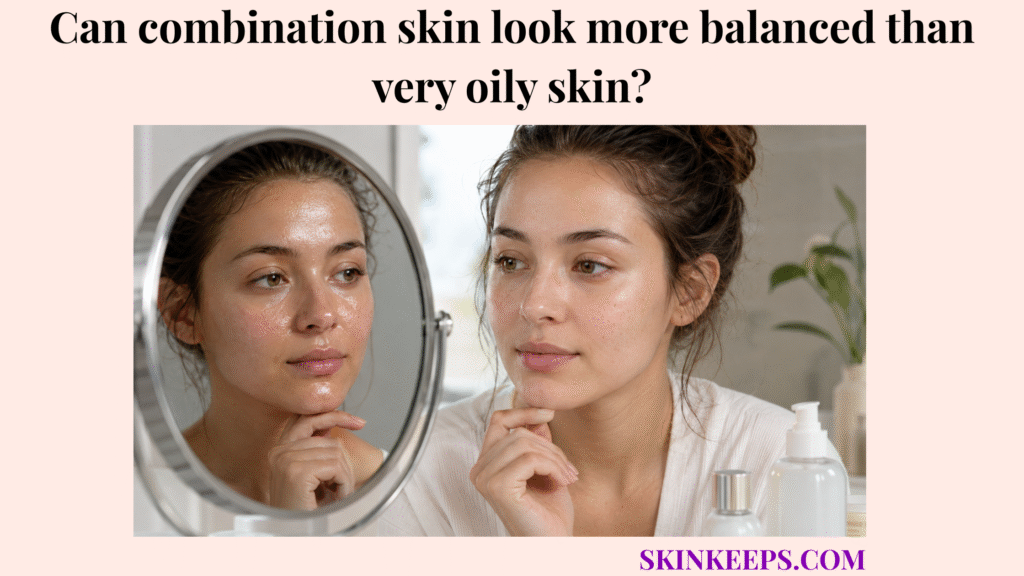
Yes, combination skin can look more balanced than very oily skin when oiliness is mostly limited to the T-zone and the cheeks stay normal, comfortable, or only mildly dry.
Combination skin may show visible shine mainly on the forehead, nose, and chin instead of across the whole face. The outer face may look calmer, less greasy, or easier to keep smooth, which can make the overall pattern look more balanced than very oily skin.
Combination skin does not always look balanced. Strong T-zone shine, flaky cheeks, active breakouts, heavy product buildup, or harsh skincare habits can make the same mixed pattern look uneven. The goal is not to erase oil completely, but to keep each facial zone comfortable enough that contrast does not dominate the face.
Can combination skin look more balanced than very oily skin?
Yes, combination skin can look more balanced than very oily skin when shine is concentrated in the T-zone instead of spreading across most of the face.
Very oily skin often looks shiny across broader facial areas. Combination skin may look different because the T-zone carries more visible oil while the cheeks, around the mouth, or outer face may stay normal, soft, matte, or only slightly dry.
This is one reason different skin types should be read by pattern, not by one oily moment. Combination skin can look visually mixed but still controlled when the oily zones and normal zones do not compete strongly.
| Visual feature | Combination skin | Very oily skin |
|---|---|---|
| Shine pattern | Usually strongest in T-zone | Often widespread |
| Cheek appearance | May look normal, balanced, or mildly dry | May also look shiny or greasy |
| Nose and forehead | Often oilier | Often very oily |
| Pore visibility | Usually more obvious in oily zones | May be more obvious across broader areas |
| Makeup wear | May separate mainly on T-zone | May separate across more of the face |
| Dry patches | Possible on cheeks or mouth area | Less central unless over-treated |
| Overall look | Can appear mixed but balanced | Can appear consistently shiny |
Combination skin looks more balanced when the contrast is controlled. It looks less balanced when oily and dry zones both become obvious.
Why can combination skin look less shiny than very oily skin?
Combination skin can look less shiny than very oily skin because oiliness is often localized to the forehead, nose, and chin instead of appearing across the whole face.
Visible balance comes from distribution. A shiny nose and forehead may still be noticeable, but they can look less overwhelming when cheeks and the outer face stay calm. The pattern is especially clear in people who have an oily T-zone with normal cheeks.
How localized T-zone oil can make combination skin look more balanced
Localized T-zone oil can make combination skin look more balanced when shine stays mainly on the forehead, nose, and chin while the cheeks look less greasy.
Forehead, nose, and chin shine may still need attention, but localized oil usually creates less full-face gloss than very oily skin. The T-zone does not have to look matte for the face to look calmer.
How normal cheeks can soften the look of combination skin
Normal cheeks can soften the look of combination skin because they reduce the appearance of full-face shine and help the outer face look calmer.
When cheek comfort stays steady, the outer face can visually balance a shinier T-zone. Normal-looking zones still need care, but they often need less aggressive oil control than the forehead, nose, and chin.
How mild dry zones can make combination skin look matte rather than greasy
Mild dry zones can make combination skin look matte rather than greasy only when dryness stays comfortable and does not become flaky, rough, or patchy.
Mild dryness may reduce cheek shine, but visible flakes, roughness, dullness, or makeup clinging are not advantages. Dry-looking contrast can make combination skin appear less balanced than very oily skin.
| Facial zone | Combination skin visual pattern | Very oily skin visual pattern |
|---|---|---|
| Forehead | Shine may appear by midday | Shine may appear earlier and stronger |
| Nose | Oily, visible pores, congestion possible | Often strongly oily and pore-visible |
| Chin | Shine or breakouts may appear | Often oily and breakout-prone |
| Cheeks | Normal, less shiny, or mildly dry | May also look shiny |
| Around mouth | May be normal or dry | Usually less defining unless irritated |
| Jawline | May vary by hormones, products, or friction | May show oil or acne more broadly |
How does combination skin differ visually from very oily skin?
Combination skin differs visually from very oily skin because combination skin is zone-specific, while very oily skin is usually more uniformly shiny.
Combination skin is recognized by contrast. The forehead, nose, and chin may look oily, while cheeks may look normal or mildly dry. Very oily skin tends to show a more even oily finish, although each person can still vary.
Pore visibility can also follow the same pattern. In combination skin, visible pores in the T-zone may be more obvious than cheek pores, while very oily skin may show a broader oily or pore-visible look.
| Question to ask | More like combination skin | More like very oily skin |
|---|---|---|
| Where does shine appear first? | Forehead, nose, chin | Most of the face |
| How do cheeks look by midday? | Normal, comfortable, or slightly dry | Shiny or greasy |
| Does makeup separate everywhere? | Mostly T-zone | Many facial areas |
| Do rich products feel heavy everywhere? | Mostly on T-zone | Across most areas |
| Do cheeks ever feel tight? | Sometimes | Less typical unless over-cleansed |
| Are pores more visible only in the T-zone? | Often | May be broader |
| Does the whole face need oil control? | Usually no | More often yes |
Very oily skin is more uniform. Combination skin is more zone-specific.
When does combination skin look more balanced than very oily skin?
Combination skin looks more balanced than very oily skin when T-zone shine is mild to moderate and the cheeks stay smooth, comfortable, and not visibly flaky.
Combination skin looks visually balanced when the T-zone does not dominate the face and the cheeks do not show roughness, peeling, or product clinging. Mild local shine can look manageable when dry or normal zones stay smooth.
| Condition in combination skin | Why it can look more balanced |
|---|---|
| T-zone oiliness is mild to moderate | Shine is local, not full-face |
| Cheeks stay normal | Outer face looks calmer |
| Dryness is not flaky or rough | Matte areas do not look damaged |
| Breakouts are limited | Texture stays more even |
| Products do not sting or peel | Barrier looks stable |
| Moisturizer is lightweight | T-zone does not look overloaded |
| Sunscreen texture is comfortable | Shine stays controlled |
| Makeup prep is zone-aware | T-zone and cheeks wear more evenly |
Combination skin looks balanced when the routine keeps oily zones controlled and dry or normal zones comfortable.
When does combination skin not look more balanced than very oily skin?
Combination skin does not look more balanced than very oily skin when strong T-zone shine, flaky cheeks, breakouts, irritation, or product buildup makes facial zones visibly uneven.
A mixed pattern can look less balanced when each zone fails in a different way. One area may look greasy, another may look dry, and makeup or sunscreen may break down unevenly.
How strong T-zone shine can make combination skin look uneven
Strong T-zone shine can make combination skin look uneven when the forehead, nose, or chin becomes so shiny that the contrast dominates the face.
Local shine is not automatically bad, but intense shine can make the T-zone visually overpower calmer cheeks. That is when gentle, targeted oil control matters more than full-face drying.
How flaky cheeks can make combination skin look less balanced
Flaky cheeks can make combination skin look less balanced because roughness, dullness, patchiness, or makeup clinging makes dry zones obvious.
Cheek dryness only looks balancing when it stays comfortable. Once flakes, roughness, and dullness appear, the face can look more uneven because dry zones and oily zones both draw attention.
How breakouts can make combination skin look unstable
Breakouts can make combination skin look unstable when clogged pores, inflamed pimples, or acne-treatment peeling appear alongside shine or dry patches.
Localized T-zone congestion or acne can reduce visual balance, especially when acne products create peeling around the mouth or cheeks. If breakouts stay mostly local, the pattern may connect with area-limited breakouts in combination skin rather than a full-face oily pattern.
| Unbalanced sign in combination skin | Why it reduces visual balance |
|---|---|
| Very shiny T-zone | Oil contrast becomes obvious |
| Flaky cheeks | Dry contrast becomes obvious |
| Oily but tight skin | Skin looks and feels unstable |
| Breakouts plus peeling | Acne care and dryness conflict |
| Product pilling or heaviness | Layers do not suit mixed zones |
| Makeup separates and clings | Different zones fail differently |
| Redness or stinging | Irritation becomes visible |
| Over-powdered T-zone | Texture can look cakey |
How can combination skin keep a more balanced look than very oily skin?
Combination skin can keep a more balanced look than very oily skin by controlling T-zone shine locally while keeping cheeks and dry-prone areas comfortable.
Visual balance usually improves when the routine respects contrast. The T-zone may need lighter layers, while cheeks, around the mouth, or outer face may need moisturizer support and less drying treatment.
Use targeted oil control on combination skin instead of full-face drying
Targeted oil control helps combination skin look balanced because the T-zone may need lighter textures, blotting, or pore-focused care while the cheeks do not need full-face drying.
Oil control should stay local when shine is local. A full-face mattifying routine can make normal or dry zones look dull, tight, or irritated.
Keep normal or dry zones in combination skin comfortable
Keeping normal or dry zones comfortable helps combination skin look balanced because smooth cheeks and outer-face areas prevent the face from looking rough or patchy.
Moisturizer support on cheeks and around the mouth can reduce visual contrast. The richer texture does not need to cover the nose and forehead if those areas clog or shine easily.
Choose sunscreen and makeup textures that suit combination skin zones
Sunscreen and makeup textures help combination skin look balanced when lightweight T-zone layers reduce shine and dry zones get enough comfort underneath.
A non-comedogenic sunscreen or lighter base may feel better on oily zones, while dry zones may need more comfort underneath. The point is not a full makeup routine; it is choosing textures by zone so products do not separate, cling, or pill.
| Visual goal for combination skin | Better move | Avoid |
|---|---|---|
| Reduce T-zone shine | Lightweight, non-comedogenic layers | Heavy creams on nose/forehead |
| Keep cheeks smooth | Moisturize dry or normal zones | Drying cheeks with oil-control products |
| Prevent makeup separation | Prep T-zone lightly | Thick layers everywhere |
| Prevent makeup clinging | Hydrate dry patches first | Powdering flakes |
| Manage visible pores | Target pore-prone areas | Scrubbing the whole face |
| Avoid oily-but-tight look | Gentle cleansing plus hydration | Over-cleansing |
Which products help combination skin look balanced without acting like very oily skin?
Products help combination skin look balanced without acting like very oily skin when they control shine by zone instead of stripping or mattifying the whole face.
Combination skin often needs product direction rather than product intensity. A gentle cleanser, lightweight moisturizer, and comfortable sunscreen can support balance without forcing every facial zone into a matte finish.
If a product leaves the face shiny but tight, peels the cheeks, or causes pilling, the issue may be product strength or placement. This is where harsh skincare products in combination skin can turn a manageable visual pattern into an uneven one.
| Product category | How it can help combination skin look balanced | Zone caution |
|---|---|---|
| Gentle cleanser | Removes oil without stripping cheeks | Avoid squeaky-tight finish |
| Lightweight moisturizer | Supports comfort without heavy shine | Add more only where dry |
| Non-comedogenic sunscreen | Protects without obvious congestion | Texture matters for T-zone |
| Mattifying primer | Controls T-zone shine | Use selectively |
| Light lotion or gel-cream | Helps oily zones stay comfortable | May not be enough for flakes |
| Richer cream | Smooths dry patches | Avoid over oily zones |
| Salicylic acid | Helps clogged T-zone if tolerated | Do not overuse on dry cheeks |
| Blotting paper | Reduces visible shine quickly | Do not rub aggressively |
Combination skin should aim for balance through placement and texture, not through stronger oil removal.
How can makeup make combination skin look more or less balanced than very oily skin?
Makeup can make combination skin look more or less balanced than very oily skin depending on whether the T-zone and cheeks are prepped differently.
Makeup often reveals zone differences quickly. Foundation may separate on the nose while clinging to cheek dryness, or powder may control shine but make dry texture look heavier.
| Makeup issue | Combination skin pattern | Better adjustment |
|---|---|---|
| Foundation separates on nose | T-zone oil breaks down product | Use light T-zone prep |
| Cheeks look patchy | Dry or under-moisturized zones | Hydrate before makeup |
| Powder gets cakey | Too much oil control or dry texture | Powder selectively |
| Primer dries cheeks | Mattifying product spread too far | Use only on oily areas |
| Dewy base looks greasy | Product too rich for T-zone | Use lighter layers |
| Matte base clings | Too dry for cheek zones | Add comfort under makeup |
| Sunscreen pills under makeup | Layers too heavy or mismatched | Simplify product layers |
Combination skin often needs split makeup prep: control shine where oily, smooth texture where dry or normal.
What mistakes stop combination skin from looking balanced?
Combination skin stops looking balanced when the whole face is treated as oily, moisturizer is skipped, heavy products are used everywhere, or over-cleansing creates tight shine.
Most visual-balance mistakes come from applying one full-face rule to a mixed-zone pattern. The face then looks matte in one area, greasy in another, and rough where comfort support was removed.
Avoid treating combination skin like very oily skin
Treating combination skin like very oily skin can make cheeks look dry, dull, rough, or irritated because full-face oil control reaches zones that do not need it.
Mattifying products and oil-control steps may help the T-zone, but dry or normal cheeks can lose smoothness if the same approach is applied everywhere.
Avoid skipping moisturizer on combination skin because the T-zone shines
Skipping moisturizer on combination skin because the T-zone shines can make dry and normal zones look rough, tight, or uneven.
Lightweight support can keep cheeks and outer-face areas smooth. Oily zones may need a thinner layer, but that does not mean the entire face should be left unsupported.
Avoid using heavy products everywhere on combination skin
Using heavy products everywhere on combination skin can make the T-zone look greasy or congested even if dry patches need richer support.
Rich creams can help dry patches, but they may not suit the nose, forehead, or chin. Selective placement protects visual balance.
Avoid over-cleansing combination skin to force a matte look
Over-cleansing combination skin to force a matte look can create tightness, irritation, and a shiny-but-stripped appearance.
Repeated washing may make the T-zone feel cleaner briefly, then tight and shiny later. The safer approach is gentle cleansing plus targeted shine control, not aggressive washing. This matters especially when over-cleansing affects combination skin by increasing both oiliness and dryness.
| Mistake | Why it hurts visual balance | Better move |
|---|---|---|
| Full-face mattifying routine | Makes cheeks dull or tight | Mattify only T-zone |
| Heavy moisturizer everywhere | Makes T-zone greasy | Apply richness selectively |
| Skipping moisturizer | Dry zones look rough | Use lightweight support |
| Over-cleansing | Creates tightness and rebound shine | Cleanse gently |
| Scrubbing pores | Increases redness and texture | Use targeted gentle care |
| Powdering the whole face | Makes dry zones cakey | Powder oily zones only |
| Ignoring sunscreen texture | Causes shine or stinging | Choose comfortable formula |
| Changing products constantly | Makes balance harder to read | Adjust one step at a time |
When should combination skin that looks unbalanced need professional help?
Combination skin that looks unbalanced needs professional help when visible shine, dryness, breakouts, irritation, burning, or product reactions become painful, persistent, spreading, or scarring.
Visible imbalance is often a skincare-adjustment issue, but pain, bleeding, burning, swelling, persistent irritation, or scarring changes the concern. Those signs should not be treated as simple cosmetic unevenness.
See a dermatologist if:
- Breakouts are painful, deep, cystic, or scarring.
- T-zone congestion does not improve with gentle targeted care.
- Dry patches crack, bleed, burn, or spread.
- Skin reacts to many gentle products.
- Redness, swelling, or rash-like patches appear.
- Peeling continues after reducing strong actives.
- Makeup or sunscreen always stings or burns.
- Oiliness and dryness worsen together despite routine simplification.
- The reader suspects acne, dermatitis, eczema, rosacea, allergy, or infection.
Looking unbalanced is cosmetic only until pain, burning, bleeding, spreading, scarring, or persistent irritation appears. Then it needs proper care.
What should you remember about combination skin looking more balanced than very oily skin?
The key point is that combination skin can look more balanced than very oily skin when shine stays local and dry or normal zones stay comfortable.
- Combination skin can look more balanced than very oily skin.
- This is most likely when oiliness is limited to the T-zone.
- Normal or mildly dry cheeks can reduce the look of full-face shine.
- Combination skin is not automatically balanced.
- Very shiny T-zone plus flaky cheeks can look more uneven than oily skin.
- Use oil control only where oil appears.
- Keep dry or normal zones moisturized.
- Choose sunscreen and makeup textures by zone.
- Avoid over-cleansing to force a matte look.
- Avoid heavy products across the whole face.
- Seek help for painful acne, persistent irritation, cracking, burning, spreading, or scarring symptoms.
Frequently Asked Questions About Combination Skin Looking Balanced
Can combination skin look less oily than very oily skin?
Yes. Combination skin can look less oily than very oily skin when shine is mostly limited to the T-zone and the cheeks remain normal, balanced, or only mildly dry.
Does combination skin always look balanced?
No. Combination skin does not always look balanced. It can look uneven if the T-zone is very shiny, the cheeks are flaky, or products create irritation, peeling, or buildup.
Why does very oily skin look shinier than combination skin?
Very oily skin can look shinier than combination skin because noticeable oil often appears across more of the face, while combination skin usually has stronger oiliness in selected zones.
Can combination skin still have visible pores?
Yes. Combination skin can still have visible pores, especially in the T-zone on the nose, forehead, or chin, even if the cheeks look more balanced.
How can combination skin look more balanced with makeup?
Combination skin can look more balanced with makeup by using lighter prep on the T-zone, moisturizing dry or normal zones, powdering selectively, and avoiding the same mattifying or rich product everywhere.
Conclusion: combination skin and balanced-looking appearance
Combination skin can look more balanced than very oily skin when T-zone shine stays local and the cheeks remain smooth, comfortable, or only mildly dry. That balance depends on zone behavior, not on the idea that one skin type is better than another.
The safest visual strategy is to control oil only where it appears, moisturize dry or normal zones enough to keep texture smooth, and avoid full-face mattifying or heavy-product habits that make mixed zones look more obvious.
Sources & Evidence for combination skin balanced appearance
Cleveland Clinic: Understanding skin types — used for combination-skin zone differences and the T-zone/cheek contrast.
American Academy of Dermatology: How to control oily skin — used for oil-free, non-comedogenic products, gentle cleansing, oil control, and avoiding harsh oil-control habits.
American Academy of Dermatology: Face washing 101 — used for gentle cleansing, lukewarm water, fingertips, avoiding scrubbing, and moisturizer support.
American Academy of Dermatology: Dermatologists’ tips for relieving dry skin — used for dry-zone moisturizer support and avoiding fragrance, harsh soaps, and drying habits.
American Academy of Dermatology: Acne care tips — used for gentle acne-prone skin care and avoiding non-abrasive cleansing mistakes.
American Academy of Dermatology: Choosing the right sunscreen — used for non-comedogenic sunscreen language for acne-prone or oily zones.
American Academy of Dermatology: Skin care habits that can worsen acne — used for makeup, sunscreen, hair-care products, over-washing, and scrubbing as acne-worsening habits.
Educational Disclaimer: This article is for general skin education only and does not diagnose, treat, or replace professional medical advice. If combination skin includes painful acne, scarring, severe dryness, cracking, bleeding, burning, spreading irritation, rash-like patches, or persistent product reactions, consult a qualified dermatologist.