
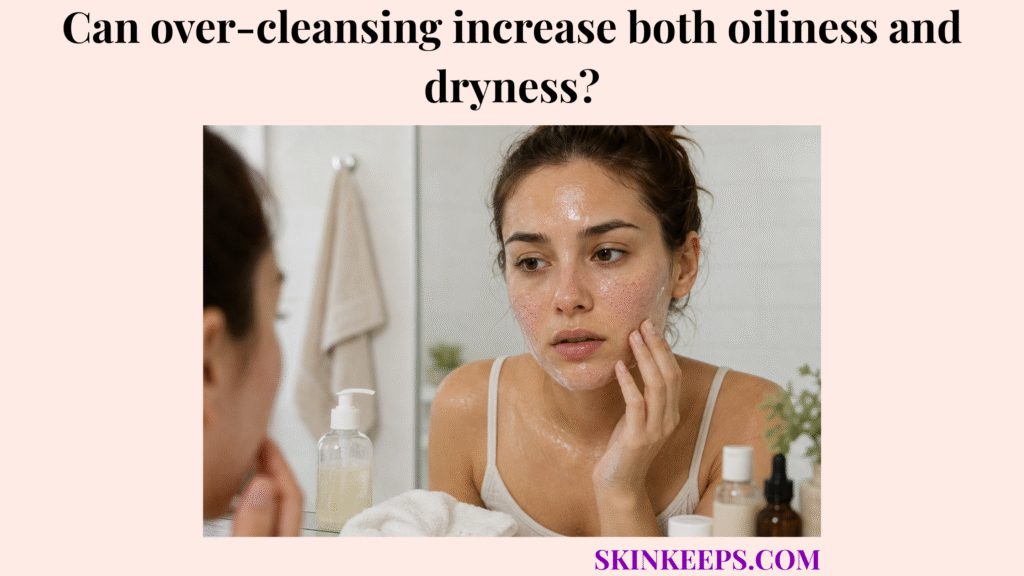
Yes, over-cleansing can increase both oiliness and dryness, especially in combination skin. The T-zone may look shinier, feel tight, or become more reactive after repeated washing, while the cheeks, mouth area, or outer face may become dry, flaky, rough, or irritated.
Combination skin does not respond evenly across the face. Washing too often or using a stripping cleanser can remove too much surface oil and weaken comfort in dry zones, while oily zones may still keep producing shine even when they feel tight.
How can over-cleansing increase both oiliness and dryness in combination skin?
Over-cleansing can increase both oiliness and dryness in combination skin by stripping the skin surface, irritating the barrier, and making facial zones react differently.
Oily areas may feel tight after washing but still become shiny later. Dry or normal areas may become rough, flaky, or sensitive because they have less room for cleansing stress.
| Over-cleansing effect in combination skin | Oily-zone result | Dry or normal-zone result |
|---|---|---|
| Washing too often | T-zone feels tight, then shiny | Cheeks become dry or rough |
| Stripping cleanser | Oil removed temporarily | Barrier comfort drops |
| Hot water | Surface oil removed fast | Tightness and dryness increase |
| Scrubbing | Irritation and redness | Flakes and rough texture |
| No moisturizer after cleansing | Skin feels unstable | Dry zones lose comfort |
| Cleansing after every shine episode | Oil cycle feels worse | Cheeks become over-treated |
| Harsh morning and night cleansing | T-zone still oily | Dry zones become reactive |
If cleansing makes one zone feel too oily and another zone feel too dry, the problem may be cleansing intensity, not the skin type itself.
Figure 1. Over-cleansing can make the center face feel stripped while cheek zones lose comfort faster.
Why does over-cleansing make oily zones worse in combination skin?
Over-cleansing can make oily zones worse in combination skin because more washing does not remove the natural oil tendency of the T-zone.
The forehead, nose, and chin can remain oil-prone even after a strong wash. This is why the face may feel stripped first, then shiny later.
How over-cleansing can make the T-zone in combination skin feel shiny but tight
Over-cleansing can make the T-zone in combination skin feel shiny but tight when the forehead, nose, and chin feel stripped after washing but become shiny again later.
That pattern does not prove the skin is dirty. It often means the cleanser removed comfort faster than it changed the underlying oil tendency.
How over-cleansing can irritate oily areas of combination skin
Over-cleansing can irritate oily areas of combination skin when repeated washing creates redness, sensitivity, roughness, or bumps that can be mistaken for acne.
Irritation can look like congestion or texture, especially around the nose, chin, or forehead. Adding stronger acne products before calming the wash step can make the pattern harder to read.
How over-cleansing can create a false need for stronger products in combination skin
Over-cleansing can create a false need for stronger products in combination skin when shine returns after washing and the reader responds by cleansing more often.
The cycle is simple: stripping, tightness, shine, more washing, then more irritation. A gentler wash pattern usually gives clearer information than another stronger cleanser.
Figure 2. Shine after washing does not automatically mean the face needs another full cleanse.
Why does over-cleansing make dry areas worse in combination skin?
Over-cleansing makes dry areas worse in combination skin because cheeks, around-mouth skin, and outer-face zones often have less oil support than the T-zone.
These zones may show tightness, flakes, dullness, and stinging sooner than the center face. This is why combination skin should not be cleansed as if every area is equally oily.
How over-cleansing weakens dry zones in combination skin
Over-cleansing weakens dry zones in combination skin when cheeks, around the mouth, and the outer face become tight, flaky, rough, dull, or uncomfortable.
Cleansing can remove too much surface support from low-oil zones. All dry cheeks are not caused by over-cleansing, but dryness that appears after stronger or more frequent washing should raise suspicion.
How over-cleansing makes moisturizers sting on combination skin
Over-cleansing makes moisturizers sting on combination skin when the skin surface is irritated or barrier-stressed after washing.
Stinging is not proof that the moisturizer is always wrong. The cleanser, hot water, scrubbing, or repeated washing may be lowering tolerance before moisturizer is applied.
How over-cleansing makes dry texture look worse in combination skin
Over-cleansing makes dry texture look worse in combination skin when flakes, roughness, and makeup clinging become more visible on dry-prone zones.
Cheeks and the mouth area may look patchier after aggressive washing. In that situation, more exfoliation is usually a risky first move because the texture may be dryness or irritation.
| Facial zone in combination skin | Over-cleansing reaction | What it suggests |
|---|---|---|
| Forehead | Tight but shiny later | Oily zone is being stripped |
| Nose | Shine returns quickly | Oil control is too aggressive |
| Chin | Rough bumps or irritation | Cleansing may be worsening texture |
| Cheeks | Tightness, dullness, flakes | Dry zone is over-cleansed |
| Around mouth | Peeling or stinging | Barrier stress may be present |
| Jawline | Redness or bumps | Friction, cleanser, or acne overlap |
What signs show over-cleansing is affecting combination skin?
Over-cleansing is affecting combination skin when the face feels clean but uncomfortable, tight, shiny, flaky, rough, or more reactive after washing.
One sign alone does not prove cleansing is the only cause. The pattern becomes stronger when symptoms began after washing more often, changing to a harsher cleanser, using hot water, or scrubbing.
- ☐Skin feels tight immediately after washing.
- ☐The T-zone becomes shiny again soon after cleansing.
- ☐Cheeks feel dry even when the T-zone is oily.
- ☐Moisturizer stings after cleansing.
- ☐The face feels clean but uncomfortable.
- ☐Rough texture increases after more washing.
- ☐Flakes appear around the mouth or cheeks.
- ☐Breakouts and peeling happen together.
- ☐Makeup clings to dry zones but separates on the T-zone.
- ☐You feel the need to wash every time shine appears.
Healthy cleansing should leave the skin clean but comfortable. Squeaky clean is often a warning sign for combination skin.
How can combination skin tell over-cleansing apart from acne, dehydration, or normal oiliness?
Combination skin can tell over-cleansing apart from acne, dehydration, or normal oiliness by checking whether symptoms became worse after washing more often or using a stronger cleanser.
Acne, dehydration, normal T-zone oil, and over-cleansing can overlap. The safest clue is timing: if tightness, flakes, stinging, or shiny-but-tight skin followed a cleansing change, over-cleansing should be treated as a suspect before adding stronger acne products.
| Pattern clue | More likely over-cleansing | More likely acne | More likely dehydration | More likely normal T-zone oil |
|---|---|---|---|---|
| Tight after washing | Yes | Not the main sign | Yes | No |
| Shiny T-zone later | Yes | Sometimes | Sometimes | Yes |
| Cheeks flake | Yes | No | Sometimes | No |
| Moisturizer stings | Yes | Rare | Sometimes | No |
| Clogged pores | Sometimes from irritation or buildup cycle | Yes | No | Sometimes |
| Red rough patches | Yes | Sometimes | Sometimes | No |
| Improves with gentler cleansing | Strong clue | Maybe partial | Maybe | Not always |
| Appears after washing more often | Strong clue | Not enough alone | Possible | No |
If symptoms worsen after increasing cleansing, over-cleansing should be treated as a suspect before adding stronger acne products.
How often should combination skin cleanse without over-cleansing?
Combination skin should cleanse consistently but not aggressively, using frequency based on sweat, sunscreen, makeup, buildup, and skin tolerance.
There is no single frequency that fits every combination skin pattern. Many routines work best with gentle cleansing once or twice daily depending on tolerance, plus gentle cleansing or rinsing after real sweat, sunscreen, makeup, or buildup.
Cleanse combination skin consistently but not aggressively
Combination skin should be cleansed consistently but not aggressively because the goal is to remove oil, sweat, sunscreen, and makeup without leaving dry zones tight.
Consistency matters more than force. A gentle cleanser should remove the day without making cheeks feel punished.
Cleanse combination skin after sweat without stripping it
Combination skin should be cleansed or rinsed gently after sweat when buildup is present, but the cleanser should stay mild and non-abrasive.
Removing sweat and buildup can help the T-zone and jawline, especially after sunscreen or exercise. Repeated scrubbing after every shine episode can still worsen dry zones.
Avoid cleansing combination skin every time the T-zone gets shiny
Combination skin should not be cleansed every time the T-zone gets shiny because midday shine does not always mean the face is dirty.
Blotting, lighter product texture, and zone-based adjustment are often safer than another full-face wash. This is especially true when cheeks already feel tight.
| Situation | Better cleansing decision for combination skin | Avoid |
|---|---|---|
| Morning skin feels comfortable | Gentle cleanse or light rinse depending on tolerance | Harsh wash just to prevent oil |
| After sunscreen or makeup | Cleanse thoroughly but gently | Sleeping with residue |
| After sweating | Cleanse or rinse gently | Scrubbing repeatedly |
| Midday T-zone shine | Blot or adjust product texture | Full face wash every time |
| Cheeks feel tight | Reduce stripping steps | Stronger cleanser |
| Breakouts plus peeling | Simplify and reassess | More cleansing plus more actives |
Which cleanser choices help combination skin avoid over-cleansing?
Cleanser choices help combination skin avoid over-cleansing when they remove oil, sweat, sunscreen, and makeup without tightness, friction, hot water, or repeated stripping.
A cleanser does not have to feel strong to work. Combination skin usually does better with a mild, non-stripping direction that cleans the T-zone while preserving comfort on the cheeks and mouth area.
| Over-cleansing habit | Gentler combination skin swap | Why it helps |
|---|---|---|
| Strong foaming cleanser | Mild gel, cream, or non-stripping cleanser | Cleans without tightness |
| Hot water | Lukewarm water | Reduces dryness and irritation risk |
| Washcloth scrubbing | Fingertips | Lowers friction |
| Cleansing many times daily | Consistent morning/evening or after sweat | Prevents repeated stripping |
| Acne cleanser everywhere | Targeted acne care if needed | Protects dry zones |
| No moisturizer after washing | Lightweight moisturizer by zone | Restores comfort |
| Strong double cleanse daily | Gentle removal only when needed | Avoids unnecessary barrier stress |
Combination skin does not need the harshest cleanser. It needs a cleanser that removes oil, sweat, sunscreen, and makeup without leaving dry zones uncomfortable.
How should combination skin recover after over-cleansing?
Combination skin should recover after over-cleansing by reducing cleanser strength, lowering friction, using lukewarm water, moisturizing after washing, and managing oily zones without extra full-face cleansing.
This reset is not a medical treatment. It is a way to lower routine pressure so the real combination skin pattern becomes easier to read.
Simplify the cleansing step for combination skin first
The cleansing step for combination skin should be simplified first by reducing cleanser strength, washing frequency, hot water, and scrubbing.
Use a gentler cleanser, lukewarm water, and fingertips. Fewer cleansing variables help show whether irritation is driving the oily-and-dry confusion.
Support dry zones in combination skin after over-cleansing
Dry zones in combination skin should be supported after over-cleansing with steady moisturizer and fewer irritating steps until tightness, flakes, or stinging improve.
Cheeks, around-mouth skin, and peeling patches should not receive acids, masks, or strong acne washes while they are already irritated.
Manage oily zones in combination skin without extra washing
Oily zones in combination skin can be managed without extra washing by using lighter products, blotting, and targeted care instead of repeated full-face cleansing.
The T-zone may still need oil control, but the answer should not punish the cheeks. If this pattern overlaps with oil-and-dryness patterns in combination skin, manage each zone separately.
| Recovery step for combination skin | What to do | What to avoid |
|---|---|---|
| Step 1: Reduce intensity | Use gentle cleanser | Strong foaming wash |
| Step 2: Reduce friction | Use fingertips | Scrubs or rough cloths |
| Step 3: Use lukewarm water | Keep cleansing comfortable | Hot water |
| Step 4: Moisturize after washing | Apply lightweight support | Leaving skin tight |
| Step 5: Pause extra harsh steps | Reduce acids, masks, strong acne washes if irritated | Stacking actives |
| Step 6: Watch zone response | Track T-zone shine and cheek comfort | Changing everything at once |
Figure 3. A cleansing reset works best when it lowers irritation without leaving sunscreen, sweat, or makeup behind.
What mistakes make over-cleansing worse in combination skin?
Over-cleansing gets worse in combination skin when shine triggers repeated washing, acne cleansers are used everywhere, rough texture is scrubbed, or moisturizer is skipped.
These mistakes usually come from treating combination skin as one uniform oily face. Understanding different skin types can help prevent that one-size-fits-all reaction.
Avoid washing combination skin more because the T-zone is shiny
Washing combination skin more because the T-zone is shiny can repeat the stripping cycle and make dry zones more uncomfortable.
Shine is not proof the face is dirty. Blotting or a lighter layer may be enough when sunscreen, sweat, or makeup buildup is not present.
Avoid using acne cleansers across all combination skin zones
Using acne cleansers across all combination skin zones can be too drying for cheeks, around-mouth skin, or normal areas if used too often.
Acne cleansers may help some breakout-prone zones, but peeling plus breakouts can also appear in breakouts and dry patches in combination skin when treatment pressure is too broad.
Avoid scrubbing combination skin to remove texture
Scrubbing combination skin to remove texture can worsen roughness when the texture is caused by irritation, flakes, or over-cleansing.
Rough texture may be dryness or cleanser irritation rather than buildup. The page on uneven skin texture across the face in combination skin explains why bumps and flakes need different responses.
Avoid skipping moisturizer after cleansing combination skin
Skipping moisturizer after cleansing combination skin can make tightness and stinging worse, even when the T-zone is oily.
Lightweight moisturizer by zone can support comfort without turning the T-zone greasy. If one product stings in some zones but not others, compare it with product reactions by facial area in combination skin.
| Mistake | Why it worsens combination skin | Better move |
|---|---|---|
| Washing whenever oil appears | Repeats the stripping cycle | Blot and adjust product texture |
| Using hot water | Increases tightness | Use lukewarm water |
| Scrubbing the T-zone | Irritates pores and texture | Cleanse gently |
| Strong cleanser morning and night | Dry zones become reactive | Use milder cleanser |
| Skipping moisturizer | Tightness and stinging worsen | Moisturize by zone |
| Adding acids after tightness | Barrier stress increases | Simplify first |
| Cleansing dry cheeks like oily skin | Flakes and roughness worsen | Treat zones differently |
Over-cleansing is one common routine error, but it can overlap with broader harsh skincare products and combination skin problems when strong cleansers, exfoliants, and drying acne steps stack together.
When should over-cleansing symptoms in combination skin need a dermatologist?
Over-cleansing symptoms in combination skin need a dermatologist when burning, swelling, intense redness, cracked patches, bleeding, painful acne, rash-like irritation, or persistent peeling does not improve after simplifying cleansing.
Over-cleansing can irritate skin, but severe or persistent symptoms may involve acne, eczema, dermatitis, rosacea, allergy, infection, or another condition that needs professional evaluation.
- ☐Burning, swelling, or intense redness appears after cleansing.
- ☐Dry patches crack, bleed, spread, or become painful.
- ☐Breakouts become deep, cystic, painful, or scarring.
- ☐Skin reacts to many gentle products.
- ☐Peeling continues after switching to gentle cleansing.
- ☐A rash-like reaction appears.
- ☐Moisturizer keeps stinging despite routine simplification.
- ☐A simplified routine does not improve comfort.
- ☐The reader suspects acne, eczema, dermatitis, rosacea, allergy, or infection.
What should you remember about over-cleansing and combination skin?
The key point is that over-cleansing can make combination skin feel oilier and drier because oily and dry zones respond differently to repeated or harsh washing.
- ☐Over-cleansing can increase both oiliness and dryness.
- ☐Combination skin may become shiny in the T-zone and dry on the cheeks at the same time.
- ☐Tightness after washing is a warning sign, not a success sign.
- ☐Repeated washing can make the face harder to read.
- ☐Hot water, scrubbing, strong foaming cleansers, and acne washes can worsen imbalance.
- ☐Moisturizer should not be skipped just because the T-zone is oily.
- ☐Cleanse after sweat, sunscreen, or makeup, but keep the cleanser gentle.
- ☐Do not wash every time shine appears.
- ☐Reset by reducing cleanser strength, frequency, friction, and harsh actives.
- ☐Track whether the skin becomes calmer with gentler cleansing.
- ☐Seek help for painful, persistent, spreading, bleeding, rash-like, or scarring changes.
Frequently Asked Questions About Over-Cleansing and Combination Skin
Can washing too much make combination skin oily and dry?
Yes. Washing too much can make combination skin feel oily and dry because the T-zone may become tight but shiny later, while cheeks or outer-face areas become rough, flaky, or irritated.
Why does my T-zone get oily after cleansing?
The T-zone may get oily after cleansing because it naturally produces more oil. If it feels tight first and shiny soon after, the cleanser may be too harsh or used too often.
Can over-cleansing cause dry cheeks in combination skin?
Yes. Over-cleansing can cause dry cheeks in combination skin because cheeks and outer facial areas often have less oil than the T-zone, so they become tight or flaky faster.
Should combination skin wash every time it feels oily?
No. Combination skin should not be washed every time it feels oily. Midday shine does not always mean the skin needs another full cleanse; blotting or lighter products may be safer.
How do I fix over-cleansed combination skin?
Fix over-cleansed combination skin by using a gentle cleanser, avoiding hot water and scrubbing, moisturizing after washing, reducing harsh actives temporarily, and managing oily zones without repeated full-face cleansing.
Conclusion About Over-Cleansing and Combination Skin
Over-cleansing can make combination skin more confusing because the same wash step can make the T-zone feel stripped and shiny while cheeks become dry, flaky, or sting-prone. The solution is not weaker hygiene; it is better cleansing judgment.
Use gentle cleansing, lukewarm water, less friction, and zone-aware moisturizer so the face can settle into a clearer pattern. If burning, swelling, cracked patches, painful acne, or rash-like irritation persists, professional guidance is safer than continuing to experiment.
Sources & Evidence for Over-Cleansing and Combination Skin
Supports the article’s explanation of combination skin as zone-based oil and dryness behavior.
Supports gentle cleansing, lukewarm water, avoiding scrubbing, and moisturizing after cleansing.
Supports cleansing up to twice daily and after sweating, choosing non-comedogenic products, and avoiding irritation from harsh oil-control habits.
Supports gentle, non-abrasive washing and moisturizer support for acne-prone skin.
Supports dry-skin prevention boundaries around hot water, harsh soaps, fragrance, and drying habits.
Supports irritation risk from soaps, detergents, water exposure, friction, dryness, cracking, redness, burning, and stinging.
Educational Disclaimer: This article is for general skin education only and does not diagnose, treat, or replace professional medical advice. If cleansing-related symptoms cause severe burning, swelling, persistent redness, cracked or bleeding patches, painful acne, scarring, rash-like irritation, spreading symptoms, or symptoms that do not improve after simplifying your routine, consult a qualified dermatologist.