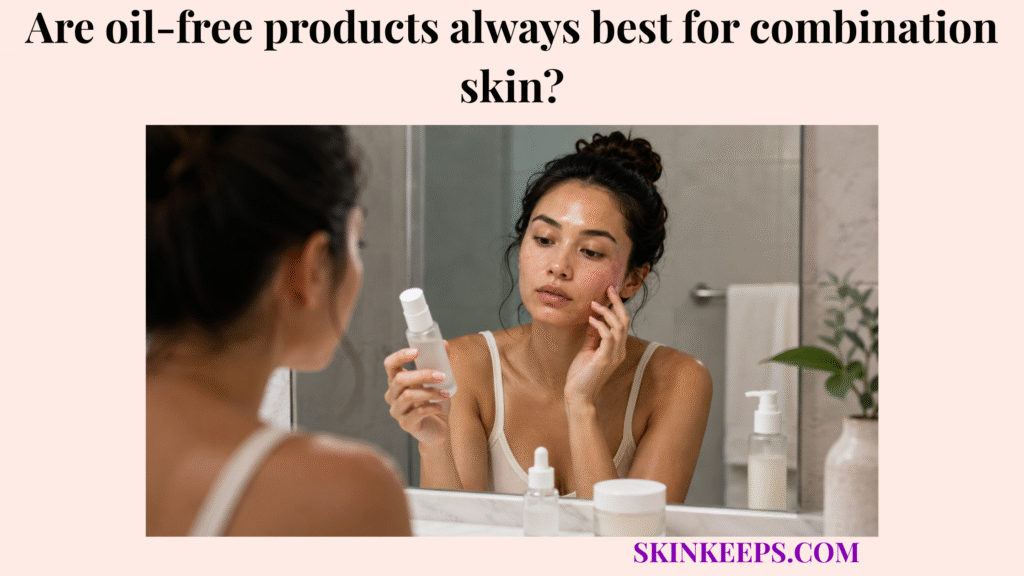
Oil-free products are not always best for combination skin. Oil-free products can be helpful on oily, shiny, clogged, or acne-prone areas of combination skin, especially the forehead, nose, and chin. They may reduce a heavy feel when moisturizers, sunscreens, primers, or makeup make the T-zone look greasy or coated.
Oil-free products may not give enough comfort to dry cheeks, around-mouth patches, or barrier-weakened areas in combination skin. The best product is lightweight enough for oily zones, supportive enough for dry zones, noncomedogenic where clogging happens, and gentle enough not to irritate.
Combination skin becomes easier to manage when product labels are treated as clues, not rules. Oil-free can help one area, but formula texture, placement, finish, and tolerance decide whether the product truly fits the face.
Why should combination skin judge the whole formula instead of only the oil-free label?
Combination skin should judge the whole formula instead of only the oil-free label because one label cannot predict comfort, clogging, dryness, irritation, or zone fit.
Combination skin often gives different feedback in different places. The forehead, nose, and chin may reject rich textures quickly, while the cheeks, around-mouth area, or outer face may feel tight when every product is chosen only for shine control.
An oil-free product can still feel sticky, sting dry cheeks, pill under sunscreen, or fail to moisturize enough. A product that is not oil-free can still be lightweight, noncomedogenic, and useful on dry zones when it is placed carefully.
| Combination skin question | Why it matters | What to choose |
|---|---|---|
| Does the T-zone clog easily? | Oil-free may help reduce heavy feel | Oil-free or noncomedogenic lightweight formula |
| Do cheeks feel dry or tight? | Oil-free may be too light | Barrier-support moisturizer or richer local layer |
| Does product sting? | Formula may irritate regardless of oil content | Fragrance-free, gentle option |
| Does makeup slide on the nose? | Texture may be too rich | Lighter T-zone product |
| Does makeup cling to cheeks? | Formula may be too drying | More supportive cheek moisturizer |
| Does sunscreen feel greasy? | Oil-free texture may help | Lightweight SPF |
| Does dry skin crack or peel? | Oil avoidance alone is not enough | Barrier-support ingredients |
| Does the product work everywhere? | No need to overthink label | Keep it if tolerated |
Practical rule: For combination skin, “oil-free” is a clue, not a complete answer.
When are oil-free products useful for combination skin?
Oil-free products are useful for combination skin when oily, shiny, congested, or breakout-prone zones feel overloaded by heavier formulas.
Oil-free products can be especially useful on the forehead, nose, and chin when heavier moisturizers, sunscreens, primers, or foundations make the T-zone look greasy or feel coated.
In combination skin, oil-free is most useful when it improves comfort without creating dryness. If an oil-free formula makes the T-zone less heavy but makes the cheeks tight, the product may need zone-based placement instead of full-face use.
| Combination skin situation | Why oil-free may help | Product category where it matters |
|---|---|---|
| Oily T-zone | Reduces heavy or greasy feel | Moisturizer, sunscreen, makeup |
| Nose blackheads | Helps avoid extra heaviness | Moisturizer, sunscreen |
| Chin breakouts | May reduce clogging risk | Moisturizer, sunscreen, foundation |
| Makeup slides on forehead | Lighter base may wear better | Primer, sunscreen, moisturizer |
| Humid weather shine | Oil-free textures may feel more wearable | Moisturizer and sunscreen |
| Acne-prone zones | Oil-free or noncomedogenic labels can guide selection | Moisturizer, sunscreen, makeup |
| Heavy cream feels coated | Oil-free gel or lotion may feel better | Moisturizer |
| SPF feels greasy | Oil-free fluid may improve daily use | Sunscreen |
Practical rule: Oil-free products are most useful where combination skin is oily, shiny, congested, or breakout-prone.
When are oil-free products not enough for combination skin?
Oil-free products are not enough for combination skin when dry zones stay tight, peeling continues, products sting, or the formula still clogs or feels heavy.
Oil-free products can help with heavy feel, but they do not automatically provide enough comfort for every dry zone in combination skin. They also do not prove that the product is non-irritating, noncomedogenic, or suitable under sunscreen and makeup.
Oil-free products may be too light for dry cheeks in combination skin
Oil-free products may be too light for dry cheeks in combination skin when cheeks, around-mouth skin, or the outer face need more emollient or barrier-supportive care.
Dry cheeks may need humectants, emollients, lipids, or a richer local layer when tightness, flakes, roughness, or around-mouth peeling continues after a light gel or lotion.
Oil-free products may still irritate sensitive combination skin
Oil-free products may still irritate sensitive combination skin when the formula contains fragrance, strong actives, drying alcohols, or a base that stings.
Oil-free does not mean gentle. If cheeks sting, burn, or redden after a product, the issue may be fragrance, actives, preservatives, texture, or individual intolerance rather than oil content alone.
Oil-free products may still clog or feel heavy on combination skin
Oil-free products may still clog or feel heavy on combination skin because oil-free does not automatically mean noncomedogenic, lightweight, residue-free, or tolerated by every person.
A sticky oil-free sunscreen, a pilling primer, or a heavy oil-free moisturizer can still feel wrong on the T-zone. Formula base, finish, and removal matter as much as the label.
| Oil-free product problem in combination skin | What it means | Better response |
|---|---|---|
| Cheeks stay tight | Formula may be too light | Add richer support on cheeks |
| Around-mouth peeling continues | Barrier needs more protection | Use barrier-support layer locally |
| Product stings | Formula may irritate | Choose fragrance-free, gentle option |
| T-zone still clogs | Formula may still be comedogenic for user | Try different noncomedogenic texture |
| Skin feels sticky | Base texture may not suit | Try lighter or simpler formula |
| Sunscreen pills | Layering mismatch | Simplify underneath |
| Makeup clings to cheeks | Not enough comfort | Hydrate and moisturize cheeks |
| Oil returns quickly | Skin may be stripped or product too drying | Review cleanser and moisturizer |
Practical rule: Oil-free does not mean balanced. It only means the product does not contain oils.
How do oil-free, noncomedogenic, lightweight, and fragrance-free labels differ for combination skin?
Oil-free, noncomedogenic, lightweight, and fragrance-free labels differ for combination skin because each label describes a different formula concern.
Combination skin usually benefits from reading labels together. Oil-free can help reduce greasy feel, noncomedogenic can guide clog-prone choices, fragrance-free can help reactive cheeks, and barrier-supportive language can matter for dry zones.
This is why ingredient roles for combination skin balance should be judged by placement and tolerance rather than by one marketing claim.
| Label or claim | What it suggests | Why it matters for combination skin | Limitation |
|---|---|---|---|
| Oil-free | No oils in formula | May feel lighter on T-zone | Can still sting, pill, or be too light |
| Noncomedogenic | Designed not to clog pores | Useful for acne-prone or oily zones | Not a guarantee for everyone |
| Lightweight | Lower heavy or greasy feel | Helps T-zone comfort | May not support dry cheeks |
| Gel-based | Water-light texture | Useful for oily or humid patterns | May be too light in dry zones |
| Fragrance-free | Lower irritation risk | Helpful for dry or reactive cheeks | Formula can still irritate |
| Alcohol-free | Reduces drying risk | Useful when skin feels tight | Does not guarantee comfort |
| Barrier-supportive | Supports dry or irritated zones | Useful on cheeks and mouth area | May be too rich for T-zone |
| Matte finish | Reduces shine appearance | Useful on oily areas | Can make cheeks dull or tight |
Practical rule: Combination skin often needs more than one label: lightweight where oily, supportive where dry, and gentle everywhere.
Which product categories should be oil-free for combination skin?
Product categories that may benefit most from oil-free labels in combination skin are leave-on products used on oily, acne-prone, or clog-prone zones.
Leave-on products usually matter most because they sit on the face for longer. Moisturizer, sunscreen, foundation, and primer may need lighter or oil-free texture on oily zones, while rinse-off products should be judged more by gentleness and comfort.
For sunscreen, oil-free can help if the T-zone gets shiny, but sunscreens for combination skin still need broad protection, enough application, and a texture the cheeks can tolerate.
| Product category | Should it be oil-free for combination skin? | Best logic |
|---|---|---|
| Moisturizer | Helpful for oily T-zone; not always for dry cheeks | Use light texture where oily, more support where dry |
| Sunscreen | Often helpful if greasy or acne-prone | Choose protective, wearable formula |
| Foundation | Helpful if T-zone clogs or slides | Noncomedogenic matters too |
| Primer | Useful for oily areas only | Avoid drying cheeks |
| Cleanser | Oil-free is less important than gentle or non-stripping | Judge after-wash comfort |
| Cleansing balm/oil | Not necessarily bad if it rinses clean | Useful for makeup/SPF removal if tolerated |
| Serum | Depends on ingredients and base | Avoid irritating actives |
| Spot treatment | Oil-free may matter less than irritation level | Apply only where needed |
| Barrier cream | Not always oil-free | Use only on dry patches if T-zone clogs |
Practical rule: Oil-free matters most for leave-on products applied to oily, acne-prone, or clog-prone zones.
Should oily areas in combination skin use oil-free products?
Oily areas in combination skin can often use oil-free products when the forehead, nose, chin, or T-zone becomes shiny, clogged, or breakout-prone.
Oily zones can still need hydration and daily protection, but they often tolerate lighter gels, gel-creams, lotions, fluids, or makeup bases better than rich textures.
Oil-free moisturizers can help oily T-zone areas in combination skin
Oil-free moisturizers can help oily T-zone areas in combination skin when light gels, gel-creams, or lotions hydrate without heavy shine.
Forehead, nose, and chin areas may need a thin layer rather than a heavy cream. This is why gel-based moisturizers for combination skin can be useful when oily zones feel coated by thicker formulas.
Oil-free sunscreens can help oily T-zone areas in combination skin
Oil-free sunscreens can help oily T-zone areas in combination skin when SPF feels greasy, slides under makeup, or makes the nose and forehead look shiny.
Oil-free SPF may improve wearability, but protection should not be weakened by using too little product. A lighter formula is better than skipping sunscreen because the T-zone shines.
Oil-free makeup can help oily T-zone areas in combination skin
Oil-free makeup can help oily T-zone areas in combination skin when foundation or primer slides, separates, or feels heavy over shiny zones.
Foundation, primer, and powder should still be checked by zone. A matte oil-free primer may belong on the nose or forehead, not automatically on dry cheeks.
| Oily area in combination skin | Oil-free product usefulness | Main caution |
|---|---|---|
| Forehead | Helpful for shine and makeup wear | Avoid drying matte overload |
| Nose | Helpful for blackhead-prone or greasy feel | Oil-free can still clog |
| Chin | Helpful if breakout-prone | Moisturize if using acne treatment |
| T-zone under sunscreen | Helpful if SPF feels greasy | Do not underapply sunscreen |
| T-zone under makeup | Helpful if makeup slides | Do not powder dry zones heavily |
| Oily but tight T-zone | Use oil-free hydration carefully | Avoid stripping formulas |
Should dry cheeks in combination skin avoid oil-free products?
Dry cheeks in combination skin do not always need to avoid oil-free products, but they should not be forced into formulas that leave them tight, dull, flaky, or under-supported.
Some dry-cheek combination skin can use oil-free lotions or gel-creams if they give enough comfort. Other dry zones need emollients, lipids, humectants, or local barrier support that may not fit a strict oil-free rule.
Dry cheeks in combination skin may tolerate oil-free products if they are hydrating enough
Dry cheeks in combination skin may tolerate oil-free products when the formula is hydrating enough and the cheeks are normal or only mildly dry.
In mild cases, a lightweight lotion or gel-cream can work across more than one zone if the amount is adjusted by area.
Dry cheeks in combination skin may need emollients or lipids
Dry cheeks in combination skin may need emollients or lipids when tightness, flakes, roughness, or around-mouth peeling continues despite light oil-free products.
Cheeks, around-mouth skin, and outer-face areas may need barrier-support ingredients that soften and protect. These should be placed where dryness appears rather than spread heavily over clogged oily zones.
Dry cheeks in combination skin should not be forced into oily-zone products
Dry cheeks in combination skin should not be forced into oily-zone products when oil-free matte formulas leave cheeks dull, tight, or uncomfortable.
Zone-based product use helps prevent this conflict. A lighter product may work on the T-zone while a more supportive layer is used only where cheeks need it.
| Dry-cheek condition in combination skin | Oil-free product may work if | More support may be needed if |
|---|---|---|
| Cheeks normal | Formula feels comfortable | No issue |
| Mild tightness | Gel-cream or lotion hydrates enough | Tightness returns quickly |
| Flaky cheeks | Usually not enough alone | Need barrier-support formula |
| Around-mouth peeling | Usually needs more protection | Peeling or stinging continues |
| Dry climate | May be too light | Wind/heat/AC worsens dryness |
| Makeup clings | Needs more comfort | Oil-free base dries down too much |
| Reactive cheeks | Must be gentle and fragrance-free | Stinging or redness appears |
Practical rule: Dry cheeks should be treated by comfort and barrier need, not by the T-zone’s oil-control label.
Can non-oil-free products work for combination skin?
Non-oil-free products can work for combination skin when they are lightweight, gentle, noncomedogenic where needed, and placed correctly by zone.
Some non-oil-free products can help dry zones without causing problems when they are used in the right place. The bigger issue is usually heavy texture on the T-zone, not the existence of every oil or lipid ingredient.
Using different products by area for combination skin can help when one shared product makes the T-zone greasy but leaves cheeks dry.
| Product type | When it may work for combination skin | Where to be cautious |
|---|---|---|
| Lightweight lotion with emollients | Cheeks need comfort but T-zone is not very clog-prone | Nose and chin |
| Cream moisturizer | Dry cheeks or cold weather | Oily T-zone |
| Barrier balm | Small dry patches | Full-face use |
| Cleansing oil/balm | Heavy sunscreen or makeup removal | Residue on acne-prone zones |
| Squalane-containing product | Dry or normal zones if tolerated | Very oily or breakout-prone zones |
| Mineral-oil/petrolatum spot layer | Cracked or rough dry spots | T-zone congestion |
| Rich sunscreen | Dry cheeks or cold weather | Greasy T-zone |
Practical rule: Non-oil-free products are not automatically wrong. Poor placement and heavy texture are usually the bigger problem.
How should combination skin choose oil-free products by season or climate?
Combination skin should choose oil-free products by season or climate because humidity may favor lighter textures while cold, wind, heat, or air conditioning may require more cheek support.
In hot or humid weather, oil-free gels, fluids, and lightweight sunscreen textures may feel more wearable on the T-zone. In cold, windy, heated, or air-conditioned conditions, dry cheeks may need more support than a very light product provides.
The same principle applies when treating oily areas without drying cheeks in combination skin: lighten oily zones without stripping or under-supporting the dry zones.
| Climate or season | Oily-zone product direction | Dry-zone product direction |
|---|---|---|
| Hot humid weather | Oil-free gels, fluids, lightweight SPF | Light moisturizer, avoid stripping |
| Cold dry weather | Keep T-zone light but not stripped | Add barrier support to cheeks |
| Windy weather | Avoid drying matte overload | Richer cheek protection |
| Indoor heating | Lightweight T-zone support | More moisture on dry areas |
| Air conditioning | Hydrating oil-free may help T-zone | Add comfort to cheeks |
| Travel | Keep core routine stable | Adjust only where symptoms appear |
Practical rule: Combination skin may need more oil-free texture in humid weather and more barrier support in dry weather.
How can combination skin test whether oil-free products are actually working?
Combination skin can test whether oil-free products are working by checking T-zone comfort, cheek comfort, clogging, stinging, makeup wear, and sunscreen layering over time.
An oil-free product should not be judged only by the first matte finish. The better test is how the forehead, nose, chin, cheeks, and around-mouth area feel after several safe uses.
- The T-zone feels comfortable, not greasy.
- The nose and chin do not become more congested.
- Cheeks do not feel tight or dull.
- Around-mouth skin does not peel.
- Products do not sting or burn.
- Makeup layers smoothly.
- Sunscreen does not pill.
- Skin does not feel coated.
- Dry zones stay comfortable for several hours.
- The product improves the routine rather than forcing more correction.
Practical rule: Do not judge oil-free products only by how matte they look at first. Judge how every zone feels later.
What mistakes happen when combination skin uses oil-free products?
Mistakes happen when combination skin uses oil-free products everywhere, trusts the oil-free label alone, avoids all emollients, or skips moisturizer because the T-zone is oily.
Most oil-free mistakes come from turning a useful label into a rigid rule. Combination skin usually needs flexibility because one zone may be shiny while another zone is tight, flaky, or reactive.
Avoid using oil-free products everywhere on combination skin without checking dry zones
Using oil-free products everywhere on combination skin can under-support dry zones when every leave-on step is chosen only for oil control.
Dry cheeks and around-mouth areas may need more support than a matte or water-light formula provides.
Avoid assuming oil-free means noncomedogenic for combination skin
Oil-free does not automatically mean noncomedogenic for combination skin because a formula can contain no oils and still clog or irritate some users.
Oil-free and noncomedogenic are related ideas, but they are not identical. Combination skin should track clogged pores, texture, and comfort rather than trusting one label alone.
Avoid fearing all oils in combination skin products
Fearing all oils in combination skin products can leave dry cheeks rough, tight, or under-supported when selective emollient or lipid support would help.
Some emollient or lipid-support products may be useful on dry zones if they are tolerated and not spread heavily over clogged oily areas.
Avoid skipping moisturizer because combination skin uses oil-free products
Skipping moisturizer because combination skin uses oil-free products can make oily zones tight and dry zones more uncomfortable.
Oil-free moisturizer can still hydrate. The goal is a lightweight layer on oily zones and stronger support where dryness appears, not zero moisturizer.
| Mistake | Why it hurts combination skin | Better move |
|---|---|---|
| Oil-free everything | Dry zones may lose comfort | Use support where dry |
| Trusting oil-free alone | Formula may still clog or irritate | Check noncomedogenic and tolerance |
| Avoiding all emollients | Cheeks may stay rough | Use barrier support locally |
| Using matte products full-face | Cheeks may look dull or tight | Matte only where oily |
| Skipping moisturizer | Oily zones can feel tight | Use lightweight moisturizer |
| Ignoring stinging | Formula may irritate | Switch to gentler option |
| Heavy oils on T-zone | Congestion may worsen | Use richer products only on dry zones |
| Changing many products | Pattern becomes unclear | Test one formula at a time |
When should oil-free product problems in combination skin need a dermatologist?
Oil-free product problems in combination skin need a dermatologist when products repeatedly cause burning, swelling, painful acne, cracked patches, bleeding, rash-like redness, or persistent reactions.
Product-label changes can help mild shine, heaviness, or clog-prone patterns, but they should not replace medical evaluation when symptoms become painful, spreading, severe, or persistent.
- Products repeatedly sting, burn, or cause swelling.
- Dry patches crack, bleed, burn, or spread.
- Breakouts become painful, deep, cystic, or scarring.
- Redness, warmth, or rash-like patches appear.
- Skin reacts to many gentle products.
- Around-mouth peeling or irritation keeps returning.
- Acne worsens despite noncomedogenic product choices.
- Oily and dry zones worsen together despite routine simplification.
- The reader suspects acne, dermatitis, eczema, rosacea, allergy, folliculitis, or infection.
Practical rule: Oil-free products can help mild clogging or shine, but persistent pain, burning, bleeding, scarring, or rash-like irritation needs professional evaluation.
What should you remember about oil-free products and combination skin?
The key point is that oil-free products can help combination skin, but they are not always best because formula fit, zone placement, and tolerance matter more than one label.
- Oil-free products are not always best for combination skin.
- Oil-free formulas can help oily T-zone areas.
- Oil-free sunscreen, makeup, and moisturizer may reduce heavy feel.
- Noncomedogenic labels matter for clog-prone zones.
- Oil-free does not guarantee non-clogging.
- Oil-free does not guarantee non-irritating.
- Dry cheeks may need emollients, lipids, or barrier-support ingredients.
- Non-oil-free products can work when lightweight, gentle, and placed correctly.
- Use richer products only where dryness needs them.
- Avoid heavy oils or creams on clogged T-zone areas.
- Avoid matte oil-free products across dry cheeks if they cause tightness.
- Judge the whole formula, not one label.
- Test one product at a time.
- Seek help for painful acne, cracking, bleeding, burning, swelling, rash-like irritation, or scarring.
Frequently Asked Questions About Oil-Free Products for Combination Skin
Are oil-free moisturizers good for combination skin?
Oil-free moisturizers can be good for combination skin, especially on oily T-zone areas. Dry cheeks may need a more supportive moisturizer if oil-free gel or lotion feels too light.
Should combination skin use only oil-free products?
No. Combination skin should not automatically use only oil-free products. Oily zones may benefit from oil-free formulas, while dry zones may need richer or barrier-supportive products.
Does oil-free mean noncomedogenic?
Not always. Oil-free means the formula does not contain oils. Noncomedogenic means the formula is designed not to clog pores. Combination skin should consider both claims when clogging is a concern.
Can oils be good for combination skin?
Some oil-containing or lipid-support products can help dry areas in combination skin if they are tolerated and used selectively. They may be too heavy for oily or clogged T-zone areas.
What is better for combination skin: oil-free or lightweight?
Lightweight is often more important than oil-free alone for combination skin. A lightweight, noncomedogenic, gentle formula can work better than an oil-free product that dries, stings, or pills.
Conclusion: oil-free product labels and combination skin
Oil-free products can be useful for combination skin, especially when the T-zone becomes shiny, clogged, or uncomfortable under heavier leave-on products. They are most helpful when they are also lightweight, noncomedogenic where needed, and gentle enough not to sting or dry the skin.
Oil-free products are not automatically best for every zone. Dry cheeks, around-mouth peeling, and barrier-weakened areas may need emollients, lipids, or richer local support, while oily zones may need less product or a lighter texture. The safest decision is to judge the whole formula by how each area responds.
Sources & Evidence for combination skin oil-free product decisions
Cleveland Clinic — Skin Type Guidance
Supports the explanation that combination skin often has different facial-zone behavior, including oilier T-zone areas and drier cheek or eye-adjacent areas.
Cleveland ClinicAmerican Academy of Dermatology — Oily Skin Care
Supports oil-free and noncomedogenic label guidance for oily or acne-prone product selection, while noting irritation can occur with active ingredients.
AADAmerican Academy of Dermatology — Acne Skin-Care Habits
Supports mild cleansing, noncomedogenic product direction, and avoiding harsh skin-care habits for acne-prone or breakout-prone zones.
AADAmerican Academy of Dermatology — Dry Skin Relief
Supports fragrance-free product selection and avoiding harsh or irritating products on dry, sensitive zones.
AADAmerican Academy of Dermatology — Product Testing
Supports testing skin-care products and choosing fragrance-free products when fragrance-related reactions occur.
AADDermNet — Emollients and Moisturizers
Supports the role of moisturizers and cautions that occlusive emollients can aggravate acne-like or follicular problems in some situations.
DermNetDermNet — Barrier Cream Ingredient Classes
Supports humectant and occlusive ingredient class explanations used for dry-zone and barrier-support context.
DermNetDermNet — Acne Management and Contact Reactions
Supports oil-free product context for acne-prone skin, irritation caution, and escalation when product reactions are persistent or severe.
DermNetEducational Disclaimer: This article is for general skin education only and does not diagnose, treat, or replace professional medical advice. If oil-free or oil-containing products cause burning, swelling, cracked or bleeding patches, painful acne, scarring, spreading redness, rash-like irritation, or persistent product reactions, consult a qualified dermatologist.