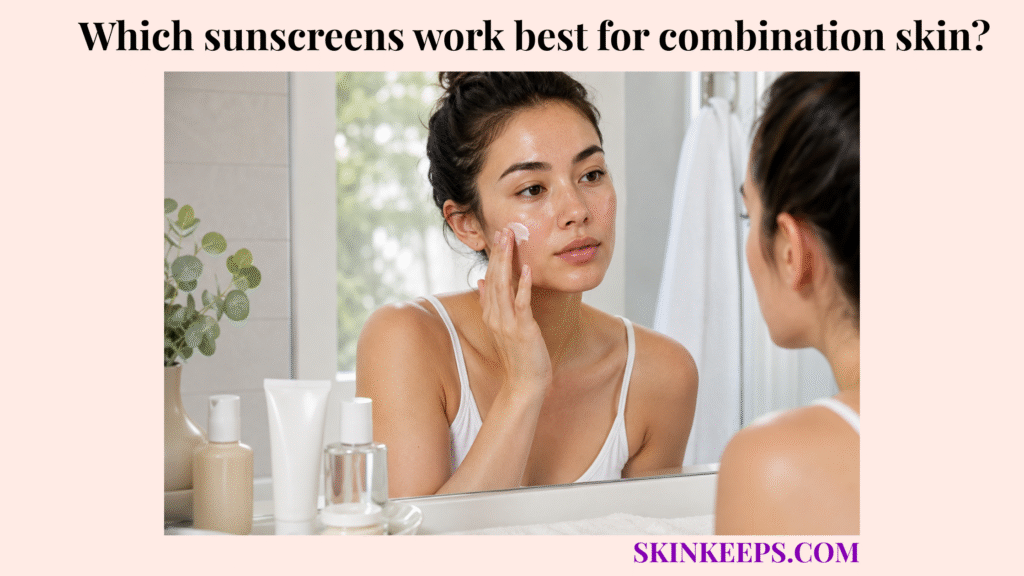
The sunscreens that work best for combination skin are broad-spectrum SPF 30 or higher formulas that protect the whole face while staying comfortable on both oily and dry zones.
For combination skin, the best sunscreen is not only about SPF on the label. Lightweight fluids, gels, gel-creams, oil-free lotions, noncomedogenic formulas, hybrid formulas, and mineral formulas can all work if they match the face’s oily and dry zones.
Combination skin often has T-zone greasiness, nose or chin clogging, dry cheeks, sensitive-zone stinging, or sunscreen pilling under makeup. A sunscreen can offer strong protection but still be a poor daily fit if combination skin cannot wear enough of it comfortably.
Why should combination skin choose sunscreen by protection, texture, and zone tolerance?
Combination skin should choose sunscreen by protection, texture, and zone tolerance because a formula can protect well but still feel greasy, drying, stingy, or hard to wear.
Combination skin needs three checks at the same time: the sunscreen should protect well, feel wearable on oily areas, and stay comfortable on dry areas. This matters because the forehead, nose, and chin may reject a rich sunscreen quickly, while cheeks may feel tight with a formula that is too matte.
The same logic that separates different skin types also matters inside combination skin. A sunscreen that fits one zone can still fail another zone if texture, finish, or tolerance is ignored.
| Combination skin decision point | What to check | Why it matters |
|---|---|---|
| Protection | Broad-spectrum SPF 30 or higher | Covers the basic sun-protection requirement |
| T-zone feel | Greasy, shiny, clogged, or comfortable | Oily zones reject heavy formulas quickly |
| Cheek feel | Tight, dry, stinging, or smooth | Dry zones may need more comfort |
| Acne tendency | Breakouts after use | Formula texture and removal matter |
| Sensitivity | Stinging, burning, redness | Filters, fragrance, or base formula may irritate |
| Makeup wear | Pilling, sliding, clinging | Sunscreen must layer well |
| Climate | Humid, dry, windy, sweaty | Texture needs change with environment |
| Consistency | Will the reader use enough daily? | Wearability affects real protection |
For combination skin, sunscreen works best when it protects well and does not force a trade-off between greasy oily zones and tight dry zones.
Figure 1. Combination skin sunscreen choice should connect protection, oily-zone comfort, dry-zone comfort, and daily wearability.
What sunscreen basics should combination skin never compromise?
Combination skin should never compromise broad-spectrum protection, SPF 30 or higher, enough application, and reapplication when sun exposure, sweating, or swimming requires it.
Texture can be adjusted, but the protection baseline should stay consistent. Combination skin may need trial and adjustment, yet the goal is still a sunscreen that protects against UVA and UVB exposure and can be applied correctly.
Outdoor sweating, swimming, long exposure, or rubbing can reduce real-world protection, so water-resistant formulas and reapplication matter when those conditions apply.
- Choose broad-spectrum protection.
- Use SPF 30 or higher.
- Choose a formula comfortable enough for daily use.
- Look for noncomedogenic or lightweight directions if oily or breakout-prone.
- Choose a gentler feel for dry or sensitive zones.
- Check compatibility with moisturizer and makeup if worn.
- Reapply when outdoors, sweating, swimming, or exposed for long periods.
- Use enough product to cover the face evenly.
- Do not skip sunscreen because one formula felt bad.
Texture can be adjusted, but sun protection should not be abandoned.
Which sunscreen textures work best for combination skin?
Sunscreen textures that work best for combination skin are usually light enough for the T-zone and comfortable enough for the cheeks.
Combination skin often needs a texture compromise. A very light sunscreen may work well on the nose and forehead but under-support cheeks, while a richer cream may smooth cheek dryness but overload the T-zone.
When readers already use zone-based moisture placement, choosing sunscreen becomes easier because the same idea applies: the oily T-zone may need lighter prep while the cheeks may need more comfort. This connects naturally with how often combination skin should be moisturized.
| Sunscreen texture | Best fit in combination skin | Main caution |
|---|---|---|
| Gel sunscreen | Oily T-zone, humid weather, lightweight feel | May be too light or drying for cheeks |
| Fluid sunscreen | Oily or acne-prone zones, easy layering | May sting or dry depending on formula |
| Gel-cream sunscreen | Mixed oily and dry zones | May still feel heavy in humidity |
| Lightweight lotion sunscreen | Many balanced combination patterns | May shine on very oily T-zone |
| Cream sunscreen | Dry cheeks, cold weather, sensitive dryness | May clog or feel greasy on T-zone |
| Matte sunscreen | Strong T-zone shine | May make cheeks look dull or tight |
| Hydrating sunscreen | Dry or tight zones | May feel too rich on nose or forehead |
| Tinted sunscreen | Redness, visible tone unevenness, mineral cast concerns | Shade match and texture matter |
| Water-resistant sunscreen | Sweat, swimming, outdoor exposure | May need careful removal |
Combination skin often needs a sunscreen texture that is light enough for the T-zone but comfortable enough for the cheeks.
Figure 2. Gel, fluid, gel-cream, lotion, and cream sunscreens can all work when the finish matches oily and dry zones.
Are gel or fluid sunscreens good for combination skin?
Gel or fluid sunscreens can be good for combination skin when oily zones need lightweight protection that does not feel heavy, greasy, or layered.
Gel sunscreens can help oily zones in combination skin because they may feel lighter on the forehead, nose, and chin than richer cream formulas. This can be useful in humid weather or when the T-zone becomes shiny quickly.
Fluid sunscreens can layer well on combination skin because thin textures may spread easily and feel less heavy under makeup or moisturizer. Formula tolerance still matters because a fluid texture can still sting or feel drying.
Gel or fluid sunscreens may be too light for combination skin when dry cheeks feel tight, sting, flake, or make makeup cling. In that case, moisturizer underneath or a middle texture may be better.
| Combination skin sign | Gel/fluid sunscreen may work if | It may not work if |
|---|---|---|
| T-zone gets greasy | Formula feels light and non-heavy | It makes skin shiny but tight |
| Nose clogs easily | Formula is noncomedogenic and removes well | Congestion worsens |
| Cheeks are normal | Texture stays comfortable | Cheeks become dry |
| Cheeks are dry | Moisturizer underneath solves comfort | Tightness continues |
| Makeup separates | Thin texture layers well | Sunscreen pills or clings |
| Humid weather | Lightweight finish feels wearable | Formula stings with sweat |
Are gel-cream or lotion sunscreens good for combination skin?
Gel-cream or lightweight lotion sunscreens can be good for combination skin because they often balance T-zone lightness with cheek comfort.
Gel-cream sunscreens can balance mixed zones in combination skin by giving more comfort than gel while still feeling lighter than many creams. This makes gel-cream useful when the T-zone dislikes heavy layers but cheeks need more support.
Lightweight lotion sunscreens can work for everyday combination skin when the T-zone is oily but not extremely greasy and the cheeks need steady comfort. Finish and formula still matter because lotion can still shine, pill, or sting depending on the base.
Gel-cream or lotion sunscreens may need zone adjustment when the T-zone needs less product underneath and the cheeks need more moisturizer underneath. Readers who already use gel-based moisturizers for combination skin can use the same light-layer logic under sunscreen.
| Combination skin pattern | Gel-cream sunscreen | Lightweight lotion sunscreen |
|---|---|---|
| Oily T-zone, normal cheeks | Often good | Often good |
| Oily T-zone, dry cheeks | Often better than gel | Often good if not greasy |
| Humid climate | May feel slightly rich | Depends on finish |
| Cold or dry climate | May need moisturizer underneath | Often more comfortable |
| Makeup wear | Usually flexible | Depends on pilling and finish |
| Acne-prone T-zone | Choose noncomedogenic | Choose noncomedogenic |
Gel-cream and lightweight lotion sunscreens are often the safest middle path for combination skin.
Are cream sunscreens good for combination skin?
Cream sunscreens can be good for combination skin when dry cheeks need comfort, but they may feel too rich on an oily T-zone.
Cream sunscreen is not wrong for combination skin. It can work when cheeks are tight, cold weather increases dryness, or makeup clings to dry patches.
The caution is placement and amount. A sunscreen that comforts the cheeks may feel greasy on the forehead, nose, or chin if layered over rich moisturizer.
| Combination skin situation | Cream sunscreen may help | Cream sunscreen may be a problem |
|---|---|---|
| Dry cheeks | Adds comfort and support | T-zone may feel greasy |
| Cold or windy weather | Protects dry zones better | May be too rich indoors |
| Sensitive dry areas | May feel less drying | Formula may still sting |
| Normal cheeks, oily nose | Use carefully | Nose may clog or shine |
| Makeup clings to cheeks | Helps smooth dry areas | Makeup may slide on T-zone |
| Heavy outdoor exposure | May be more durable depending on formula | Removal must be thorough |
Cream sunscreen may belong more on dry zones than oily zones in combination skin.
Should combination skin choose mineral, chemical, or hybrid sunscreen?
Combination skin should choose mineral, chemical, or hybrid sunscreen by formula feel and tolerance, not by assuming one filter category is always best.
Mineral sunscreens use filters such as zinc oxide and titanium dioxide. They may suit some sensitive or reactive zones, but some formulas can feel heavy, dry, chalky, or visible on the skin.
Chemical sunscreens often feel lighter and easier to spread for some combination skin patterns, but certain formulas may sting eyes or sensitive cheeks. Hybrid sunscreens can blend filter systems, yet the base formula still decides comfort.
| Sunscreen type | Why it may work for combination skin | Main caution |
|---|---|---|
| Mineral sunscreen | May suit sensitive or reactive zones; often uses zinc oxide or titanium dioxide | Can feel heavy, dry, chalky, or leave cast |
| Chemical sunscreen | Often lighter and easier to spread | May sting eyes or sensitive areas for some |
| Hybrid sunscreen | Can balance feel and protection features | Formula still matters |
| Tinted mineral sunscreen | May reduce visible white cast and help tone unevenness | Shade match can be difficult |
| Matte chemical or hybrid sunscreen | May help oily T-zone shine | May dry cheeks |
| Hydrating mineral sunscreen | May comfort dry cheeks | May feel too rich on nose/chin |
Combination skin should choose by formula feel and tolerance, not by assuming one filter category is always best.
Which sunscreens work best for oily T-zone areas in combination skin?
Sunscreens that work best for oily T-zone areas in combination skin are usually lightweight, noncomedogenic, oil-free, fluid, gel, or semi-matte formulas that do not feel heavy.
The T-zone usually needs wearable texture rather than skipped sunscreen. If the forehead, nose, or chin gets greasy, the better move is to adjust moisturizer underneath, formula weight, and finish.
This section connects with using different products by area for combination skin, because the same sunscreen may need different prep on the T-zone and cheeks.
| Oily T-zone issue in combination skin | Sunscreen direction | Avoid |
|---|---|---|
| Forehead shine | Lightweight fluid, gel, or matte finish | Rich cream under heavy moisturizer |
| Nose congestion | Noncomedogenic, residue-free formula | Thick layers that are hard to remove |
| Chin breakouts | Lightweight, noncomedogenic sunscreen | Greasy sunscreen over acne treatment |
| Makeup sliding | Thin sunscreen layer over light prep | Too many layers |
| Sunscreen pilling | Simplify moisturizer underneath | Layering many gels/serums |
| Oily but tight T-zone | Lightweight hydrating sunscreen | Drying matte formula |
| Humid-weather shine | Gel/fluid/water-light texture | Heavy cream sunscreen |
The T-zone usually needs a sunscreen that feels light, not a routine that removes sunscreen or skips it.
Which sunscreens work best for dry cheek areas in combination skin?
Sunscreens that work best for dry cheek areas in combination skin are usually hydrating, comfortable, non-stinging formulas that layer well over cheek moisturizer.
Dry cheeks may need support before sunscreen, especially in cold weather, air conditioning, or when makeup clings. The sunscreen should protect without making the cheeks tight, dull, or irritated.
This does not mean the same rich layering belongs on the nose or forehead. The goal is comfort where dry and lightness where oily, which is also central to treating oily areas without drying cheeks in combination skin.
| Dry-cheek issue in combination skin | Sunscreen direction | Avoid |
|---|---|---|
| Cheeks feel tight | Hydrating sunscreen or moisturizer underneath | Dry matte sunscreen alone |
| Makeup clings to cheeks | More moisturizer before sunscreen | Powdering dry patches |
| Sunscreen stings | Fragrance-free or gentler formula | Pushing through burning |
| Cheeks look dull | Comfort-focused texture | Over-mattifying whole face |
| Flaky cheeks | Barrier support before sunscreen | Applying sunscreen over untreated flakes |
| Cold-weather dryness | Creamier or more supportive sunscreen on cheeks | Same lightweight gel everywhere if too dry |
| Around-mouth irritation | Gentle formula and careful application | Strong actives underneath |
Dry cheeks may need moisturizer under sunscreen even if the T-zone needs less layering.
Which sunscreens work best for acne-prone combination skin?
Sunscreens that work best for acne-prone combination skin are usually lightweight, noncomedogenic, comfortable formulas that protect without leaving heavy residue.
Noncomedogenic sunscreen can help acne-prone combination skin when the T-zone, chin, or jawline clogs easily. This label is useful, but it does not guarantee that no individual breakout will happen.
Lightweight sunscreen can help acne-prone combination skin because heavy or greasy formulas may feel uncomfortable and discourage daily use. Sunscreen should protect acne-prone skin without acting like a heavy, residue-prone layer.
Acne-prone combination skin should remove sunscreen gently because leftover residue can feel clogging while aggressive scrubbing can irritate acne and dry zones.
| Acne-prone combination skin concern | Better sunscreen direction | Caution |
|---|---|---|
| Nose blackheads | Lightweight noncomedogenic formula | Thick residue |
| Chin breakouts | Non-greasy sunscreen | Drying acne treatment underneath |
| Forehead bumps | Check sunscreen and hair products | Blaming sunscreen only |
| Breakouts after SPF | Track formula and removal | Skipping sunscreen entirely |
| Acne plus flakes | Use gentle sunscreen and moisturize | Dry matte formulas |
| Sensitive acne | Fragrance-free, gentle formula | Stinging or burning filters |
Sunscreen should protect acne-prone combination skin without adding heavy residue or irritation.
Which sunscreens work best for sensitive combination skin?
Sunscreens that work best for sensitive combination skin are usually gentle, fragrance-free, non-stinging formulas that the cheeks, eye-adjacent areas, and T-zone can tolerate.
Sensitive combination skin should judge sunscreen by repeated comfort, not by filter category alone. Mineral sunscreen may suit some sensitive areas, while another person may tolerate a chemical or hybrid formula better.
If cheeks sting, eyes burn, or redness appears after repeated use, the formula may not suit that reader’s skin. The same caution applies to fragrance-heavy bases, drying finishes, and products layered over strong actives.
| Sensitive combination skin issue | Sunscreen direction | Watch out for |
|---|---|---|
| Stinging on cheeks | Fragrance-free, gentle formula | Strong fragrance or alcohol-heavy base |
| Eye stinging | Try different formula or filter type | Applying too close to eyes if irritating |
| Redness after sunscreen | Stop and reassess | Repeated exposure to irritant |
| Dry reactive cheeks | Moisturizer under sunscreen | Matte drying formulas |
| Breakouts plus stinging | Formula may be irritating or clogging | Adding more actives |
| Mineral sunscreen cast | Tinted option may help | Shade mismatch |
| Mineral sunscreen dryness | Moisturizer underneath | Applying over untreated dry patches |
Sensitive combination skin should prioritize tolerance first, then finish.
How should combination skin layer moisturizer and sunscreen?
Combination skin should layer moisturizer and sunscreen by using less moisturizer under oily zones and more support under dry zones before applying enough sunscreen.
The sunscreen step should cover the whole face, but the moisturizer underneath can vary by zone. A thinner layer under the nose and forehead can reduce heaviness, while cheeks may need moisturizer first to prevent tightness.
Ingredient choices still matter under sunscreen. Readers choosing humectants, barrier support, or fragrance-free options can use the same principles from ingredients that support combination skin balance.
| Combination skin pattern | Moisturizer before sunscreen | Sunscreen texture direction |
|---|---|---|
| Oily T-zone, normal cheeks | Thin moisturizer layer or less on T-zone | Lightweight fluid, gel, or lotion |
| Oily T-zone, dry cheeks | Less moisturizer on T-zone, more on cheeks | Gel-cream or zone-adjusted formula |
| Dry cheeks only | Moisturizer on cheeks before SPF | More comfortable sunscreen |
| Acne-prone chin | Light noncomedogenic moisturizer | Noncomedogenic sunscreen |
| Oily but tight skin | Lightweight hydration first | Non-drying sunscreen |
| Makeup wearer | Let layers settle | Avoid too many products under SPF |
Combination skin may need different moisturizer amounts under the same sunscreen.
Figure 3. Combination skin may use different moisturizer amounts under sunscreen while keeping protection consistent across the whole face.
How should combination skin choose sunscreen for makeup wear?
Combination skin should choose sunscreen for makeup wear by preventing T-zone sliding while keeping cheeks smooth enough that makeup does not cling.
Makeup problems can reveal sunscreen mismatch. If foundation separates on the nose, the T-zone prep may be too rich. If makeup clings to cheeks, the sunscreen or base layer may be too drying.
The fix is often layer simplification rather than adding more products. Combination skin may need fewer layers under the T-zone and better moisturizer support on the cheeks.
| Makeup issue in combination skin | Sunscreen-related clue | Better adjustment |
|---|---|---|
| Foundation separates on nose | SPF or moisturizer layer too rich | Use lighter T-zone prep |
| Makeup clings to cheeks | SPF or base too drying | Moisturize cheeks first |
| Sunscreen pills | Too many layers or incompatible textures | Simplify routine |
| Powder looks cakey | Cheeks too dry or over-mattified | Powder only oily zones |
| T-zone gets shiny fast | Formula too dewy or heavy | Try lighter/matte finish on T-zone |
| Cheeks look dull | Formula too matte | Add cheek moisturizer underneath |
| Primer conflicts with SPF | Layering mismatch | Use fewer products |
Combination skin makeup prep should support two goals: less slide on the T-zone and less cling on the cheeks.
How should combination skin choose sunscreen by climate or activity?
Combination skin should choose sunscreen by climate or activity because humidity, dry weather, sweating, swimming, and indoor air can change texture tolerance.
Hot humid weather may make creams feel heavy on the T-zone, while cold dry weather may make gel sunscreens feel under-supportive on the cheeks. Outdoor sweat or swimming changes the need for water-resistant sunscreen and reapplication.
Climate changes do not require changing every step at once. Combination skin should adjust sunscreen texture, moisturizer underneath, or reapplication habits according to the condition that is causing the problem.
| Situation | Sunscreen direction for combination skin | Main caution |
|---|---|---|
| Hot humid weather | Lightweight gel, fluid, matte, or water-light SPF | Do not skip moisturizer if tight |
| Cold dry weather | More hydrating or creamier SPF on dry zones | Avoid clogging T-zone |
| Outdoor sweating | Water-resistant sunscreen | Reapply and remove gently later |
| Swimming | Water-resistant sunscreen | Reapply as directed |
| Air conditioning | Lightweight SPF plus cheek support | Cheeks may dry out |
| Indoor window exposure | Daily comfortable SPF | Underapplication |
| Travel | Keep formula familiar if possible | Testing new SPF under stress |
Combination skin may need a summer sunscreen and a dry-weather sunscreen if one formula cannot handle both conditions.
How can combination skin tell if a sunscreen is working well?
Combination skin can tell a sunscreen is working well when it protects with broad-spectrum SPF 30 or higher and feels wearable enough to apply correctly.
A sunscreen is not working well just because it looks matte. For combination skin, a good sunscreen protects, stays wearable, does not repeatedly sting, and does not make the reader want to underapply or skip it.
- It is broad-spectrum SPF 30 or higher.
- It feels comfortable enough to use daily.
- It does not make the T-zone greasy too quickly.
- It does not leave the cheeks tight or flaky.
- It does not sting repeatedly.
- It does not worsen breakouts in repeated use.
- It layers well with moisturizer.
- It does not pill under makeup.
- It can be reapplied when needed.
- It removes cleanly with gentle cleansing.
- It does not make the reader want to skip sunscreen.
The best sunscreen for combination skin is the one that is protective and wearable enough to use correctly.
What mistakes happen when choosing sunscreen for combination skin?
Sunscreen mistakes happen in combination skin when the formula is chosen only for the oily T-zone, only for dry cheeks, or skipped because one texture felt bad.
Choosing sunscreen only for the oily T-zone can control shine but leave cheeks dry, dull, tight, or uncomfortable. Matte finishes can help oily areas, but they should not make dry zones feel worse.
Choosing sunscreen only for dry cheeks can make the forehead, nose, or chin greasy, clogged, or hard to layer. Cream sunscreen is not bad, but rich textures may need selective use or lighter preparation on oily zones.
Skipping sunscreen because combination skin feels greasy leaves the face unprotected. One bad formula means the texture needs adjustment, not that sunscreen should be abandoned.
Underapplying sunscreen to reduce shine weakens protection and usually means the formula or layering needs adjustment. The better move is to find a wearable sunscreen texture.
| Mistake | Why it hurts combination skin | Better move |
|---|---|---|
| Skipping sunscreen due to oily T-zone | Leaves skin unprotected | Choose lighter texture |
| Using heavy cream SPF everywhere | T-zone may clog or shine | Use less under T-zone or different texture |
| Using matte SPF everywhere | Cheeks may look dry or dull | Add moisturizer to cheeks |
| Underapplying sunscreen | Reduces protection | Choose more wearable formula |
| Not reapplying outdoors | Protection weakens | Reapply when needed |
| Scrubbing sunscreen off | Irritates cheeks and acne | Remove gently |
| Ignoring stinging | Formula may not suit | Switch or simplify |
| Blaming all breakouts on sunscreen | Misses cleanser, makeup, sweat, hair products | Track pattern |
When should sunscreen problems in combination skin need a dermatologist?
Sunscreen problems in combination skin need a dermatologist when sunscreen repeatedly causes burning, swelling, rash-like redness, painful acne, or reactions that prevent daily protection.
Sunscreen is essential, but persistent product reactions need careful review. Combination skin should not be forced through repeated burning or rash-like irritation just to keep using a formula that does not suit it.
- Sunscreen repeatedly causes burning, swelling, or rash-like redness.
- Dry patches crack, bleed, burn, or spread.
- Breakouts become painful, deep, cystic, or scarring.
- Eye or face stinging happens with many formulas.
- Redness, warmth, or irritation persists after stopping the sunscreen.
- Skin reacts to many gentle products.
- The reader cannot find any sunscreen they can tolerate.
- Acne, dermatitis, eczema, rosacea, allergy, or infection is suspected.
- Sunscreen irritation keeps preventing daily use.
Sunscreen is essential, but persistent reactions need professional guidance so protection can continue safely.
What should you remember about sunscreens for combination skin?
The key point is that combination skin needs broad-spectrum SPF 30 or higher sunscreen that is protective, wearable, and tolerated by both oily and dry zones.
- Combination skin needs broad-spectrum SPF 30 or higher.
- The best sunscreen is protective and wearable.
- Lightweight gel or fluid sunscreens may suit oily T-zones.
- Gel-cream or lotion sunscreens may suit mixed zones.
- Creamier sunscreens may suit dry cheeks or cold weather.
- Mineral sunscreens may suit some sensitive users.
- Chemical sunscreens may feel lighter for some users.
- Hybrid sunscreens can be a useful middle option.
- Noncomedogenic formulas matter for acne-prone zones.
- Dry cheeks may need moisturizer under sunscreen.
- Oily zones may need less moisturizer under sunscreen.
- Do not skip sunscreen because one formula feels greasy.
- Do not underapply sunscreen to avoid shine.
- Reapply when outdoors, sweating, swimming, or exposed for long periods.
- Seek help if sunscreen causes persistent burning, rash-like irritation, swelling, or severe acne.
Frequently Asked Questions About Sunscreens for Combination Skin
Is gel sunscreen good for combination skin?
Yes. Gel sunscreen can be good for combination skin, especially when the T-zone gets oily or shiny. It may be too light for dry cheeks unless moisturizer is used underneath.
Is mineral sunscreen good for combination skin?
Mineral sunscreen can work for combination skin, especially if the skin is sensitive, but some mineral formulas may feel heavy, dry, chalky, or leave a visible cast.
Is chemical sunscreen good for combination skin?
Chemical sunscreen can work well for combination skin because many formulas are lightweight and easy to spread. Some people may find certain formulas sting, especially near the eyes or on sensitive cheeks.
Should combination skin use oil-free sunscreen?
Oil-free sunscreen may help oily or acne-prone zones in combination skin, but the formula still needs to be comfortable on dry or normal areas.
What sunscreen finish is best for combination skin?
A natural, lightweight, semi-matte, or zone-balanced finish often works best for combination skin. Very matte formulas may dry cheeks, while very dewy formulas may make the T-zone look greasy.
Conclusion: Sunscreen selection for combination skin
Combination skin does best with sunscreen that protects the whole face while respecting different zone needs. The T-zone often benefits from lighter, noncomedogenic, residue-conscious textures, while dry cheeks may need a more comfortable sunscreen base or moisturizer underneath.
No sunscreen category is automatically best for every combination skin pattern. Broad-spectrum SPF 30 or higher is the baseline, but daily success depends on texture, finish, tolerance, reapplication habits, and whether the formula is wearable enough to use correctly.
Sources & Evidence for Sunscreens and Combination Skin
American Academy of Dermatology: How to select a sunscreen — used for broad-spectrum, SPF 30 or higher, and water-resistant sunscreen criteria.
American Academy of Dermatology: How to apply sunscreen — used for application, reapplication, and consistent protection guidance.
American Academy of Dermatology: Acne skin-care tips — used for noncomedogenic sunscreen and gentle care guidance for acne-prone skin.
American Academy of Dermatology: Dermatologists’ tips for relieving dry skin — used for sunscreen, dry-skin support, and moisturizer comfort boundaries.
Cleveland Clinic: What is my skin type? — used for combination-skin T-zone and cheek zone differences.
Educational Disclaimer: This article is for general skin education only and does not diagnose, treat, or replace professional medical advice. If sunscreen causes burning, swelling, cracked or bleeding patches, painful acne, scarring, spreading redness, rash-like irritation, or persistent product reactions, consult a qualified dermatologist.