
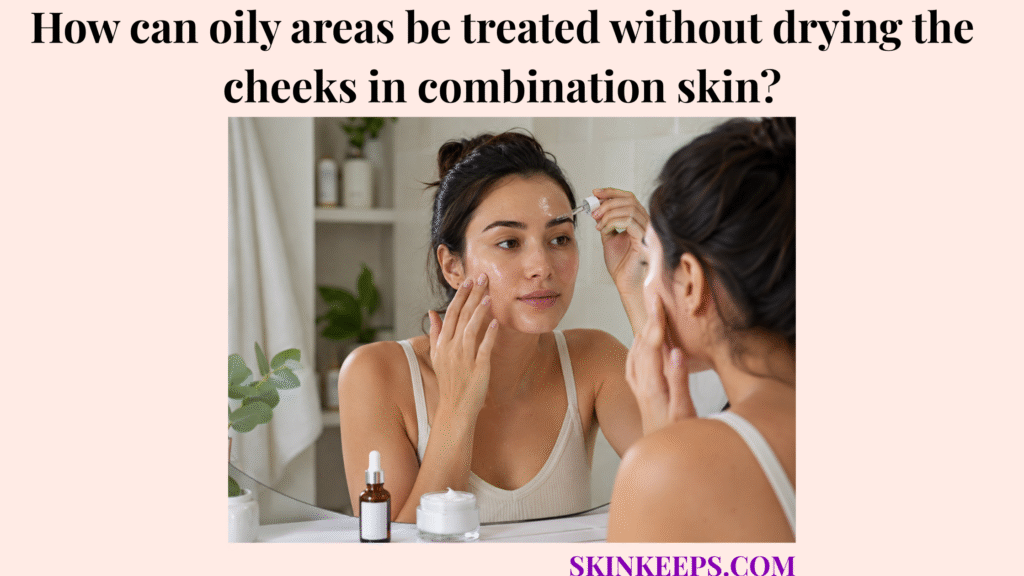
Oily areas in combination skin can be treated without drying the cheeks by using gentle cleansing, lightweight noncomedogenic products, targeted oil-control steps only on the T-zone, and extra moisture support where the cheeks feel dry or tight.
The goal in combination skin is to manage shine, congestion, and breakouts without stripping the whole face. The forehead, nose, and chin may need lighter oil-control steps, while the cheeks should not receive the same treatment unless they share the same problem.
In combination skin, oil control should be local while cheek protection should be constant. That means treating oily areas directly, then keeping the cheeks, around-mouth area, and outer face comfortable enough to avoid tightness, flakes, stinging, or irritation.
Why should combination skin protect the cheeks before treating oily areas?
Combination skin should protect the cheeks before treating oily areas because oil-control products can easily make drier zones tight, flaky, stingy, or irritated.
Products used for oil, clogged pores, blackheads, or breakouts can be useful in the T-zone, but those same steps may be too strong for cheeks. This is why different skin types and mixed-zone patterns need a zone-aware approach instead of one full-face rule.
If cheek areas become damaged or irritated, combination skin often looks and feels more unbalanced. A routine that makes the nose less shiny but leaves cheeks burning, flaking, or rough is not a balanced oily-area treatment.
Figure 1: In combination skin, oil-control treatment should stay local while cheek comfort is protected.
| Combination skin zone | Common need | Treatment logic |
|---|---|---|
| Forehead | Shine, bumps, sweat buildup | Use light oil-control steps only where needed |
| Nose | Blackheads, visible pores, oil | Target congestion carefully |
| Chin | Breakouts, oil, treatment dryness | Treat breakouts but moisturize around them |
| Cheeks | Dryness, tightness, sensitivity | Protect barrier and avoid strong actives |
| Around mouth | Peeling, stinging, irritation | Keep acne actives away if reactive |
| Jawline | Breakouts, dryness, friction | Track cause before treating aggressively |
Practical Rule: Do not let the oiliest zone decide the treatment strength for the driest zone.
How should combination skin cleanse oily areas without drying cheeks?
Combination skin should cleanse oily areas without drying cheeks by using a gentle cleanser that removes oil, sweat, sunscreen, and residue without leaving cheeks tight.
Cleansing is often the first place oily-area treatment goes wrong. Combination skin can need enough cleansing to remove sunscreen, sweat, and residue from oily zones, but not so much cleansing that cheeks feel squeaky, stretched, or uncomfortable.
Use gentle cleansing for combination skin instead of harsh oil removal
Gentle cleansing works better for combination skin than harsh oil removal because the cleanser should clean the T-zone without making the cheeks tight or the face squeaky.
A cleanser can remove oil, sweat, sunscreen, and residue without trying to erase every trace of surface oil. For many people, choosing the right care tips that balance oily and dry zones in combination skin starts with a cleanser that feels clean but not stripped.
Cleanse combination skin after sweat without scrubbing cheeks
Combination skin should be cleansed or rinsed gently after sweat because buildup can affect oily areas, but scrubbing can dry or irritate the cheeks.
Workouts, masks, helmets, humid exposure, and sunscreen residue can make the T-zone feel heavier. Gentle removal is safer than repeated scrubbing because friction can make cheeks more reactive while the oily areas still return to shine later.
Watch cheek tightness after cleansing combination skin
Cheek tightness after cleansing combination skin is a warning sign that the cleanser may be too strong even if the T-zone feels clean.
If cheeks feel tight within minutes after washing, the cleanser may not fit the whole face. That warning matters even when the forehead, nose, or chin feels temporarily fresh.
| Cleansing issue in combination skin | Better move | Avoid |
|---|---|---|
| T-zone gets oily by midday | Gentle morning or evening cleansing | Strong cleanser to “dry it out” |
| Cheeks feel tight after wash | Use milder cleanser | High-foam stripping cleanser |
| Sweat after workout | Cleanse or rinse gently | Scrubbing repeatedly |
| Sunscreen residue | Cleanse thoroughly but gently | Using toner to strip residue |
| Oily but tight T-zone | Add light hydration | Washing more often |
| Breakouts plus flakes | Simplify cleanser first | Acne cleanser everywhere |
Practical Rule: A cleanser that helps the T-zone but tightens the cheeks is not balanced for combination skin.
How should combination skin moisturize oily areas without clogging them or drying cheeks?
Combination skin should moisturize oily areas with thin lightweight layers and moisturize cheeks more supportively so oil control does not turn into dryness.
Moisturizer is not the enemy of oily areas. In combination skin, the safer move is usually to change amount, texture, and placement rather than skip moisturizer completely.
Use lightweight moisturizer on oily areas in combination skin
Lightweight moisturizer helps oily areas in combination skin when the forehead, nose, and chin need comfort without thick cream or greasy buildup.
Gel, gel-cream, or light lotion textures may fit oily areas when used thinly. A lightweight layer can support comfort without forcing heavy cream over the T-zone.
Use more supportive moisturizer on cheeks in combination skin
More supportive moisturizer helps cheeks in combination skin when they feel dry, tight, rough, flaky, or easily irritated.
Cheeks and the around-mouth area may need more barrier support than the T-zone. That does not mean the whole face needs a rich layer; it means cheek support should be placed where dryness appears.
Change moisturizer amount before changing every product on combination skin
Combination skin should change moisturizer amount before changing every product because one moisturizer may work with less on oily zones and more on cheeks.
Amount control keeps the routine easier to read. If one product works on cheeks but feels heavy on the nose, changing placement may solve the issue before adding more products.
| Combination skin area | Moisturizer direction | What to avoid |
|---|---|---|
| Forehead | Thin lightweight layer | Heavy cream if shiny or bumpy |
| Nose | Very thin layer | Thick occlusive layers |
| Chin | Light noncomedogenic support | Acne treatment with no moisturizer |
| Cheeks | Normal to generous layer | Treating cheeks like oily zones |
| Around mouth | Barrier support if peeling | Strong actives without protection |
| Jawline | Adjust by acne or dryness | Heavy layer over clogged bumps |
Practical Rule: Oily areas usually need less moisturizer, not no moisturizer.
Which oil-control treatments can combination skin use only on oily areas?
Oil-control treatments that combination skin can use only on oily areas include targeted salicylic acid, spot treatments, clay masks, lightweight hydration, blotting, and lighter textures.
Oily-area care in combination skin should be precise. The treatment should match the forehead, nose, or chin concern without drying cheeks that are already normal, tight, or reactive.
Many oil-control decisions overlap with targeted treatments for the T-zone and cheeks, because the safer rule is to treat the zone with the repeated problem.
Figure 2: Oily-zone care works best when active ingredients follow the problem instead of spreading across dry cheeks.
| Oily-area concern in combination skin | Targeted treatment option | How to protect cheeks |
|---|---|---|
| Nose blackheads | Salicylic acid on nose or T-zone if tolerated | Keep away from dry cheeks |
| Forehead bumps | Salicylic acid or product-contact review | Check hair products and sweat first |
| Chin breakouts | Spot treatment or acne active | Moisturize surrounding dry areas |
| T-zone shine | Lightweight texture, blotting, oil-free products | Do not over-wash |
| Oily but tight skin | Hydrating gel or light lotion | Avoid stronger drying products |
| Temporary oil surge | Clay mask on T-zone only | Do not apply to cheeks |
| Clogged sunscreen feel | Lighter sunscreen or better removal | Avoid scrubbing |
Practical Rule: Treat oily areas by placing the right product in the right zone, not by making the whole face drier.
How can combination skin use salicylic acid without drying cheeks?
Combination skin can use salicylic acid without drying cheeks by applying it only to clogged oily zones and reducing use when tightness, flakes, burning, or stinging appears.
Salicylic acid may help clogged oily zones, but it can also dry or irritate areas that do not need it. Combination skin should use it as a targeted active, not as a full-face default.
Apply salicylic acid only to clogged oily zones in combination skin
Salicylic acid should be applied only to clogged oily zones in combination skin, such as the nose, forehead, chin, or T-zone areas that repeatedly show congestion.
Nose blackheads, forehead congestion, and chin bumps are examples of areas where salicylic acid may make sense if tolerated. The surrounding cheeks do not need the same active unless they are also clogged and comfortable with it.
Keep salicylic acid away from dry cheeks in combination skin
Salicylic acid should be kept away from dry cheeks in combination skin when cheeks are tight, peeling, stingy, or already under-supported.
Dry cheeks often need moisture and barrier support instead of more exfoliation. This is why ingredients that support combination skin balance should be selected by role and placement, not copied everywhere.
Reduce salicylic acid frequency if combination skin becomes tight or flaky
Salicylic acid frequency should be reduced in combination skin when dryness, peeling, burning, or stinging suggests the active is too frequent, too strong, or too widely placed.
More active use is not always better. If oily areas start feeling tight or dry zones begin peeling, placement and frequency should be reassessed before adding another treatment.
| Combination skin pattern | Salicylic acid placement | Caution |
|---|---|---|
| Nose blackheads only | Nose only | Do not spread to cheeks |
| Forehead congestion | Forehead only | Watch dryness near temples |
| Chin breakouts | Chin or spot areas | Avoid mouth corners |
| T-zone congestion | T-zone only | Use low frequency first |
| Cheeks are dry | Avoid cheeks | Use barrier support instead |
| Breakouts plus peeling | Pause or reduce | Repair barrier first |
How can combination skin use benzoyl peroxide or spot treatments without drying cheeks?
Combination skin can use benzoyl peroxide or spot treatments without drying cheeks by applying them only to inflamed pimples or recurring breakout zones.
Benzoyl peroxide and spot treatments can be drying around the treated area. In combination skin, that means the product should stay close to the pimple or breakout zone instead of spreading over cheeks or mouth corners.
Use benzoyl peroxide only where combination skin has inflamed breakouts
Benzoyl peroxide should be used only where combination skin has inflamed breakouts because it can dry or irritate the surrounding skin.
Inflamed pimples on the chin, jawline, or forehead may need direct care. The surrounding dry skin should be protected so the treatment does not create peeling beyond the breakout.
Avoid spreading spot treatments like moisturizer on combination skin
Spot treatments should not be spread like moisturizer on combination skin because they belong on pimples or recurring breakout zones, not dry cheeks.
A spot treatment is not a full-face moisturizing step. Spreading it widely can turn a local breakout plan into a full-face irritation problem.
Moisturize around treated areas in combination skin
Combination skin should be moisturized around treated areas because acne treatments can cause peeling around pimples, chin areas, or mouth-adjacent skin.
Lightweight moisturizer may be enough near oily zones, while mouth-adjacent or cheek areas may need a more protective layer. Moisturizer does not cancel sensible acne care; it can make treatment easier to tolerate.
| Situation in combination skin | Better move | Avoid |
|---|---|---|
| One inflamed chin pimple | Spot treat only the pimple | Full-face benzoyl peroxide |
| Jawline breakout cluster | Treat the affected zone | Spread to dry cheeks |
| Cheeks are peeling | Avoid drying spot treatments there | Treating flakes as acne |
| Mouth-area pimples | Apply carefully away from corners | Over-applying |
| Peeling after spot treatment | Reduce amount or frequency | Adding another active |
| Painful deep acne | Consider dermatology help | Endless spot treatment |
How can combination skin use clay masks without drying cheeks?
Combination skin can use clay masks without drying cheeks by applying them only to oily T-zone areas and avoiding dry, tight, or reactive cheek zones.
Clay masks can be useful for temporary T-zone oil control in combination skin, but they should usually be applied only to oily areas. Dry cheeks, around-mouth skin, and reactive patches may become tighter or more irritated if clay masks are applied full-face.
| Clay mask use in combination skin | Better placement | Avoid |
|---|---|---|
| Shiny nose | Nose only or T-zone only | Full-face drying mask |
| Oily forehead | Forehead only | Applying to dry cheeks |
| Chin oiliness | Chin only if not peeling | Around-mouth dryness |
| Dry cheeks | Skip clay there | “Balancing” mask full-face |
| Tight skin after mask | Use less often or stop | Leaving mask until cracking |
| Breakouts plus flakes | Avoid clay over flakes | More drying products |
Practical Rule: A clay mask should absorb oil where oil is a problem, not punish areas that are already dry.
How can combination skin exfoliate oily areas without damaging cheeks?
Combination skin can exfoliate oily areas without damaging cheeks by targeting tolerated clogged zones and avoiding exfoliation over flakes, burning, redness, or dry roughness.
Exfoliation is not the same as scraping away every texture change. In combination skin, rough cheeks may be dry or irritated, while the nose or chin may be truly clogged.
| Texture issue in combination skin | Better exfoliation decision | Avoid |
|---|---|---|
| Nose congestion | Targeted salicylic acid if tolerated | Scrubbing the whole face |
| Forehead bumps | Check sweat and hair products first | Daily harsh acids immediately |
| Chin clogged pores | Use low-frequency targeted exfoliation | Treating dry mouth area |
| Cheek roughness | Moisturize and repair first | Exfoliating flakes aggressively |
| Oily but tight T-zone | Hydrate and reduce stripping | More exfoliation |
| Burning or red zones | Stop exfoliation there | Pushing through irritation |
| Breakouts plus peeling | Reduce actives | Stacking acid and acne treatment |
Practical Rule: In combination skin, rough cheeks are often under-supported, not under-exfoliated.
How can combination skin protect cheeks while treating oily areas?
Combination skin can protect cheeks while treating oily areas by moisturizing cheeks, keeping actives local, avoiding product migration, and stopping steps that cause stinging or flakes.
Cheek protection is not a side detail. It is part of treating oily areas safely because a stronger T-zone plan can accidentally spread to mouth corners, nose corners, or dry cheek zones.
| Cheek risk in combination skin | Protection step | Why it helps |
|---|---|---|
| Tight cheeks after oil-control products | Apply moisturizer to cheeks before treatment | Limits dryness |
| Cheeks sting after acids | Avoid acid on cheeks | Reduces irritation |
| Around-mouth peeling | Keep actives away from mouth corners | Protects delicate zones |
| Makeup clings to cheeks | Moisturize cheeks before sunscreen or makeup | Smooths dry texture |
| Redness after treatment | Simplify and use gentle formulas | Lowers irritation load |
| Dry patches worsen | Pause exfoliation on cheeks | Helps barrier recovery |
| Treatment spreads accidentally | Apply with precision and wash hands | Reduces product migration |
Practical Rule: Cheek protection is part of oily-area treatment. Without it, the routine is not balanced.
How should combination skin choose sunscreen and makeup when treating oily areas?
Combination skin should choose sunscreen and makeup by zone when treating oily areas so the T-zone stays lighter while cheeks stay moisturized and smooth.
Sunscreen and makeup can undo a careful oil-control routine if the T-zone gets overloaded or the cheeks are left under-supported. A lighter T-zone layer can sit beside a more comfortable cheek prep.
For oily-but-tight zones, a gel-based moisturizer for combination skin may help the center face feel comfortable without the heaviness that can make sunscreen or makeup slide.
| Daily-wear issue in combination skin | Oily-area adjustment | Cheek protection |
|---|---|---|
| Sunscreen greasy on T-zone | Use lighter moisturizer underneath or lighter SPF texture | Keep cheeks moisturized |
| Foundation separates on nose | Use less prep product on nose | Do not over-powder cheeks |
| Powder cakes on cheeks | Powder only oily zones | Hydrate dry zones first |
| Primer dries cheeks | Use mattifying primer only on T-zone | Use normal or hydrating prep on cheeks |
| Makeup clings to flakes | Avoid exfoliating flakes aggressively | Moisturize and reduce actives |
| Sunscreen clogs chin | Improve gentle removal | Do not scrub |
Practical Rule: For combination skin, makeup and sunscreen prep should be split: lighter where oily, smoother where dry.
How can combination skin tell if oily-area treatment is too harsh?
Combination skin can tell oily-area treatment is too harsh when the T-zone feels tight or hot, cheeks sting or flake, or breakouts appear with peeling.
A treatment does not need to burn, sting, or strip to work. If oily areas look less shiny but cheeks become rough, the treatment may be too strong, too frequent, or placed too widely.
Figure 3: The safer goal is comfort plus targeted shine control, not a stripped or squeaky finish.
| Skin response in combination skin | Balanced oil treatment | Too harsh |
|---|---|---|
| T-zone | Less greasy but comfortable | Shiny but tight or hot |
| Cheeks | Comfortable and smooth | Tight, flaky, or stinging |
| Around mouth | Calm | Peeling or burning |
| Breakouts | Gradually less congested | Breakouts plus peeling |
| Makeup | Wears more evenly | Clings to dry zones |
| Moisturizer | Feels comfortable | Stings after treatment |
| Cleansing feel | Clean but not squeaky | Squeaky, stretched, dry |
Practical Rule: If treating oil creates tightness, flakes, or stinging, the treatment is too aggressive or placed too widely.
How should combination skin test oily-area treatments safely?
Combination skin should test oily-area treatments safely by adding one oil-control product at a time and applying it only to the oily or congested zone.
Testing should make the pattern easier to understand. Adding multiple active products, masks, toners, and acne steps at once makes it harder to know which step helped the T-zone or harmed the cheeks.
- Add one oil-control product at a time.
- Apply it only to the oily or congested zone.
- Start with low frequency.
- Keep cleanser, moisturizer, and sunscreen stable.
- Use moisturizer on cheeks before strong actives if needed.
- Track T-zone shine, nose congestion, chin breakouts, cheek tightness, and around-mouth peeling.
- Avoid combining salicylic acid, benzoyl peroxide, retinoids, clay masks, and exfoliating toners all at once.
- Stop or reduce if burning, swelling, rash-like redness, or persistent peeling appears.
- Judge improvement over repeated use, not one day.
- Remove the harshest product first if the skin becomes oily and dry at the same time.
Practical Rule: A targeted oil-control plan should make combination skin easier to read, not more irritated.
What mistakes dry the cheeks while treating oily areas in combination skin?
The mistakes that dry cheeks while treating oily areas in combination skin are full-face oil-control products, over-cleansing, full-face clay masks, skipped moisturizer, and too many strong actives.
Most cheek-drying mistakes happen when an oily-zone idea becomes a full-face rule. Combination skin needs targeted control, not global drying.
Avoid full-face oil-control products on combination skin
Full-face oil-control products can dry cheeks in combination skin when products meant for the T-zone are spread over normal, dry, or reactive zones.
Salicylic acid, acne cleansers, and astringent toners may have a role in oily areas, but they do not belong over every cheek or around-mouth area by default.
Avoid over-cleansing combination skin to reduce shine
Over-cleansing combination skin to reduce shine can tighten cheeks and leave the T-zone oily but uncomfortable.
Frequent washing can make the face feel stripped without solving midday shine. This is why toner for combination skin should not be used as a drying second cleanser when the better fix is gentler cleansing or lighter textures.
Avoid using clay masks across the whole face in combination skin
Clay masks across the whole face can dry cheeks in combination skin because cheeks may not need the same oil absorption as the T-zone.
The nose, forehead, and chin may tolerate a clay step better than cheeks or the around-mouth area. Full-face masking can turn local oil control into cheek tightness.
Avoid skipping moisturizer on combination skin
Skipping moisturizer on combination skin can make cheeks lose support and make oily zones feel tighter after cleansing or active ingredients.
Moisturizer helps treatment tolerance. Use a light layer on oily zones and a more supportive layer on cheeks instead of removing moisturizer from the routine.
| Mistake | Why it dries cheeks in combination skin | Better move |
|---|---|---|
| Acne cleanser full-face | Dry cheeks and mouth area may peel | Use gentle cleanser or targeted treatment |
| Salicylic acid everywhere | Dry zones may sting or flake | Apply only where clogged |
| Clay mask full-face | Cheeks become tight | T-zone only |
| Alcohol-heavy toner | Strips and irritates | Skip or use gentle hydrating option |
| Washing whenever shiny | Weakens comfort | Blot or adjust texture |
| No moisturizer | Cheeks lose support | Moisturize by zone |
| Scrubbing blackheads | Adds friction | Use gentle targeted care |
| Heavy cream to “repair” whole face | T-zone may clog | Richer layer only on cheeks |
When should oily-area treatment problems in combination skin need a dermatologist?
Oily-area treatment problems in combination skin need a dermatologist when treatments cause pain, burning, swelling, bleeding, spreading irritation, rash-like patches, or scarring.
Localized oiliness is usually a routine-management issue, but pain, cystic acne, bleeding, spreading redness, swelling, or rash-like irritation should not be treated as ordinary shine.
- Breakouts are painful, deep, cystic, or scarring.
- T-zone acne does not improve with gentle targeted care.
- Cheeks crack, bleed, burn, or spread with irritation.
- Products repeatedly sting, burn, or cause swelling.
- Around-mouth peeling keeps returning.
- Redness, warmth, or rash-like patches appear.
- Peeling continues after stopping strong actives.
- Skin reacts to many gentle products.
- Oiliness and dryness worsen together despite routine simplification.
- The reader suspects acne, dermatitis, eczema, rosacea, allergy, folliculitis, or infection.
Practical Rule: Oily-area treatment should not create pain, bleeding, burning, swelling, or spreading irritation. Those signs need professional review.
What should you remember about treating oily areas without drying cheeks in combination skin?
The key point is that oily areas in combination skin should be treated locally while cheeks are protected with gentle cleansing, moisture support, and fewer strong actives.
- Treat oily areas in combination skin without drying the cheeks by targeting only the oily zones.
- Use a gentle cleanser, not a stripping cleanser.
- Do not wash repeatedly just because the T-zone shines.
- Use lightweight moisturizer on oily zones.
- Use stronger moisture support on cheeks.
- Apply salicylic acid only where clogged and tolerated.
- Use benzoyl peroxide or spot treatments only where breakouts occur.
- Use clay masks on the T-zone only.
- Keep strong actives away from dry cheeks and around-mouth areas.
- Protect cheeks before increasing oil-control strength.
- Choose sunscreen and makeup prep by zone.
- Watch for tightness, flakes, stinging, burning, or breakouts plus peeling.
- Test one oil-control product at a time.
- Seek help for painful acne, cracking, bleeding, burning, swelling, rash-like irritation, or scarring.
Frequently Asked Questions About Treating Oily Areas in Combination Skin
Can combination skin use oil-control products only on the T-zone?
Yes. Combination skin often does better when oil-control products are used only on oily or congested zones, such as the forehead, nose, and chin.
How do I stop my cheeks from drying out when treating an oily T-zone?
Keep oil-control steps on the T-zone, use a gentle cleanser, moisturize cheeks more supportively, and avoid clay masks, acids, or acne treatments on dry cheek areas.
Should salicylic acid go on the whole face if only my T-zone is oily?
Not usually. Salicylic acid should usually go where congestion or blackheads occur. Dry cheeks may peel or sting if salicylic acid is applied unnecessarily.
Can clay masks dry out cheeks in combination skin?
Yes. Clay masks can make dry or normal cheeks feel tight, rough, or irritated. They are usually safer on the oily T-zone only.
Should oily areas still be moisturized in combination skin?
Yes. Oily areas in combination skin often still need a thin, lightweight moisturizer, especially after cleansing or acne treatment. Skipping moisturizer can make skin feel tight and unstable.
Conclusion About Treating Oily Areas Without Drying Cheeks in Combination Skin
Treating oily areas in combination skin works best when the T-zone gets targeted care and the cheeks stay protected. Gentle cleansing, lightweight textures, noncomedogenic support, careful active placement, and cheek moisturizer can reduce the risk of turning oil control into dryness.
Combination skin does not need the whole face dried to make the oily areas look calmer. The safer approach is to treat shine, congestion, or breakouts where they repeat, then stop or reduce any step that causes cheek tightness, flakes, burning, or irritation.
Sources & Evidence for Treating Oily Areas Without Drying Cheeks in Combination Skin
Cleveland Clinic: What Is My Skin Type and Why Does It Matter? — supports the article’s combination-skin zone framing, including oilier T-zone areas and drier cheek or eye-area zones.
American Academy of Dermatology: Face washing 101 — supports gentle cleansing, lukewarm water, fingertip cleansing, avoiding scrubbing, and cleansing after sweating.
American Academy of Dermatology: How to control oily skin — supports oil-free and noncomedogenic product selection, gentle cleansing, avoiding scrubbing, and reducing irritating acid use when needed.
American Academy of Dermatology: Moisturizer and acne treatment — supports moisturizer use when acne treatments such as benzoyl peroxide, salicylic acid, and retinoids cause dryness or irritation.
American Academy of Dermatology: How to safely exfoliate at home — supports selective exfoliation and caution for dry, sensitive, acne-prone, or irritated skin.
DermNet: Emollients and moisturisers — supports humectant, emollient, and occlusive moisturizer roles and barrier-support logic for dry areas.
Educational Disclaimer About Treating Oily Areas in Combination Skin
Educational Disclaimer: This article is for general skin education only and does not diagnose, treat, or replace professional medical advice. If oily-area treatments cause burning, swelling, cracked or bleeding patches, painful acne, scarring, spreading redness, rash-like irritation, or persistent product reactions, consult a qualified dermatologist.