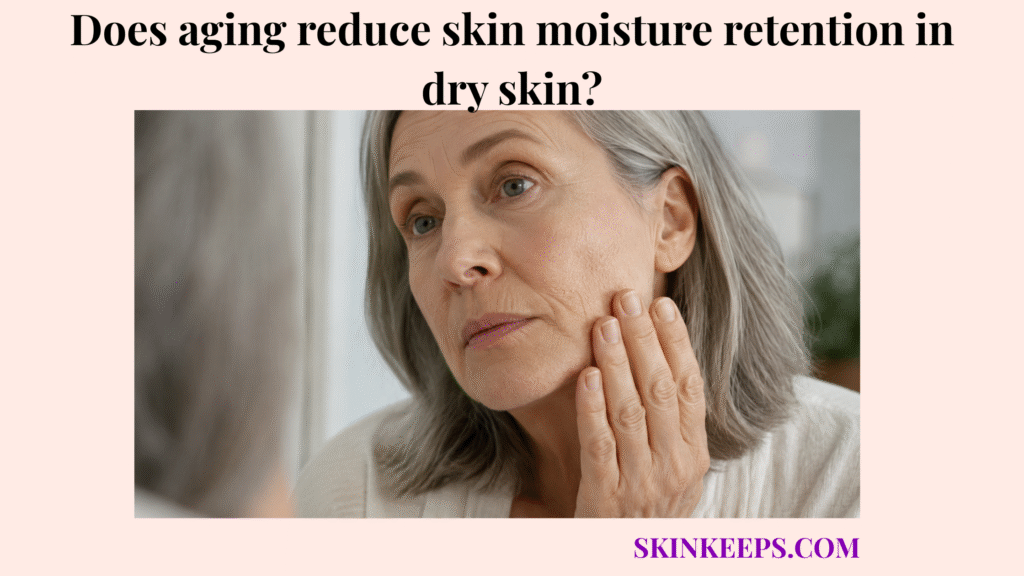
Yes, aging reduce skin moisture retention in dry skin by lowering natural oil support, weakening barrier comfort, slowing repair, and making the outer layer less able to stay flexible. This is why dry skin may feel tighter, rougher, itchier, thinner, more fragile, and slower to recover as the skin ages.
This article explains how aging affects dry-skin moisture retention, why older skin often produces less natural oil, how barrier lipids and repair speed change, why aged dry skin can look duller or more lined, how hormones may influence moisture balance, and when dryness should be evaluated instead of treated as normal aging.
How does aging reduce moisture retention in dry skin?
Aging reduces moisture retention in dry skin by making the outer layer less efficient at holding water, maintaining lipid support, and recovering from daily barrier stress. These changes can make dryness feel more persistent than it did earlier in life. Age-related moisture loss is one pathway within dry skin, but it deserves its own page because the trigger is chronological barrier change rather than weather alone.
Older dry skin can also respond less forgivingly to washing, weather, sun exposure, and friction. A small trigger may create tightness or roughness that lasts longer because the skin’s recovery process is slower. National Institute on Aging describes skin changes with age and recommends protective care for older skin. National Institute on Aging
How older skin holds less water in the outer layer
Older skin holds less water in the outer layer because age-related changes can reduce barrier efficiency, flexibility, and the skin’s ability to keep moisture where it is needed. This does not require unverified water-loss numbers to be useful. The practical result is tighter, rougher skin that may feel less flexible after ordinary daily stress.
Why aging makes dry skin more persistent
Aging makes dry skin more persistent because older skin often recovers more slowly after washing, weather exposure, irritation, or surface lipid loss. Slower recovery means the skin may still feel dry when the next trigger arrives. That overlap can make age-related dryness feel harder to control.
| Age-Related Change | What Happens | Dry-Skin Result |
|---|---|---|
| Lower oil production | Less natural surface lubrication | More tightness and roughness |
| Weaker barrier lipids | Skin loses moisture more easily | More dryness and irritation |
| Slower skin renewal | Dry cells shed less smoothly | Flaking or dull texture |
| Slower repair | Barrier recovers more slowly | Dryness lasts longer |
| Thinner skin support | Skin becomes more fragile | Cracking or sensitivity risk |
Why does older skin produce less natural oil?
Older skin produces less natural oil because aging can reduce sebaceous support, leaving the surface with less lubrication and less protection against post-wash tightness. This matters most in dry skin, where the surface already lacks enough comfort. With less oil support, dry skin can feel rougher after cleansing or exposure to cold air.
Lower oil does not mean older skin needs greasy products everywhere. It means the surface may need better barrier support and more consistent moisturizer. The product goal is comfort and flexibility, not a heavy film that feels unpleasant or blocks practical daily use.
How reduced oil production weakens surface comfort
Reduced oil production weakens surface comfort by leaving older dry skin with less natural slip, softness, and friction protection. That loss of slip can make fabric, towels, and washing feel more abrasive. Surface comfort matters because dry skin often notices friction before the skin looks visibly cracked.
Why less oil makes dry skin feel rougher after washing
Less oil makes dry skin feel rougher after washing because cleansing removes some surface comfort from skin that already has reduced natural lubrication. When older skin feels tight immediately after washing, harsh soaps remove natural lipids may explain why cleansing becomes less tolerable. A gentler cleanser can reduce that post-wash stripped feeling.
How does aging weaken the skin’s moisture barrier?
Aging weakens the skin’s moisture barrier by changing lipid support, slowing recovery, and making the outer layer less able to prevent water loss and irritation. Barrier lipids matter because they help the outer layer stay organized and comfortable. When that structure is weaker, older dry skin can feel tighter and more reactive after common triggers.
Aging belongs near biological and medical factors that contribute to dry skin, but this page isolates the moisture-retention mechanism instead of listing every internal cause. The focus stays on barrier aging, oil support, water retention, and recovery speed.
Why barrier lipids matter for moisture retention
Barrier lipids matter for moisture retention because they help the outer skin layer hold water, resist irritation, and stay flexible during daily stress. These lipids act like support between surface cells. When support is reduced, older dry skin can become less comfortable after washing, weather, or friction.
How weaker barrier organization increases water loss
Weaker barrier organization increases water loss by making the outer layer less efficient at keeping moisture inside the skin surface. This creates a practical problem rather than only a structural one. The skin can feel tight, rough, or easily irritated even when it does not yet look severely dry.
| Barrier Feature | Younger Dry Skin | Older Dry Skin |
|---|---|---|
| Oil support | Usually stronger | Often reduced |
| Barrier recovery | Faster | Slower |
| Flexibility | Better | Lower |
| Water retention | More resilient | Easier moisture loss |
| Irritation risk | Lower if barrier is intact | Higher when dry or over-washed |
Why does aging make dry skin look thinner, duller, or more lined?
Aging makes dry skin look thinner, duller, or more lined because reduced moisture retention and slower surface renewal make texture changes more visible. Fine lines can look clearer when the surface is dry, and dullness can increase when the outer layer is less smooth. When age-related dryness becomes visibly flaky, dry skin flaking and scaling can explain why older surface cells shed unevenly.
This section should not become a full anti-aging article. The page is about moisture retention, so visible changes should be understood as dryness-related texture changes. The focus stays on surface roughness, dullness, flaking, cracking, and comfort rather than broad claims about wrinkles, sagging, or facial aging.
Age-Related Visible Changes
- Fine lines look clearer when the surface is dry.
- Skin may look dull because the outer layer is less smooth.
- Roughness becomes more noticeable.
- Flaking may last longer.
- Cracks can form more easily when skin becomes stiff.
- Hands, legs, elbows, and face may show dryness more clearly.
How do hormones affect moisture retention as skin ages?
Hormones affect moisture retention as skin ages by changing oil support, barrier comfort, sensitivity, and the skin’s ability to stay hydrated during midlife and later years. This can make dryness more noticeable during perimenopause or menopause, when the skin may feel less naturally lubricated. The article should not reduce all older dry skin to one hormone.
Hormonal aging often interacts with other age-related changes. Lower surface comfort, slower recovery, medication use, and weather exposure can combine so dryness feels less predictable. The pattern should be explained without turning the page into a hormone-only discussion.
| Hormonal Change | Possible Dry-Skin Effect |
|---|---|
| Lower estrogen support | Less moisture retention and barrier comfort |
| Menopause or perimenopause | Dryness may become more noticeable |
| Age-related oil decline | Skin feels less naturally lubricated |
| Slower recovery after irritation | Dryness may persist longer |
Which habits make age-related dry skin worse?
Habits that make age-related dry skin worse include long hot showers, harsh soaps, skipping moisturizer, over-exfoliating, ignoring sunscreen, and rubbing the skin with rough towels. These habits remove comfort or add friction to skin that already repairs more slowly. The result can be tighter, rougher, itchier, or more easily irritated dry skin.
Long hot water can exaggerate age-related tightness because hot showers worsen dryness by removing comfort from an already lower-lipid surface. Older dry skin can also worsen faster when environmental factors that worsen dry skin add cold air, wind, or low humidity on top of age-related barrier changes.
| Habit | Why It Worsens Older Dry Skin |
|---|---|
| Long hot showers | Removes limited surface oils |
| Harsh soaps | Strips an already weaker barrier |
| Skipping moisturizer | Leaves water loss unsupported |
| Over-exfoliating | Makes fragile dry skin more reactive |
| Ignoring sunscreen | Adds long-term texture and barrier stress |
| Rubbing with rough towels | Adds friction to thinner dry skin |
How should aging dry skin be supported?
Aging dry skin should be supported with gentle cleansing, warm rather than hot showers, damp-skin moisturizing, richer support when dryness is obvious, sunscreen, and reduced friction. This routine helps compensate for lower oil support and slower recovery. Older dry skin usually benefits from consistency more than aggressive product changes.
Creams or ointments may be better when dryness is obvious, while lighter moisturizers may work when dryness is mild. Product texture should match skin feel instead of promising one universal “best” moisturizer. AAD recommends fragrance-free moisturizer, applying moisturizer after bathing, and using ointment when skin is very dry in older adults. American Academy of Dermatology
Older Dry-Skin Support Checklist
When is age-related dry skin more than normal aging?
Age-related dry skin is more than normal aging when it becomes severe, painful, bleeding, suddenly widespread, infection-looking, intensely itchy, or resistant to consistent supportive care. Mild dryness can be common with age, but severe or changing symptoms should not be dismissed. Professional evaluation is safer than assuming every dry-skin change is expected aging.
Dryness that cracks, bleeds, or stops responding to support may fit the escalation pattern where persistent dry skin needs a dermatologist. Body symptoms such as fatigue, weight changes, excessive thirst, or frequent urination should also move the issue beyond basic skincare. This section should stay clear, calm, and safety-oriented.
Medical Warning-Sign Checklist
What should you remember about aging and dry skin moisture retention?
The main point to remember is that aging can reduce skin moisture retention by lowering natural oil support, weakening barrier comfort, and slowing dry-skin recovery. Older skin often needs more consistent barrier support because it may be less forgiving after washing, weather exposure, and friction. Severe, sudden, bleeding, painful, or persistent dryness should be checked rather than treated as normal aging.
Final Takeaways
- Aging can reduce skin moisture retention.
- Older skin often produces less natural oil and repairs the barrier more slowly.
- Dryness can become tighter, rougher, itchier, and more persistent with age.
- Hormonal changes can make dryness more noticeable during midlife or later years.
- Older dry skin usually needs gentler cleansing and stronger barrier support.
- Severe, painful, bleeding, sudden, widespread, or persistent dryness should be evaluated professionally.
FAQs
Does aging reduce skin moisture retention in dry skin?
Yes, aging can reduce skin moisture retention in dry skin by lowering natural oil support, weakening barrier comfort, and slowing recovery.
Why does dry skin feel tighter with age?
Dry skin can feel tighter with age because the outer layer may hold less water and have less natural oil support than it did earlier in life.
Why does older skin produce less natural oil?
Older skin may produce less natural oil because age-related sebaceous support often declines, leaving the surface less lubricated.
Can aging make dry skin itchier?
Yes, aging can make dry skin itchier when reduced moisture retention, lower oil support, and slower repair make the outer layer more reactive.
Can hormones make older dry skin worse?
Yes, hormonal changes during perimenopause, menopause, or other age-related transitions can make dryness more noticeable.
What helps aging dry skin retain moisture?
Gentle cleansing, warm showers, damp-skin moisturizer, creams or ointments when needed, sunscreen, and reduced friction can help aging dry skin retain comfort.
When should age-related dry skin be checked?
Age-related dry skin should be checked when it is severe, painful, bleeding, suddenly widespread, infection-looking, intensely itchy, or not improving with supportive care.
Conclusion
Aging can reduce skin moisture retention in dry skin by lowering natural oil support, weakening barrier comfort, and slowing the skin’s recovery from daily stress. These changes can make dry skin feel tighter, rougher, itchier, thinner, more fragile, and more persistent than it felt earlier in life.
Supportive care should focus on gentle cleansing, damp-skin moisturizing, richer barrier support when needed, sunscreen, and professional evaluation when dryness becomes severe, sudden, painful, bleeding, widespread, or resistant to care. The goal is not to promise anti-aging reversal, but to support older dry skin more safely and consistently.