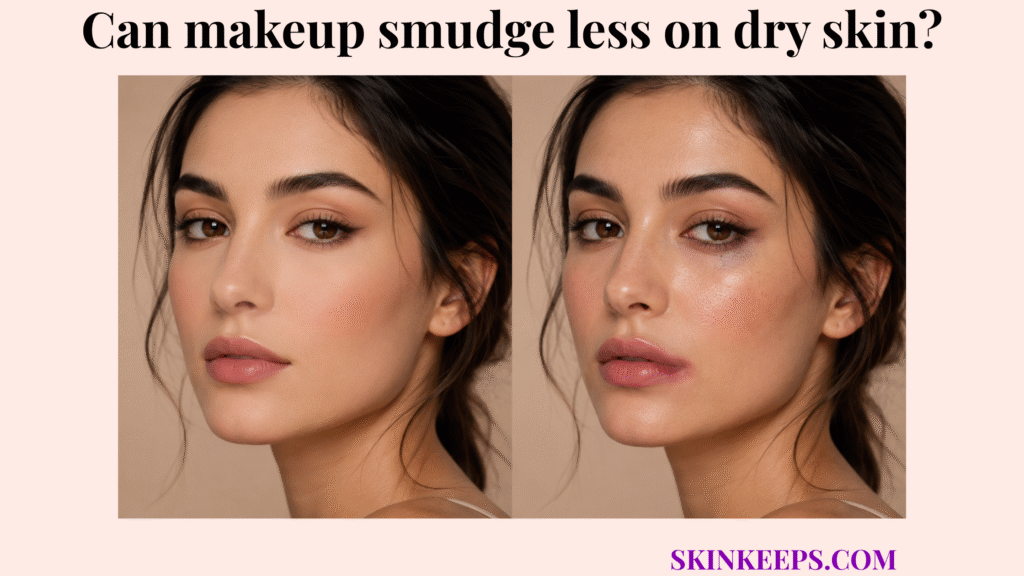
Yes, makeup can sometimes smudge less on dry skin because dry skin usually produces less sebum, so foundation, concealer, and eye makeup may be less likely to slide, separate, or become greasy during the day. This lower-oil pattern mainly reduces oil-driven transfer and smudging.
Dry skin has a different makeup problem: makeup can cling to flakes, settle into fine lines, crack around dry patches, or look uneven if the skin is not properly moisturized first. This article compares smudging, patchiness, dry vs oily makeup wear, makeup type direction, prep mistakes, warning signs, and final takeaways.
Why Can Makeup Smudge Less on Dry Skin?
Makeup can smudge less on dry skin because lower sebum output leaves less surface oil available to break down makeup and move product during the day. Sebum is the skin’s natural oil, and it can loosen makeup when it builds between the skin and the product film. This makeup-wear pattern fits the broader behavior of dry skin, where lower oil often comes with a higher need for moisture support.
Smudging can come from oil, sweat, friction, product texture, or application technique, so oil is not the only reason makeup moves. Dry skin mainly reduces the oil-driven part of smudging, not every possible form of transfer. Lower shine may also help makeup stay matte longer, especially when dry skin is less prone to oily shine during the day.
How Lower Sebum Reduces Makeup Slipping
Lower sebum reduces makeup slipping because less surface oil collects between the skin and the makeup film. Oil can loosen foundation, concealer, or cream products by increasing surface slickness and product movement. Dry texture can still cause different wear problems, so reduced slipping does not mean smoother makeup in every case.
Why Dry Skin Usually Has Less Oil-Driven Transfer
Dry skin usually has less oil-driven transfer because there is less surface oil to carry makeup onto fingers, phones, clothing, or masks. Product transfer often becomes more noticeable when T-zone oil breaks through and moves makeup away from the skin. Oil-driven transfer is different from texture clinging, which is why makeup can slide off more easily on oily skin than on skin with lower sebum.
| Dry-Skin Factor | Makeup Effect |
|---|---|
| Lower sebum output | Less oil breaking down makeup |
| Less greasy shine | Makeup may stay more matte |
| Less oil transfer | Less smudging onto fingers, phone, or clothing |
| Less T-zone oil breakthrough | Foundation may separate less from oil |
| Lower surface slickness | Products may move less during the day |
How Is Makeup Smudging Different From Makeup Patchiness?
Makeup smudging is different from makeup patchiness because smudging happens when product moves or transfers, while patchiness happens when makeup grips unevenly to dry or textured areas. Oil, sweat, friction, and product movement can cause smudging. Dryness, flakes, rough texture, and low-flexibility skin can cause patchiness, cracking, or fine-line settling.
This difference protects the reader from the wrong solution. If the issue is oily smudging, the problem is product movement. If the issue is dry patchiness, the problem is uneven grip and poor surface flexibility.
| Makeup Issue | Main Cause | More Common Skin Pattern |
|---|---|---|
| Smudging | Oil, sweat, friction, product movement | Oily or sweaty skin |
| Separating | Sebum breaking down product film | Oily T-zone |
| Patchiness | Makeup clinging unevenly | Dry or flaky skin |
| Cracking | Low flexibility and dry texture | Dry skin |
| Settling into lines | Surface dryness or fine texture | Dry or dehydrated-looking skin |
What Makeup Problems Are More Common on Dry Skin?
The makeup problems more common on dry skin are usually texture-related, including flakes, cracking, rough powder finish, patchy base makeup, and fine-line settling. These problems come from surface irregularity rather than oily transfer. Patchiness becomes more likely when flaking and scaling are common signs of dry skin before makeup is applied.
Dry-Skin Makeup Problems
- Foundation clings to flakes.
- Concealer looks cracked under the eyes.
- Powder makes skin look rougher.
- Matte foundation can emphasize dry patches.
- Makeup may settle into fine lines.
- Blush or bronzer may apply unevenly.
- Product can look dull instead of smooth.
Less smudging does not mean smoother makeup. Dry skin may avoid some oil-driven movement while still showing uneven texture. The better goal is not drier skin; it is moisturized skin that holds makeup evenly.
How Does Makeup Wear Differently on Dry Skin Compared With Oily Skin?
Makeup wears differently on dry skin compared with oily skin because dry skin usually has less oil-driven smudging but more texture-related patchiness. The contrast becomes clearer beside oily skin, where surface oil can make makeup movement more noticeable. Dry skin needs hydration and smoothing, while oily skin usually needs oil control and long-wear setting.
Fine-line settling can look more obvious when surface moisture is low, which connects to why fine lines appear more clearly on dry skin. This is still a makeup-wear comparison, not a broad dry-versus-oily skin ranking. Each skin type has a different failure pattern.
| Makeup Behavior | Dry Skin | Oily Skin |
|---|---|---|
| Smudging from oil | Usually lower | Higher |
| Foundation separation | Less oil-driven | More common in oily zones |
| Patchiness | More common | Less from dryness, more from oil breakdown |
| Fine-line settling | More noticeable if dehydrated-looking | Can happen, but often from product movement |
| Shine breakthrough | Lower | Higher |
| Best prep priority | Hydration and smoothing | Oil control and long-wear setting |
Which Makeup Types Work Better on Dry Skin?
Makeup types that often work better on dry skin are usually hydrating, satin, natural-finish, cream-based, or lightweight formulas that reduce texture clinging without adding heavy buildup. These directions describe finish and texture, not specific product brands. A product can still fail if it is too heavy, too matte, or poorly matched to the skin’s texture.
Best-Fit Makeup Direction
- Hydrating foundation.
- Satin or natural-finish base products.
- Cream blush or cream bronzer when texture is dry.
- Lightweight concealer instead of thick matte concealer.
- Minimal powder on dry areas.
- Hydrating primer where flakes or tightness appear.
- Setting spray instead of heavy powder when dryness is obvious.
The best-fit direction should reduce texture clinging without creating an artificial film. Heavy makeup can hide redness briefly but still look cakey when it sits on rough patches. The finish should match the surface, not force dryness into a matte formula.
What Makeup Mistakes Make Dry Skin Look Worse?
Makeup mistakes that make dry skin look worse usually involve applying product over unmoisturized texture, using too much powder, choosing very matte formulas, or scrubbing flakes before makeup. These mistakes backfire because dry skin has less surface flexibility. Scrubbing can also increase redness before the makeup is even applied.
Too much powder can turn a lower-smudge advantage into a rougher finish. Heavy product can also collect where the surface is uneven. The safer direction is smoothing and thin layering, not forcing a thick cover over dry texture.
| Mistake | Why It Backfires |
|---|---|
| Applying foundation on unmoisturized dry skin | Makeup clings to rough patches |
| Using too much powder | Dry texture looks more visible |
| Choosing very matte foundation | Flakes and fine lines stand out |
| Skipping lip or under-eye prep | Cracking becomes more obvious |
| Scrubbing flakes right before makeup | Irritation and redness increase |
| Using heavy product to hide texture | Makeup looks cakey instead of smooth |
How Should Dry Skin Be Prepped So Makeup Wears Smoothly?
Dry skin should be prepped for smooth makeup wear by cleansing gently, moisturizing before makeup, allowing moisturizer to settle, and applying thin layers that do not overload dry texture. Prep should reduce texture clinging without creating heaviness. Makeup prep works better when moisturizer timing is right, because moisturizer should be applied to dry skin before the surface feels tight or depleted.
This section should stay practical rather than becoming a full makeup tutorial. The purpose is to make the surface flexible enough for smoother makeup wear. A thin, settled layer is usually more helpful than piling product on top of flakes.
Dry-Skin Makeup Prep Checklist
- Cleanse gently.
- Apply moisturizer before makeup.
- Let moisturizer absorb before foundation.
- Use hydrating primer only where needed.
- Avoid heavy powder on dry patches.
- Use thin makeup layers instead of one thick layer.
- Choose satin, natural, or hydrating finishes.
- Press makeup gently instead of rubbing over flakes.
- Touch up dry patches with moisturizer, not more powder.
When Is Makeup Clinging or Cracking a Sign of Barrier Dryness?
Makeup clinging or cracking can be a sign of barrier dryness when it appears with stinging, painful dry patches, heavy flaking, redness, burning, itching, cracking, bleeding, swelling, oozing, or crusting. These signs suggest that the surface may be too compromised for normal cosmetic wear. The point is not to diagnose eczema, dermatitis, allergy, or infection from makeup behavior alone.
Persistent, painful, worsening, or unexplained symptoms may need professional review. Makeup should not sting, repeatedly crack over painful patches, or sit on broken skin without the skin issue being addressed. Cosmetic wear is secondary when the barrier is visibly irritated or damaged.
Barrier Dryness Warning Signs
- Makeup stings after application.
- Foundation cracks over painful dry patches.
- Skin flakes heavily under makeup.
- Redness, burning, or itching appears.
- Dry patches keep returning in the same places.
- Moisturizer does not improve makeup texture.
- Skin is cracked, bleeding, swollen, oozing, or crusted.
What Should You Remember About Makeup Smudging on Dry Skin?
Makeup can smudge less on dry skin because there is usually less sebum to break it down, but dry skin’s main makeup tradeoff is patchiness rather than oily smudging. Lower oil can reduce slipping and transfer, while flakes and rough texture can make makeup cling. The goal is smooth, moisturized skin, not drier skin.
Final Takeaways
- Makeup can smudge less on dry skin because there is usually less sebum to break it down.
- Dry skin’s main makeup problem is usually patchiness, not oily smudging.
- Lower shine can help makeup stay matte longer.
- Flakes, tightness, and rough patches can make makeup cling or crack.
- Dry skin needs hydration-focused prep before makeup.
- The goal is not drier skin; it is smooth, moisturized skin that holds makeup evenly.
Frequently Asked Questions
Does Makeup Last Longer on Dry Skin?
Makeup can sometimes last longer on dry skin when lower sebum reduces oil-driven slipping, transfer, and foundation separation. It may still look patchy, cracked, or uneven if dry skin is flaky, tight, rough, or not moisturized first.
Why Does Foundation Look Patchy on Dry Skin?
Foundation looks patchy on dry skin when makeup grips unevenly to flakes, rough patches, or low-flexibility texture. Patchiness is different from smudging because it usually reflects surface texture and prep problems rather than oil breakdown.
Should Dry Skin Avoid Powder Makeup?
Dry skin does not always need to avoid powder makeup, but heavy powder can make flakes, rough texture, and fine lines look more visible. Minimal powder on dry areas is usually safer than layering powder to hide texture.
Can Moisturizer Make Makeup Smudge on Dry Skin?
Moisturizer can make makeup move on dry skin if too much product is applied or if the moisturizer has not absorbed before foundation. Moisturizer is still important for dry skin, but makeup usually wears better when it has time to settle.
Is Matte Foundation Bad for Dry Skin?
Matte foundation is not always bad for dry skin, but very matte formulas can emphasize flakes, tightness, rough patches, and fine lines. Finish choice should match skin texture and comfort, not only the desire to avoid shine.
Conclusion
Makeup can sometimes smudge less on dry skin because lower sebum output leaves less surface oil available to break down or move makeup. That lower-oil pattern may reduce slipping, transfer, and oil-driven foundation separation compared with oilier skin.
Dry skin still creates a different makeup challenge: flakes, tightness, rough patches, and fine lines can make makeup cling, crack, or look patchy. The better goal is not drier skin; it is smooth, moisturized skin that lets makeup hold evenly without discomfort.