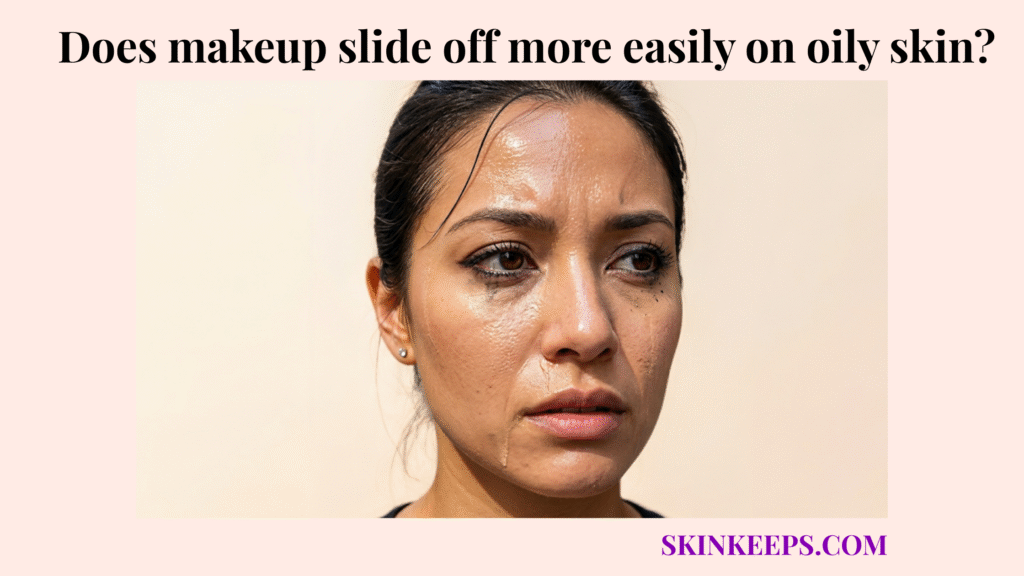
Yes, makeup often slides off oily skin more easily because surface sebum reduces cosmetic grip, weakens film stability, and makes the skin surface more slippery during wear. This sliding happens because makeup needs friction and surface contact to stay even, while oil reduces both.
This guideline explains how sebum interferes with makeup adhesion, why foundation separates or darkens, which touch-up mistakes create patchiness, and what formula traits improve oily-skin wear. It also explains how to apply and touch up makeup so the cosmetic film stays more stable without promising impossible permanence.
Why does makeup slide off more easily on oily skin?
Makeup sliding off more easily on oily skin happens because surface sebum creates a slippery lipid layer that reduces friction between cosmetics and the stratum corneum. This lipid layer reduces the friction that normally helps foundation and concealer grip the stratum corneum. The reduced friction makes coverage more likely to move, separate, or gather in textured areas. Because slick skin feel and makeup movement share the same surface-oil cause, an oily skin greasy feeling strongly predicts how quickly foundation will break down.
Oily or seborrheic skin is associated with sebum production above 1.5 mg/10 cm² every 3 hours. This higher output means makeup can face repeated oil breakthrough after application. The repeated oil breakthrough explains why wear can degrade even when the first application looks smooth. [PMC]
How surface sebum interferes with makeup adhesion
Surface sebum interferes with makeup adhesion by forming a lipid film that sits between the skin surface and the cosmetic film. This lipid film reduces direct contact between the foundation and the stratum corneum. Reduced contact weakens the grip that normally keeps the cosmetic film even.
Why oil buildup makes foundation more likely to move during wear
Oil buildup makes foundation more likely to move during wear because increasing surface lipids lower the grip that holds the cosmetic film in place. This oil buildup is a progressive process that happens continuously from the follicles. As the surface oil increases, the coverage becomes increasingly mobile and unstable.
How does sebum weaken makeup adherence on oily skin?
Sebum weakens makeup adherence on oily skin by mixing with compatible cosmetic ingredients and reducing the stability of the makeup film. This mixing changes how evenly the film sits on the skin. The uneven film becomes more likely to separate, streak, or gather around pores. Understanding the biology of oily skin helps clarify why this physical interaction between human lipids and cosmetic bases is unavoidable.
Human sebum contains several lipid fractions, with triglycerides and free fatty acids forming the largest portion, followed by wax esters and squalene. This lipid composition matters because many liquid foundations also contain oil-compatible emollients or pigment dispersion ingredients. The shared lipid compatibility helps explain why oily skin can destabilize makeup during wear. [PMC]
How sebum mixes with foundation components during wear
Sebum mixes with foundation components during wear when surface lipids interact with oil-compatible emollients, pigments, or dispersing agents. This interaction represents a physical compatibility rather than a destructive chemical reaction. The physical compatibility allows the cosmetic film to blend with the skin’s natural oils.
How a slippery oil film reduces friction and grip on the skin surface
A slippery oil film reduces friction and grip on the skin surface by coating the microscopic texture that makeup normally uses for hold. This microscopic texture provides the necessary traction for a stable foundation application. When oil fills these microscopic spaces, the surface becomes too slick to maintain strong cosmetic adhesion.
Why oily areas lose coverage faster than less oily areas
Oily areas lose coverage faster than less oily areas because repeated oil breakthrough weakens the makeup film more strongly in sebum-rich zones. This regional breakdown commonly targets the T-zone where follicular output is highest. The continuous outward flow of sebum simply displaces the cosmetic coverage over time.
| Mechanism | What Happens | Visible Result |
|---|---|---|
| Surface oil buildup | Sebum spreads across the skin | Makeup grips less well |
| Product–oil mixing | Foundation interacts with surface lipids | Coverage becomes less stable |
| Reduced surface grip | Skin surface becomes more slippery | Makeup shifts more easily |
| Repeated oil return | Sebum keeps reaching the surface | Wear breakdown increases over time |
How does oily skin cause makeup to separate, streak, or wear away unevenly?
Oily skin causes makeup to separate, streak, or wear away unevenly because sebum breaks down coverage locally around pores and oil-prone facial zones. This uneven breakdown often begins around pores, the nose, the forehead, or the chin. The localized pattern makes makeup look streaky, patchy, or lifted instead of evenly faded. Because T-zone oil makes both shine and makeup breakdown more noticeable, oily skin facial shine serves as an early warning for imminent foundation separation.
Sebaceous glands density can be high in facial regions, with anatomical references describing some sebaceous areas in the range of 400–900 glands/cm². This range should be used as a general high-density reference, not as a fixed value for every T-zone area. The practical point is that oil-prone zones often create faster makeup breakdown than less oily areas. [ScienceDirect]
How oily skin makes foundation separate around pores and textured areas
Oily skin makes foundation separate around pores and textured areas because sebum reaches the surface through follicular openings and disrupts nearby coverage. This pore-centered separation breaks the continuous makeup film into smaller, disconnected patches. The disrupted patches gather around the follicle, highlighting texture rather than hiding it.
Why makeup breaks apart faster in the T-zone on oily skin
Makeup breaks apart faster in the T-zone on oily skin because the forehead, nose, and chin often show stronger oil breakthrough during wear. This T-zone breakdown happens because the central face hosts a higher concentration of active sebaceous glands. The resulting intense oil flow lifts the foundation away from the stratum corneum rapidly.
How sliding differs from simple fading
Sliding differs from simple fading because sliding involves product movement, clumping, or displacement, while fading is a more even loss of coverage. This product movement pushes pigments into fine lines or pores, creating a messy finish. Simple fading leaves the skin looking bare but smooth, whereas sliding leaves a visible, disrupted residue.
Why can foundation look darker or more orange on oily skin over time?
Foundation can look darker or more orange on oily skin over time because sebum can saturate pigments, change light reflection, and make the makeup film look deeper or less fresh. This pigment saturation changes how the foundation reflects light. The changed light reflection can make the same shade look deeper, warmer, or less fresh during wear.
Oil breakthrough can also make foundation color look uneven. This uneven color appears when pigments clump in some areas and thin out in others. The result is patchiness that people may mistake for oxidation or a shade mismatch.
How sebum interaction can make foundation appear deeper or less fresh
Sebum interaction can make foundation appear deeper or less fresh because oil-wetted pigments reflect light differently from dry, evenly dispersed pigments. This optical darkening is similar to how a dry sponge looks lighter than a wet sponge. The physical wetting effect shifts the visual tone without requiring a complex chemical transformation.
Why separation and oil breakthrough can change the look of foundation color
Separation and oil breakthrough can change the look of foundation color because pigments stop sitting in a smooth, even film. This clumping and thinning leaves concentrated pigment in some spots and bare skin in others. The dense pigment clusters naturally look darker and heavier than a freshly blended application.
Why sweat and heat can worsen the appearance of wear even when sebum is the bigger driver
Sweat and heat can worsen the appearance of wear even when sebum is the bigger driver because moisture and warmth can spread an already unstable makeup film. These amplifiers increase the mobility of the cosmetic layer. The increased mobility causes the compromised foundation to streak and pool much faster.
| Wear Stage | What Is Happening | Common Visible Change |
|---|---|---|
| Fresh application | Film is more even and intact | Smoother, truer color |
| Early oil breakthrough | Sebum begins reaching the surface | More shine and weaker hold |
| Advanced wear | Mixing and separation increase | Darker-looking, patchier, less even makeup |
What touch-up mistakes make makeup sliding worse on oily skin?
Touch-up mistakes make makeup sliding worse on oily skin when powder, foundation, or rich products are layered directly over unblotted sebum. This powder-over-oil layering creates a thicker surface mixture instead of restoring a smooth finish. The thicker mixture can look cakey, patchy, or more textured. Removing surface oil before adding powder is critical, making blotting papers for oily skin an essential tool for preventing touch-up clumping.
Heavy foundation layering can also worsen wear on oily skin. This extra product mass gives sebum more material to mix with during the day. The larger mixed layer becomes less stable than a thinner, better-set film.
Why adding powder directly over surface oil creates patchiness
Adding powder directly over surface oil creates patchiness because dry powder can clump when it contacts a wet lipid film. This powder clumping generates small, uneven clusters of product across the face. The resulting texture looks heavy and emphasizes pores instead of blurring them.
Why repeated heavy layering makes oily makeup wear look cakier
Repeated heavy layering makes oily makeup wear look cakier because extra product mass mixes with sebum and builds uneven surface texture. This product mass overwhelms the skin’s ability to hold a smooth cosmetic film. The overloaded surface inevitably cracks, shifts, and looks highly unnatural.
Why dewy or overly emollient prep can worsen sliding on oily skin
Dewy or overly emollient prep can worsen sliding on oily skin because it adds extra slip before the makeup film has a chance to grip. This prep slip introduces unnecessary lubrication to an already oil-prone barrier. Skin prep should match the skin’s oil level to prevent immediate foundation failure.
| Mistake | What It Causes | Visible Result |
|---|---|---|
| Powdering over unblotted oil | Oil-powder buildup | Cakiness and clumping |
| Reapplying foundation over separation | More unstable layering | Patchiness and texture emphasis |
| Using overly rich prep | More surface slip | Faster breakdown |
| Skipping blotting before touch-ups | Oil remains under makeup | Continued sliding |
Which primer and foundation traits help makeup stay on oily skin better?
Primer and foundation traits that help makeup stay on oily skin better include matte finishes, oil-free bases, absorbent powders, and film-forming structures that resist surface sebum. Primer and foundation traits improve oily-skin wear when they reduce slip and support film stability. This improved cohesion helps the makeup layer stay more even during oil breakthrough. Choosing targeted oily skin product formulations ensures the cosmetic film is structurally suited to handle lipid interference.
The American Academy of Dermatology recommends oil-free, water-based makeup for oily skin and notes that matte products can reduce shine. This recommendation supports choosing lighter, matte-leaning formulas instead of heavy emollient bases. The same formula logic can improve wear by reducing extra surface slip. [American Academy of Dermatology]
Which primer features help reduce oil breakthrough under makeup
Primer features that help reduce oil breakthrough under makeup include absorbent powders and silicone-based textures that reduce surface slip. Ingredients like silica and dimethicone provide temporary wear support by soaking up minor oil and smoothing texture. These components create a more resilient base for the foundation to hold onto.
Which foundation traits improve wear on oily skin
Foundation traits that improve wear on oily skin include lightweight bases, matte-leaning finishes, and lower-slip textures. Oil-free makeup and water-based makeup formulas limit the amount of additional lipid introduced to the skin. These formulation choices ensure the makeup does not actively contribute to its own sliding.
Why film-forming and more matte-leaning formulas usually perform better on oily skin
Film-formers and more matte-leaning formulas usually perform better on oily skin because they create a more cohesive layer with less surface slip. This cohesive film holds its structure together even when minor sebum begins to emerge. The realistic expectation is improved wear stability, rather than absolute permanence.
| Formula Trait | Why It Helps |
|---|---|
| More matte finish | Reduces visible shine and slip |
| Film-forming wear structure | Improves cohesion during wear |
| Lighter, less emollient base | Reduces extra surface slip |
| Oil-control primer support | Helps delay visible breakthrough |
| Oil-free or water-based format | Adds less additional surface oil |
How should makeup be applied to reduce sliding on oily skin?
Makeup should be applied to reduce sliding on oily skin by using lightweight prep, thin product layers, strategic setting, and blotting before any touch-up. Makeup application reduces sliding when the base is light and controlled. This light base gives foundation fewer slippery layers to compete with. The result is a thinner cosmetic film that is easier to stabilize.
Touch-ups work better when oil is removed before new product is added. This blot-first method restores a drier surface for powder or foundation correction. A broader routine can use the same restraint principles found in oily skin care tips when the reader wants daily skincare steps that support makeup wear.
What prep steps help oily skin hold makeup better
Prep steps that help oily skin hold makeup better focus on removing excess surface oil and adding lightweight hydration without extra slip. Gentle cleansing and a lightweight moisturizer create a clean, non-greasy canvas. Choosing a dedicated oily skin sunscreen ensures daily UV protection does not add a heavy gloss before makeup application.
How thin layers improve makeup wear on oily skin
Thin layers improve makeup wear on oily skin because less product mass gives sebum less material to mix with during the day. This minimal approach keeps the cosmetic film tightly bound to the stratum corneum. Less product buildup naturally results in less visible sliding and separation.
Why blot-then-touch-up works better than layering over oil
Blot-then-touch-up works better than layering over oil because removing the lipid film first gives the next product a cleaner surface to grip. Blotting before powder prevents the fresh makeup from instantly clumping. This touch-up order preserves a smoother, more natural finish.
Daily Makeup-Wear Checklist
FAQs
Does makeup slide off more easily on oily skin?
Yes, makeup often slides off oily skin more easily because sebum reduces surface friction and weakens cosmetic film stability. This effect becomes more visible when foundation separates around pores, streaks, or shifts in the T-zone.
Why does foundation separate on oily skin?
Foundation separates on oily skin because surface sebum mixes with the makeup film and disrupts even pigment placement. This disruption often appears around pores, the nose, the forehead, and other oil-prone zones.
Why does foundation look darker on oily skin?
Foundation can look darker on oily skin because sebum saturates pigments and changes how they reflect light. This is usually a physical wear issue, not proof that skin pH has chemically turned the makeup orange.
Should I powder oily skin when makeup starts sliding?
You should blot first before adding powder. Powdering directly over unblotted oil can create clumps, cakiness, and patchiness because dry powder mixes with the existing lipid film.
What type of foundation works better on oily skin?
Matte-leaning, oil-free, water-based, and film-forming foundations usually work better on oily skin. These formulas reduce extra slip and support a more stable cosmetic layer during oil breakthrough.
Does primer stop makeup from sliding on oily skin?
Primer can reduce sliding, but it does not stop sebum production. Absorbent or silicone-based primers may improve grip and reduce surface slip, especially in the T-zone.
Why does makeup slide off my oily nose first?
Makeup often slides off the oily nose first because the nose sits in the T-zone, where oil breakthrough is usually stronger. This stronger oil presence weakens the makeup film faster than in less oily areas.
How can I touch up oily-skin makeup without making it cakey?
Blot first, then apply a small amount of powder only where needed. This method removes the lipid film before touch-up, which lowers clumping and keeps the makeup surface cleaner.
Conclusion
Makeup slides more easily on oily skin because sebum reduces grip and destabilizes the cosmetic film during wear. Oily-skin makeup lasts longer when the routine reduces slip before and during wear. Lightweight prep, thin layers, matte-leaning formulas, strategic setting, and blot-before-touch-up methods improve stability without promising permanent hold.
Better oily-skin makeup wear comes from managing friction, film stability, and oil breakthrough. At SkinKeeps, we explain these cosmetic chemistry mechanics to help readers build reliable, frustration-free routines.