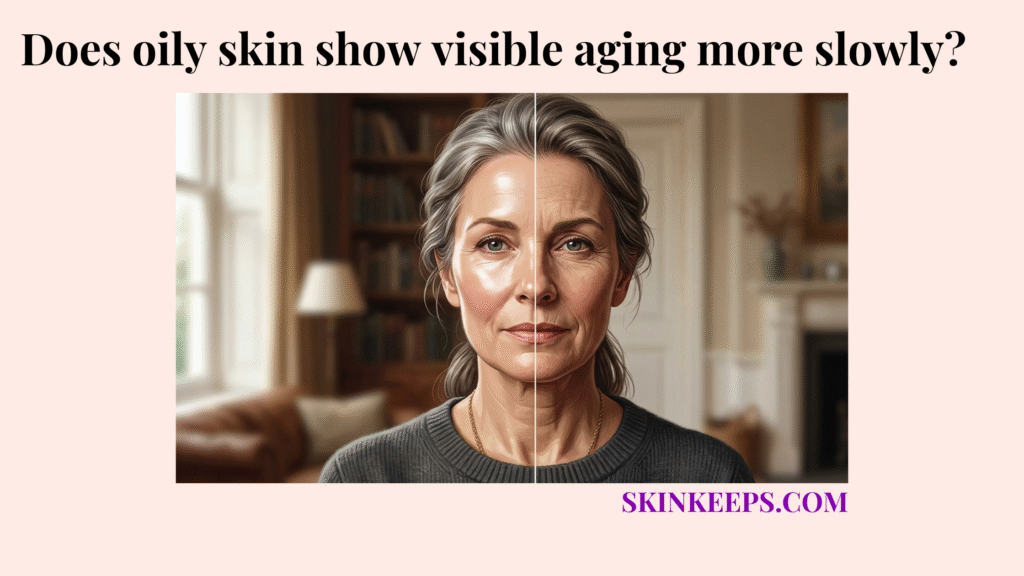
Yes, oily skin can show some visible aging signs more slowly, especially superficial dryness lines, because sebum helps lubricate the surface and soften the look of early creasing. This means oily skin may look smoother than drier skin in some early surface-aging patterns, but it does not become immune to aging.
This guideline explains why oily skin may show softer-looking early fine lines, how sebum changes surface optics, which aging signs still appear normally, and why UV exposure can override the oily-skin advantage. It also gives a preservation routine built around SPF, gentle cleansing, lightweight hydration, and careful non-comedogenic aging support.
Why can oily skin show early visible aging signs more slowly?
Oily skin can show early visible aging signs more slowly because surface sebum reduces the dry, tight texture that makes superficial fine lines look sharper. This advantage is strongest for fine dryness lines, not deeper wrinkles. The visible difference comes from surface lubrication, not from a complete slowing of biological aging.
The advantage has research support, but it must be stated carefully. A survey reported that oily skin was more protected against wrinkling and facial looseness than drier skin types, while a separate PubMed-indexed study linked higher sebaceous gland density with less wrinkle deepening in specific facial regions. These sources support a cautious claim, not a promise that oily skin avoids aging completely.
How surface sebum softens the look of early fine lines
Surface sebum softens the look of early fine lines by adding a thin lipid film that reduces the dry, etched appearance of the stratum corneum. This surface film can make small creases look less sharp under normal light. A fuller explanation of this optical effect belongs in oily skin fine lines because the advantage is mostly about line visibility, not wrinkle prevention.
Why drier skin often makes small creases look sharper
Drier skin often makes small creases look sharper because low surface lubrication allows roughness, flaking, and tightness to exaggerate shallow lines. This lack of lubrication leaves the epidermal folds completely exposed. The exposed folds catch more shadows, appearing deeper to the naked eye.
Why oily skin’s aging advantage is visual, not absolute
Oily skin’s aging advantage is visual, not absolute, because sebum can soften surface appearance without stopping collagen decline, UV damage, or deeper wrinkle formation. A skin-aging review states that collagen and elastin synthesis decrease by about 1% each year, which supports the point that structural aging continues even when sebum softens the surface appearance. This number should be used as general aging context, not as an oily-skin-specific aging rate. [PMC]
How does sebum change the appearance of fine lines on oily skin?
Sebum changes the appearance of fine lines on oily skin by lubricating the surface, reducing dry texture, and softening the shadowing that makes shallow lines look etched. This mechanism explains why fine lines may look softer on oily skin than on dry skin. The change is appearance-based, so it does not stop deeper wrinkle formation.
This surface benefit has a limit. When sebum becomes excessive, the skin may trade fine-line softness for shine, enlarged-looking pores, and uneven texture. This is why oily skin benefits should always describe sebum as useful when balanced, not when uncontrolled.
How natural surface lubrication reduces a dry, creased look
Natural surface lubrication reduces a dry, creased look by helping the outer skin surface appear smoother and less papery. This smoothness comes from the constant conditioning effect of sebaceous lipids. The conditioned surface resists the fine, crinkled texture that often characterizes dehydrated tissue.
How reflectivity can make shallow lines appear less defined
Reflectivity can make shallow lines appear less defined because a slightly lubricated surface scatters light differently from a dry, matte surface. This altered light scattering optically blurs minor textural indentations. The blurring effect acts like a subtle physical filter over early signs of aging.
Why oil can blur fine lines without preventing wrinkle formation
Oil can blur fine lines without preventing wrinkle formation because surface lubrication does not stop the deeper structural processes that create permanent folds. This superficial blurring only masks the topmost layer of the epidermis. Meanwhile, repeated facial movements continue to etch permanent pathways into the underlying dermal matrix.
| Mechanism | Effect on Oily Skin | Visible Aging Result |
|---|---|---|
| Surface lubrication | Reduces dry surface tightness | Fine lines may look softer |
| Less flaking | Skin may look smoother than very dry skin | Texture appears less crepey |
| Higher reflectivity | Light can soften shallow shadowing | Small lines look less etched |
| Excess oil | Can increase shine and congestion | Aging signs may be replaced by pore or texture concerns |
Which aging signs may still appear normally on oily skin?
Oily skin can still develop normal aging signs, including deep wrinkles, facial looseness, uneven tone, enlarged-looking pores, skin texture change, and acne-related marks. These aging signs are not controlled by sebum alone. They are influenced by collagen, elastin, UV exposure, facial movement, inflammation, and injury history.
This means oily skin may age differently rather than simply slower. It may show fewer papery dryness lines while showing more pore texture, post-acne marks, or shine-related unevenness. This balanced view protects the article from becoming a false anti-aging claim.
Why deeper wrinkles still develop on oily skin
Deeper wrinkles still develop on oily skin because collagen, elastin, movement, and UV exposure shape structural aging beneath the surface oil. A skin-aging review states collagen and elastin synthesis decrease by about 1% each year, reinforcing that fundamental biological aging happens universally. The steady decline in these supportive proteins eventually causes the dermal framework to collapse into deep folds. [PMC]
Why enlarged pores and texture changes can become more noticeable
Enlarged pores and texture changes can become more noticeable on oily skin because sebum, follicular size, and aging-related support changes can combine over time. This combination often leads to coarser skin as dermal laxity allows oil-filled pores to stretch further. The resulting heavy texture creates a uniquely sebaceous aging pattern.
Why acne marks and scarring can make oily skin look older
Acne marks and acne scarring can make oily skin look older because post-breakout discoloration and uneven texture compete with the smoother surface advantage of sebum. These pigmented or pitted marks draw visual attention away from the lubricated areas. Treating these specific blemishes is essential for maintaining an even, youthful appearance.
| Aging Feature | Oily Skin Effect | Key Distinction |
|---|---|---|
| Superficial dryness lines | May appear less obvious | Mostly surface-level visibility |
| Deep wrinkles | Still develop | Driven by collagen, elastin, movement, and UV damage |
| Facial looseness | May still occur | Not prevented by sebum alone |
| Pore texture | Can become more prominent | Oily skin has its own aging pattern |
| Post-acne marks | Can persist or darken | Not solved by natural oil |
How does sun exposure override oily skin’s slower-aging advantage?
Sun exposure can override oily skin’s slower-aging advantage because UV damage damages collagen, worsens uneven tone, and accelerates visible photoaging regardless of sebum level. AAD states that broad-spectrum sunscreen protects against UVA and UVB rays and helps prevent early skin aging, including premature age spots, wrinkles, and sagging. This makes sunscreen essential even when oily skin appears naturally smoother.
The protection standard should be specific. AAD says SPF 30 filters about 97% of UVB rays and recommends SPF 30 or higher, while SPF 15 filters about 93%, but no sunscreen filters 100% of UVB rays. AAD also says sunscreen should be reapplied every 2 hours outdoors and after sweating or water exposure, noting that water-resistant sunscreens are tested for 40 or 80 minutes. [AAD]
Why sebum is not sunscreen
Sebum is not sunscreen because surface oil is not designed or tested to provide broad-spectrum UVA and UVB protection. Applying a dedicated oily skin sunscreen secures actual UV defense without relying on an inadequate lipid film. Treating natural oil as a UV shield is a dangerous misconception that accelerates severe structural damage.
How UV exposure accelerates wrinkles, uneven tone, and texture aging
UV exposure accelerates wrinkles, uneven tone, and texture aging by damaging skin structures beneath the surface oil. AAD says UVA rays can prematurely age skin, causing wrinkles and age spots. This penetrating radiation effectively dismantles the dermal matrix, completely negating any superficial softness provided by sebum.
Why oily skin still needs lightweight daily SPF
Oily skin still needs lightweight daily SPF because sunscreen prevents UV damage while the correct texture prevents unnecessary grease. Avoiding the mistake of oily skin skipping sunscreen ensures the tissue remains defended against photoaging. AAD advises applying sunscreen to dry skin 15 minutes before going outdoors, noting most adults need about 1 ounce for exposed body skin and at least 1 teaspoon for the face. Opting for oil-free or non-comedogenic formulas balances this necessary defense with comfortable daily wear. [AAD]
What mistakes make oily skin look older sooner?
Mistakes that make oily skin look older sooner include skipping sunscreen, over-stripping the barrier, avoiding moisturizer when dehydrated, and using aggressive acne care. AAD recommends gentle cleansing for oily skin, warns against oil-based or alcohol-based cleansers, recommends moisturizer after cleansing, and advises sunscreen outdoors. These recommendations protect oily skin’s smoother appearance from being undermined by irritation and UV damage.
These mistakes erase the surface advantage of sebum. Oily skin may naturally soften fine lines, but harsh routines can replace that softness with tightness, irritation, dullness, or post-acne marks. The issue is not oily skin itself; the issue is unmanaged stress on the barrier.
Why skipping sunscreen increases premature visible aging
Skipping sunscreen increases premature visible aging because UV exposure can create wrinkles, age spots, and uneven tone even on oily skin. This unprotected exposure systematically breaks down elasticity over time. The resulting photoaging drastically ages the complexion far faster than normal chronological progression.
Why over-stripping oily skin makes fine lines look sharper
Over-stripping oily skin makes fine lines look sharper by removing surface comfort and increasing a tight, dehydrated appearance. This harsh cleansing completely strips away the natural lipid film that previously blurred shallow creases. The stripped barrier subsequently highlights every minor fold and texture irregularity.
Why avoiding moisturizer can make oily skin look dehydrated and dull
Avoiding moisturizer can make oily skin look dehydrated and dull because surface oil does not replace water comfort in the stratum corneum. Utilizing an appropriate oily skin moisturizer supports this critical water balance without adding heavy occlusives. Starving the skin of hydration inevitably creates a flat, tired appearance regardless of sebum output.
| Mistake | What It Causes | Visible Result |
|---|---|---|
| Skipping SPF | More UV-related damage | Dark marks, wrinkles, uneven tone |
| Harsh cleansing | Barrier stress and dehydration | Tightness, sharper-looking lines |
| No moisturizer | Poor water balance | Oily but dull or creased skin |
| Aggressive acne care | Irritation and surface roughness | Older-looking texture |
Which routine choices preserve oily skin’s smoother-looking appearance?
Routine choices that preserve oily skin’s smoother-looking appearance focus on gentle cleansing, lightweight hydration, daily SPF, non-comedogenic formulas, and gradual aging-support actives. AAD recommends gentle foaming cleansers, oil-free and non-comedogenic products, moisturizer after cleansing, and sunscreen outdoors for oily skin. This routine preserves surface comfort while reducing congestion and UV-related aging risk.
Anti-aging care should not fight oily skin aggressively. Retinoids and antioxidants may support long-term texture and aging care, but they should be introduced gradually and paired with barrier support. The better goal is controlled oil, not zero oil, which is further detailed in oily skin care tips.
Which gentle cleansing habits protect oily skin from dehydration
Gentle cleansing habits protect oily skin from dehydration by removing excess sebum without stripping the barrier into tightness and irritation. This mild approach effectively clears daily buildup while leaving the necessary protective lipids intact. Avoiding harsh scrubbing ultimately preserves the smooth, supple nature of the epidermal surface.
Which lightweight hydrators keep fine lines less visible without heaviness
Lightweight moisturizer options keep fine lines less visible without heaviness by supporting water comfort while avoiding rich, pore-heavy textures. These humectant-based formulas plump the stratum corneum efficiently. The resulting hydration smooths superficial lines cleanly, preserving the visual advantage without clogging follicles.
Which sunscreen textures protect oily skin without extra grease
Sunscreen textures that protect oily skin without extra grease include lightweight, oil-free, non-comedogenic, gel, fluid, or matte formulas. AAD states dermatologists recommend broad-spectrum, water-resistant sunscreen with SPF 30 or higher, and AAD label guidance says SPF 30 filters about 97% of UVB rays. Selecting the proper texture ensures this critical defense remains comfortable enough for strict daily adherence. [AAD] and [AAD]
Which retinoid or antioxidant habits may support long-term aging care
Retinoid or antioxidant habits may support long-term aging care when they are introduced gradually and chosen in non-comedogenic formats. These active ingredients assist in collagen maintenance and oxidative stress reduction. A cautious, tolerance-based introduction prevents the irritation that frequently undermines an otherwise effective anti-aging strategy.
| Goal | Best Direction |
|---|---|
| Preserve smoother surface | Gentle cleansing and lightweight hydration |
| Prevent UV-driven aging | Oil-free or matte broad-spectrum SPF |
| Avoid congestion | Non-comedogenic formulas |
| Support long-term texture | Gradual retinoid or antioxidant use if tolerated |
| Prevent overcorrection | Control oil without stripping all sebum |
What should you remember about oily skin and slower visible aging?
The main point to remember is that oily skin may show early surface aging more slowly, but it still ages through UV damage, collagen decline, post-inflammatory hyperpigmentation (PIH), texture change, and deeper wrinkles.
Key Takeaways
- Oily skin can make some early surface lines look less visible.
- Sebum may soften dryness-related fine lines, but it does not stop aging.
- Oily skin still develops UV damage, pigmentation, deeper wrinkles, texture changes, and pore concerns.
- The advantage is strongest when oily skin is healthy, protected, and not over-stripped.
- Daily SPF, gentle cleansing, lightweight hydration, and non-comedogenic products preserve the advantage better than harsh oil removal.
FAQs
Does oily skin show visible aging more slowly?
Yes, oily skin can show some early visible aging signs more slowly, especially superficial dryness lines. This effect comes from sebum’s surface lubrication, not from complete protection against aging.
Does oily skin get fewer wrinkles?
Oily skin may show fewer superficial wrinkles or less wrinkle deepening in some contexts, but it still develops deeper wrinkles over time. AAD says people with oily skin tend to have thicker skin and fewer wrinkles, and a PubMed-indexed study reports sebaceous gland density may be one factor that helps prevent wrinkle deepening in some regions.
Does oily skin age slower than dry skin?
Oily skin may show some dryness-related aging signs less visibly than dry skin, but it is safer to say oily skin may appear to age differently rather than biologically aging slower in every way.
Does oily skin prevent collagen loss?
No, oily skin does not prevent collagen loss. A skin-aging review states collagen and elastin synthesis decrease by about 1% per year, which means structural aging can continue beneath the surface oil. [PMC]
Does oily skin still need sunscreen?
Yes, oily skin still needs sunscreen because sebum is not broad-spectrum UV protection. AAD recommends broad-spectrum, water-resistant SPF 30 or higher. [AAD]
How much UVB does SPF 30 filter?
AAD says SPF 30 filters about 97% of UVB rays, while no sunscreen filters 100% of UVB rays. [AAD]
What makes oily skin look older sooner?
Oily skin can look older sooner when sunscreen is skipped, harsh cleansers are overused, moisturizer is avoided during dehydration, or aggressive acne treatments irritate the barrier.
What is the best aging routine for oily skin?
The best aging routine for oily skin uses gentle cleansing, lightweight moisturizer, broad-spectrum SPF 30+, non-comedogenic formulas, and gradual retinoid or antioxidant use if tolerated.
Conclusion
Oily skin can show some early visible aging signs more slowly because sebum softens superficial dryness lines, but it does not stop structural aging. The advantage is real but limited. Oily skin may look smoother for longer at the surface, yet UV exposure, collagen decline, pigmentation, texture change, and deeper wrinkles still require consistent prevention.
Healthy oily skin ages best when its natural surface lubrication is protected, not stripped, and when daily SPF prevents UV damage from overriding that advantage. At SkinKeeps, we provide clinical insights to help you build a routine that respects this delicate balance over the long term.