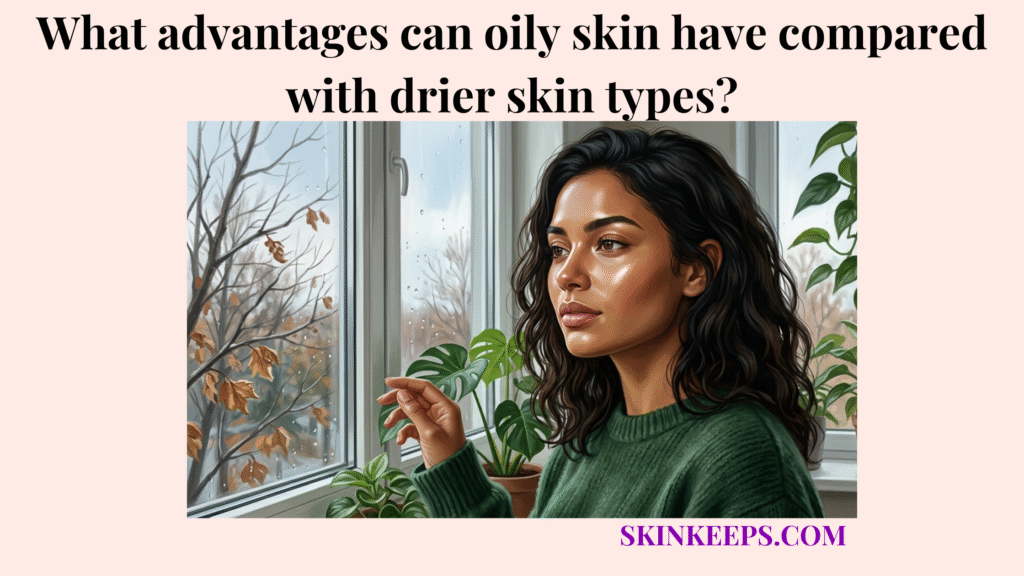
The main advantages oily skin can have compared with drier skin types are stronger surface lubrication, less dryness-related tightness, softer-looking superficial fine lines, and reduced visible flaking when sebum remains balanced. These benefits come from sebum, the skin’s natural lipid film, which can make the surface feel smoother and more comfortable than drier skin. However, these advantages depend on balanced sebum, because excess oil can still lead to shine, enlarged-looking pores, blackheads, and breakouts.
This guideline explains the visible and functional advantages of oily skin compared with drier skin, including surface lubrication, fine-line softness, reduced dryness-related discomfort, and barrier comfort. It also corrects the myths that oily skin cannot age, does not need moisturizer, or is naturally protected from the sun.
Why can oily skin have advantages compared with drier skin types?
Oily skin can have advantages compared with drier skin types because its higher sebum output can provide more natural surface lubrication and reduce dryness-related discomfort. This sebum advantage is most useful when oil remains balanced enough to support oily skin comfort without creating congestion. When sebum becomes excessive, the same surface lipid benefit can turn into shine, blackheads, or clogged pores.
The comparison should stay practical rather than emotional. Drier skin often struggles with tightness, roughness, and visible flaking, while oily skin often struggles with shine and congestion. Both skin types need care, but they need different forms of balance.
How sebum gives oily skin more natural surface lubrication
Sebum gives oily skin more natural surface lubrication by coating the stratum corneum with a lipid film that reduces surface friction. This lipid film can make the skin feel less dry or rough than drier skin types. Review literature describes sebum as contributing to skin homeostasis and barrier function, which supports this advantage when sebum remains balanced. [PMC]
Why oily skin may feel less tight than dry skin
Oily skin may feel less tight than dry skin because surface lipids can reduce the dry, stretched sensation that often appears when the barrier lacks oil. This natural lipid coating means evaluating oily skin less dryness requires understanding how sebum temporarily masks underlying water loss.
Why oily skin advantages depend on balanced sebum, not excess congestion
Oily skin advantages depend on balanced sebum, not excess congestion, because surface oil helps comfort only when it does not overwhelm the pores. When the lipid output exceeds the follicle’s capacity, the skin quickly transitions from lubricated to clogged. This tradeoff demands an approach that values moderate oil over absolute dryness.
How does sebum support the visible advantages of oily skin?
Sebum supports the visible advantages of oily skin by smoothing the surface appearance and reducing the dry, rough look that makes fine texture more obvious. This surface-smoothing effect is why some oily-skin users notice fewer papery lines than people with drier skin. The benefit is optical and textural, not proof that oily skin is immune to aging.
Sebum also has a broader biological role beyond shine. Review literature describes sebum as supporting barrier function and antimicrobial defense, while dysregulated sebum can contribute to acne and oily-skin disorders. This dual role is why the article should praise balanced sebum, not uncontrolled oiliness. [PMC]
How surface oil helps reduce dryness-related roughness
Surface oil helps reduce dryness-related roughness by coating uneven surface texture with a thin lipid film. This optical smoothing gently fills microscopic gaps between shedding cells. The resulting continuous layer reflects light more evenly than an unlubricated, rough surface.
How sebum contributes to skin surface softness and flexibility
Sebum contributes to skin surface softness and flexibility by reducing friction across the outer barrier. Exploring oily skin softness plumpness reveals how this persistent lipid layer keeps the epidermis supple. This mechanical flexibility shields the tissue from environmental cracking and scaling.
Why sebum can be helpful in moderation but problematic in excess
Sebum can be helpful in moderation but problematic in excess because the same oil that softens the surface can also collect around pores. This collection easily evolves into visible shine, blackheads, closed comedones, and inflammatory breakouts. Managing this balance ensures the skin enjoys the lipid benefits without the comedogenic consequences.
| Sebum State | What It Does | Visible Result |
|---|---|---|
| Balanced sebum | Lubricates the surface | Skin may look smoother and feel more comfortable |
| Moderate oil film | Reduces dry, tight appearance | Fine lines may look softer |
| Excess sebum | Builds up on the surface and around pores | Shine, congestion, blackheads, and breakouts |
| Dysregulated sebum | Interacts with clogged pores and inflammation | Acne-prone oily skin |
Why may fine lines look less visible on oily skin than on dry skin?
Fine lines may look less visible on oily skin than on dry skin because surface sebum can soften the dry texture that makes superficial creases stand out. This visible advantage is most relevant to fine dryness lines, not deeper structural wrinkles. The deeper discussion belongs in oily skin fine lines because surface oil changes appearance more than it changes aging biology.
Research supports a cautious version of this idea. A PubMed-indexed study reports that sebaceous gland density seems to be one of multiple factors that prevent wrinkle deepening in specific facial regions. This does not mean oily skin avoids aging; it means sebaceous activity may influence how some wrinkles appear. [PubMed]
How surface lubrication softens the look of fine dryness lines
Surface lubrication softens the look of fine dryness lines by reducing the rough, papery texture that makes small creases more visible. The constant supply of lipids gently coats the shallow indentations. This gentle coating visually diffuses the sharp edges of superficial dehydration lines.
Why dry skin can make superficial creases look sharper
Dry skin can make superficial creases look sharper because a lower-lipid surface often appears rougher, tighter, and less light-reflective. The absence of a softening oil film exposes every minor structural fold to direct lighting. Consequently, fine dryness lines command much more visual attention on an unlubricated barrier.
Why oily skin still develops deeper aging changes over time
Oily skin still develops deeper aging changes over time because sebum does not stop collagen loss, UV damage, or photoaging. AAD states dermatologists recommend broad-spectrum sunscreen, water-resistant SPF 30+ sunscreen, and sunscreen helps prevent premature skin aging caused by unprotected UV exposure. This reality confirms that structural aging proceeds regardless of epidermal oil levels. [AAD]
| Feature | Oily Skin | Drier Skin |
|---|---|---|
| Surface lubrication | Higher natural oil film | Lower natural oil film |
| Dryness lines | Often less visually sharp | Often more noticeable |
| Surface tightness | Usually less common when barrier is stable | More common |
| Deeper aging | Still happens | Still happens |
| Main risk | Acne, shine, visible pores | Dryness, flaking, fine-line emphasis |
How can oily skin resist dryness-related discomfort better than drier skin types?
Oily skin can resist dryness-related discomfort better than drier skin types because surface lipids can reduce friction, tightness, and roughness when the barrier is balanced. This comfort advantage is most obvious after cleansing or in dry conditions where drier skin may feel tight more quickly. The advantage becomes weaker when oily skin is over-cleansed or irritated.
Oily skin still needs barrier-respecting care because oil and hydration are not identical. AAD recommends avoiding scrubbing, choosing oil-free and non-comedogenic products, and stopping oil-control ingredients if irritation develops. This supports a routine that manages shine without stripping away the skin’s natural lipid advantage. [AAD]
How natural lipids reduce the feeling of tightness
Natural lipids reduce the feeling of tightness by giving the skin surface more slip and less dry friction. This inherent slip allows the stratum corneum to stretch comfortably during facial expressions. The resulting ease of movement acts as a natural buffer against environmental stressors.
Why oily skin may tolerate dry environments differently than dry skin
Oily skin may tolerate dry environments differently than dry skin because its surface lipid film can buffer some dryness-related discomfort. The continuous sebaceous output offers mild protection against frigid or arid climates. However, this tolerance varies substantially based on daily routine habits and individual barrier health.
Why oily skin can still become dehydrated despite excess sebum
Oily skin can still become dehydrated despite excess sebum because oil supports lubrication while hydration depends on water balance. This means incorporating an appropriate oily skin moisturizer provides necessary water support without adding heavy grease. Neglecting hydration allows the tissue to become parched underneath its reflective lipid layer.
Which barrier-related advantages can oily skin have compared with drier skin?
Oily skin can have barrier-related advantages compared with drier skin because sebum contributes to surface lubrication, comfort, and skin homeostasis. Review literature describes sebum as maintaining barrier function and supporting antimicrobial defense. This gives oily skin a real functional advantage when sebum remains balanced. [PMC]
The advantage has limits. Excess or dysregulated sebum can become part of an acne-prone skin environment. This is why oily skin sebum barrier dynamics should explain sebum as a dual-role system, not a purely good or bad substance.
How surface lipids support a more protected skin feel
Surface lipids support a more protected skin feel by reducing friction and helping the outer skin surface feel less exposed. This lipid envelope functions as an initial physical interface against minor environmental contact. The consistent coating naturally sustains a comforting tactile barrier over the epidermis.
Why oily skin may show less flaking than dry skin
Oily skin may show less flaking than dry skin because surface lipids can reduce the dry, scaly look that appears when the barrier lacks oil. The oil effectively mats down loose corneocytes, masking uneven shedding. While oily skin can still flake if over-treated, its baseline state minimizes this particular visual annoyance.
Why barrier support does not mean oily skin is immune to irritation
Barrier support does not mean oily skin is immune to irritation because excess oil, harsh cleansing, acne treatments, and UV exposure can still destabilize the skin. These combined tradeoffs quickly compromise even the most robust lipid layer. A compromised barrier invariably leads to redness, stinging, and heightened sensitivity.
| Skin Function | Possible Oily-Skin Advantage | Common Dry-Skin Challenge |
|---|---|---|
| Surface lubrication | More natural slip and softness | More tightness or roughness |
| Fine-line appearance | Superficial lines may look softer | Fine lines may look sharper |
| Flaking tendency | Often less visible flaking | More visible scaling or peeling |
| Comfort | May feel less tight when balanced | More discomfort after cleansing |
| Main tradeoff | More shine and congestion risk | More dryness and sensitivity risk |
What myths exaggerate the advantages of oily skin?
The myths that exaggerate the advantages of oily skin usually turn real sebum benefits into false claims about aging, sunscreen, and moisturizer. The most damaging version is the belief that oily skin does not age. Oily skin may show some superficial lines differently, but it still undergoes UV damage, collagen changes, and photoaging.
Oily skin also still needs practical care. AAD recommends broad-spectrum, water-resistant SPF 30+ sunscreen, and AAD oily-skin guidance recommends oil-free and non-comedogenic products rather than skipping care entirely. These recommendations directly contradict the myth that oily skin can be left alone because it already produces oil. [AAD] and [AAD]
Why oily skin does not mean “skin that never ages”
Oily skin does not mean “skin that never ages” because sebum may soften surface texture but cannot stop deeper biological aging. The structural loss of dermal collagen occurs independently of epidermal lipid output. Treating oil as an absolute shield invites severe, irreversible architectural decline.
Why oily skin still needs moisturizer and sunscreen
Oily skin still needs moisturizer and sunscreen because oil does not replace water balance or broad-spectrum UV protection. Failing to apply hydration leads to a tight, uncomfortable barrier. Neglecting sunscreen guarantees long-term cellular damage and persistent hyperpigmentation.
Why oily skin benefits disappear when sebum becomes congested or inflammatory
Oily skin benefits disappear when sebum becomes congested or inflammatory because excess oil can shift from surface comfort into pore blockage and acne-prone irritation. The trapped lipids combine with dead cells to initiate the comedogenic cascade. This transition transforms a supportive film into an active dermatological problem.
| Myth | Better Explanation |
|---|---|
| Oily skin does not age | Fine lines may look less visible, but aging and UV damage still occur |
| Oily skin does not need moisturizer | Oily skin can still become dehydrated or irritated |
| Oily skin is naturally protected from the sun | Sebum is not sunscreen |
| Oily skin is always stronger | Oily skin can still be acne-prone, sensitive, or barrier-stressed |
| More oil means healthier skin | Balanced sebum helps; excess sebum can worsen congestion |
How should oily skin preserve its advantages without worsening its downsides?
Oily skin should preserve its advantages by keeping enough natural lipid comfort while preventing excess sebum from turning into congestion. AAD recommends washing oily skin morning and evening and after exercise, resisting scrubbing, choosing oil-free and non-comedogenic products, and stopping oil-control ingredients if irritation develops. This supports balanced oil management instead of aggressive oil removal. [AAD]
The goal is not zero oil. The goal is comfortable oil control that preserves softness while reducing shine, blackheads, and clogged pores. A maintenance routine can continue through oily skin care tips once the user understands that balanced sebum is the real advantage.
Which gentle cleansing habits preserve oily skin’s surface balance
Gentle cleanser habits preserve oily skin’s surface balance by removing excess oil without stripping away every trace of protective lipid. This mild approach prevents the barrier from feeling tight, stinging, or irritated. Completely avoiding scrubbing maintains the skin’s structural integrity safely.
Which lightweight moisturizers support oily skin without heaviness
Lightweight moisturizers support oily skin without heaviness by adding water comfort without burying the surface under rich, greasy layers. Selecting an oil-free, non-comedogenic fluid or gel ensures the skin stays hydrated seamlessly. This careful selection eliminates the risk of occlusive pore blockages.
Which sunscreen textures protect oily skin without extra grease
Sunscreen textures protect oily skin without extra grease when they are broad-spectrum, SPF 30 or higher, and comfortable enough for daily use. AAD states dermatologists recommend broad-spectrum, water-resistant SPF 30+ sunscreen. Identifying a matte or fluid formulation encourages consistent compliance without amplifying facial shine. [AAD]
Why acne control should not destroy the skin’s natural lipid advantage
Acne control should not destroy the skin’s natural lipid advantage because over-drying the barrier can replace useful lubrication with tightness and irritation. Applying strong actives excessively guarantees an uncomfortable, compromised epidermis. Maintaining a balanced approach treats the congestion while honoring the skin’s need for protective oils.
Preserving Oily Skin Advantages
What should you remember about oily skin advantages compared with dry skin?
The main point to remember is that oily skin can have real advantages over drier skin types when sebum stays balanced rather than congested.
Key Takeaways
- Oily skin can have real advantages over drier skin types.
- Sebum can help the surface look smoother and feel less tight.
- Fine dryness lines may appear less obvious on oily skin.
- Oily skin still needs sunscreen, gentle cleansing, and sometimes moisturizer.
- The advantage is balanced sebum, not uncontrolled grease.
- Excess sebum can still increase shine, blackheads, and breakouts.
- The best routine preserves lubrication while preventing congestion.
FAQs
What advantages can oily skin have compared with dry skin?
Oily skin can have more natural surface lubrication, less dryness-related tightness, and softer-looking superficial fine lines compared with dry skin. These benefits depend on balanced sebum, not excess congestion.
Does oily skin age more slowly than dry skin?
Oily skin may show some superficial fine lines less sharply, but it does not stop aging. A PubMed-indexed study reports that sebaceous gland density may be one of multiple factors that prevents wrinkle deepening in specific facial regions.
Is sebum good for the skin?
Sebum can be helpful because it supports surface lubrication, barrier function, and antimicrobial defense. It can also become problematic when dysregulated or excessive.
Does oily skin still need moisturizer?
Yes, oily skin may still need moisturizer when it feels tight, irritated, or dehydrated. Oil supports lubrication, but hydration depends on water balance and compatible moisturizer choices.
Does oily skin still need sunscreen?
Yes, oily skin still needs sunscreen because sebum is not broad-spectrum UV protection. AAD recommends broad-spectrum, water-resistant SPF 30+ sunscreen.
Is oily skin better than dry skin?
No skin type is automatically better. Oily skin may have advantages in lubrication and fine-line softness, while dry skin may have less shine and fewer oil-related clogs.
What is the downside of oily skin?
The main downside of oily skin is that excess sebum can contribute to shine, enlarged-looking pores, blackheads, closed comedones, and breakouts.
How can oily skin keep its advantages?
Oily skin can keep its advantages by cleansing gently, using oil-free and non-comedogenic products, moisturizing when needed, applying sunscreen, and avoiding harsh stripping routines.
Conclusion
Oily skin can have advantages compared with drier skin types when balanced sebum supports lubrication, comfort, and softer-looking surface texture. The advantage is not uncontrolled grease. The advantage is a stable lipid film that supports comfort while the routine prevents congestion, shine, and irritation.
Healthy oily skin works best when its natural lubrication is preserved, not stripped away. At SkinKeeps, we outline how to respect your biological baseline to maintain these enduring structural benefits without compromising clarity.