
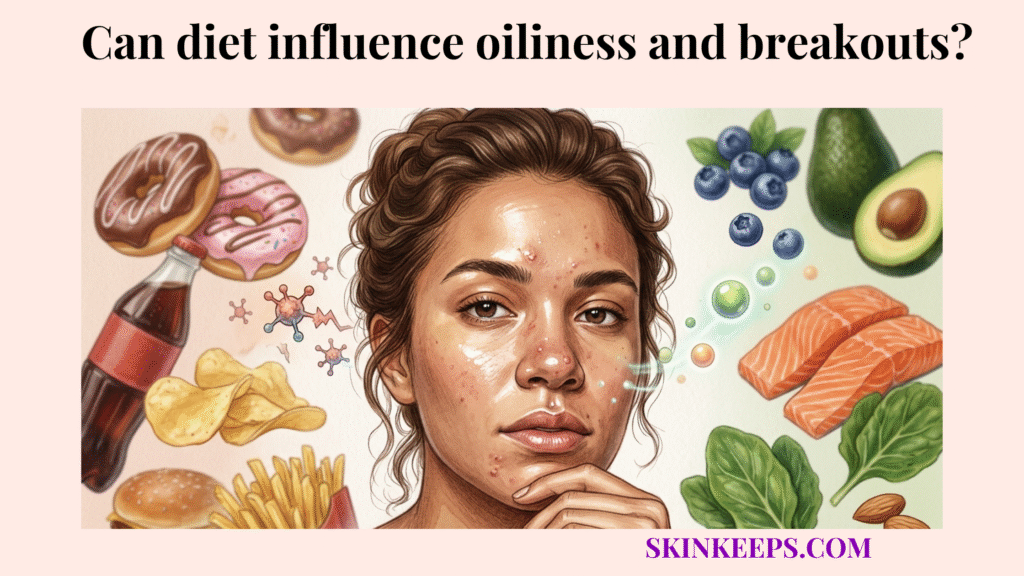
Yes, diet can influence oiliness and breakouts in some people by changing metabolic signals that affect sebaceous activity, follicular clogging, and inflammation. This means diet can modify the behavior of acne-prone skin without replacing genetics, hormones, hygiene, or established acne treatment.
This guideline explains how high-glycemic meals, insulin, IGF-1, dairy, whey protein, and mTORC1-related mechanisms may influence breakout-prone skin. It also corrects greasy-food myths and shows how lower-glycemic patterns, omega-3-rich foods, zinc adequacy, and whole-diet quality can support skin stability without extreme restriction.
How can diet influence sebum production and acne-prone skin?
Diet can influence sebum production and acne-prone skin by modifying insulin, IGF-1, and growth-signaling pathways that interact with sebaceous glands and follicles. This metabolic influence matters because acne-prone skin is already shaped by sebum, follicular keratinization, inflammation, and microbial factors. Diet can amplify that environment, but it does not create every breakout from nothing.
IGF-1 is relevant because review literature links it with sebaceous lipogenesis through SREBP-1-related pathways. This pathway helps explain why insulin- and IGF-1-related diet patterns are discussed in acne research. The claim should be used as mechanism support, not as proof that one meal directly creates oily skin. [PMC]
How insulin and IGF-1 are linked to acne-promoting signaling
Insulin and Insulin-like Growth Factor 1 (IGF-1) are linked to acne-promoting signaling because they influence growth pathways that can affect sebocytes, keratinocytes, and inflammation. These growth pathways respond to metabolic shifts after high-glycemic or dairy-rich meals. The response can increase the cellular turnover rate inside acne-prone follicles.
How these signals can support sebaceous activity and follicular clogging
These signals can support sebaceous activity and follicular clogging by influencing both lipid-related pathways and keratinocyte behavior inside acne-prone follicles. This influence increases the amount of sebum and dead skin cells trapped inside the pore. Understanding this mechanism clarifies how oily skin sebum production is regulated by more than just local glandular size.
Why diet is a modifier, not the only cause of oily or acne-prone skin
Diet is a modifier, not the only cause of oily or acne-prone skin, because acne develops through multiple interacting pathways. These interacting pathways include genetics, hormones, microbial activity, and daily skincare habits. Exploring the broader range of oily skin causes reveals why treating diet as the sole acne explanation often leads to frustration.
| Step | What Happens | Possible Skin Effect |
|---|---|---|
| High-glycemic-load meal | Blood glucose and insulin rise quickly | More acne-promoting signaling |
| IGF-1-related signaling increases | Growth and sebaceous pathways may be amplified | More oiliness or clogging tendency in susceptible skin |
| Keratinocyte and sebocyte activity shift | Follicles may clog more easily | More comedones and breakouts |
| Inflammation overlaps | Acne-prone lesions become more visible | Redder, more persistent flares |
Why do high-glycemic diets often worsen oiliness and breakouts?
High-glycemic-load diets often worsen oiliness and breakouts because rapidly digested carbohydrates can increase insulin-related signaling that supports acne-prone pathways. The American Academy of Dermatology summarizes small studies where low-glycemic-load diets were linked with fewer acne lesions, including a 12-week Australian study in 43 males aged 15–25. This evidence is stronger than the old claim that greasy foods directly create greasy skin. [AAD]
A Korean randomized controlled trial found that a low-glycemic-load diet improved both inflammatory and non-inflammatory acne lesions after 10 weeks. The same study reported reduced sebaceous gland size, decreased inflammation, and reduced SREBP-1 and interleukin-8 expression in skin samples from the 32 participants. This makes low-glycemic eating the clearest diet-intervention area, while still not making it a universal acne cure. [MJS Publishing]
How rapid glucose spikes increase insulin-related signaling
Rapid glucose spikes increase insulin-related signaling because the body responds to fast carbohydrate absorption with stronger insulin release. This stronger insulin release subsequently alters IGF-1 availability and related binding proteins. The altered metabolic state encourages growth signaling in susceptible tissues.
Why low-glycemic patterns often improve acne-prone skin
Low-glycemic patterns often improve acne-prone skin because they reduce sharp post-meal insulin pressure and may lower acne-promoting signaling. This reduced pressure helps stabilize the epidermal environment over time. Clinical trials note visible lesion improvement, indicating that steady metabolic control offers tangible dermatological benefits.
Why the trigger is metabolic signaling, not sugar “becoming oil”
The trigger is metabolic signaling, not sugar becoming oil, because carbohydrates are digested and absorbed before they can influence skin through hormonal pathways. This digestion process means sugar interacts with sebaceous glands via the bloodstream, not by leaking directly through pores. Understanding this biological mechanism replaces harmful guilt with actionable science.
| Dietary Pattern | Metabolic Effect | Common Acne-Related Implication |
|---|---|---|
| High-glycemic load | Higher glucose and insulin signaling | More acne-promoting activity in susceptible skin |
| Lower-glycemic load | Lower post-meal insulin spikes | Less acne-promoting signaling pressure |
| Mixed balanced meals | Slower digestion when fiber/protein are included | More stable metabolic response |
| Inconsistent high-sugar pattern | Repeated spikes | More difficult flare tracking |
Why are dairy and whey often linked to acne-prone oily skin?
Dairy and whey are often linked to acne-prone oily skin because milk intake and whey protein have been associated with acne in some studies, likely through insulin- and IGF-1-related signaling. The American Academy of Dermatology states that whole, low-fat, and skim milk have been linked with acne, while yogurt and cheese have not shown the same evidence. This distinction prevents the article from treating all dairy foods as identical triggers. [AAD]
Skim milk deserves careful discussion because some observational data show a stronger signal. The AAD cites a large recall study where women drinking 2 or more glasses of skim milk per day were 44% more likely to have acne than other women. This is an association, not proof that skim milk causes acne in everyone. [AAD]
Whey protein should be discussed as a possible trigger in susceptible users, especially supplement users. A 2024 case-control study reported a positive association between whey protein consumption and acne risk, while mechanistic reviews discuss whey and milk proteins through insulin and IGF-1 signaling. This supports trial-based tracking, not automatic lifelong avoidance. [PMC]
Why milk, especially skim milk, has been repeatedly studied in acne
Milk, especially skim milk, has been repeatedly studied in acne because observational studies have found associations between cow’s milk intake and acne occurrence. These associations prompt researchers to investigate specific protein and hormone contents within the fluid. The findings suggest skim processing might concentrate certain acne-promoting factors, though causation requires further study.
Why whey protein is often discussed in acne-prone individuals
Whey protein is often discussed in acne-prone individuals because whey supplements may increase insulin-related signaling and have been associated with acne risk in some research. These supplements are highly concentrated and frequently consumed by younger, active demographics. The concentrated exposure makes whey a notable variable for susceptible people testing dietary triggers.
Why the dairy association does not mean everyone with acne must avoid all dairy
The dairy intake association does not mean everyone with acne must avoid all dairy because individual response, dairy type, acne severity, and total diet pattern all matter. This individual variability means elimination should be tested rather than permanently assumed. A measured tracking approach prevents unnecessary fear-based dietary restrictions.
How strong is the evidence for mTORC1 and growth signaling in diet-related acne?
The evidence for mTORC1 and growth signaling in diet-related acne is strongest as a mechanistic framework, not as a simple clinical switch. Review literature discusses high-glycemic-load foods and dairy proteins as inputs that increase insulin/IGF-1 signaling and converge on mTORC1-related acne pathways. This framework helps explain why different foods can point toward similar growth-signaling mechanisms. [PubMed]
The mTORC1 pathway should support the understanding of acne rather than dominate it. Clinical acne behavior still depends on genetics, hormones, follicular clogging, inflammation, medication use, and skincare routine. The pathway is useful because it explains plausibility, not because it replaces dermatological care.
How mTORC1 is used as a mechanistic framework in acne research
mTORC1 is used as a mechanistic framework in acne research because it links nutrient and growth signals with cell-growth and lipid-related pathways. This mammalian target of rapamycin complex 1 acts as a fundamental nutrient sensor inside cells. The sensing mechanism helps researchers map out why western diets often correlate with acne severity.
Why insulin-, IGF-1-, and amino-acid signaling are discussed together
Insulin-, IGF-1-, and amino-acid signaling are discussed together because these inputs can converge on nutrient-sensitive growth pathways. High-glycemic foods and dairy proteins both supply stimuli that can amplify these overlapping cellular routes. The convergence explains how diverse dietary choices might produce similar acne-worsening results in predisposed individuals.
Why this pathway should support the page, not dominate it
This pathway should support the understanding of acne rather than dominate it because diet-related acne remains multifactorial. This multifactorial nature means systemic endocrine factors are just as vital to the complete clinical picture. Exploring oily skin hormones clarifies how diet pathways overlap with established endocrine signaling.
What diet myths confuse oily, breakout-prone skin?
Diet myths confuse oily, breakout-prone skin by replacing metabolic signaling with simplistic stories about food grease, sugar, dairy, or single trigger foods. The AAD specifically frames greasy fries and burgers as “probably not for the reason you think,” then points toward high-glycemic foods, blood-sugar spikes, inflammation, and sebum. This supports the article’s central correction: the issue is signaling, not literal grease leaking through pores. [AAD]
The “one food causes acne” idea is usually too simple because acne has multiple drivers. A single food may correlate with flares in one person and not in another. The stronger editorial rule is to track repeated patterns across weeks, not blame one meal.
Why greasy food does not literally push grease out of pores
Greasy food does not literally push grease out of pores because dietary fat is digested and metabolized before it can influence skin through systemic pathways. This digestive process breaks down fats into basic molecular components long before they reach the epidermis. Therefore, eating a fried meal does not directly coat the face in cooking oil.
Why the real issue is metabolic signaling, not food oil appearing on the face
The real issue is metabolic signaling, not food oil appearing on the face, because acne-related diet evidence centers more on glycemic load and milk association than on literal dietary grease. This evidence focus shifts the conversation from surface residue to internal hormonal pathways. Managing insulin spikes becomes much more relevant than arbitrarily restricting dietary fats.
Why “one food causes acne” is usually too simplistic
The idea that one food causes acne is usually too simplistic because acne-prone skin responds to overall patterns, susceptibility, hormones, and inflammation. This complex response network rarely relies entirely on a single slice of pizza. Encouraging careful pattern tracking prevents patients from developing unhelpful nutritional anxieties, ensuring they still utilize oily skin active ingredients instead of relying on diet alone.
| Myth | Better Explanation |
|---|---|
| Greasy food makes skin greasy directly | Stronger evidence points to metabolic and hormonal signaling, not literal food grease coming through pores |
| Sugar causes acne instantly in everyone | High-glycemic patterns can worsen acne tendency, but response varies |
| Dairy always causes acne | Milk is associated with acne in some people, not a universal rule |
| Chocolate alone is the whole problem | Evidence is mixed; sugar, dairy content, and overall pattern matter more than simplistic blame |
| One clean diet cures acne | Diet can support acne management, but many users still need evidence-based skincare or medical treatment |
Which dietary patterns and nutrients may help reduce diet-related oiliness and breakouts?
Dietary patterns and nutrients that may help reduce diet-related oiliness and breakouts focus on lower-glycemic eating, anti-inflammatory support, zinc adequacy, and whole-diet stability. Lower-glycemic meals target the strongest diet-acne pathway by reducing sharp insulin pressure. This makes them a better first nutrition priority than chasing isolated “clear-skin foods.”
Omega-3 fatty acids may support acne-prone skin as an adjunct, especially where inflammation is prominent. A 10-week randomized controlled study found that omega-3 fatty acid or γ-linolenic acid supplementation significantly reduced inflammatory and non-inflammatory acne lesions and inflammation markers. This supports adjunct language, not a claim that omega-3s alone cure acne. [MJS Publishing]
Zinc also belongs in adjunct language. A systematic review and meta-analysis found lower serum zinc levels in acne patients and reported zinc effectiveness particularly for reducing inflammatory papules. This does not justify megadosing; it supports zinc adequacy and clinician-aware supplementation when needed. [PubMed]
Why low-glycemic eating patterns are the strongest dietary intervention
Low-glycemic eating patterns are the strongest dietary intervention because they target the best-supported diet-acne pathway: insulin and IGF-1-related signaling. This intervention smoothly reduces the metabolic spikes that commonly irritate sensitive sebaceous tissue. Clinical trials repeatedly note lesion improvement when patients adopt steadier glycemic habits.
How omega-3-rich dietary patterns may support less inflammatory skin behavior
Omega-3-rich dietary patterns may support less inflammatory skin behavior by contributing anti-inflammatory fatty acids to the overall diet. These fatty acids help modulate the body’s baseline immune response. The resulting modulation can be a useful supportive tool for individuals battling tender, red acne lesions.
Why zinc and whole-diet quality fit better than miracle-food claims
Zinc and whole-diet quality fit better than miracle-food claims because acne nutrition works through long-term support rather than single-food cures. This long-term support requires consistent dietary balance and adequate micronutrient levels. Maintaining this stability gently assists dermatological treatments without demanding extreme dietary overhauls.
| Nutrient or Pattern | Main Role | Best Fit |
|---|---|---|
| Lower-glycemic meals | Reduce sharp insulin and IGF-1-related signaling | Oily, acne-prone skin with sugar-related flares |
| Omega-3-rich foods | Support less inflammatory signaling | Inflammatory acne-prone skin |
| Zinc adequacy | May support inflammatory acne management | Adjunct support, not a cure |
| High-fiber, minimally processed dietary pattern | Supports metabolic stability | General oily/acne-prone skin support |
| Consistent meal structure | Improves pattern tracking | Users testing diet-related flares |
How should a daily diet support less oily, less breakout-prone skin?
A daily diet should support less oily, less breakout-prone skin by stabilizing blood sugar, testing individual sensitivities carefully, and maintaining a sustainable whole-diet pattern. This daily structure works better than blaming single foods because repeated metabolic inputs are easier to track than isolated meals. Users should connect diet tracking with the broader oily skin care tips framework so nutrition does not replace basic acne-friendly skincare.
Testing dairy sensitivity should be specific rather than extreme. A user can track skim milk, cow’s milk, or whey protein separately for several weeks while keeping the rest of the routine stable. If acne is severe, painful, scarring, or persistent, the next step belongs with an oily skin dermatologist rather than deeper food restriction.
What meal structure helps reduce glucose spikes
A meal structure that helps reduce glucose spikes pairs carbohydrates with protein, fiber, or minimally processed foods to slow digestion. This pairing ensures a steadier release of glucose into the bloodstream. The steadier release prevents the sharp insulin surges that can antagonize susceptible skin.
How to test dairy sensitivity without making extreme assumptions
Testing dairy sensitivity without making extreme assumptions means tracking specific sources such as skim milk, cow’s milk, or whey protein before making permanent restrictions. This targeted tracking helps pinpoint the actual trigger without needlessly eliminating yogurt or cheese. A thoughtful, several-week trial period yields the most reliable personal data.
Why consistency matters more than short-term restriction
Consistency matters more than short-term restriction because acne-prone skin responds to repeated metabolic patterns rather than one isolated food choice. This responsiveness means sustainable, balanced eating supports the skin better than crash diets. A consistent approach ultimately fosters long-term metabolic and dermatological stability.
Daily Dietary Support for Oily, Breakout-Prone Skin
FAQs
Can diet influence oiliness and breakouts?
Yes, diet can influence breakouts and may contribute to oilier, more congestion-prone skin in some people. The strongest evidence involves high-glycemic-load diets and milk intake, but diet is a modifier rather than the only cause.
Does sugar make skin oily?
Sugar does not physically become skin oil. High-glycemic patterns may worsen acne-prone skin by increasing insulin and IGF-1-related signaling, which can influence sebaceous and follicular behavior.
Are low-glycemic diets helpful for acne?
Low-glycemic diets may help acne-prone skin. AAD summarizes small studies showing fewer acne lesions on low-glycemic diets, and a Korean RCT found clinical and histological improvement after 10 weeks.
Does dairy cause acne?
Dairy does not cause acne in everyone, but cow’s milk intake has been associated with acne in some studies. AAD notes that whole, low-fat, and skim cow’s milk have been linked with acne, while yogurt and cheese have not shown the same evidence.
Is skim milk worse for acne?
Skim milk has appeared repeatedly in acne research. AAD cites a study where women drinking 2 or more glasses of skim milk daily were 44% more likely to have acne, but this is observational evidence, not proof for every person.
Can whey protein trigger breakouts?
Whey protein may be associated with acne risk in some users, especially supplement users with acne-prone skin. A 2024 case-control study reported a positive association between whey protein consumption and acne risk.
Does greasy food directly make skin greasy?
No. Greasy food does not literally travel into pores as facial oil. AAD frames the stronger diet-acne discussion around high-glycemic foods, blood-sugar spikes, inflammation, sebum, and milk association—not literal food grease leaking through pores.
Can omega-3 or zinc help acne?
Omega-3 and zinc may support acne management as adjuncts, especially for inflammatory acne patterns. They should be treated as supportive tools, not cures or replacements for medical acne treatment.
Conclusion
Diet can influence oiliness and breakouts by modifying metabolic signals, but it is not the only driver of acne-prone skin. High-glycemic patterns, cow’s milk, and whey protein may worsen breakouts in susceptible people through insulin, IGF-1, and growth-signaling pathways.
The best nutrition strategy is lower-glycemic consistency, careful trigger tracking, and whole-diet support rather than fear-based restriction. Diet works best as a skin-support modifier, not as a guilt-based acne explanation.