
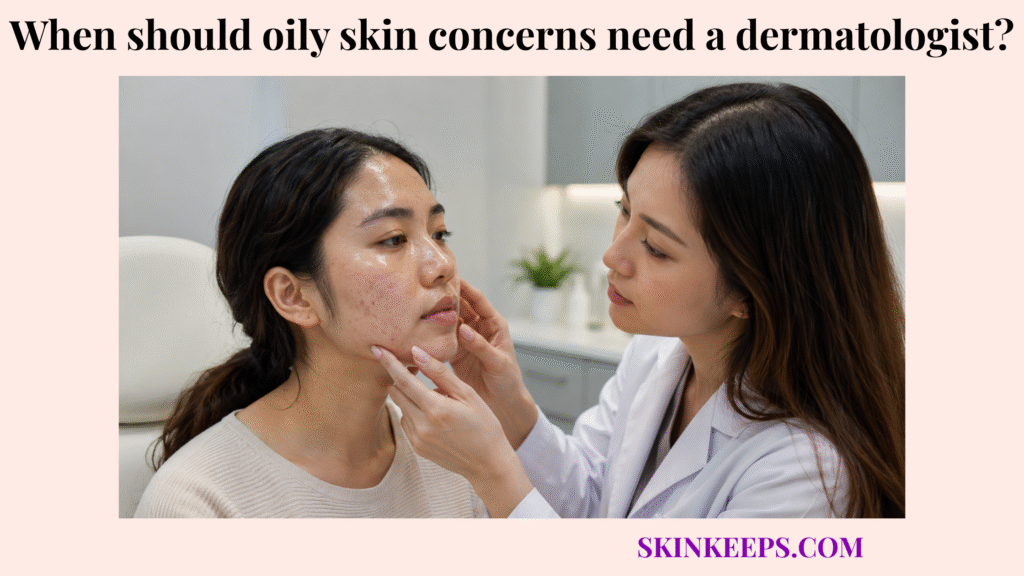
Oily skin concerns need a dermatologist when oiliness is paired with painful, persistent, spreading, scarring, hormonal-pattern, or emotionally distressing acne symptoms. This matters because oily skin alone is usually a manageable skin-type pattern, while oily skin with deeper or worsening inflammation may require medical evaluation.
This guideline explains the difference between home-manageable oiliness and dermatologist-level warning signs, including painful cysts, nodules, scarring, dark marks, failed over-the-counter care, sudden adult-onset patterns, hormonal clues, and emotional distress.
When is oily skin normal enough to manage at home?
Oily skin is usually normal enough to manage at home when shine is the main concern and breakouts are mild, occasional, shallow, and not leaving scars. This type of oiliness usually appears as T-zone shine, visible pores, small blackheads, or a greasy feel during the day. When symptoms stay mild and respond to gentle care, the concern does not automatically require a dermatologist.
Home care becomes reasonable when the skin remains comfortable and predictable. Gentle cleansing, non-comedogenic products, lightweight hydration, and careful use of basic oil-control ingredients may be enough. Readers with ordinary shine and no red flags can begin with the broader oily skin care tips page before escalating to specialist care.
When shine is the main concern without painful breakouts
Shine alone is usually not a dermatologist-level concern when it appears without pain, swelling, spreading acne, or scarring. Shine is a common feature of oily skin, not a disease by itself. Persistent shine can still be frustrating, but it is usually approached first with routine adjustment, product texture choices, and gentle oil-control habits.
When blackheads or mild clogged pores respond to simple care
Blackheads or mild clogged pores can usually be managed at home when they improve with consistent, gentle care and do not become inflamed or painful. Mild clogged pores are different from deep, swollen lesions that hurt or leave lasting marks. If basic care helps and the skin is not worsening, monitoring at home is usually reasonable.
| Sign | Meaning |
|---|---|
| Shine appears mainly in the T-zone | Often normal oily-skin behavior |
| Breakouts are mild and occasional | Home care may be enough |
| Blackheads are limited and not painful | Basic care may help |
| No deep cysts or nodules are present | Lower referral urgency |
| No scars or rapidly worsening marks appear | Lower damage risk |
| Gentle products improve symptoms | Continue monitoring at home |
When does oily skin with acne need a dermatologist?
Oily skin with acne needs a dermatologist when breakouts become moderate, severe, persistent, spreading, painful, or resistant to consistent over-the-counter care. This type of acne is no longer just excess shine or occasional clogged pores. It may need professional assessment because deeper inflammation and repeated lesions raise the risk of marks, scarring, and treatment frustration.
Spreading acne also matters because oily skin concerns can extend beyond the face. Breakouts on the chest, back, jawline, or multiple areas may signal a pattern that home products cannot manage well. The NHS advises medical help for moderate or severe acne, nodules, cysts, or acne that is not controlled and causing unhappiness. [NHS]
When acne is moderate, severe, or spreading
Acne is more likely to need a dermatologist when it becomes widespread, inflamed, painful, or difficult to control with ordinary store-bought products. The American Academy of Dermatology explains that severe acne can involve deeper painful breakouts such as cysts and nodules and may not clear with store-bought acne treatment alone. [AAD]
When breakouts keep returning despite consistent care
Breakouts that keep returning despite consistent care may need a dermatologist because repeated inflammation suggests the current routine is not controlling the underlying acne pattern. This does not mean the reader should keep stacking stronger products at home. It means professional evaluation may help determine whether the issue is acne severity, irritation, product mismatch, or another trigger.
When acne affects the face, chest, back, or multiple areas
Acne affecting the face, chest, back, or multiple areas may need professional evaluation because wider distribution often requires more than a simple face-only routine. A face wash or one spot product may not match acne that appears across several body areas. If the reader wants to understand what they already tried, the active ingredients for oily skin guide can help organize that product history before speaking with a clinician.
When are painful cysts or nodules a red flag?
Painful cysts or nodules are red flags because they form deeper in the skin, hurt more than ordinary pimples, and carry a higher risk of lasting scars or marks. These lesions should not be treated like small surface pimples. When they appear repeatedly, oily skin needs medical evaluation rather than stronger scrubbing, squeezing, or product stacking.
The danger is not only the oiliness but the depth of inflammation. Deep acne can stay swollen, tender, and difficult to calm with standard home care. AAD describes cysts and nodules as deeper painful breakouts and warns against trying to drain them at home. [AAD]
Why deep, painful lumps should not be treated like ordinary pimples
Deep, painful lumps should not be treated like ordinary pimples because they sit below the surface and usually need professional assessment when they persist or recur. Squeezing or trying to drain them can worsen irritation and may raise the risk of infection or scarring. The safer decision is to seek evaluation instead of turning a deep lesion into a home procedure.
Why cysts and nodules increase the risk of permanent scarring
Cysts and nodules increase the risk of permanent scarring because deeper inflammation can damage surrounding skin structure before the breakout resolves. Scarring is not guaranteed, but the risk is higher when lesions are deep, painful, or repeatedly inflamed. This is why early professional care matters more than waiting for each painful lump to fade on its own.
| Sign | Dermatologist Need | Why |
|---|---|---|
| Painful cysts | High | Deep inflammation needs evaluation |
| Deep nodules | High | Higher scarring risk |
| Acne leaving pits | High | Texture change may be forming |
| Swollen painful lesions | High | Inflammation is deeper than mild acne |
| Acne worsening quickly | High | Early intervention may reduce damage risk |
When do acne scars or dark marks need professional help?
Acne scars or dark marks need professional help when new breakouts keep leaving lasting texture changes, pits, raised scars, or discoloration that continues to worsen. This pattern shows that oily skin is not only producing shine or clogged pores; it is developing visible post-inflammatory damage. Early professional care can reduce the chance that each flare leaves a longer-term reminder.
Dark marks and scars should not be ignored just because the skin is oily. Oily skin can still develop post-acne discoloration, uneven tone, or texture changes after inflammation. Mayo Clinic notes that a dermatologist can help control acne, avoid scarring or other skin damage, and make scars less noticeable. [Mayo Clinic]
When new breakouts are leaving scars
New breakouts are more concerning when they leave scars because scarring means inflammation is damaging the skin beyond a temporary surface blemish. This is different from a small pimple that fades without a lasting mark. Repeated scars suggest the acne pattern should be evaluated before more texture change develops.
When post-acne marks keep darkening or lasting longer
Post-acne marks need more attention when they keep darkening, spreading, or lasting longer after each breakout cycle. Dark marks are not always permanent scars, but repeated inflammation can make the skin look uneven for a long time. Professional care can help separate active acne control from mark-management decisions.
Why early treatment matters before scarring becomes permanent
Early treatment matters before scarring becomes permanent because controlling active acne can reduce the number of new inflammatory lesions that create lasting damage. The goal is not only to calm today’s breakout. The goal is to stop the cycle that keeps creating new marks, pits, and texture changes.
When has over-the-counter oily-skin care failed?
Over-the-counter oily-skin care has failed when breakouts keep worsening, products remain intolerable, or acne continues to spread despite consistent and appropriate use. This failure matters because adding more products can increase irritation without solving the acne pattern. At that point, professional guidance is safer than repeatedly escalating strength at home.
Failed care can look like persistent stinging, peeling, tightness, redness, or oily skin that feels inflamed and uncomfortable at the same time. The issue may be undertreatment, overtreatment, or the wrong diagnosis. Readers who suspect their routine is making symptoms worse can review over-exfoliating oily skin before assuming stronger products are the answer.
| Sign | What It Suggests |
|---|---|
| Breakouts keep spreading | Current care is not controlling the pattern |
| Lesions become deeper or painful | Home care may be insufficient |
| Products cause persistent stinging | Barrier may be irritated |
| Peeling and tightness continue | Routine may be too harsh |
| Product switching becomes constant | The plan lacks stability |
| Oily, tight, inflamed skin persists | Professional evaluation may be needed |
When could oily skin signal a hormonal issue?
Oily skin could signal a hormonal issue when sudden adult-onset acne, repeated jawline flares, irregular periods, excess facial hair, or treatment-resistant breakouts appear together. This does not mean every oily face is hormonal. It means certain patterns deserve clinical evaluation because the skin may be reflecting internal hormone-related activity.
This section should not be used for self-diagnosis. A clinician can decide whether the pattern suggests hormone-related testing, acne treatment planning, or another explanation. Readers who need background on oil-related endocrine triggers can connect this section to the hormones increase skin oiliness page.
When oily skin appears suddenly in adulthood
Oily skin that appears suddenly in adulthood deserves more attention when it arrives with new acne, cycle changes, or other body-wide hormonal clues. A sudden change is more clinically useful than long-standing shine that has always been present. The key is to report the change clearly rather than assume the cause alone.
When acne flares follow menstrual or hormonal patterns
Acne flares that follow menstrual or hormonal patterns may need evaluation when they repeat predictably, worsen over time, or resist ordinary topical care. Pattern tracking helps a clinician understand whether timing is relevant. It does not prove the cause by itself, but it gives the appointment better evidence.
When oily skin appears with irregular periods or excess facial hair
Oily skin appearing with irregular periods or excess facial hair should be discussed with a clinician because those signs may reflect broader hormone-related changes. This does not mean the reader should diagnose PCOS or any endocrine disorder alone. It means the skin concern belongs in a wider medical conversation.
| Warning Sign | Why It Matters |
|---|---|
| Sudden adult-onset oily acne | May need medical evaluation |
| Repeated jawline or chin flares | Can suggest hormonal-pattern acne |
| Acne with irregular periods | Needs clinician discussion |
| Acne with new excess facial hair | May suggest hormone-related evaluation |
| Treatment-resistant adult acne | May require professional treatment planning |
When does oily skin affect mental health enough to seek help?
Oily skin affects mental health enough to seek help when acne, shine, scars, or marks cause anxiety, avoidance, low confidence, or problems at school, work, or socially. This matters because skin severity is not measured only by lesion count. A smaller acne pattern can still cause serious emotional distress if it affects daily life.
Emotional distress is legitimate, not cosmetic vanity. If the reader avoids people, feels ashamed, or feels controlled by their skin, seeking professional support is reasonable. PCDS guidance notes that severe psychological symptoms can justify referral regardless of physical signs. [PCDS]
When oily skin or acne causes anxiety, avoidance, or low confidence
Oily skin or acne needs support when it causes anxiety, avoidance, or low confidence that changes how someone lives day to day. The concern is not only how the skin looks in a mirror. The concern is whether the skin is shrinking normal activities, confidence, and social comfort.
When skin concerns interfere with school, work, or social life
Skin concerns become more serious when they interfere with school, work, social life, photos, relationships, or normal routines. This is true even if another person says the acne is not severe. The person living with the symptoms is the one experiencing the quality-of-life impact.
How should someone prepare for a dermatologist visit about oily skin?
Someone should prepare for a dermatologist visit about oily skin by documenting symptoms, product use, breakout patterns, irritation triggers, and the treatments that have already failed. This preparation helps the dermatologist understand whether the issue is acne severity, irritation, hormonal patterning, product mismatch, or scarring risk. Clear details are more useful than a long list of guessed causes.
Photos can also help because acne often improves or worsens before the appointment. The reader should record where breakouts appear, whether they hurt, whether marks remain, and whether symptoms follow stress, menstrual timing, products, climate, or diet. Mayo Clinic’s appointment preparation guidance similarly emphasizes listing products, personal information, triggers, treatment history, and questions for the clinician. [Mayo Clinic]
Appointment Preparation Checklist
What should oily skin remember about dermatologist-level concerns?
The main point to remember is that oily skin alone does not always need a dermatologist, but oily skin with painful, persistent, scarring, hormonal, or distressing acne signs does. The decision should be based on risk signals, not fear of ordinary shine. When pain, scarring, worsening marks, failed care, hormonal clues, or emotional distress appear, the skin concern deserves professional evaluation.
Final Takeaways
- Oily skin alone does not always need a dermatologist.
- Oily skin with painful, persistent, spreading, or scarring acne should be evaluated professionally.
- Cysts and nodules are red flags because they are deeper and more likely to leave lasting damage.
- New scars, pits, raised scars, or dark marks that keep worsening are valid reasons to seek help.
- Failed over-the-counter care is a valid reason to ask for medical guidance.
- Sudden adult-onset acne or acne with hormonal-pattern signs should be discussed with a clinician.
- Emotional distress, avoidance, anxiety, or low confidence are legitimate reasons to seek support.
- Early professional evaluation can reduce the risk of long-term scarring and repeated treatment failure.
FAQs
Does oily skin always need a dermatologist?
No, oily skin does not always need a dermatologist when the main issue is shine, mild clogged pores, or occasional small breakouts that improve with gentle care.
When should oily skin with acne see a dermatologist?
Oily skin with acne should see a dermatologist when breakouts are painful, persistent, spreading, scarring, deep, or not improving with appropriate over-the-counter care.
Are cysts and nodules serious?
Yes, cysts and nodules are more serious than ordinary surface pimples because they sit deeper in the skin, often hurt, and can increase the risk of lasting scars or marks.
Should dark marks after acne be seen by a dermatologist?
Dark marks should be discussed with a dermatologist when they keep worsening, last a long time, appear after repeated breakouts, or occur alongside active acne that is not controlled.
Can oily skin be hormonal?
Oily skin and acne can have a hormonal pattern when flares appear suddenly in adulthood, repeat around menstrual timing, cluster along the jawline, or appear with irregular periods or excess facial hair.
Is emotional distress a valid reason to seek help for oily skin?
Yes, emotional distress is a valid reason to seek help when oily skin, acne, scars, or marks cause anxiety, avoidance, low confidence, or disruption to school, work, or social life.
What should I bring to a dermatologist appointment for oily skin?
Bring a list of products, treatment history, breakout locations, flare-up photos, trigger notes, scarring concerns, dark-mark concerns, and any emotional impact the skin is causing.
Conclusion
Oily skin needs a dermatologist when it stops being simple shine and starts causing pain, persistent acne, scarring, hormonal-pattern symptoms, failed treatment cycles, or emotional distress. Mild oiliness can often be managed with gentle home care, but deeper, recurring, spreading, or scarring acne should not be handled by adding stronger products at random.
The safest next step is professional evaluation when the skin shows red flags or begins affecting daily life. That does not make ordinary oily skin dangerous, but it does mean painful or scarring patterns deserve a better plan than repeated guessing.