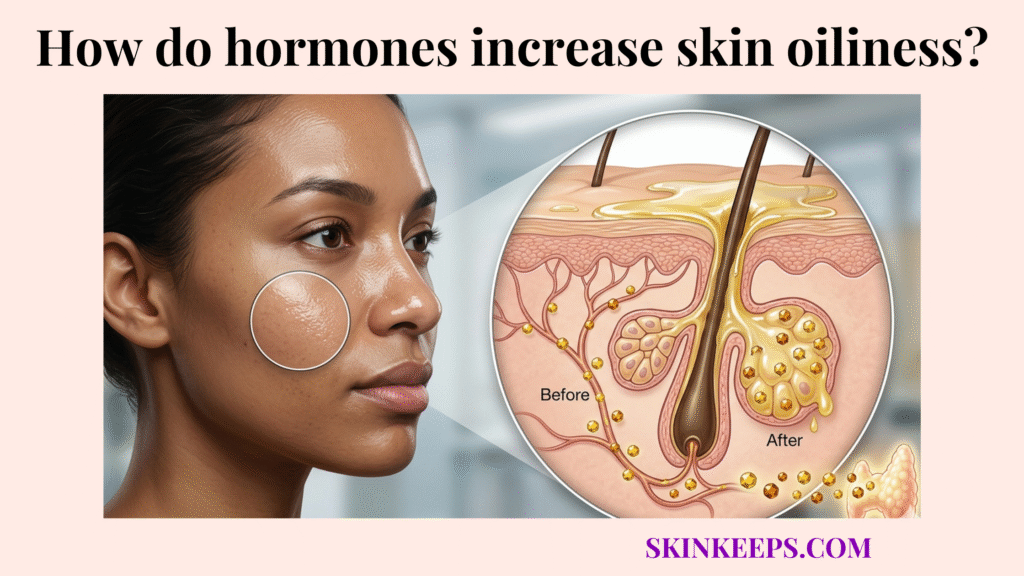
Hormones increase skin oiliness when androgen signals stimulate sebaceous glands to produce more sebum, while local skin enzymes can strengthen that hormonal effect inside the gland. This internal process explains why cleansing can remove surface oil temporarily without stopping the deeper signaling that creates new oil.
This guideline explains how androgens, androgen receptors, and type 1 5-alpha reductase affect sebaceous glands, why puberty and some cycle patterns can increase oiliness, and how stress should be understood as a modifier rather than a guaranteed sebum trigger. It also shows how treatment choices should separate cosmetic oil control from clinician-guided acne therapy.
What hormonal pathway increases sebum production in the skin?
The hormonal pathway that increases sebum production begins when androgens bind to receptors in sebaceous glands and stimulate sebocyte activity. This androgen signal increases the gland’s tendency to synthesize and release lipids. Readers who need the cellular layer behind this process can continue through oily skin sebum production once they understand the hormonal trigger.
Sebaceous glands release sebum through holocrine secretion, a process in which lipid-filled sebocytes mature and break down to discharge their contents. This mechanism explains why hormone-driven oiliness is produced inside the follicle before surface oil becomes visible. The process is physiological, not a sign of poor cleansing. [NCBI]
How sebaceous glands respond to androgen signals
Sebaceous glands respond to androgen signals by increasing the activity of cells that synthesize and release sebum. This gland response dictates how much raw lipid material the sebocytes will accumulate. The heightened activity translates directly into a greasier epidermal surface.
How sebocytes increase lipid production after hormonal stimulation
Sebocytes increase lipid production after hormonal stimulation by synthesizing more sebum components before releasing them through holocrine secretion. This lipid synthesis swells the cellular volume prior to its programmed breakdown. The breakdown releases the concentrated oil payload directly into the follicular canal.
Why hormone-driven oiliness is an internal signaling issue, not a dirt issue
Hormone-driven oiliness is an internal signaling issue, not a dirt issue, because sebum is manufactured inside the follicle before it reaches the skin surface. This internal origin means that an individual with oily skin is dealing with biology, not poor hygiene. The biological distinction prevents users from adopting overly aggressive surface routines.
| Step | What Happens | Visible Result |
|---|---|---|
| Androgen signal reaches the skin | Sebaceous glands receive hormonal input | Oil production can rise |
| Sebocyte activity increases | More lipids are made inside the gland | More sebum moves toward the surface |
| Sebum output increases | Surface oil becomes more noticeable | Shine, greasiness, and clogged pores may appear |
How do androgens and DHT make skin oilier?
Androgens and DHT make skin oilier by stimulating sebaceous gland growth and secretory activity. This androgen effect matters because sebaceous glands and follicular keratinocytes contain receptors for testosterone and DHT, with DHT showing stronger receptor affinity. The larger causal picture belongs within oily skin causes, where hormones are one major internal driver among several. [NCBI]
Type 1 5-alpha reductase converts testosterone into a more potent androgen form and is abundantly produced in sebaceous glands, especially on the face and scalp. This local conversion helps explain why skin-level androgen effects can be strong even when a blood test does not fully predict visible facial oiliness. The claim should be framed as local amplification, not as proof of systemic hormone abnormality. [NCBI]
How androgen receptors increase sebaceous gland activity
Androgen receptors increase sebaceous gland activity by allowing gland cells to respond to circulating androgen signals. This receptor responsiveness determines how effectively the hormonal message translates into cellular action. Even normal hormone levels can produce an oily phenotype if these local receptors are highly sensitive.
How local 5-alpha reductase supports DHT-related oil production
Local type 1 5-alpha reductase supports DHT-related oil production by converting testosterone into a more potent androgen within sebaceous regions. This local 5-alpha reductase activity concentrates the strongest hormonal stimulus directly at the gland. The resulting DHT significantly increases local lipogenesis.
Why oily skin can occur even when blood hormone levels are not extremely high
Oily skin can occur even when blood hormone levels are not extremely high because local gland responsiveness and local androgen metabolism also influence the visible result. This tissue responsiveness ensures the skin acts independently of minor systemic fluctuations. Evaluating oily skin therefore requires recognizing that the skin is its own hormonally active organ.
| Factor | Main Role | Effect on Oiliness |
|---|---|---|
| Androgens | Stimulate sebaceous glands | More sebum production |
| Androgen receptors | Allow glands to respond to hormones | Stronger or weaker oil response |
| Type 1 5-alpha reductase | Supports local DHT-related signaling | Can amplify sebaceous activity in facial regions |
When do hormonal shifts make skin oilier?
Hormonal shifts can make skin oilier during puberty and, in some people, during recurring menstrual-cycle phases. Puberty commonly increases skin oiliness because rising androgen production stimulates sebaceous glands to produce more sebum. This developmental pattern is one of the clearest examples of hormone-driven oiliness. It explains why oily skin often becomes more obvious during adolescence. [NCBI]
Cycle-linked oiliness is real for some people but not universal. A study found cyclic changes with maximum sebum excretion during the week before menstruation in seborrheic women, while women with low sebum production showed no change. Monthly tracking is therefore useful for identifying a repeated personal pattern rather than assuming every flare is hormonal. [PubMed]
Why puberty commonly increases skin oiliness
Puberty commonly increases skin oiliness because rising androgen production stimulates sebaceous glands to become more active. This developmental activation sets the baseline for adult sebaceous behavior. The sudden influx of androgens reliably shifts the complexion from pre-pubertal dryness to noticeable shine.
Why some people notice oilier skin before part of the menstrual cycle
Some people notice oilier skin before menstruation because cyclical hormone shifts can increase sebum output in seborrheic skin profiles. This premenstrual phase spike is highly individualized and depends strongly on the person’s existing sebaceous baseline. Understanding this specific timing helps users prepare targeted surface care rather than reacting with alarm.
When persistent hormone-driven oiliness may point to a condition like PCOS
Persistent hormone-driven oiliness may need medical evaluation when it appears with other signs such as irregular periods, excess hair growth, or severe persistent acne. These systemic symptoms suggest an endocrine disorder like PCOS rather than standard cosmetic oiliness. Securing a proper medical assessment is paramount when these red flags cluster.
Common Timing Patterns in Hormonal Oiliness
- Puberty: Androgen rise commonly increases sebaceous activity.
- Menstrual cycle: Some seborrheic users may notice oilier skin in the week before menstruation.
- Medical evaluation: Persistent oiliness with irregular periods, hirsutism, or severe acne may justify clinical assessment.
How can stress-related hormones worsen skin oiliness?
Stress-related endocrine changes may worsen acne-prone skin behavior, but direct evidence that stress consistently increases sebum quantity is limited. A prospective adolescent study found stress-related acne worsening while reporting that psychological stress did not appear to affect sebum production quantity. This makes stress a safer modifier than a proven direct cause of extra oil output. [Medical Journals Sweden]
Stress can still matter clinically because acne flares are not driven by sebum alone. Inflammation, sleep disruption, scratching, product misuse, and routine inconsistency can all make hormonally oily skin harder to manage. The focused guide on oily skin stress should be linked inside this explanation so the reader understands stress without exaggerating its sebum effect.
How stress can increase androgen-related signaling
Stress response mechanisms can influence acne-prone skin through endocrine and inflammatory pathways, but it should not be presented as a guaranteed direct sebum trigger. The release of cortisol and specific neuropeptides alters the localized tissue environment. This altered environment can exacerbate pre-existing glandular sensitivities without definitively skyrocketing oil volume.
Why lack of sleep and chronic stress can make oiliness harder to control
Lack of sleep and chronic stress can make hormone-driven oiliness harder to manage by destabilizing routines and increasing flare-prone skin behavior. This routine destabilization compromises the consistent care required to mitigate shine. The resulting erratic behavior makes the oily phenotype appear much more volatile.
Why stress can worsen both oiliness and acne tendency
Stress can worsen the overall appearance of oily, acne-prone skin even when it does not directly increase sebum quantity. This overall worsening happens because a stressed barrier struggles to resolve localized inflammation effectively. As the inflammation lingers, both the oiliness and the lesions appear more severe.
| Stress-Related Factor | Likely Pathway | Possible Skin Effect |
|---|---|---|
| Acute stress | Neuroendocrine and inflammatory response | Acne may look worse |
| Chronic stress | Ongoing routine disruption and inflammatory burden | Harder-to-control flare pattern |
| Sleep disruption | Reduced routine consistency and stress-system strain | More unstable skin behavior |
Why doesn’t aggressive washing fix hormone-driven oiliness?
Aggressive washing does not fix hormone-driven oiliness because cleansing removes surface oil without stopping the internal signaling that produces new sebum. This surface-versus-root distinction explains why shine can return even after the face feels squeaky clean. The common mistake of over-washing oily skin belongs naturally inside this paragraph because it shows why more washing is not the same as better hormonal control.
The American Academy of Dermatology advises gentle foaming cleansers for oily skin and warns that harsh face wash can irritate the skin and trigger increased oil production. This makes gentle oil removal safer than aggressive stripping. The target is steadier control, not total dryness. [AAD]
Why hormones keep signaling the gland after the surface oil is removed
Hormones keep signaling the gland after surface oil is removed because the internal endocrine pathway continues independently of cleansing. This internal signaling operates deep within the dermis, safely isolated from surface surfactants. Consequently, a clean epidermis cannot halt the cellular lipogenesis driven by systemic androgens.
Why harsh cleansers can irritate oily skin and make control harder
Harsh cleansers can irritate oily skin and make control harder by damaging comfort while sebaceous output continues. This barrier damage strips essential lipids and hydration, provoking a tight, uncomfortable sensation. The tight sensation coupled with returning oil makes the complexion exceedingly difficult to manage.
Why hormone-driven oiliness needs management, not scrubbing
Hormone-driven oiliness needs management, not scrubbing, because stable control works better than repeated attempts to strip away every trace of oil. This stable control focuses on normalizing the surface film without inducing irritation. Gently supporting the barrier allows for a clearer, calmer complexion long-term.
| Mistake | What It Does | Likely Result |
|---|---|---|
| Over-washing | Removes surface oil aggressively | Temporary dryness with oil return |
| Alcohol-heavy astringents | Irritate and strip the barrier | Oily yet irritated skin |
| Repeated harsh cleansing | Focuses only on the surface | Internal oil-driving signals still continue |
Which interventions help manage hormone-driven oiliness?
Interventions that help manage hormone-driven oiliness range from cosmetic oil-control support to clinician-guided acne therapies that target androgen-related pathways. Topical oil-control support can include niacinamide and salicylic acid. A controlled study found that topical 2% niacinamide may reduce measured facial sebum parameters, while salicylic acid is better framed as pore-clearing support rather than hormone therapy. Readers comparing ingredient roles can continue through oily skin active ingredients after understanding that cosmetic actives manage visible oil rather than systemic hormones. [PubMed]
Prescription therapy belongs in a different tier. FDA labeling identifies clascoterone cream 1% as an androgen receptor inhibitor indicated for topical acne treatment in patients 12 years and older, while AAD guidelines list clascoterone, combined oral contraceptives, and spironolactone among acne therapies. These options should be described as clinician-guided acne treatments, not cosmetic oily-skin fixes. [FDA] and [AAD]
Which topical options help reduce visible oiliness and congestion
Topical options such as niacinamide and salicylic acid help reduce visible oiliness and congestion without altering systemic hormone levels. This cosmetic approach ensures the skin surface looks refined and matte for longer durations. Managing expression safely provides daily relief without systemic side effects.
When topical antiandrogen treatment may be relevant
Topical antiandrogen treatment may be relevant when acne with androgen-related features requires prescription care rather than routine cosmetic oil control. This prescription care targets the specific receptor pathway driving the sebaceous glands. Such targeted therapy addresses the biological root of acne vulgaris when surface care is insufficient.
When systemic hormonal therapy may be considered
Systemic hormonal therapy may be considered under clinician guidance for selected patients with persistent hormonally influenced acne. This systemic intervention addresses the circulating factors that initiate the entire cascade. Proper physician oversight is mandatory to ensure these therapies are utilized safely and appropriately.
| Treatment Type | Example | Main Role | Best Use Case |
|---|---|---|---|
| Cosmetic oil-control support | Niacinamide, salicylic acid | Reduce visible oiliness or congestion | Mild oily-skin support |
| Prescription topical acne treatment | Clascoterone | Targets androgen receptor pathway in acne care | Acne with androgen-related features |
| Systemic hormonal acne therapy | Spironolactone, combined oral contraceptives | Addresses hormonally influenced acne | Selected patients under clinician guidance |
How should a daily and monthly routine manage hormone-driven oiliness?
A daily and monthly routine should manage hormone-driven oiliness by combining gentle surface care with repeated pattern tracking. Daily care controls visible oil and barrier comfort, while monthly tracking helps identify whether oiliness repeatedly worsens around cycle timing, stress, or sleep disruption. The broader oily skin care tips guide should be utilized because hormone-aware care still depends on a stable basic routine.
Monthly tracking is useful because not every oil flare is hormonal and not every hormonal pattern is identical. Repeated notes about shine, breakouts, menstruation, sleep, and stress can reveal whether a true pattern exists. If oiliness is severe, persistent, or accompanied by symptoms such as irregular periods or hirsutism, the user should seek professional evaluation rather than self-diagnosing. [NHS]
What daily skincare habits help control hormone-driven oiliness
Daily skincare habits that help control hormone-driven oiliness include gentle cleansing, lightweight hydration, and appropriate topical oil-control support. This gentle foundation protects the barrier from becoming overly reactive. Utilizing non-comedogenic hydration ensures the skin stays balanced without exacerbating follicular congestion.
What monthly pattern-tracking helps identify hormonal oil spikes
Monthly pattern-tracking helps identify hormonal oil spikes by showing whether shine and breakouts recur at similar points in a person’s own cycle. This personal tracking clarifies whether the flares correlate reliably with timing. Recognizing a personal pattern allows the user to prepare their routine calmly.
Why consistency works better than aggressive oil removal
Consistency works better than aggressive oil removal because internal hormone signaling is managed more safely through steady support than repeated stripping. This steady support reinforces the skin’s natural defenses over time. Ultimately, regular maintenance achieves far better cosmetic results than erratic, forceful washing.
Hormone-Driven Oiliness Management Checklist
FAQs
How do hormones make skin oily?
Hormones make skin oily mainly through androgens, which stimulate sebaceous glands to produce more sebum. Local skin enzymes such as type 1 5-alpha reductase can strengthen androgen effects within sebaceous regions.
Does DHT increase skin oiliness?
DHT can contribute to oiliness because it is a potent androgen involved in sebaceous signaling. Type 1 5-alpha reductase helps convert testosterone into more potent androgen activity in facial sebaceous regions.
Why is my skin oilier before my period?
Some people notice more oiliness before menstruation. A study found maximum sebum excretion during the week before menstruation in seborrheic women, but this pattern did not appear in women with low sebum production.
Does stress directly increase sebum?
The evidence is weaker than many people assume. One adolescent study found that stress worsened acne severity but did not appear to increase sebum quantity, so stress is best treated as a modifier rather than a guaranteed direct oil trigger.
Can washing more fix hormonal oily skin?
No. Washing removes surface oil temporarily, but it does not stop internal hormone signaling. Harsh cleansing can also irritate oily skin and make control harder.
Is clascoterone an oil-control product?
Clascoterone is a prescription topical androgen receptor inhibitor approved for acne treatment, not a general cosmetic oil-control product. It belongs in a clinician-guided acne discussion.
When are spironolactone or birth control pills considered?
Spironolactone and combined oral contraceptives may be considered for selected patients with hormonally influenced acne under clinician guidance. They are not routine oily-skin products.
When should hormone-driven oiliness need medical evaluation?
Medical evaluation is reasonable when persistent oiliness appears with irregular periods, excess hair growth, severe acne, or other signs that may suggest a hormonal disorder such as PCOS.
Conclusion
Hormone-driven oiliness begins inside the sebaceous gland, so the best strategy is targeted management rather than surface overcorrection. Androgens, local DHT-related signaling, puberty, and some cyclical hormone patterns can increase visible oiliness.
Gentle skincare manages the surface, while clinician-guided treatment is reserved for persistent hormonally influenced acne. Hormonal oiliness is best controlled by understanding the signal, not by scrubbing harder.