
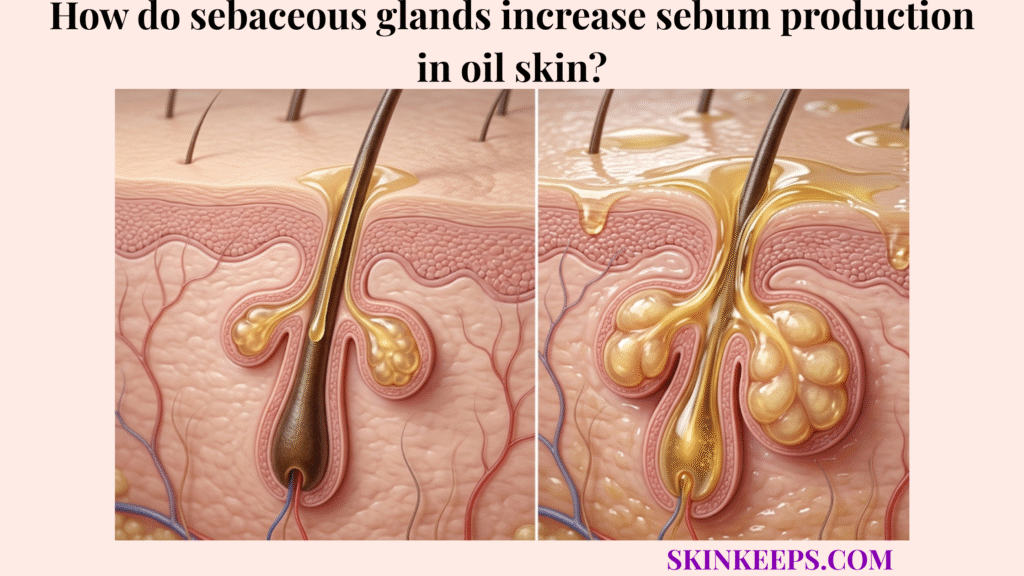
Sebaceous glands increase sebum production in oily skin when sebocytes mature, accumulate lipids, respond to androgen signaling, and release more surface oil through holocrine secretion. This process happens inside the sebaceous follicle, so visible oiliness is not a hygiene failure or simply surface dirt.
This guideline explains how sebocytes produce sebum, how holocrine secretion releases oil into the follicle, why genetics and hormones can raise gland activity, and how IGF-1, stress, diet, and topical ingredients modify visible oil output. It also explains how to manage sebaceous activity without harsh stripping.
What is holocrine secretion in sebaceous glands?
Holocrine secretion in sebaceous glands is the biological process where sebocytes accumulate lipids, mature, disintegrate, and release their contents into the follicular canal. This secretion process makes sebaceous glands different from glands that release only part of their contents. The complete cellular breakdown explains why sebum contains both lipids and cellular material. This cellular mechanism is the deeper biological layer behind oily skin as a sebum-driven skin type.
NCBI StatPearls describes sebaceous glands as specialized because their product is synthesized through holocrine secretion, where the whole cell breaks down to release secretory products. This source-supported mechanism is the safest way to explain sebum release. The wording should remain histological, not dramatic. [NCBI]
How sebocytes mature and accumulate lipids
Sebocytes mature and accumulate lipids by synthesizing sebum components as they move through the sebaceous gland toward the duct. This lipid accumulation fills the cell with sebum components before release. The accumulated lipids later become part of the oily material that reaches the skin surface.
How holocrine secretion releases sebum into the follicle
Holocrine secretion releases sebum into the follicle when mature sebocytes break down and discharge their lipid-rich contents into the follicular canal. This cellular breakdown ensures the lipids effectively empty into the follicular space. The follicular movement then carries the mixture outward.
Why increased sebocyte activity can raise visible oil output
Increased sebocyte activity can raise visible oiliness because more lipid synthesis and sebocyte turnover can send more sebum into the follicular canal. This visible oil output appears as the surface result of a faster glandular cycle. The faster cycle naturally deposits a thicker layer of oil on the stratum corneum.
| Step | What Happens | Why It Matters |
|---|---|---|
| Basal sebocyte formation | New sebocytes develop inside the gland | Starts the production cycle |
| Lipid accumulation | Sebocytes synthesize and store sebum components | Increases glandular lipid content |
| Cellular breakdown | Mature sebocytes disintegrate during holocrine secretion | Releases sebum into the follicular canal |
| Sebum movement into follicle | Secreted material moves toward the duct and skin surface | Visible oiliness becomes easier to see |
Why do some sebaceous glands produce more sebum than others?
Some sebaceous glands produce more sebum than others because inherited biology and hormone sensitivity vary between individuals. This inherited variation changes how actively sebocytes produce and release lipids. The variation explains why some people develop visible oiliness even with consistent cleansing.
Regional gland activity also explains why oily skin often appears strongest on the face. This regional activity concentrates visible oil in areas with more sebaceous behavior. The same pattern helps explain why oily skin causes include both baseline biology and daily amplifiers.
How genetics influence sebaceous gland activity
Genetics influence sebaceous gland activity by shaping inherited differences in gland behavior, sebocyte activity, and baseline oil tendency. This inherited tendency affects how strongly sebaceous glands contribute to baseline shine. Recognizing this innate biological framework connects directly to oily skin genetics, helping readers separate inherited oil tendency from temporary triggers.
Why gland size and sebocyte behavior affect baseline sebum output
Gland size and sebocyte behavior affect baseline sebum output because larger or more active glands can contain more lipid-producing cells. These lipid-producing cells act as the foundational source of the surface film. The larger cellular volume typically translates into a heavier daily oil presence.
Why oily skin is a biological tendency, not a hygiene failure
Oily skin is a biological tendency, not a hygiene failure, because sebaceous activity occurs inside the follicle before oil reaches the surface. This internal activity means that washing removes surface oil temporarily. Washing does not stop internal production, so the lipid film will inevitably return over time.
How do androgens increase sebum production in sebaceous glands?
Androgens increase sebum production in sebaceous glands by interacting with androgen receptors and supporting sebocyte lipogenesis. This androgen response makes sebaceous glands sensitive to hormonal signaling. The response can increase visible oil output when receptor sensitivity or local androgen metabolism is stronger. Understanding this androgen pathway connects closely to oily skin hormones, allowing readers to explore hormone-related oiliness without assuming a medical disorder.
NCBI StatPearls notes that type 1 5-alpha reductase converts testosterone into a more potent androgen form and is abundantly produced in sebaceous glands, especially on the face and scalp. This source supports explaining local androgen metabolism as a major sebaceous-gland pathway. The claim should not be rewritten as proof that every oily-skin person has abnormal hormone levels. [NCBI]
How androgen receptors influence sebocyte proliferation and lipogenesis
Androgen receptors influence sebocyte proliferation and lipogenesis by allowing sebaceous glands to respond to androgen signals. This receptor sensitivity determines how vigorously the sebocytes synthesize new lipids. The vigorous synthesis results in higher oil output across the localized tissue.
How local 5-alpha reductase activity supports androgen signaling in sebaceous glands
Local 5-alpha reductase activity supports androgen signaling in sebaceous glands by converting testosterone into more potent androgen activity within the skin. This enzyme activity matters because local conversion can strengthen androgen effects at the gland level. Regional 5-alpha reductase research supports the role of local conversion in sebaceous regulation. [PubMed]
Why oily skin can occur even when circulating hormone levels are not extreme
Oily skin can occur even when circulating hormone levels are not extreme because sebaceous glands may be locally sensitive to normal androgen signals. This localized gland sensitivity means the tissue reacts strongly to standard physiological baselines. The strong reaction creates a greasy phenotype without indicating an underlying systemic disorder.
| Factor | Main Role | Effect on Sebum Production |
|---|---|---|
| Androgens | Support sebaceous gland function | Can increase sebocyte activity and oil production |
| Androgen receptors | Receive hormone signals | Influence gland responsiveness |
| 5-alpha reductase | Supports local androgen conversion | Can amplify local androgen effect in sebaceous regions |
| Sebocyte lipogenesis | Builds sebum lipids inside cells | Raises visible surface oil when activity increases |
Which metabolic and lifestyle factors can increase sebaceous activity?
Metabolic and lifestyle factors can increase sebaceous activity by modifying hormone-related and inflammatory pathways in susceptible people. These modifiers do not replace genetics or androgen sensitivity as baseline drivers. They can make existing oiliness, congestion, or acne-prone behavior more noticeable.
IGF-1 is a strong research-supported example of a metabolic modifier because it has been shown to induce SREBP-1 expression and lipogenesis in sebocytes. This finding connects insulin signaling with sebum biology. The claim should be used to explain susceptibility, not to blame one food or one meal for oily skin. [PMC]
How stress can contribute to oilier skin
Stress can contribute to oilier skin by shifting neuroendocrine and inflammatory signals that may influence sebaceous activity. This stress signaling utilizes cortisol and neuropeptides that can interact with sebaceous structures. Treating oily skin stress as a modifier rather than a root cause allows for a more realistic management strategy.
How high-glycemic dietary patterns may worsen oily, acne-prone skin
High-glycemic dietary patterns may worsen oily, acne-prone skin by influencing insulin and IGF-1 signaling in susceptible people. This pathway matters because IGF-1 has been linked with increased sebum production and sebum-production-related proteins in cultured sebocytes. Exploring oily skin diet and breakouts helps clarify why one food does not directly create oily skin. [PMC]
Why these factors modify oily skin rather than fully determine it
These factors modify oily skin rather than fully determine it because they amplify an existing genetic, hormonal, or sebaceous baseline. This amplification creates temporary fluctuations in oil output. Recognizing the difference between a baseline and an amplifier ensures lifestyle changes remain supportive rather than punishing.
| Factor | Main Pathway | Likely Effect |
|---|---|---|
| Stress | Neuroendocrine and inflammatory signaling | More visible oiliness or breakouts in some people |
| High-glycemic intake | Insulin/IGF-1-related signaling | May increase acne-prone oiliness in susceptible people |
| Hormonal sensitivity | Stronger sebaceous response | Higher baseline oil output |
| Chronic routine irritation | Barrier stress | Harder-to-control oiliness |
Which topical ingredients may help reduce visible sebum production?
Topical ingredients may help reduce visible sebum production by changing what reaches or remains on the skin surface. This visible reduction can come from lower measured surface oiliness, clearer follicles, or better barrier comfort. The effect is oil control, not permanent gland shutdown. A fuller ingredient comparison can use oily skin active ingredients when the reader needs to choose between BHA, AHA, and oil-control actives.
A controlled study found that topical 2% niacinamide may lower sebum excretion rate in Japanese subjects and casual sebum level in Caucasian subjects. This evidence supports niacinamide as a realistic oil-control ingredient category. The claim should not be stretched into a promise that every niacinamide formula fully suppresses sebaceous output. [PubMed]
How niacinamide may help reduce facial sebum output
Niacinamide may help reduce facial sebum output over time by lowering measured surface oiliness in some studied populations. This visible oil control reduces the thick lipid film that causes excessive reflection. The reduced reflection helps the complexion look more balanced throughout the day.
Which oil-control ingredients support oily skin without heavy residue
Oil-control ingredients such as salicylic acid, lightweight humectants, and non-comedogenic products support oily skin without adding heavy residue. Salicylic acid clears pore buildup, while lightweight moisturizer supplies essential water balance. These targeted formulations protect the barrier without exacerbating the sebaceous slickness.
Why topical oil regulation usually improves control rather than eliminating sebum
Topical oil regulation usually improves control rather than eliminating sebum because sebaceous glands continue producing oil internally. This internal production serves to lubricate and protect the epidermis naturally. Proper skincare merely manages the surplus rather than aggressively fighting the skin’s functional biology.
| Ingredient or Category | Main Role | Best Fit |
|---|---|---|
| Niacinamide | Supports visible oil control over time | Daily routine support |
| Salicylic acid / BHA | Reduces oil-related clogging and buildup | Oily, congestion-prone skin |
| Lightweight oil-free moisturizers | Support hydration without heavy residue | Barrier-friendly oil control |
| Matte, non-comedogenic products | Reduce visible shine | Daytime oil management |
What daily habits help reduce excessive sebum without worsening oily skin?
Daily habits help reduce excessive sebum without worsening oily skin by controlling visible oil while protecting the barrier. This barrier protection depends on gentle cleansing, lightweight hydration, and non-comedogenic product textures. The result is steadier shine control without tightness or irritation.
The American Academy of Dermatology advises oily-skin users to avoid harsh or alcohol-heavy cleansers because irritation can trigger increased oil production. This guidance supports gentle cleansing instead of repeated stripping. The routine goal should be stable oil control rather than complete dryness. [American Academy of Dermatology]
Why gentle cleansing works better than aggressive stripping
Gentle cleansing works better than aggressive stripping because harsh cleansers can irritate oily skin while surface oil still returns later. This barrier irritation compromises the skin’s structural comfort. The compromised barrier feels uncomfortably tight even when the sebaceous glands resume their output.
Why lightweight hydration still matters for oily skin
Lightweight hydration still matters for oily skin because water balance and oil production are separate barrier needs. Sebum provides a lipid-rich coating, but hydration relies on holding water within the cellular matrix. Applying a lightweight, non-comedogenic moisturizer fulfills this water requirement beautifully.
How consistency helps keep sebaceous activity more stable-looking
Consistency helps keep sebaceous activity more stable-looking because predictable routines reduce avoidable irritation and surface oil swings. This visible stability emerges when the skin is not constantly fighting to recover from aggressive treatments. A steady, barrier-safe approach yields far more reliable oil management.
Daily Sebaceous Activity Management Checklist
FAQs
How do sebaceous glands produce sebum?
Sebaceous glands produce sebum through holocrine secretion. In this process, sebocytes mature, accumulate lipids, break down, and release their lipid-rich contents into the follicular canal.
Why do sebaceous glands produce more oil in oily skin?
Sebaceous glands may produce more oil in oily skin because of inherited gland behavior, higher gland activity, androgen sensitivity, local 5-alpha reductase activity, and sebocyte lipogenesis.
What are sebocytes?
Sebocytes are specialized cells inside sebaceous glands that synthesize and store sebum lipids. Mature sebocytes eventually break down during holocrine secretion and release their contents into the follicle.
How do androgens increase sebum?
Androgens can increase sebum by interacting with androgen receptors in sebaceous glands. Local 5-alpha reductase activity can strengthen androgen-related signaling in sebaceous regions such as the face and scalp.
Does DHT cause oily skin?
DHT can contribute to sebaceous activity because it is a potent androgen involved in local skin signaling. Oily skin does not automatically mean hormone levels are abnormal, because local gland sensitivity also matters.
Can stress increase sebum production?
Stress may worsen oiliness in some people through neuroendocrine and inflammatory signaling. Stress is best treated as a modifier, not the only cause of oily skin.
Does niacinamide reduce sebum?
Topical 2% niacinamide has clinical evidence for lowering measured facial sebum parameters in studied groups. It should be described as visible oil-control support, not as a permanent gland suppressant.
Can harsh cleansing reduce sebaceous gland activity?
Harsh cleansing removes surface oil temporarily, but it does not stop internal sebaceous production. It can irritate oily skin and make oil control harder, so gentle cleansing is safer.
Conclusion
Sebaceous glands increase sebum production through sebocyte maturation, holocrine secretion, androgen signaling, and metabolic modifiers. Oily skin begins inside the sebaceous gland, where sebocytes synthesize lipids and release sebum through holocrine secretion.
Genetics, androgen sensitivity, 5-alpha reductase, IGF-1 signaling, stress, and diet can modify how visible that oil becomes. The best strategy is controlled oil regulation, not aggressive stripping.