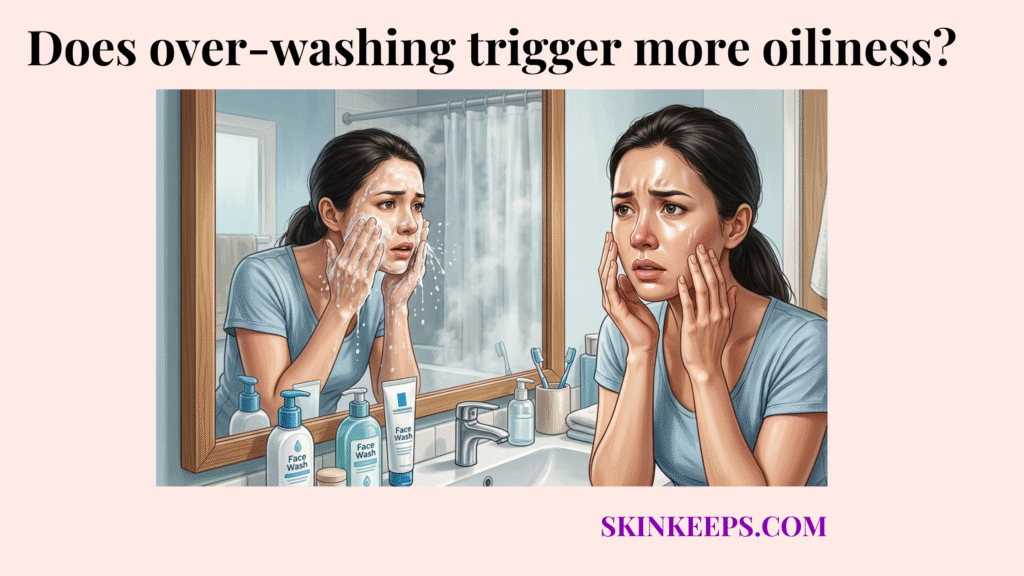
Yes, over-washing can trigger more visible oiliness in some people by stripping surface lipids, irritating the barrier, and making oil control less stable. This explains why an oil-prone complexion often feels temporarily cleaner after repeated washing but becomes tight, shiny, or harder to manage later.
This guideline explains how excessive cleansing removes surface lipids, why acid mantle disruption can create tight-yet-greasy skin, what rebound oiliness means in realistic terms, and how to break the strip-and-shine cycle. It also shows which cleanser habits support oil control without turning cleansing into another source of irritation.
How does excessive cleansing strip the natural epidermal lipid barrier?
Excessive cleansing can strip the natural epidermal lipid barrier by repeatedly removing surface sebum and barrier-supporting lipids faster than the skin can comfortably recover. AAD states that washing the face several times a day can further irritate acne-prone skin and lead to more breakouts. This makes oily skin skincare mistakes the correct parent context for understanding why over-washing fails. [AAD]
The temporary matte feeling after cleansing is not the same as stable oil control. This matte feeling only proves that surface oil has been removed for the moment. If the cleansing pattern irritates the barrier, shine can return while the skin feels less comfortable.
How repeated washing removes surface sebum and acid-mantle components
Repeated washing removes surface sebum and acid-mantle components by repeatedly dissolving the surface film that helps lubricate and protect the stratum corneum. This dissolution leaves the epidermis exposed to environmental stress and friction. As discussed in oily skin harsh products, removing this film repeatedly creates chronic, localized discomfort.
Why harsh cleansers increase pH disruption and barrier stress
Harsh cleansers can increase pH disruption and barrier stress when they push the skin surface away from its mildly acidic environment. Natural soaps are often high pH, and facial cleansing with such agents can raise skin surface pH away from its normal mildly acidic state. Normal cutaneous pH is commonly discussed around the mildly acidic range, meaning alkaline shifts compromise essential structural defense. [ScienceDirect] and [PMC]
Why “squeaky clean” skin is often a warning sign, not a success signal
Squeaky-clean skin is often a warning sign rather than a success signal because the tight, high-friction feeling usually means too much surface lipid has been removed. This tactile friction proves the barrier lacks adequate lubrication. When the skin squeaks, the protective lipid matrix has been severely compromised.
| Step | What Happens | Common Result |
|---|---|---|
| Repeated cleansing | Surface oil is removed again and again | Temporary matte feel |
| Harsh cleanser use | pH and barrier comfort may be disrupted | Tightness and irritation |
| Barrier stress increases | Water comfort becomes less stable | Oily yet dehydrated skin feel |
| Oil control becomes less stable | Shine returns while comfort worsens | Harder-to-manage midday oiliness |
Why does acid mantle disruption make oily skin feel tighter but look greasier?
Acid mantle disruption can make oily skin feel tighter but look greasier because water comfort and surface sebum are controlled by different skin processes. A stripped surface can feel dehydrated or irritated while sebaceous glands continue releasing oil. This is the stripped-yet-shiny pattern many users mistake for needing even more washing.
The acid mantle matters because acidic skin surface pH contributes to permeability-barrier function and antimicrobial balance. When repeated washing or high-pH cleansing disturbs this surface environment, the skin can become less tolerant even if it still looks oily. This explains the tight-yet-greasy state without needing dramatic rebound biology. [IJDVL]
How TEWL may increase after over-washing
Transepidermal water loss (TEWL) may increase after over-washing when repeated stripping weakens barrier comfort and allows water-loss stress to become more noticeable. This water loss leaves the upper skin layers feeling tight and physically restrictive. Such evaporative stress highlights the direct damage caused by overzealous cleansing.
Why dehydrated oily skin can still produce visible shine
Dehydrated oily skin can still produce visible shine because hydration level and sebaceous lipid production are separate biological functions. This separation explains why oily skin skipping moisturizer traps the barrier in an uncomfortable, dehydrated state while shine continues. Glands will deposit oil regardless of how dry the tissue feels underneath.
Why tightness and grease can coexist in the same complexion
Tightness and grease can coexist in the same complexion when the barrier feels dehydrated while surface sebum continues to reflect light. This dual state confuses users who equate tightness with cleanliness. In reality, the skin is displaying distinct signs of both high oil output and acute barrier distress simultaneously.
| Skin State | Main Barrier Status | Common Feel | Common Appearance |
|---|---|---|---|
| More balanced oily skin | Surface barrier is more stable | Comfortable, slicker in oily zones | Controlled shine |
| Over-washed oily skin | Barrier is stressed or dehydrated | Tight, irritated, uncomfortable | Greasy, shiny, less stable |
| Irritated oily skin | Barrier tolerance is lower | Stinging or reactive | Shine plus redness |
| Hydrated oily skin | Water comfort is supported | Softer, less tight | Shine may still appear but feels easier to manage |
What does compensatory seborrhea mean in over-washed oily skin?
Compensatory seborrhea in over-washed oily skin should be understood as rebound-like oil instability after repeated stripping, not as a guaranteed emergency oil surge. This term is best used to describe the user-facing pattern where oil seems harder to control after harsh cleansing. The mechanism should stay tied to irritation, barrier stress, and visible oil return.
AAD’s oily-skin guidance supports this measured explanation because it warns that harsh face wash can irritate oily skin and trigger increased oil production. That claim does not prove a fixed timeline or identical response in every person. It does justify explaining why repeated stripping can make oily skin feel less stable. [AAD]
How rebound oiliness describes oil instability after repeated stripping
Rebound oiliness describes oil instability after repeated stripping because oil return may feel faster or harder to manage when the barrier is irritated. This visible experience leads users to believe their skin is producing more oil, even if the primary change is merely poor tolerance. The resulting frustration emphasizes the need for a stable, calming routine.
Why over-washing can make oily skin feel harder to regulate
Over-washing can make oily skin feel harder to regulate because repeated cleansing removes surface oil while adding irritation and tightness. This constant fluctuation keeps the skin surface off balance. A perpetually unbalanced surface inevitably feels more volatile and significantly greasier overall.
Why rebound oiliness is a tendency, not a guaranteed fixed-timeline event
Rebound oiliness is a tendency, not a guaranteed fixed-timeline event, because individual skin response depends on cleanser strength, washing frequency, barrier tolerance, and baseline oiliness. This individual variation means some users will feel greasy within an hour, while others simply experience mild irritation. Understanding this tendency prevents users from waiting for an exact “midday oil surge” clock.
Why does washing too often trap oily skin in a chronic strip-and-shine cycle?
Washing too often can trap oily skin in a strip-and-shine cycle because temporary matte relief encourages repeated cleansing that keeps the barrier irritated. The user feels greasy, washes again, feels temporarily matte, then experiences shine return with more tightness. Exploring over-exfoliating oily skin provides additional context for how repetitive, harsh actions degrade barrier resilience.
Breaking the cycle requires changing the response to midday oiliness. Blotting surface shine or adjusting moisturizer texture often works better than another full cleanse. The goal is to reduce repeated surfactant exposure while keeping the skin comfortable.
Why midday oiliness often leads to more washing instead of better control
Midday oiliness often leads to more washing instead of better control because the immediate discomfort of shine makes extra cleansing feel logical. This behavior reinforcement rewards the user briefly with a dry surface. Unfortunately, it completely ignores the subsequent irritation that follows shortly after.
How repeated stripping increases irritation and visible oil instability
Repeated stripping increases irritation and visible oil instability by exposing the skin to cleanser, water, and friction more often than necessary. This frequent chemical and mechanical contact wears down the stratum corneum. The worn-down barrier invariably displays worse oil control than a healthy, gently managed surface.
Why the cycle becomes harder to break once harsh cleansing becomes routine
The cycle becomes harder to break once harsh cleansing becomes routine because the skin and user both adapt to short-term matte relief instead of long-term comfort. This adaptation blinds the user to the underlying barrier stress they are actively causing. Breaking this habit requires deliberately accepting mild shine while the barrier heals.
Which cleansers help oily skin without triggering rebound oiliness?
Cleansers that help oily skin without triggering rebound oiliness remove excess sebum while keeping the skin comfortable after rinsing. AAD recommends a mild, gentle foaming cleanser for oily skin instead of a strong face wash that dries the skin out. This supports cleanser tolerance as the main selection rule. [AAD]
Oil cleansing or balm cleansing may help some users when sunscreen or makeup removal otherwise requires repeated harsh washing. This first-cleanse approach should rinse clean and be followed by a gentle cleanser if needed. It should not leave a heavy film on already congestion-prone skin.
Which low-pH cleansers suit oily skin better
Low-pH cleansers suit oily skin better when they clean without leaving the face tight, stinging, or squeaky. The right pH-aware, mild formula effortlessly removes grime while preserving comfort after washing. Discovering these balanced options is a key step in mastering oily skin product formulations.
Which gentle surfactants reduce over-stripping risk
Gentle surfactants reduce over-stripping risk when they remove sweat, sunscreen, and excess oil without leaving the skin uncomfortable. This feel-based tolerance dictates whether a cleanser is appropriate for long-term use. If a cleanser tightens the skin, its surfactants are inherently too aggressive.
When oil cleansing or balm cleansing may help without worsening oily skin
Oil cleansing or balm cleansing may help without worsening oily skin when it reduces friction during sunscreen or makeup removal and rinses away cleanly. This optional, tolerance-based step is beneficial for heavy product days. It eliminates the need for harsh rubbing or multiple stripping washes.
| Cleanser Type | Main Characteristic | Better or Worse for Over-Washed Oily Skin |
|---|---|---|
| Harsh alkaline cleanser | Higher pH and stronger stripping | Usually worse |
| Strong high-foam cleanser | More aggressive lipid removal | Often worse |
| Gentle low-pH gel cleanser | Better comfort and pH compatibility | Usually better |
| Gentle first cleanse for makeup/SPF removal | Less friction and fewer repeated washes | Better when rinsed clean and tolerated |
What daily routine helps break the over-washing cycle?
A daily routine helps break the over-washing cycle by limiting unnecessary cleansing, replacing harsh products, and supporting hydration after washing. AAD recommends washing acne-prone skin twice daily and after sweating, instead of washing several times throughout the day. This rule gives structure without ignoring sweat-related cleansing needs. [AAD]
The recovery routine should feel simpler and less reactive. Gentle cleansing, blotting papers, and lightweight hydration reduce the urge to rewash every time shine appears. The full maintenance plan can continue through oily skin care tips once the over-washing loop is controlled.
Why twice-daily cleansing is often enough for oily skin
Twice-daily cleansing is often enough for oily skin because it removes overnight oil and daily buildup without unnecessary repeated surfactant exposure. Incorporating a third wash after heavy sweating is perfectly acceptable when needed. This balanced cadence prevents the continuous irritation generated by relentless mid-day washing.
How blotting papers can replace extra daytime washing
Blotting papers can replace extra daytime washing by lifting surface oil without exposing the skin to another full cleanse. This friction-light oil control method safely manages shine. Utilizing papers prevents the barrier from enduring repeated wet-and-dry cycles throughout the afternoon.
Why lightweight hydration belongs in recovery from over-washing
Lightweight hydration belongs in recovery from over-washing because humectants like glycerin or hyaluronic acid can improve comfort without adding a greasy finish. This moisture support soothes the dehydrated surface tissue while recovery progresses. The added hydration makes the initial shift away from harsh washing much more physically comfortable.
How to tell when the skin is becoming more stable
You can tell when the skin is becoming more stable when tightness, stinging, and rapid irritation decrease while shine becomes more predictable. These reliable stability markers signal that the barrier is no longer inflamed. The ultimate goal is less tightness, less irritation, and a more steady daily appearance.
Daily Cycle-Breaking Routine for Over-Washed Oily Skin
FAQs
Does over-washing trigger more oiliness?
Yes, over-washing can trigger more visible oiliness in some people by irritating the barrier and making oil control less stable. AAD warns that harsh face wash can irritate oily skin and trigger increased oil production.
How often should oily skin be washed?
Oily or acne-prone skin is commonly washed twice daily and after sweating. Washing several times throughout the day can further irritate the skin and worsen breakouts.
Why does my skin feel tight but oily after washing?
Skin can feel tight but oily after washing because hydration and sebum are separate. A cleanser can leave the barrier uncomfortable while sebaceous glands continue releasing oil.
What does rebound oiliness mean?
Rebound oiliness means oil feels harder to control after repeated stripping or irritation. It should be treated as a tendency, not a guaranteed fixed-timeline event.
Is squeaky-clean skin good for oily skin?
No. Squeaky-clean skin usually means too much surface lipid has been removed. Healthy oil control should leave the skin clean but still comfortable.
What cleanser is best for over-washed oily skin?
A gentle, pH-aware cleanser that removes oil without leaving tightness is best. AAD recommends a mild, gentle foaming face wash for oily skin rather than a harsh product that dries the skin out.
Can blotting papers replace extra washing?
Yes. Blotting papers can reduce visible shine without exposing the skin to another round of cleanser, water, and friction.
Should oily skin moisturize after washing?
Yes. Oily skin can still need hydration after washing, especially if it feels tight or dehydrated. The moisturizer should be lightweight and non-comedogenic.
Conclusion
Over-washing can trigger more visible oiliness when repeated cleansing strips surface lipids, irritates the barrier, and keeps oily skin in a tight-yet-greasy cycle. The solution is not stronger cleansing. The solution is gentler washing, fewer unnecessary cleanses, lightweight hydration, and blotting instead of repeated surfactant exposure.
Stable oily-skin control starts when cleansing stops being aggressive and starts being consistent. At SkinKeeps, we provide the physiological insight needed to build barrier-safe routines that support your skin rather than punishing it.