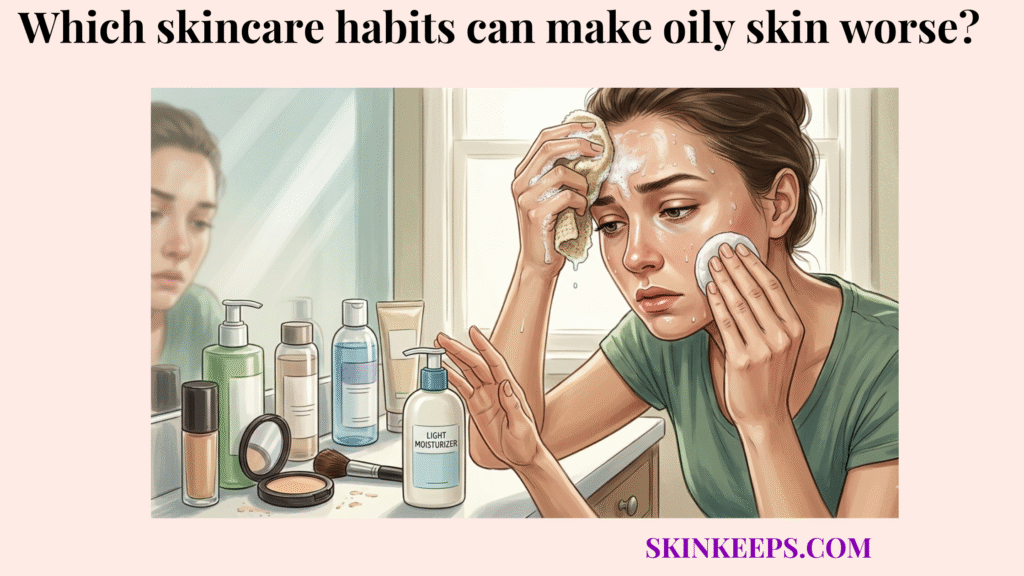
The skincare habits that make oily skin worse are the routines that strip, irritate, over-exfoliate, dehydrate, or overload an already oil-prone barrier. This explains why oily skin can become shinier and more reactive after aggressive cleansing instead of becoming cleaner and calmer.
This guideline explains how harsh cleansers, skipped moisturizer, physical scrubs, excessive acids, and heavy layering can worsen oily-skin symptoms. It also shows which gentle substitutions help restore a more stable routine without pretending that skincare can shut down sebaceous glands.
How does aggressive over-cleansing chemically trigger a rebound-like oily response in a sebaceous profile?
Aggressive over-washing can trigger a rebound-like oily response in a sebaceous profile by irritating the barrier and removing too much surface lipid at once. The AAD warns that harsh face wash can irritate oily skin and trigger increased oil production, which makes gentle cleansing safer than trying to dry the skin out completely. This is why over-washing oily skin should be treated as a core routine mistake, not a stronger version of good hygiene. [AAD]
The tight, squeaky-clean feeling after washing is a warning sign rather than proof of proper oil control. This feeling often means the cleanser has removed too much surface lipid and left the skin less comfortable. Better oil control starts with lower irritation, not stronger stripping.
The Disruption of the Acid Mantle
The disruption of the acid mantle begins when harsh or alkaline cleansing repeatedly alters the acidic surface environment that helps support barrier function. Never wash an oily face until it feels tight or squeaky-clean. That squeaky sensation often signals over-removal of surface lipids, and alkaline soaps can raise skin pH after washing, which may disturb barrier comfort. Washing three or four times daily with strong foaming or alcohol-heavy acne washes can leave oily skin tight, irritated, and still shiny later. [IJDVL]
Compensatory Seborrhea
Compensatory seborrhea should be described cautiously as increased visible oiliness or harder oil control after barrier irritation, not as a guaranteed oil surge. This irritation-related oil-control difficulty happens when compromised skin feels physically tight while underlying sebaceous output continues. The resulting contradiction leaves the face appearing highly reflective while feeling acutely dehydrated.
| Habit | Barrier Effect | Likely Skin Response |
|---|---|---|
| Washing too often | Repeated surface lipid removal | Tightness with oil return |
| Harsh foaming cleanser | Barrier irritation | Shinier, less comfortable skin |
| Alcohol-heavy cleanser | Surface dryness and irritation | Oily yet dehydrated feel |
| Gentle cleanser replacement | Lower irritation | More stable oil control |
Why does skipping daily hydration worsen an overactive lipid matrix?
Skipping daily hydration can worsen oily skin because surface oil and skin water balance are separate needs, so an oily face can still feel tight, dehydrated, or irritated. The AAD recommends applying moisturizer after cleansing even for oily skin, which supports lightweight hydration instead of moisturizer avoidance. The focused guide on oily skin moisturizer should be explored because moisturizer choice matters more than moisturizer avoidance. [AAD]
Lightweight hydration does not mean adding a greasy layer. A gel, lotion, or non-comedogenic moisturizer can support water comfort without overloading an oil-prone surface. The goal is barrier stability, not extra heaviness.
The Water vs. Oil Disconnect
The water versus oil disconnect means sebum and hydration are different biological needs, so oily skin can still lack water comfort. This disconnect becomes obvious when acne treatments cause dryness or irritation due to overuse. Recognizing that lipids do not replace internal water prevents the user from accidentally dehydrating their complexion.
The Dehydration Compensation
Dehydration compensation should be explained as oily-but-dehydrated skin discomfort, not as proof that the skin always makes emergency oil to stop water loss. This oily-but-dehydrated state elevates transepidermal water loss (TEWL) across the compromised surface. An appropriate moisturizer directly supports barrier function and mitigates this ongoing evaporative strain.
| Epidermal Component | Biological Function | What It Feels Like When Depleted | Oily Skin Misconception |
|---|---|---|---|
| Water / hydration | Supports comfort, flexibility, and enzyme function | Tight, dull, irritated | “I have oil, so I do not need hydration.” |
| Oil / sebum | Lubricates and helps protect the stratum corneum | Rough, less protected, uncomfortable | “Any moisturizer will make me greasier.” |
How do harsh physical exfoliants traumatize and inflame a breakout-prone complexion?
Harsh physical exfoliants can traumatize and inflame a breakout-prone complexion by adding mechanical irritation to skin that is already vulnerable to acne flares. The AAD warns that scrubbing acne-prone skin can irritate it and cause acne to flare, while its exfoliation guidance says acne-prone skin may prefer a mild chemical exfoliator because mechanical exfoliation may be too irritating. This is why over-exfoliating oily skin belongs inside this corrective routine framework. [AAD]
Chemical exfoliation can be useful, but it can also irritate when overused. Salicylic acid helps exfoliate inside acne-prone patterns, but it should be introduced based on tolerance. A gentle chemical option is not permission to exfoliate aggressively.
Epidermal Irritation From Scrubbing
Epidermal irritation from scrubbing occurs when abrasive particles or stiff tools repeatedly rub an acne-prone surface. This mechanical friction severely stresses the superficial stratum corneum layers. Using harsh apricot, walnut, or sugar scrubs frequently transforms mild congestion into widespread, visible redness.
The Inflammatory Flare Risk
The inflammatory flare risk increases when physical friction adds redness, tenderness, or barrier discomfort to already congested skin. This inflammation aggravates existing papules and pustules rather than clearing them. Consequently, aggressive abrasion routinely turns minor breakouts into prolonged, painful healing events.
| Exfoliation Method | Mechanism of Action | Impact on Oily Skin | Irritation Risk |
|---|---|---|---|
| Harsh scrubs or stiff brushes | Mechanical friction | Can aggravate active acne-prone skin | Higher when used aggressively |
| Gentle washcloth or fingertips | Low-friction cleansing | Removes cleanser without harsh abrasion | Lower when used gently |
| Salicylic acid / BHA | Chemical exfoliation and desquamation support | Helps clogged-pore patterns when tolerated | Irritating if overused |
| No exfoliation during irritation | Barrier-rest approach | Allows reactive skin to calm | Often safest during flare periods |
Which barrier-suffocating product layering habits structurally worsen a congested oily barrier?
Comedogenic products and heavy layering habits can worsen a congested oily barrier when heavy or poorly matched products trap residue, sweat, makeup, and surface oil in acne-prone areas. The problem is usually the whole routine context, not one ingredient in isolation. A heavy occlusive layer may be helpful on dry cracked areas but uncomfortable or congestion-prone across an already oily T-zone.
Petrolatum needs accurate framing because it is a highly effective occlusive, not automatically a pore-clogging villain. A moisturizer review describes petrolatum as an excellent occlusive agent that can reduce epidermal moisture loss by 99%. That occlusive strength explains why full-face slugging can feel mismatched on very oily, active-breakout areas even though petrolatum itself should not be described as inherently comedogenic. [PMC]
The Slugging Mismatch
The slugging mismatch happens when a heavy occlusive layer is applied across oily, congestion-prone zones that do not need that level of moisture sealing. If a user applies a thick occlusive layer over oily, breakout-prone zones, it traps unwanted materials. The occlusive layer may hold sweat, product residue, makeup residue, or surface oil against the skin for longer. The skin may feel heavier, slicker, or more congestion-prone, especially if the underlying routine already contains comedogenic or irritating products.
Emollient Overload
Emollient overload occurs when a multi-step routine leaves more product film on oily skin than the barrier can comfortably tolerate. This leftover film sits heavily on the surface rather than absorbing neatly. The resulting congestion-prone feel guarantees the complexion looks persistently greasier than its natural baseline.
Which barrier-supportive formulations successfully regulate a damaged, oil-reactive skin type?
Barrier-supportive formulations help regulate a damaged, oil-reactive skin type by reducing irritation, supporting hydration, and avoiding heavy product overload. A gentle cleanser, lightweight moisturizer, and carefully introduced active can often outperform a harsh routine. The detailed ingredient selection can continue through oily skin active ingredients after this article corrects the main behavior mistakes.
Salicylic acid can fit oily, clogged-pore routines when used carefully. U.S. OTC acne regulations list salicylic acid at 0.5% to 2%, so 2% should be described as a common upper OTC strength rather than a mandatory starting point. This keeps BHA advice useful without turning it into another over-exfoliation mistake. [eCFR]
Low-pH, Non-Stripping Cleansers
Low-pH, non-stripping cleansers remove daily buildup while helping the skin avoid the tight, irritated feeling caused by harsher washing habits. This pH-aware support minimizes alkaline stress on the acid mantle. Replacing stripping products with these mild options reduces irritation-related oil-control difficulty, which fundamentally differentiates a healthy wash from the oily skin harsh products that exacerbate oiliness.
Water-Based Humectants
Water-based humectants such as glycerin and hyaluronic acid support oily skin by improving hydration comfort without adding a heavy surface film. These ingredients bind essential moisture tightly to the stratum corneum cells. Improving this water balance provides a soothing, lightweight texture that never feels thick or greasy.
| Bad Habit | Biological Consequence | Better Replacement Habit | Expected Practical Result |
|---|---|---|---|
| Washing until squeaky-clean | Barrier irritation and tightness | Cleansing with a gentle, pH-aware cleanser | Calmer, more comfortable skin |
| Skipping moisturizer | Poor water comfort and tightness | Using a lightweight humectant gel or lotion | Better hydration without heaviness |
| Using harsh scrubs | Mechanical irritation and acne flare risk | Using salicylic acid carefully if clogged pores are present | Clearer pores with less friction |
| Full-face heavy occlusive layering | Heavier film and possible congestion-prone feel | Using lightweight, non-comedogenic fluids | Better comfort in oily zones |
| Repeating actives too often | Over-exfoliation and irritation | Rotating actives by tolerance | More stable routine behavior |
What is the ultimate daily checklist to correct bad habits and stabilize an oily epidermal state?
The ultimate daily checklist to correct bad habits and stabilize an oily epidermal state focuses on gentle cleansing, reduced friction, lightweight hydration, and careful active use. This routine works because it lowers avoidable irritation while still addressing oil and clogged pores. Readers can review oily skin care tips for the full daily system after the damaging habits are corrected.
Corrective progress should be judged by comfort, fewer irritation flares, less tightness, and more predictable midday shine. The goal is not to remove every trace of oil. The goal is to stop making oily skin more reactive through avoidable routine stress.
Cleansing and Exfoliation Parameters
Cleansing and exfoliation parameters require gentle washing and careful exfoliant use rather than repeated stripping or aggressive scrubbing. Cleanse morning and evening, and after heavy sweating if needed. Recommend blotting papers for midday shine instead of repeated full cleansing. Suggest salicylic acid 0.5% to 2% based on tolerance, not automatic daily use.
Mandatory Hydration and Protection
Hydration and protection require a lightweight non-comedogenic moisturizer after cleansing and a sunscreen texture that does not leave the skin feeling overloaded. These fluid, gel, or light lotion textures hydrate effectively without causing congestion. Selecting appropriate protection ensures the barrier stays resilient against daily environmental stressors.
Daily Corrective Routine Checklist
FAQs
Which skincare habits make oily skin worse?
The skincare habits that make oily skin worse include harsh cleansing, alcohol-based products, abrasive scrubbing, skipping moisturizer, overusing exfoliants, and layering heavy products on oily, congestion-prone zones.
Can washing your face too much make oily skin worse?
Yes, washing too much or using harsh cleansers can irritate oily skin and make oil control harder. AAD warns that harsh face wash can irritate oily skin and trigger increased oil production. [AAD]
Does oily skin still need moisturizer?
Yes, oily skin can still need moisturizer because sebum and hydration are different needs. AAD recommends applying moisturizer after cleansing, even for oily skin. [AAD]
Are physical scrubs bad for oily acne-prone skin?
Harsh physical scrubs can be a problem for oily acne-prone skin because scrubbing can irritate skin and cause acne to flare. AAD says acne-prone skin may prefer a mild chemical exfoliator because mechanical exfoliation may be too irritating. [AAD]
Is salicylic acid better than scrubbing?
Salicylic acid can be better than harsh scrubbing for clogged-pore oily skin because it supports chemical exfoliation without abrasive friction. U.S. OTC acne regulations list salicylic acid at 0.5% to 2%, so it should be used according to tolerance. [eCFR]
Is slugging bad for oily skin?
Slugging is not automatically bad, and petrolatum should not be called inherently comedogenic. The issue is that heavy occlusive layering can feel too heavy or congestion-prone on active oily areas, especially when layered over sweat, makeup, or irritating products.
What should replace harsh oily-skin habits?
Better replacements include a gentle cleanser, lightweight non-comedogenic moisturizer, careful salicylic acid use if clogged pores are present, blotting papers for midday shine, and sunscreen in a fluid or matte texture.
What is the biggest oily-skin routine mistake?
The biggest oily-skin routine mistake is trying to dry the skin into balance. Oily skin usually improves more reliably when the routine reduces irritation, supports hydration, and controls congestion without aggressive stripping.
Conclusion
Skincare habits make oily skin worse when they add irritation, dehydration, friction, or heavy product buildup to an already oil-prone surface. Harsh cleansing, skipped moisturizer, abrasive scrubs, overused actives, and heavy layering can all make oily skin harder to control. The better strategy is a stable, lightweight routine that cleans gently, hydrates without heaviness, and treats clogged pores without friction.
Oily skin improves fastest when the routine stops fighting the barrier and starts supporting it. At SkinKeeps, we provide clinical insights to help you eliminate damaging habits and establish an effective, barrier-friendly regimen.