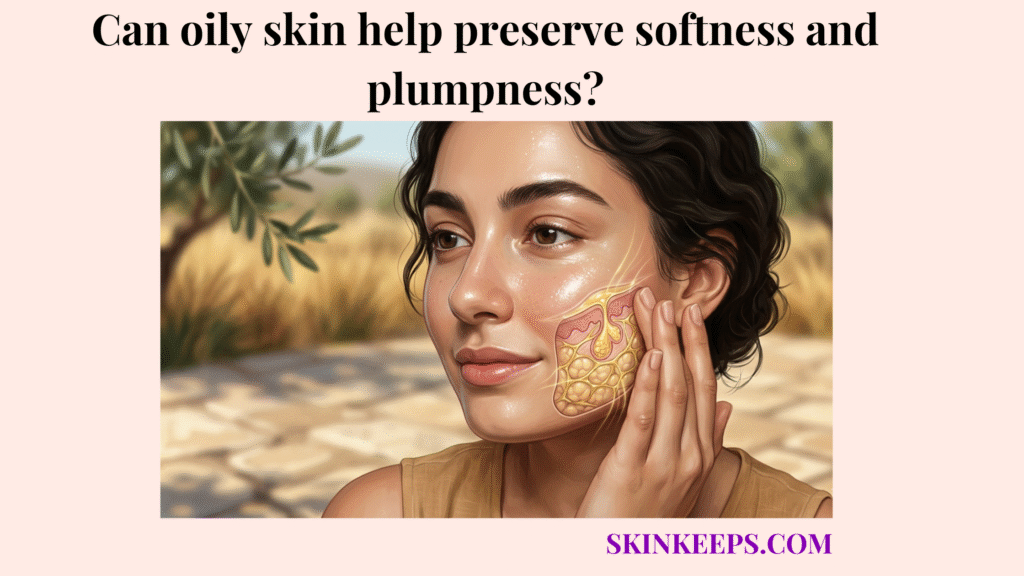
Yes, oily skin can help preserve surface softness and a plump-looking finish because sebum lubricates the stratum corneum, reduces friction, and makes rough texture feel smoother. This makes oily skin feel more supple at the surface when sebum remains balanced instead of heavy or congested.
This guideline explains how sebum creates tactile softness, how surface oil reduces drag across the skin, why oily skin may look temporarily more plump, and why oil is still different from hydration and dermal firmness. It also explains how to preserve a soft oily-skin surface with lightweight hydration, gentle cleansing, and non-comedogenic care.
What kind of softness can oily skin naturally preserve?
Oily skin can naturally preserve tactile softness, meaning the skin may feel smoother, more slippery, and less rough because sebum coats the outer barrier. This softness is felt at the surface where fingers meet the stratum corneum. The benefit is therefore sensory and biophysical, not proof that the deeper skin is firmer or more hydrated.
Sebum has a real biological role, but it should not be exaggerated. Review literature describes sebum as supporting skin homeostasis and barrier function, while also noting that dysregulated sebum can contribute to skin problems. This means sebum can support a soft surface when balanced, but excess oil can still create shine or congestion. [PMC]
How sebum creates a smoother tactile feel on oily skin
Sebum creates a smoother tactile feel on oily skin by forming a thin lipid layer that reduces rough contact between the skin surface and the fingers. This lipid layer can make the outer skin feel more flexible and less papery. The effect belongs to surface lubrication, not deeper tissue volume.
Why oily softness is mostly a surface-lubrication effect
Oily softness is mostly a surface-lubrication effect because sebum changes the way the outer barrier feels without directly increasing internal water content. Exploring oily skin benefits provides further context on why this is one specific benefit, not the entire advantage category. The key takeaway remains that oil provides slip, not moisture.
Why soft-feeling oily skin can still be dehydrated underneath
Soft-feeling oily skin can still be dehydrated underneath because surface oil and internal water balance are controlled by different skin functions. Adding an oily skin moisturizer ensures that water balance receives proper support regardless of how much lipid coats the exterior. The skin requires dedicated hydration even when the surface feels fully lubricated.
How does sebum reduce friction on the skin surface?
Sebum reduces friction on the skin surface by adding slip between the stratum corneum and anything that moves across it. This slip can make oily skin feel smoother than lipid-poor skin, especially after cleansing or in dry air. The same slip becomes less pleasant when oil accumulates heavily and feels coated.
This friction effect is one reason oily skin may feel softer even when it looks shiny. The skin is not necessarily healthier just because it feels slick. The correct reading is that sebum changes surface drag, while hydration and barrier comfort still need separate support.
How natural oil lowers surface drag across the stratum corneum
Natural oil lowers surface drag across the stratum corneum by creating a smoother contact layer over the outer skin cells. This smoother contact minimizes the physical resistance encountered during touch or movement. The reduced resistance effectively prevents the chafing commonly associated with a depleted barrier.
Why oily skin may feel less rough than lipid-poor dry skin
Oily skin may feel less rough than lipid-poor dry skin because sebum can reduce the dry friction that makes surface texture feel coarse. Reviewing oily skin less dryness explains why a continuous lipid coating naturally diminishes this tight, rough sensation. However, over-treated oily skin can also feel rough if the barrier becomes severely compromised.
How excess sebum can shift softness into greasiness
Excess sebum can shift softness into greasiness when the lipid film becomes too heavy, uneven, or mixed with sweat and residue. This transition occurs when the sheer volume of oil overwhelms the skin’s capacity for light lubrication. The resulting thick layer feels sticky and coated rather than supple and smooth.
| Sebum Effect | What Happens | Skin Feel |
|---|---|---|
| Light surface lubrication | Sebum coats the outer layer | Softer and smoother |
| Reduced friction | Skin surface has more slip | Less roughness |
| Excess oil buildup | Oil sits heavily on the surface | Greasy or coated |
| Oil plus dehydration | Surface is slick but water-poor | Soft outside, tight underneath |
Why can oily skin look plumper on the surface?
Oily skin can look plumper on the surface because sebum creates a supple, light-reflective finish that reduces the appearance of dry flatness. This plump-looking effect is strongest when surface oil is balanced and hydration is adequate. If hydration is missing, the surface may still look shiny while feeling tight.
Surface plumpness should not be confused with structural plumpness. Surface plumpness is about finish and comfort. Structural plumpness depends on deeper support from collagen, elastin, and facial volume.
How surface oil makes the skin look more supple
Surface oil makes the skin look more supple by softening the dry, matte finish that can make the outer barrier appear flat. This visual softening relies on the continuous dispersion of light across the lipid film. The even light reflection generates a healthy-looking, flexible exterior finish.
Why reduced surface dryness can create a fuller-looking finish
Reduced surface dryness can create a fuller-looking finish because smoother surface texture reflects light more evenly than rough, dry skin. This optical illusion makes the superficial tissue appear slightly elevated and completely uninterrupted. The visual trick relies heavily on eliminating any microscopic flaking that scatters light.
Why surface plumpness is not the same as dermal volume
Surface plumpness is not the same as dermal volume because sebum affects the outer finish, while dermal volume depends on deeper structural support. This deeper support is generated by collagen, elastin, and subcutaneous fat. Recognizing this biological distinction prevents users from expecting sebaceous glands to perform the job of structural proteins.
| Type of Plumpness | Main Cause | What It Affects |
|---|---|---|
| Surface plumpness | Sebum plus adequate hydration | Smoothness and suppleness |
| Hydration plumpness | Water in the stratum corneum | Comfort and flexibility |
| Structural plumpness | Collagen, elastin, and fat support | Firmness and facial volume |
| Temporary cosmetic plumpness | Product film or humectants | Short-term surface appearance |
How is sebum-supported softness different from hydration?
Sebum-supported softness is different from hydration because sebum lubricates the surface, while hydration refers to water held inside the stratum corneum. This means oily skin can feel smooth to the touch but still lack enough water for comfort. The visible clue is skin that looks slick yet feels tight after washing.
Lightweight humectants address the water side of softness. A clinical hydration study notes that hyaluronic acid and glycerin are well-known substances able to improve skin hydration. This supports their use in oily skin when the goal is softness without heavy greasiness. [PMC]
Why sebum cannot replace water inside the skin barrier
Sebum cannot replace water inside the skin barrier because lipids and water perform different functions in the stratum corneum. Lipids provide a hydrophobic seal, whereas water ensures enzymatic action and cellular flexibility. These distinct roles mean surface grease can never substitute for internal moisture.
Why oily skin can feel soft but still become tight after cleansing
Oily skin can feel soft but still become tight after cleansing because surfactants can reduce surface lipids while water evaporates from the outer barrier. Understanding oily skin sebum barrier dynamics clarifies why preserving these lipids maintains essential barrier comfort. Once the lipids are washed away, the underlying lack of water is immediately felt.
Why lightweight hydration preserves softness better than heavy grease
Lightweight hydration preserves softness better than heavy grease because water-binding ingredients support comfort without adding a thick oily film. These humectant-based products plump the stratum corneum efficiently. This targeted water delivery ensures the tissue feels genuinely soft rather than superficially slick.
| Skin Factor | Main Source | Main Benefit | Limitation |
|---|---|---|---|
| Sebum | Sebaceous glands | Surface softness and lubrication | Does not hydrate cells |
| Hydration | Water in the stratum corneum | Flexibility and comfort | Can evaporate without support |
| Barrier lipids | Skin barrier structure | Reduced water loss | Can be disrupted by harsh cleansing |
| Dermal firmness | Collagen and elastin | Deeper support | Not created by surface oil |
When does oily skin lose its natural softness?
Oily skin loses its natural softness when harsh cleansing, over-exfoliation, dehydration, or heavy product overload disrupts the balance between sebum, water, and barrier function comfort. These habits do not simply remove oil. They can turn a naturally smooth-feeling surface into skin that feels tight, stinging, coated, or unstable.
The AAD recommends that oily skin be cleansed up to twice daily and after sweating, while also advising users to avoid scrubbing. This guidance matters because soft oily skin depends on controlled cleansing rather than friction or repeated stripping. [AAD]
When harsh cleansing turns soft oily skin into tight oily skin
Harsh cleansing turns soft oily skin into tight oily skin when it removes too much surface lipid and leaves the barrier feeling exposed. This excessive removal strips away the natural lubrication that provides the soft tactile feel. The resulting barrier stress transforms a smooth complexion into an uncomfortably rigid surface.
When over-exfoliation makes oily skin feel smooth but damaged
Over-exfoliation can make oily skin feel temporarily smooth but uncomfortable when repeated exfoliation outpaces the skin’s tolerance. This forced shedding exposes immature cells to the environment prematurely. The compromised tissue quickly begins to sting and react negatively to ordinary skincare.
When dehydration makes oily skin feel slick but uncomfortable
Dehydration makes oily skin feel slick but uncomfortable when surface oil remains present while the stratum corneum lacks enough water. This paradoxical state creates a highly unpleasant sensory experience. The skin requires targeted humectants to resolve the internal tightness beneath the oil.
| Habit | What It Removes or Disrupts | Result |
|---|---|---|
| Harsh foaming cleansers | Surface lipids and barrier comfort | Tight, stripped oily skin |
| Over-exfoliation | Protective surface tolerance | Shiny but sensitive skin |
| Skipping hydration | Water support | Greasy yet tight skin |
| Heavy occlusive overload | Surface balance | Softness becomes congestion or heaviness |
Which ingredients preserve soft oily skin without making it greasy?
Ingredients that preserve soft oily skin without making it greasy are lightweight humectants, barrier-supportive actives, and non-comedogenic textures that improve comfort without heavy residue. Hyaluronic acid and glycerin are useful here because they support hydration rather than adding more oil. A clinical hydration study notes that both ingredients are well-known for improving skin hydration. [PMC]
Niacinamide can also fit a soft oily-skin routine when oil feels unstable. A clinical study found topical 2% niacinamide may reduce facial sebum-related measurements in studied groups. This makes niacinamide a support ingredient for balance, not a replacement for hydration. [PubMed]
How glycerin supports soft oily skin without heavy residue
Glycerin supports soft oily skin without heavy residue by binding water into the stratum corneum instead of adding a thick oil layer. This efficient water-binding capacity enhances structural flexibility. The enhanced flexibility keeps the skin feeling naturally supple without feeling slick.
How hyaluronic acid improves water-based suppleness
Hyaluronic acid improves water-based suppleness by supporting stratum corneum hydration, which helps oily skin feel flexible rather than slick and tight. This targeted moisture delivery ensures the surface cells remain comfortably plump. The targeted hydration acts entirely independently of the sebaceous glands.
How niacinamide supports a balanced soft-surface feel
Niacinamide supports a balanced soft-surface feel by helping oily skin maintain comfort while managing visible oil instability. This ingredient aids in fortifying the barrier against everyday environmental stress. The fortified barrier exhibits a much more consistent, refined texture over time.
Why lightweight gel textures suit oily softness better than rich creams
Lightweight gel moisturizer textures often suit oily softness better than rich creams because they deliver water comfort with less surface weight. Analyzing oily skin product formulations confirms that these specialized bases absorb cleanly without leaving an occlusive layer. The clean absorption prevents the suffocating sensation associated with heavier emulsions.
| Ingredient or Texture | Main Role | Best Use |
|---|---|---|
| Glycerin | Water-binding softness | Daily lightweight hydration |
| Hyaluronic acid | Water-based suppleness | Oily but tight skin |
| Niacinamide | Barrier comfort and oil-balance support | Oily skin that feels unstable |
| Gel moisturizer | Hydration with low residue | Shine-prone skin |
| Non-comedogenic fluid SPF | Protection without heaviness | Morning routine |
How should oily skin maintain a soft, supple surface every day?
Oily skin should maintain a soft, supple surface every day by cleansing gently, replacing water loss with lightweight hydration, and keeping sebum balanced instead of stripping it away. The AAD recommends cleansing oily skin up to twice daily and after sweating, choosing oil-free and non-comedogenic products, and avoiding scrubbing. This routine protects softness by reducing irritation and unnecessary lipid removal. [AAD]
Daily sunscreen also protects the deeper support that surface softness cannot replace. The AAD says SPF 30 filters about 97% of UVB rays and recommends reapplication every 2 hours outdoors. This makes lightweight SPF part of a soft-surface routine, not only an anti-aging step. [AAD]
What a morning routine should do for soft oily skin
A morning routine for soft oily skin should remove overnight oil gently, add lightweight hydration, and protect the surface with a non-comedogenic sunscreen. This straightforward sequence establishes a defensive barrier against the day’s stressors. Utilizing non-comedogenic formulas ensures that this defense does not provoke new breakouts.
What an evening routine should do for surface recovery
An evening routine for surface recovery should remove sebum, sunscreen, and daily residue without stripping away every trace of natural lipid comfort. Following comprehensive oily skin care tips guarantees that nighttime maintenance remains gentle and restorative. This careful removal prepares the epidermis for targeted, soothing hydration while at rest.
How to keep softness without chasing a greasy glow
You can keep softness without chasing a greasy glow by judging the skin by comfort, flexibility, and low congestion rather than by shine alone. This tactile assessment proves far more reliable than visual reflection. A truly balanced surface feels effortlessly smooth, completely bypassing the heavy sensation of excess grease.
Daily Soft-Surface Routine for Oily Skin
What should you remember about oily skin, softness, and plumpness?
The main point to remember is that oily skin can feel softer and look more supple because sebum improves surface lubrication, but this effect is not the same as hydration or dermal firmness.
Key Takeaways
- Oily skin can feel softer because sebum reduces surface friction.
- Oily skin can look more supple because surface oil reduces dry-looking roughness.
- This is mainly a surface effect, not proof of deeper firmness.
- Oil does not replace hydration.
- Too much oil can become heaviness, congestion, or shine.
- Lightweight humectants can preserve softness without adding heavy grease.
- The best routine preserves softness while preventing greasiness and clogged pores.
FAQs
Can oily skin help preserve softness and plumpness?
Yes, oily skin can help preserve surface softness and a plump-looking finish because sebum lubricates the outer skin layer. This effect is mostly surface-level and does not replace hydration or deeper firmness.
Why does oily skin feel soft?
Oily skin can feel soft because sebum reduces friction across the stratum corneum. This creates more slip and less roughness when the surface oil remains balanced.
Does sebum hydrate the skin?
No, sebum does not hydrate the skin in the same way water does. Sebum lubricates the surface, while hydration depends on water held in the stratum corneum.
Can oily skin be soft but dehydrated?
Yes, oily skin can be soft at the surface but dehydrated underneath. This happens because surface oil can remain present while the stratum corneum lacks enough water for comfort.
What ingredients help oily skin stay soft without greasiness?
Glycerin, hyaluronic acid, lightweight gel moisturizers, and niacinamide can help preserve comfort without heavy residue. Hyaluronic acid and glycerin are well-known hydration-supporting ingredients.
Does niacinamide help soft oily skin?
Niacinamide may help soft oily skin when visible oil feels unstable. Formulations containing niacinamide may reduce facial sebum-related measurements in studied groups.
Can too much oil make skin less soft?
Yes, too much oil can shift softness into greasiness, heaviness, or congestion. Balanced sebum supports comfort, while excess sebum can make the surface feel coated.
How often should oily skin cleanse to preserve softness?
Dermatology guidelines often recommend cleansing oily skin up to twice daily and after sweating. This supports cleanliness without encouraging unnecessary stripping or friction.
Conclusion
Oily skin can help preserve a soft, supple surface because sebum reduces friction and makes the outer barrier feel smoother. This softness is useful but limited. Sebum can improve surface feel and appearance, but it cannot replace hydration, sunscreen, or deeper structural firmness.
Healthy oily skin stays soft when the routine protects balanced sebum, adds lightweight water support, and avoids turning natural lubrication into greasiness. At SkinKeeps, we provide the biophysical knowledge needed to embrace your skin’s natural softness while utilizing effective, non-comedogenic hydration strategies.