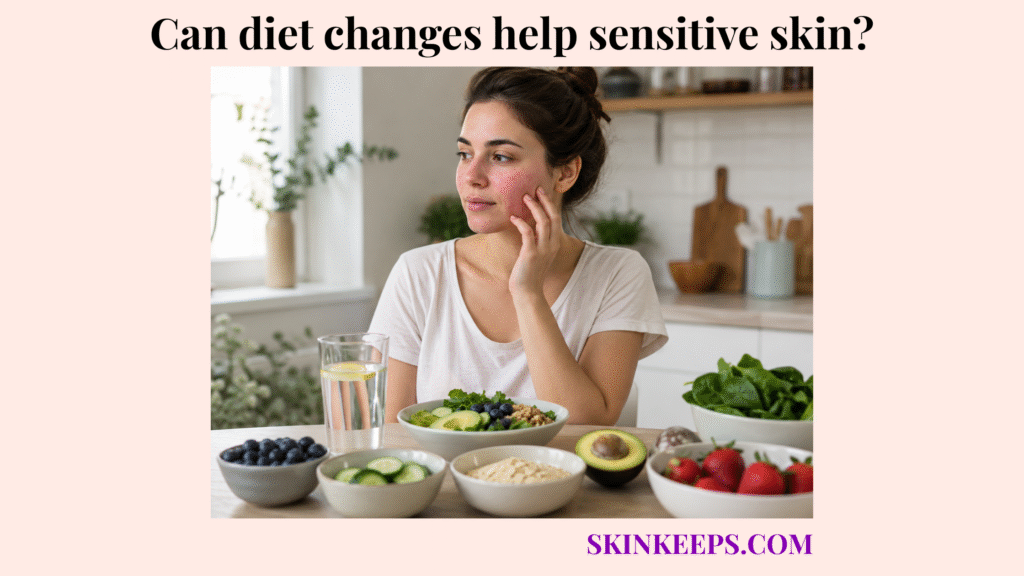
Diet changes may help some people with sensitive skin when food, hydration, alcohol, spicy meals, allergies, intolerances, or inflammatory skin conditions are part of a repeatable trigger pattern. Diet is not a universal cause of sensitive skin, and a single food reaction does not prove a food trigger.
No single diet can reliably cure sensitive skin. This article moves from diet support to food-pattern tracking, hydration, flushing triggers, allergy warning signs, elimination-diet caution, supplement caution, non-diet clues, and professional evaluation.
How Can Diet Changes Support Sensitive Skin?
Diet changes can support sensitive skin when they improve hydration, reduce repeatable personal triggers, or support overall skin health without causing unnecessary restriction. Diet can be one supportive layer, but it should sit beside care tips that help calm and protect sensitive skin rather than replace barrier care.
Why May Diet Influence Some Skin Reactions?
Diet may influence some skin reactions because alcohol, spicy foods, hot drinks, dehydration, allergies, or inflammatory conditions can affect flushing, itching, dryness, or discomfort in certain people.
Why Is Sensitive Skin Not Always Food-Related?
Sensitive skin is not always food-related because many reactions are more directly linked to products, cleansing, weather, heat, wind, sun exposure, stress, hormones, friction, or underlying skin conditions.
| Diet-related factor | How it may affect sensitive skin behavior |
|---|---|
| Hydration | May support comfort when dryness worsens sensitivity. |
| Balanced nutrition | Supports general skin health and recovery. |
| Repeated food-trigger patterns | May help identify personal sensitivity links. |
| Alcohol intake | May worsen flushing or heat-related reactions in some people. |
| Spicy foods | May trigger warmth or flushing in some reactive skin. |
| Food allergy | Can cause wider reactions that need medical evaluation. |
| Restrictive dieting | May worsen nutrition gaps if done carelessly. |
| Food diary | Helps separate real patterns from guesses. |
Once diet is framed as support rather than cure, the next step is to prevent the common mistake of blaming every sensitive-skin reaction on food.
Diet Support Is Pattern-Based, Not Cure-Based
This visual shows how hydration, food patterns, skincare stability, and warning signs should be compared before diet is treated as a sensitive-skin trigger.
Figure 1. Diet changes are most useful when they are based on repeated patterns, not one-time guesses.
Is Sensitive Skin Usually Caused by Diet?
No, sensitive skin is not usually caused by diet alone. Because many sensitive skin triggers come from products, weather, heat, friction, or barrier stress, diet should be evaluated as one possible modifier rather than the only cause.
| Better view | Misleading view |
|---|---|
| Diet may influence some trigger patterns. | Diet is always the root cause. |
| Food diaries can reveal repeatable links. | One reaction proves a food is the cause. |
| Balanced eating supports general skin health. | A strict diet cures sensitive skin. |
| Allergy-like reactions need medical guidance. | All food reactions can be self-diagnosed. |
| Skin care and barrier support still matter. | Diet alone replaces skincare care. |
Because diet is not usually the whole explanation, the useful question is whether the same food or drink repeatedly appears before the same skin reaction.
Which Diet Patterns May Matter for Sensitive Skin?
Diet patterns may matter for sensitive skin when the same food, drink, or hydration pattern repeatedly appears before the same type of reaction. If a sensitive skin flare-up appears after the same food or drink more than once, the pattern may be worth tracking instead of guessing from one isolated meal.
| Pattern | What it may suggest |
|---|---|
| Flushing after alcohol | Alcohol may be a personal trigger. |
| Warmth or redness after spicy meals | Heat or vascular response may be involved. |
| Itching with hives or swelling after food | Possible allergy concern; seek medical guidance. |
| Dryness during poor fluid intake | Hydration may be contributing. |
| Flares after repeated same food exposure | Pattern may be worth tracking. |
| No consistent food link | Diet may not be a major factor. |
| Skin worsens during highly restrictive dieting | Nutrition stress may be involved. |
| Reactions occur despite stable diet | Products, environment, or skin conditions may matter more. |
One of the safest diet-related patterns to review first is hydration, because it can influence comfort without requiring restrictive food changes.
Can Hydration Help Sensitive Skin Feel Calmer?
Hydration can support sensitive-skin comfort when low fluid intake, heat, sweat, or dry conditions contribute to dryness or tightness. Hydration may support general comfort, but the sensitive skin barrier still depends heavily on external moisture support, gentle cleansing, and reduced irritation.
Hydration Review Checklist
- Drink fluids consistently through the day.
- Watch whether dryness worsens when fluid intake is low.
- Consider sweat, heat, exercise, and climate.
- Support skin externally with moisturizer when dry or tight.
- Avoid relying on water intake alone to fix irritation.
- Seek help if dryness is severe, cracked, painful, or persistent.
After hydration, the next pattern to watch is flushing or heat after specific drinks or meals.
Can Certain Foods Trigger Sensitive-Skin Flushing or Heat?
Certain foods or drinks can trigger flushing, warmth, or burning sensations in some sensitive or reactive skin patterns, but this does not mean everyone must avoid them. Alcohol, spicy foods, very hot drinks, or personal triggers matter most when the pattern repeats.
| Trigger pattern | Better response |
|---|---|
| One-time flushing after a meal | Observe, do not overrestrict. |
| Repeated flushing after alcohol | Consider reducing or avoiding that trigger. |
| Heat after spicy foods | Track dose and timing. |
| Flare after hot drinks | Temperature may matter, not only ingredients. |
| Flushing with swelling or hives | Seek medical evaluation. |
| Flushing with known rosacea | Professional guidance may help. |
Flushing alone may be a personal trigger pattern, but hives, swelling, breathing symptoms, or widespread itching require a different level of caution.
Can Food Allergies or Intolerances Look Like Sensitive Skin Reactions?
Yes, food allergies or intolerances can sometimes look like skin reactions, but they should not be casually labeled as ordinary sensitive skin. Food-related reactions may involve itching, hives, swelling, rash, flushing, stomach symptoms, or discomfort.
| Reaction pattern | Why it matters |
|---|---|
| Hives after eating | Possible allergy-type reaction. |
| Lip, face, or eyelid swelling | Needs medical caution. |
| Widespread itching | May be more than sensitive skin. |
| Rash after repeated food exposure | Pattern should be assessed. |
| Stomach symptoms plus skin symptoms | Food intolerance or allergy may be involved. |
| Breathing symptoms or throat tightness | Urgent medical concern. |
Important Note
Food allergy or serious systemic reactions require medical evaluation, not skincare-only management.
Because food reactions can be complex, broad elimination diets should not be the first response to uncertain skin symptoms.
Should Sensitive Skin Try an Elimination Diet?
Sensitive skin should not begin a strict elimination diet without a clear reason or professional guidance. Removing many foods can create nutrition gaps, anxiety, and confusion when the true trigger may be skincare, weather, heat, stress, or another condition.
| Situation | Better direction |
|---|---|
| No clear food pattern | Avoid unnecessary restriction. |
| One food repeatedly triggers flushing | Track timing and reduce exposure cautiously. |
| Hives or swelling occur | Seek medical evaluation. |
| Multiple foods seem to trigger symptoms | Avoid self-diagnosing; seek guidance. |
| Diet becomes very restricted | Professional support is important. |
| Skin improves with balanced eating | Maintain supportive habits. |
| Skin does not change with diet | Focus on products, environment, barrier, and medical causes. |
Instead of cutting foods broadly, most readers should start with balanced nutrition that supports general skin and body health.
Can Anti-Inflammatory Foods Help Sensitive Skin?
A balanced eating pattern that includes fruits, vegetables, whole grains, healthy fats, adequate protein, and fluids may support general skin health, but no single anti-inflammatory food cures sensitive skin.
| Nutritional support | Possible relevance |
|---|---|
| Adequate protein | Supports general tissue repair processes. |
| Fruits and vegetables | Provide micronutrients and antioxidants. |
| Healthy fats | Support overall skin and body health. |
| Whole grains and fiber | Support general wellness. |
| Adequate fluids | Supports hydration status. |
| Consistent meals | Helps avoid extreme dietary swings. |
| Reduced excess alcohol if it triggers flushing | May reduce personal flare patterns. |
Balanced food patterns are different from supplement use, which needs more caution because more pills do not automatically mean better skin support.
Are Supplements Useful for Sensitive Skin?
Supplements are not automatically useful for sensitive skin unless there is a specific deficiency, medical reason, or clinician recommendation. Random supplements can cause side effects, interact with medications, or make reactions harder to trace.
| Supplement issue | Why caution matters |
|---|---|
| Taking many supplements at once | Makes reactions harder to trace. |
| High-dose supplements | May cause side effects. |
| Skin detox claims | Often marketing-driven. |
| Herbal supplements | Can cause reactions or interactions. |
| Deficiency-based supplements | Should be guided by appropriate evaluation. |
| Expecting fast skin cure | Sensitive skin usually needs broader care. |
If the reader still suspects diet is involved, the safer next step is controlled tracking rather than sudden restriction or supplement stacking.
How Can Diet Changes Be Tested Without Overreacting?
Diet changes can be tested without overreacting by keeping the skincare routine stable and tracking one suspected pattern at a time. Changing food, supplements, cleanser, moisturizer, sunscreen, and actives at the same time makes the cause impossible to identify.
Controlled Diet-Pattern Testing Method
- Keep the skincare routine stable while tracking diet.
- Record foods, drinks, symptoms, and timing.
- Look for repeated patterns, not one-time events.
- Avoid removing many foods at once.
- Change one suspected trigger at a time when reasonable.
- Watch whether symptoms improve consistently.
- Reassess if reactions continue despite diet changes.
- Seek professional help for swelling, hives, severe itching, or repeated unclear reactions.
If reactions continue without a repeatable food pattern, the article should guide readers back to more likely skin, product, and environment triggers.
What Signs Suggest Diet Is Not the Main Issue?
Diet may not be the main issue when reactions follow skincare products, cleansing, weather, hot showers, sunscreen, fabric friction, stress, or hormonal timing more clearly than meals. When reactions follow new skincare products more clearly than meals, it may be more useful to patch test new products than to restrict food.
| Clue | What may matter more |
|---|---|
| Skin reacts after products | Product irritation or ingredient intolerance. |
| Skin burns after cleansing | Cleansing habit or cleanser type. |
| Flares happen in wind or cold | Environmental exposure. |
| Skin worsens after hot showers | Water temperature and barrier stress. |
| Sunscreen stings | Sunscreen formula or barrier condition. |
| Itching occurs where fabric rubs | Friction or textile irritation. |
| Symptoms follow stress or hormonal timing | Internal modifiers may be involved. |
| Reactions continue with no food pattern | Diet may be secondary or unrelated. |
The biggest risk is not missing one perfect food rule; it is making diet changes so aggressively that the real trigger becomes harder to see.
What Diet Mistakes Can Make Sensitive-Skin Management Harder?
Diet mistakes can make sensitive-skin management harder when they create restriction, confusion, nutrition gaps, or delayed medical evaluation. The goal is pattern clarity, not fear around food.
| Mistake | Why it backfires |
|---|---|
| Blaming every flare on food | Misses products, weather, and barrier triggers. |
| Cutting many foods without evidence | Can create nutrition gaps. |
| Starting supplements and diet changes together | Makes results unclear. |
| Ignoring hives or swelling | May delay allergy evaluation. |
| Expecting one food to cure sensitivity | Oversimplifies sensitive skin. |
| Following online detox diets | May be restrictive or unsupported. |
| Not tracking timing | Makes trigger patterns unreliable. |
| Changing diet while also changing many products | Makes causes impossible to separate. |
A careful tracking worksheet gives the reader a safer way to test diet patterns without guessing or overrestricting.
How Should Diet-Related Sensitive-Skin Patterns Be Tracked?
Diet-related sensitive-skin patterns should be tracked by recording foods, drinks, symptoms, timing, skincare products, and other possible triggers on the same day. A food diary is most useful when it also includes skincare, heat, sweat, stress, hormones, weather, and fabric friction.
Diet and Sensitive-Skin Tracking Worksheet
- Date and time of reaction.
- Foods and drinks consumed before symptoms.
- Alcohol, spicy food, hot drinks, or new foods.
- Hydration level that day.
- Skin symptoms: flushing, warmth, itching, burning, rash, swelling, dryness, tightness.
- Where symptoms appeared.
- Time between food and symptoms.
- Skincare products used that day.
- Weather, heat, sweat, stress, hormones, or fabric exposure.
- Whether the pattern repeated.
- Whether reducing a suspected trigger helped.
- Photos of visible reactions if needed.
If the worksheet shows hives, swelling, widespread itching, severe symptoms, or multiple unclear food reactions, the next step should be professional evaluation rather than more restriction.
Diet Pattern Tracking Loop
This visual shows how to compare food and drink timing with skincare, weather, stress, and symptoms before making diet changes.
Figure 2. Diet tracking should compare meals with non-diet triggers so the reader does not overrestrict based on guesswork.
When Should Diet-Related Skin Reactions Be Professionally Evaluated?
Diet-related skin reactions should be professionally evaluated when symptoms include hives, swelling, throat tightness, breathing symptoms, severe itching, spreading rash, or repeated unclear reactions. Severe, spreading, swollen, blistering, painful, recurring, or unclear skin reactions are reasons to see a dermatologist, especially when food allergy or another condition may be involved.
Professional Evaluation Warning Signs
- Hives appear after eating.
- Lips, eyes, face, or throat swell.
- Breathing symptoms, dizziness, or throat tightness occur.
- Itching is severe or widespread.
- Rash spreads or repeatedly returns.
- Skin swells, blisters, oozes, crusts, or bleeds.
- Symptoms disrupt sleep or daily comfort.
- Multiple foods seem to trigger reactions.
- Diet has become very restricted.
- Food allergy, eczema, dermatitis, rosacea, infection, or another condition may be involved.
Urgent Safety Note
Breathing difficulty, throat tightness, faintness, dizziness, or rapid facial, lip, tongue, or throat swelling requires emergency medical care.
After the medical boundary is clear, the article can close by returning to the main principle: diet may support sensitive skin, but it should be tracked carefully and kept balanced.
What Should You Remember About Diet Changes and Sensitive Skin?
Diet changes may help some people with sensitive skin, but diet is not a universal cause or cure.
What Should You Remember?
- Diet changes may help some sensitive-skin patterns.
- Diet is not the universal cause of sensitive skin.
- No single diet reliably cures sensitivity.
- Repeated patterns matter more than one-time reactions.
- Hydration may support comfort when dryness and low fluid intake overlap.
- Alcohol, spicy foods, or hot drinks may trigger flushing in some people.
- Hives, swelling, throat symptoms, or breathing symptoms need medical evaluation.
- Strict elimination diets should not be started casually.
- Supplements are not automatically needed.
- Product, weather, cleansing, heat, friction, stress, hormones, and skin conditions may matter more than diet.
- Tracking is safer than guessing.
Frequently Asked Questions
Can Diet Changes Cure Sensitive Skin?
No. Diet changes do not reliably cure sensitive skin. They may support some people when repeatable food, hydration, alcohol, spicy-food, allergy, or condition-related patterns are involved.
Should Sensitive Skin Avoid Spicy Foods?
Sensitive skin does not need to avoid spicy foods unless there is a repeatable pattern of flushing, warmth, burning, or discomfort after spicy meals.
Can Drinking More Water Fix Sensitive Skin?
Drinking enough water may support comfort when dehydration contributes to dryness or tightness, but water intake alone does not fix every sensitive-skin reaction.
Should Sensitive Skin Try an Elimination Diet?
A strict elimination diet should not be started casually. If a specific food repeatedly seems linked to symptoms, tracking and professional guidance are safer than broad restriction.
Can Food Allergy Look Like Sensitive Skin?
Yes. Food allergy may involve hives, swelling, widespread itching, rash, breathing symptoms, or throat tightness. These symptoms need medical evaluation rather than skincare-only management.
What If Diet Changes Do Not Improve Sensitive Skin?
If diet changes do not improve sensitive skin, the issue may be more related to products, cleansing, weather, heat, friction, stress, hormones, barrier condition, or an underlying skin condition.
Conclusion
Diet changes may help sensitive skin when a repeatable food, drink, hydration, allergy, intolerance, or condition-related pattern is part of the reaction picture. Diet can support sensitive skin, but it should not become the only explanation for every flare.
Because sensitive skin often reacts to products, weather, heat, cleansing, friction, stress, and barrier stress, food patterns should be tracked instead of assumed. The best diet approach for sensitive skin is not extreme restriction; it is balanced support, repeatable pattern tracking, and timely medical guidance when symptoms suggest more than ordinary sensitivity.
Sources & Evidence
National Eczema Association — Diet and Nutrition Guidance
Supports avoiding unnecessary food restriction and seeking allergist guidance when food allergy is suspected.
[NEA]AAAAI — Food Allergy Symptoms and Diagnosis
Supports food allergy warning signs and the need for professional evaluation.
[AAAAI]DermNet — Urticaria and Angioedema
Supports hives, itching, swelling, and warning-pattern interpretation.
[DermNet]National Rosacea Society — Rosacea Triggers
Supports alcohol, spicy food, and hot beverage flushing patterns for some people with rosacea-prone reactivity.
[NRS]Atopic Dermatitis and Food Allergy Review
Supports the complex relationship between food allergy and inflammatory skin disease.
[PMC]Diet and Chronic Urticaria Review
Supports careful interpretation of diet-responsive urticaria and evidence-based evaluation.
[PMC]Disclaimer: This article provides general educational information and does not diagnose or treat food allergy, food intolerance, irritant contact dermatitis, allergic contact dermatitis, eczema, rosacea, acne, infection, or another medical condition. Do not begin a strict elimination diet or supplement plan without appropriate professional guidance, especially if symptoms are severe, repeated, widespread, or unclear. Seek medical advice for hives, swelling, severe itching, spreading rash, recurring reactions, or symptoms that disrupt sleep or daily comfort. Breathing difficulty, throat tightness, faintness, dizziness, or rapid facial, lip, tongue, or throat swelling requires urgent medical care.