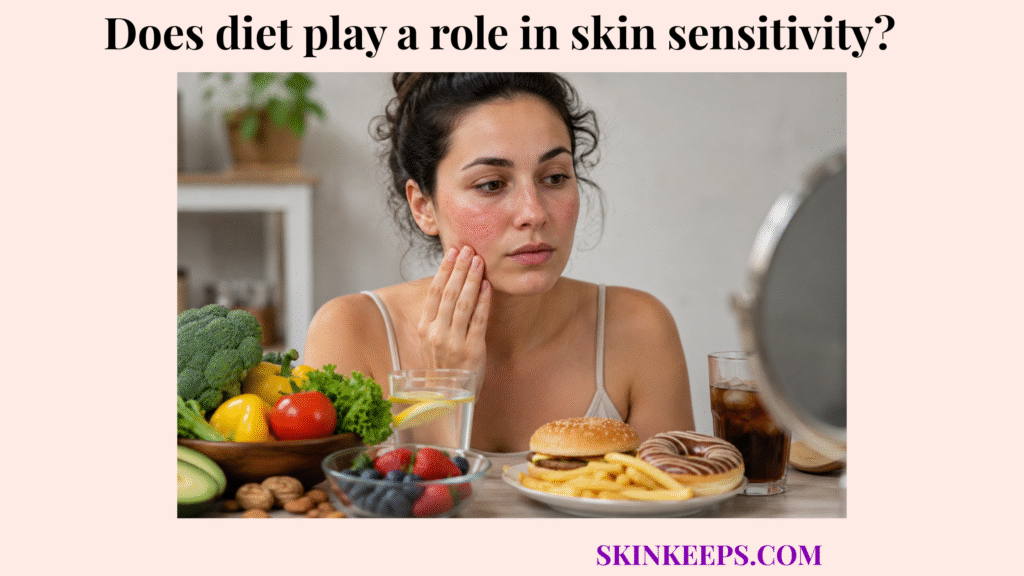
Yes, diet can modify skin sensitivity in some people by affecting nutritional adequacy, systemic hydration, vascular flushing, or individual food-linked reactions, but diet is rarely the only cause of sensitive skin. Alcohol, spicy foods, very hot foods or drinks, poor nutritional intake, or a reproducible food reaction may change skin comfort in a susceptible person, yet products, weather, heat, friction, hormones, stress, genetics, and skin conditions can produce similar symptoms.
This article explains how nutrition supports normal skin function, why drinking water is different from repairing the outer barrier, which dietary exposures may intensify flushing, how food-linked itching differs from ordinary reactivity, why food allergy requires a separate safety framework, how to avoid unnecessary elimination diets, how to track a credible pattern, and when professional care is necessary.
How Can Diet Influence Sensitive-Skin Reactivity?
Diet can influence sensitive-skin reactivity through nutritional adequacy, systemic hydration, vascular responses, and individually reproducible food reactions. These pathways are different: a varied diet supports normal physiology, while a specific drink or food may provoke warmth, flushing, itching, hives, or another symptom only in a susceptible person.
Diet should be evaluated as one possible modifier of sensitive skin rather than the automatic explanation for every episode of burning, itching, flushing, or product intolerance. A credible dietary relationship depends on the exposure, timing, recurrence, symptom pattern, and competing triggers.
Nutritional support and direct triggering should not be combined into one claim. Protein, fats, vitamins, minerals, and fluids support normal body function, but alcohol-related vasodilation, capsaicin-related warmth, hot beverages, or a true food-allergy response operate through different mechanisms.
How Does Nutrient Adequacy Support Barrier Comfort?
Nutrient adequacy supports barrier comfort by supplying energy, amino acids, essential fats, vitamins, and minerals required for normal skin maintenance and repair. Keratinocytes, the main cells of the epidermis, need adequate biological resources for routine turnover and recovery.
Dietary protein supplies amino acids used throughout tissue maintenance, while essential fatty acids contribute to normal cellular and lipid function. Barrier lipids are fats arranged between outer skin cells that help limit water loss and reduce entry of irritants; severe deficiency can interfere with normal skin function, but ordinary variation between meals is not equivalent to deficiency.
Protein, essential fats, vitamins, and minerals support normal tissue maintenance, but skin-barrier function also depends on topical care, genetics, inflammation, and environmental exposure. Nutrition cannot cancel repeated irritation from harsh products, heat, friction, or an untreated skin condition.
Research on long-chain fatty acids describes their role in the synthesis of skin lipids needed for water-barrier and thermal functions, supporting the broader point that adequate nutrition matters without proving that supplements treat sensitive skin. [PubMed: Long-Chain Fatty Acids and Skin Lipids]
Why Do Individual Dietary Triggers Affect People Differently?
Individual dietary triggers affect people differently because vascular sensitivity, immune responses, underlying conditions, portion size, food temperature, and accompanying exposures vary between individuals. The same food may produce no reaction in one person, transient facial warmth in another, and an immune-mediated reaction in someone with a true allergy.
Alcohol may widen superficial blood vessels, spicy food can activate heat-sensitive sensory pathways, and a very hot drink can raise facial warmth without acting as an allergen. Heat, exercise, stress, illness, medication changes, and skincare products can occur at the same time and make the dietary trigger appear more certain than it is.
A single episode provides weak evidence. Reproducibility means that a similar exposure repeatedly precedes a similar reaction under comparable conditions, but deliberate re-exposure is unsafe after hives, swelling, breathing difficulty, faintness, or another severe response.
| Dietary factor | Possible role in sensitive skin |
|---|---|
| Consistent fluid intake supports general body hydration. | It supports systemic hydration but does not directly repair the outer skin barrier. |
| Adequate protein supplies amino acids. | It supports normal tissue maintenance rather than acting as a direct sensitive-skin treatment. |
| Essential dietary fats contribute to normal lipid and cellular function. | Severe inadequacy may affect skin function, but more intake does not guarantee better tolerance. |
| A varied diet supports vitamin and mineral intake. | Dietary variety reduces deficiency risk without creating a universal skin-healing diet. |
| An individually reproducible exposure precedes symptoms. | The food or drink may modify flushing, itching, or discomfort in that person. |
| Alcohol or very hot drinks increase warmth. | Vascular or heat-related flushing may intensify in susceptible individuals. |
| A highly restrictive diet removes many foods. | Dietary variety may fall while nutritional and interpretive risk increases. |
Can Poor Nutrition Make Sensitive Skin Harder to Manage?
Poor nutrition can make sensitive skin harder to manage when inadequate energy, protein, essential fats, or micronutrients impair normal tissue maintenance, but ordinary dietary variation does not automatically cause skin sensitivity. Clinically meaningful undernutrition differs from having an occasional unbalanced meal.
Severe restriction, food insecurity, malabsorption, chronic illness, or sustained low intake can reduce the resources available for normal cell turnover and recovery. These states may coexist with dryness, cracking, slower wound healing, hair or nail changes, fatigue, weight change, or gastrointestinal symptoms, but none of those clues identifies a specific deficiency by itself.
Broad health changes deserve clinical assessment because product irritation, eczema, thyroid disease, medication effects, malabsorption, infection, and other conditions can produce overlapping skin findings. One vitamin should not be blamed or supplemented without an evidence-based reason.
Possible Nutrition-Related Clues
- The diet excludes several major food groups without a medical reason.
- Energy or protein intake appears consistently inadequate.
- Dryness or cracking occurs with hair, nail, or wound-healing changes.
- Unintentional weight loss or reduced appetite is present.
- Digestive or absorption problems are known or suspected.
- Skin symptoms occur with broader health changes rather than isolated product reactions.
- Restrictive eating affects daily life, food security, or emotional wellbeing.
Does Low Fluid Intake Worsen Sensitive-Skin Discomfort?
Low fluid intake can contribute to systemic dehydration and general discomfort, but drinking more water does not directly repair a reactive or disrupted skin barrier. Systemic hydration describes the body’s overall fluid status, while the stratum corneum controls how well the outer skin surface retains water.
Transepidermal water loss is the passive movement of water through the epidermis into the environment. It is measured in research or clinical settings and should not be treated as a home diagnosis. A moisturizer acts at the outer surface by adding or retaining water and supporting the barrier environment, while fluids support internal physiology.
A systematic review found limited evidence that additional dietary water may increase stratum-corneum hydration in some healthy people, especially those with lower prior intake, but the evidence does not establish water as a treatment for sensitive-skin reactions or barrier disease. [PubMed: Dietary Water and Skin Hydration Review]
Consistent drinking is reasonable according to individual needs, health conditions, climate, activity, and clinician guidance. Excessive water intake does not guarantee improved tolerance and can be unsafe in some medical contexts.
| Hydration issue | What the issue means |
|---|---|
| Low systemic hydration affects the body’s overall fluid status. | Thirst, illness, heat, exercise, or fluid losses may require attention beyond skin care. |
| Increased barrier water loss occurs at the outer skin surface. | Dryness and irritant sensitivity may persist despite normal fluid intake. |
| Drinking fluids supports systemic hydration. | Fluid intake does not replace moisturizer or trigger reduction. |
| Moisturizer and barrier-supportive care act more directly on the surface. | They can improve outer-surface comfort when the formula is tolerated. |
| Excessive water intake is used as a skin remedy. | More water does not guarantee better sensitive-skin tolerance. |
Which Foods or Drinks May Worsen Flushing in Sensitive Skin?
Alcohol, spicy foods, and very hot foods or drinks can intensify facial warmth or flushing in some susceptible people, especially when vascular reactivity or a flushing-prone condition is present. These exposures do not cause sensitive skin in everyone and do not automatically indicate allergy.
Alcohol can promote vasodilation, meaning widening of superficial blood vessels. Capsaicin, the compound that gives chili peppers their heat, activates sensory pathways associated with warmth and burning, while the physical temperature of a hot drink can intensify facial heat independently of its ingredients.
Alcohol, spicy foods, and very hot drinks may intensify redness and flushing in susceptible people without causing sensitive skin in everyone. The American Academy of Dermatology identifies heat from hot beverages, alcohol, and spicy food as possible rosacea flare triggers, while emphasizing that triggers differ between individuals. [AAD: Rosacea Trigger Prevention]
A personal trigger becomes more credible when the same exposure repeatedly precedes a similar response and competing factors remain relatively stable. A generic trigger list is not a reason to permanently remove a tolerated food.
Possible Flushing Triggers
- Alcohol repeatedly precedes facial warmth or color change.
- Spicy food repeatedly produces burning warmth or flushing.
- Very hot drinks or soups intensify facial heat.
- A large contrast between environmental and food temperature precedes symptoms.
- Heat, exercise, or stress occurs at the same time and may amplify the response.
- The same exposure is tolerated at other times, suggesting context matters.
Can Foods Trigger Itching or Rash-Like Sensitive-Skin Reactions?
Foods can trigger itching, hives, swelling, or rash-like symptoms in some people, but these reactions are not equivalent to ordinary sensitive-skin discomfort. Itching after eating may reflect local contact irritation, hives, an immune reaction, an underlying condition, or a coincidence with heat, products, medication, or illness.
Food touching the lips or surrounding skin may irritate a raw or inflamed surface without producing a systemic allergy. In contrast, widespread raised welts, swelling of the lips or eyelids, vomiting, breathing symptoms, dizziness, or rapid progression indicate a broader reaction that requires medical attention.
Hives are raised, often itchy welts, while angioedema is deeper swelling that commonly affects the lips, eyelids, face, tongue, or throat. Breathing difficulty, throat tightness, tongue swelling, faintness, or rapidly worsening facial swelling requires emergency care.
| Pattern | Possible interpretation |
|---|---|
| Facial flushing follows spicy food without other symptoms. | A vascular or sensory flushing pattern may be present. |
| Itching repeatedly follows one food. | A food-related reaction may require assessment, especially if the pattern is consistent. |
| Widespread raised hives develop. | The reaction is not ordinary sensitive-skin discomfort. |
| Lips, tongue, eyelids, or face swell. | A possible allergic reaction requires prompt assessment. |
| Digestive symptoms occur with a rash. | A systemic food reaction may require medical evaluation. |
| Irritation appears only where food touched the skin. | Local contact irritation may be involved. |
How Is Food-Related Sensitivity Different From a Food Allergy?
Food-related flushing or mild localized discomfort differs from food allergy because allergy activates an immune response that can produce hives, swelling, digestive symptoms, breathing difficulty, or cardiovascular symptoms. Food intolerance uses different mechanisms and commonly produces digestive symptoms rather than anaphylaxis, although readers should not self-diagnose either condition.
A mild flushing pattern may depend on alcohol, temperature, dose, heat, or stress and remain localized to the face. A possible food-allergy pattern may involve raised hives, angioedema, vomiting, wheezing, throat tightness, dizziness, faintness, or symptoms affecting more than one body system.
The American Academy of Allergy, Asthma & Immunology distinguishes food intolerance from food allergy and lists skin, digestive, respiratory, and severe systemic symptoms among possible allergic reactions. [AAAAI: Food Intolerance Versus Food Allergy]
| Feature | Sensitive-skin or flushing reaction | Possible food allergy |
|---|---|---|
| Main symptoms | Warmth, flushing, mild localized itching, or discomfort. | Hives, swelling, vomiting, respiratory symptoms, or faintness. |
| Distribution | Often facial or limited to a repeatable trigger pattern. | May affect the skin and several other body systems. |
| Timing | May depend on context, amount, temperature, heat, or alcohol. | Can begin rapidly, although timing varies. |
| Severity | Often localized and uncomfortable. | Can become medically urgent. |
| Next step | Track repeatable patterns and competing exposures. | Seek assessment and emergency care for severe symptoms. |
Can Diet Worsen an Underlying Sensitive-Skin Condition?
Diet can worsen symptoms in selected people with flushing-prone, allergy-linked, or inflammatory skin conditions, but the relevant trigger depends on the condition and the individual. Diet should not be used as a substitute for diagnosis, skin care, prescribed treatment, or professional follow-up.
Dietary triggers become more clinically relevant when underlying skin conditions create a repeatable flushing, inflammatory, or allergy-linked pattern. Rosacea-prone skin may flush after alcohol, spicy food, or hot drinks, while food allergy can coexist with eczema in selected cases without explaining every eczema flare.
Acne-related dietary research does not automatically explain burning, stinging, or product intolerance. Dry-sensitive skin still needs gentle cleansing and outer-barrier care even when nutrition is adequate, and unsupported food restriction can worsen nutritional status without improving the skin condition.
| Skin pattern | Possible dietary relationship |
|---|---|
| Rosacea-prone flushing | Alcohol, spicy food, or very hot drinks may intensify flushing in some people. |
| Allergy-prone symptoms | A specific food may trigger an immune reaction that needs allergy assessment. |
| Eczema-prone skin | Food may be relevant in selected cases, but unsupported restriction can cause harm. |
| Acne-prone skin | Some dietary patterns may affect breakouts, while treatment irritation remains a separate issue. |
| Dry-sensitive skin | Nutritional adequacy supports normal function but does not replace barrier care. |
Should Someone Use an Elimination Diet for Sensitive Skin?
A broad elimination diet should not be the first response to sensitive skin because removing several foods without a credible pattern can create nutritional gaps and obscure the true trigger. Improvement during restriction does not prove that every removed food was responsible.
A targeted elimination may be considered when one well-defined exposure repeatedly precedes symptoms and a clinician or registered dietitian believes the approach is appropriate. Reintroduction is needed for causal interpretation, but a suspected allergen must never be reintroduced at home after hives, swelling, breathing symptoms, faintness, or another serious reaction.
Removing multiple foods at once creates confounding variables, meaning several changes make it impossible to identify which factor mattered. The American Academy of Allergy, Asthma & Immunology explains that eczema is not usually caused by one food and does not routinely recommend food testing or elimination diets solely because eczema is present. [AAAAI: Food Allergy Myths and Eczema]
Safer Elimination-Diet Approach
- Record the usual diet and symptoms before removing foods.
- Look for the same reaction after naturally occurring repeated exposure.
- Change one suspected factor at a time when medically safe.
- Do not remove major food groups casually.
- Do not conduct a home challenge after hives, swelling, breathing symptoms, or faintness.
- Seek professional guidance for recurrent or severe reactions.
- Reassess products, weather, heat, exercise, alcohol, illness, and stress.
- Use registered-dietitian support when restriction affects several foods or food groups.
What Diet Myths About Sensitive Skin Should Be Avoided?
The main diet myths about sensitive skin treat one food, more water, vague dietary purity, or supplements as universal solutions to a condition with multiple possible causes. These claims replace mechanism and individual evidence with a rule that may not fit the reader.
Dairy and gluten should not be removed automatically, and supplements should not replace diagnosis or a varied diet. Direct-to-consumer IgG panels do not diagnose food allergy or prove that a food causes skin symptoms; the AAAAI recommends against using IgG testing for food allergy or intolerance. [AAAAI: The Myth of IgG Food Panel Testing]
| Myth | Better explanation |
|---|---|
| One food causes all sensitive skin. | Sensitive-skin reactivity usually reflects several biological, environmental, product, and lifestyle factors. |
| Drinking more water cures sensitivity. | Fluid intake supports systemic hydration but does not directly repair a disrupted outer barrier. |
| Everyone with sensitive skin should avoid dairy. | Dairy restriction needs a repeatable pattern, diagnosis, or professional recommendation. |
| Everyone with sensitive skin should avoid gluten. | Gluten restriction is inappropriate without a credible clinical reason. |
| A vaguely “pure” diet prevents all reactions. | Products, weather, heat, friction, stress, genetics, and skin conditions remain relevant. |
| Tingling after food always means allergy. | Symptom type, distribution, timing, and other body-system signs determine urgency. |
| Supplements automatically repair the skin barrier. | Supplements do not replace adequate nutrition, topical care, or medical assessment. |
| Commercial food-sensitivity tests identify every trigger. | Many tests do not diagnose allergy or prove a skin-trigger relationship. |
Which Eating Habits May Support Sensitive-Skin Comfort?
A varied, nutritionally adequate, and non-restrictive eating pattern may support sensitive-skin comfort by supplying the energy, protein, fats, vitamins, minerals, and fluids required for normal body function. This approach reduces deficiency-related risk without promising that food alone will prevent reactivity.
Broad food-pattern guidance is safer than a rigid sensitive-skin menu. Adequate protein, sources of essential fats, fruits, vegetables, other tolerated foods, and consistent fluids can support overall nutrition, while only credible individual triggers or medically necessary foods should be restricted.
More of a tolerated nutrient does not necessarily produce better skin. Supplements can cause adverse effects, interact with medication, or obscure the reason for symptoms, so confirmed deficiency and clinician guidance should determine supplementation.
Supportive Eating Pattern
- Eat a varied diet when medically possible.
- Include adequate protein across the regular eating pattern.
- Include sources of essential dietary fats.
- Eat fruits and vegetables regularly when tolerated.
- Drink fluids consistently according to individual needs and medical guidance.
- Avoid unnecessary broad restriction.
- Limit only exposures that produce a credible repeatable reaction or require medical avoidance.
- Make one trackable dietary change at a time.
- Seek nutrition guidance when several foods are removed.
What Signs Suggest Diet May Be Influencing Skin Sensitivity?
Diet is more likely to influence skin sensitivity when the same food or drink repeatedly precedes a similar symptom pattern within a comparable context. Reproducibility means the exposure, general timing, symptom type, and surrounding conditions recur often enough to form a coherent pattern.
A stronger pattern includes the same exposure, a similar portion, comparable timing, a similar reaction, and improvement during medically safe avoidance. Improvement supports the hypothesis but does not prove causality because heat, exercise, alcohol, stress, products, illness, and medication may change at the same time.
A single isolated reaction, uncertain timing, several simultaneous dietary changes, or a new skincare product weakens the food hypothesis. Confirmation bias can make ordinary symptom fluctuation appear food-driven when the reader expects a particular food to be harmful.
Diet-Linked Pattern Checklist
- The same food or drink repeatedly precedes symptoms.
- Symptoms begin within a similar general timeframe.
- A similar type of flushing, itching, warmth, hives, or rash recurs.
- The pattern occurs without a major skincare change.
- Heat, exercise, alcohol, illness, or stress does not better explain the pattern.
- Symptoms improve during medically safe avoidance.
- Alcohol, spicy food, or hot drinks repeatedly precede flushing.
- Skin symptoms occur with digestive, respiratory, dizziness, or swelling symptoms.
- A clinician considers the pattern biologically and medically plausible.
How Should Someone Track Diet-Related Sensitive-Skin Reactions?
Diet-related skin reactions should be tracked by recording the food or drink, amount, timing, symptoms, other exposures, and whether the same pattern has occurred before. A food log supports pattern recognition and professional assessment but does not diagnose allergy, intolerance, or a skin condition.
A useful food log should record heat, exercise, alcohol, skincare changes, sleep, and stress-related skin reactivity because these factors can imitate or amplify a suspected food pattern. A confounding variable is another changing factor that offers a competing explanation for the reaction.
Change one main dietary variable at a time when medically safe. Do not deliberately reproduce a severe reaction, do not continue tracking if the process promotes dangerous restriction, and do not rely on photographs without recording symptoms and other body-system signs.
Food and Symptom Tracking Checklist
When Should Diet-Related Skin Reactions Be Professionally Evaluated?
Diet-related skin reactions should be professionally evaluated when symptoms are recurrent, severe, systemic, nutritionally disruptive, or difficult to separate from food allergy or an underlying skin condition. Persistent, recurrent, spreading, painful, or diagnostically unclear skin reactions are reasons to see a dermatologist rather than continuing unsupported food restriction.
An allergist evaluates suspected immune reactions and may use a detailed history, medically appropriate testing, or a supervised oral food challenge in selected cases. A registered dietitian evaluates dietary adequacy and can reduce nutritional risk when several foods or food groups have been removed.
A dermatologist assesses whether the reaction better fits eczema, rosacea, contact dermatitis, urticaria, infection, or another skin condition. These roles can overlap, especially when skin symptoms occur with digestive, respiratory, or systemic signs.
Professional Evaluation Checklist
- Hives repeatedly appear after eating.
- Lips, tongue, face, or eyelids swell.
- A rash spreads rapidly or repeatedly returns.
- Itching is severe, persistent, or sleep-disrupting.
- Skin and digestive symptoms occur together.
- Several foods appear to trigger reactions.
- Food restriction affects weight, nutrition, or daily life.
- The reaction may involve eczema, rosacea, dermatitis, urticaria, or another condition.
- The suspected trigger remains unclear despite careful tracking.
- Breathing difficulty, throat tightness, dizziness, faintness, or rapid swelling occurs.
What Should You Remember About Diet and Sensitive Skin?
Diet can modify sensitive-skin symptoms in selected people, but a credible relationship requires a specific, repeatable pattern rather than a general assumption that food causes every reaction.
What Should You Remember?
- Diet can modify skin sensitivity in some people but is rarely the only cause.
- Nutritional adequacy supports normal skin maintenance without guaranteeing symptom-free skin.
- Systemic hydration and outer-barrier water retention are different processes.
- Drinking more water does not directly repair a disrupted skin barrier.
- Alcohol, spicy food, and very hot drinks may intensify flushing in susceptible individuals.
- A single episode does not prove that a food is a trigger.
- Repeated timing, symptom type, and exposure context make a food relationship more credible.
- Hives, swelling, vomiting, breathing symptoms, dizziness, or faintness are not ordinary sensitive-skin reactions.
- Broad dairy, gluten, or food-group restriction should not begin without a credible reason.
- Elimination diets can create nutritional gaps when they are broad or prolonged.
- Food logs should include skincare, heat, exercise, alcohol, stress, and other competing triggers.
- Severe reactions must not be deliberately reproduced.
- Persistent or systemic reactions require professional evaluation.
- Emergency allergy symptoms require immediate medical care.
Frequently Asked Questions
Can One Food Cause Sensitive Skin?
One food rarely explains sensitive skin as a whole. A specific food may intensify flushing, itching, hives, or another symptom in an individual, but sensitive-skin reactivity is also influenced by barrier characteristics, products, weather, stress, friction, and underlying conditions.
Does Drinking More Water Cure Sensitive Skin?
No. Adequate fluids support systemic hydration, but drinking more water does not directly repair the outer skin barrier. Gentle cleansing, suitable moisturizer, trigger reduction, and treatment of any underlying condition remain more directly relevant to skin-surface comfort.
Should Sensitive Skin Avoid Dairy?
Dairy should not be removed automatically. Restriction is more defensible when a repeatable reaction, diagnosed allergy, medical condition, or professional recommendation provides a clear reason. Unnecessary avoidance can reduce dietary variety without improving skin sensitivity.
Should Sensitive Skin Avoid Gluten?
Gluten avoidance is not a general sensitive-skin recommendation. Gluten should be restricted when a diagnosed condition, medically credible reaction, or professional assessment supports avoidance. Removing gluten without a reason may complicate nutrition and diagnosis.
Can Spicy Food Cause Facial Flushing?
Yes, spicy food can intensify facial warmth or flushing in some susceptible people. Capsaicin activates sensory pathways associated with heat and burning, but a flushing response does not automatically mean food allergy or permanent skin damage.
Can Food Allergy Cause Only Skin Symptoms?
Food allergy can affect only the skin in some episodes, but hives or swelling may also occur with digestive, respiratory, or cardiovascular symptoms. Any breathing difficulty, throat tightness, faintness, or rapidly progressing swelling requires emergency care.
Are Food-Sensitivity Tests Reliable for Identifying Skin Triggers?
Many direct-to-consumer food-sensitivity tests do not diagnose food allergy or prove that a food causes skin symptoms. A detailed history, medically appropriate testing, and supervised assessment are more reliable when a food-related reaction is suspected.
Conclusion
Diet may influence sensitive-skin comfort, flushing, or itching, but food should be treated as one possible modifier within a broader system of biological, environmental, product, and lifestyle factors. Nutritional adequacy supports normal skin function, fluid intake supports systemic hydration, and alcohol, spice, or food temperature may alter flushing in susceptible people.
Credible triggers produce repeatable patterns, while broad restriction creates nutritional and diagnostic risks. Food-linked hives, swelling, breathing symptoms, vomiting, dizziness, faintness, or rapidly worsening reactions require a different level of assessment than ordinary sensitive-skin discomfort. The safest dietary decision is based on a repeatable pattern, appropriate evidence, and professional guidance—not fear of a single food.