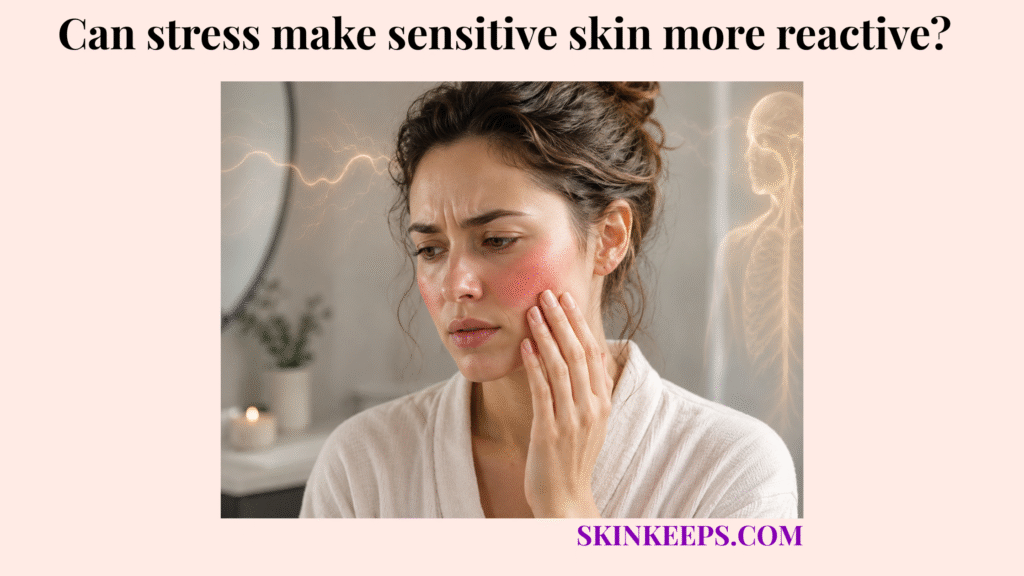
Yes, stress can make sensitive skin more reactive by increasing skin discomfort, inflammation, flushing tendency, itching, tightness, burning, breakouts, and product sensitivity in some people.
Stress does not usually act alone; it often makes the skin easier to trigger by products, weather, heat, sweat, friction, poor sleep, scratching, or existing skin conditions. This article explains why stress can increase sensitive-skin reactivity, how it may affect barrier comfort, itching, flushing, burning, heat, breakouts, product tolerance, how stress-linked sensitivity differs from product irritation and hormonal sensitivity, how to support and track stress flares, which mistakes to avoid, and when professional evaluation is safer.
Why Can Stress Make Sensitive Skin More Reactive?
Stress can make sensitive skin more reactive because it may increase discomfort, inflammation, itch sensitivity, flushing tendency, barrier discomfort, and temporary product intolerance. Stress-linked reactivity should be interpreted inside the broader pattern of sensitive skin, where barrier weakness, trigger response, and product intolerance can overlap.
Stress belongs to the internal-reactivity layer because biological factors can increase skin sensitivity before an outside trigger appears. Stress may lower the skin’s tolerance window, but it does not replace trigger identification.
How Stress Can Increase Skin Discomfort and Reactivity
Stress can increase skin discomfort and reactivity by making itching, burning, warmth, tightness, flushing, tenderness, or irritation feel stronger. Stress can act like a reactivity amplifier through discomfort, inflammation, and nervous-system arousal.
This does not diagnose a mental-health condition or a skin condition. It simply explains why symptoms may feel more noticeable during high-pressure periods.
Why Stressed Skin May Tolerate Triggers Less Well
Stressed skin may tolerate triggers less well because products, sweat, heat, wind, friction, or poor sleep can feel harsher during reactive periods. Stress may affect barrier comfort, especially when sensitive skin has a compromised barrier that loses comfort easily.
A routine may stay unchanged while symptoms still rise during stress. That pattern suggests stress may be lowering tolerance, not that stress is always the only cause.
| Stress-Related Factor | How It May Affect Sensitive Skin |
|---|---|
| Increased inflammation | Skin may become red, darker, swollen, tender, or irritated. |
| Higher itch sensitivity | Itching may feel stronger or harder to ignore. |
| Flushing tendency | Skin may feel warmer, redder, or more reactive. |
| Barrier discomfort | Skin may feel tight, dry, raw, or more easily irritated. |
| Poor sleep | Recovery may feel slower and symptoms may feel worse. |
| Scratching or rubbing | Friction can worsen irritation. |
| Product intolerance | Familiar products may sting, burn, or itch during stressful periods. |
How Can Stress Affect the Skin Barrier?
Stress can affect sensitive skin by making the barrier feel less stable, less comfortable, or slower to calm after irritation. This section focuses on barrier comfort, not full barrier science.
During stressful periods, skin may feel drier, tighter, rougher, stingier, or slower to recover after cleansing, products, sweat, or weather exposure. These clues matter most when the same stress pattern repeats.
Barrier Discomfort Clues
- Skin feels tighter during stressful periods.
- Products sting more than usual.
- Moisturizer feels less soothing than expected.
- Dryness or roughness appears with stress.
- Skin takes longer to calm after irritation.
- Skin reacts even though the routine has not changed.
Can Stress Increase Itching in Sensitive Skin?
Stress can increase itching in sensitive skin by making itch feel stronger or harder to ignore, especially when the skin is already dry, irritated, inflamed, or condition-prone. Itch can then lead to scratching, and scratching adds friction to the barrier.
This is a stress-itch-scratch loop, not a product-itch diagnosis. Stress flares need boundaries because underlying skin conditions can increase sensitivity and may also worsen during stressful periods.
| Step | What May Happen |
|---|---|
| Stress increases discomfort | Skin feels itchier or more reactive. |
| Itching leads to scratching | The surface becomes irritated. |
| Scratching weakens comfort | Skin becomes more inflamed or tender. |
| Irritation increases itch | The cycle continues. |
| Skin takes longer to calm | Sensitivity feels persistent. |
Can Stress Trigger Flushing, Burning, or Heat in Sensitive Skin?
Stress can trigger flushing, burning, or heat in some sensitive skin when emotional pressure or nervous-system arousal makes facial skin feel warmer, stingier, or more reactive. This can overlap with heat, exercise, sweat, skincare, weather, and environmental triggers.
Stress-related warmth does not diagnose rosacea. Recurring flushing, heat, or burning should be tracked and evaluated if it is severe, persistent, or difficult to explain.
Stress-Related Heat Clues
- Facial warmth appears during emotional stress.
- Flushing occurs without a new product.
- Burning feels worse during high-stress days.
- Skin reacts faster to heat, sweat, or exercise.
- Warmth appears with tightness, tenderness, or redness/darker irritation.
Can Stress Make Breakouts Worse on Sensitive Skin?
Stress can make breakouts worse on sensitive skin in some people, and sensitive skin can become more irritated when those breakouts are treated too aggressively. Breakouts, tenderness, burning, peeling, tightness, and product intolerance can overlap during stressful periods.
This is not an acne treatment plan and does not recommend product brands. The safer point is that harsh scrubbing or aggressive actives can make a stress breakout feel more irritated.
Stress-Breakout Sensitivity Clues
- Breakouts appear during stressful periods.
- Skin feels tender around blemishes.
- Acne products sting or peel the skin.
- Skin feels oily and tight at the same time.
- Scrubbing or strong actives make irritation worse.
- Breakouts and sensitivity improve when the skin is calmed.
How Is Stress-Linked Sensitivity Different From Product Irritation?
Stress-linked sensitivity differs from product irritation because stress usually raises overall reactivity, while product irritation usually starts after a specific product or formula. Stress can make skin easier to irritate, while external triggers can worsen sensitive skin reactions once that reactive window is present.
Both can overlap. Stress may lower tolerance, but a product can still directly trigger stinging, burning, itching, tightness, rash-like texture, or swelling.
| Feature | Stress-Linked Sensitivity | Product Irritation |
|---|---|---|
| Main clue | Appears during stressful periods. | Appears after a specific product. |
| Pattern | May affect itching, flushing, tightness, breakouts, and tolerance. | Usually appears where the product touched. |
| Timing | May last across days or repeat with stress. | Often starts soon after application. |
| Trigger relationship | Stress makes skin easier to trigger. | Product is the direct trigger. |
| Best clue | Routine unchanged, symptoms rise with stress. | Same product repeatedly causes reaction. |
Simple rule: Stress can make skin more reactive overall, while a product trigger explains what directly sets off the reaction.
How Is Stress-Linked Sensitivity Different From Hormonal Sensitivity?
Stress-linked sensitivity differs from hormonal sensitivity because stress-linked symptoms often follow emotional pressure, poor sleep, workload, anxiety-like tension, or life disruption, while hormonal sensitivity often follows cycle or life-stage timing. Stress-linked timing should be separated from periods when hormonal changes affect skin sensitivity through oil, moisture, flushing, and product tolerance.
Stress and hormones can still overlap. Timing is the main clue, not a diagnosis tool.
| Pattern | More Likely Stress-Linked | More Likely Hormone-Linked |
|---|---|---|
| Timing | High-pressure days or poor sleep. | Cycle or life-stage pattern. |
| Symptoms | Itch, flushing, tightness, burning, breakouts. | Oil shifts, dryness, breakouts, flushing, tolerance changes. |
| Main clue | Stress level changes symptoms. | Hormonal timing repeats symptoms. |
| Overlap | Stress may worsen hormone-related flares. | Hormones may make stress reactions stronger. |
What Signs Suggest Stress Is Making Sensitive Skin More Reactive?
Stress may be making sensitive skin more reactive when symptoms rise during stressful periods, poor sleep, emotional pressure, or life disruption even though the skincare routine has not changed. This checklist is for pattern recognition, not diagnosis.
The strongest clue is repetition. When similar stressful patterns repeatedly come with itching, flushing, burning, tightness, breakouts, or product intolerance, stress may be acting as an amplifier.
Stress Reaction Pattern Checklist
How Can Stress-Reactive Sensitive Skin Be Supported?
Stress-reactive sensitive skin can be supported by keeping skincare simple during stressful periods, reducing avoidable irritation, and tracking stress timing alongside skin reactions. This is skin-focused support, not mental-health treatment.
A gentle cleanser, moisturizer if the skin feels tight or itchy, avoiding scrubbing or picking, pausing strong exfoliants, and protecting skin from heat, sweat, wind, and friction can reduce avoidable irritation. Sleep and recovery habits may help where possible, but they should not be framed as a cure.
Support Direction
- Keep skincare simple during stressful periods.
- Avoid adding strong new products during flare-prone days.
- Use a gentle, fragrance-free cleanser.
- Moisturize if skin feels tight, dry, or itchy.
- Avoid scrubbing, picking, or rubbing irritated skin.
- Pause strong exfoliants if skin stings, burns, or peels.
- Protect skin from heat, sweat, wind, and friction.
- Prioritize sleep and recovery habits where possible.
- Track stress timing alongside skin reactions.
What Mistakes Make Stress-Related Sensitivity Worse?
Stress-related sensitivity can worsen when every flare is treated with stronger actives, scratching, picking, hot water, or constant product switching. These responses add irritation when the skin’s tolerance is already lower.
Ignoring poor sleep patterns can also miss a common flare amplifier. Assuming stress is the only cause can miss product triggers, hormonal timing, or condition-linked patterns.
| Mistake | Why It Backfires |
|---|---|
| Treating every stress flare with stronger actives | Can worsen burning, peeling, and tightness. |
| Scratching itchy skin | Adds friction and barrier damage. |
| Picking stress breakouts | Increases inflammation and marks. |
| Switching many products at once | Makes triggers harder to identify. |
| Ignoring poor sleep patterns | Misses a common flare amplifier. |
| Using hot water for comfort | Can increase dryness, flushing, and itch. |
| Assuming stress is the only cause | May miss product triggers or skin conditions. |
How Should Someone Track Stress-Related Skin Sensitivity?
Someone should track stress-related skin sensitivity by recording stress level, sleep quality, symptoms, products, routine changes, heat, sweat, friction, weather, scratching, duration, and what improves or worsens the flare. Tracking is pattern recognition, not stress or skin-condition diagnosis.
Photos can help if visible changes appear. The most useful record connects the stressful period, sleep quality, skin symptoms, product exposure, and whether scratching or rubbing made the reaction worse.
Stress Flare Tracking Checklist
When Should Stress-Related Sensitive Skin Be Professionally Evaluated?
Stress-related sensitive skin should be professionally evaluated when symptoms are severe, persistent, worsening, painful, sleep-disrupting, eye-area related, infected-looking, or involve swelling, blisters, oozing, crusting, bleeding, recurring rash, or repeated burning and flushing. These signs should not be dismissed as ordinary stress reactivity.
Professional review becomes important when sensitive skin needs a dermatologist instead of repeated product guessing. Evaluation helps separate stress-amplified sensitivity from eczema, dermatitis, allergy, rosacea, infection, acne, psoriasis, hives, or another concern.
Professional Evaluation Warning Signs
What Should You Remember About Stress and Sensitive Skin?
Stress can make sensitive skin more reactive by increasing itching, flushing, burning, tightness, breakouts, tenderness, barrier discomfort, and temporary product intolerance. Stress often makes skin easier to trigger rather than acting as the only cause.
Final Takeaways
- Stress can make sensitive skin more reactive.
- It may increase itching, flushing, burning, tightness, breakouts, tenderness, and product intolerance.
- Stress often makes skin easier to trigger rather than acting as the only cause.
- Poor sleep, scratching, friction, heat, and strong products can worsen stress-related sensitivity.
- Tracking stress timing helps separate stress flares from product irritation or hormonal patterns.
- Severe, persistent, painful, swollen, blistering, oozing, or recurring symptoms should be professionally evaluated.
Frequently Asked Questions
Can Stress Really Make Sensitive Skin Worse?
Stress can make sensitive skin worse for some people by increasing itching, flushing, burning, tightness, inflammation, breakouts, or product intolerance. Stress may lower the skin’s tolerance window, but products, weather, sweat, friction, hormones, and skin conditions may still contribute.
Why Does My Skin Itch More When I Am Stressed?
Skin may itch more during stress because stress can make itch feel stronger, and scratching can irritate the barrier further. This stress-itch-scratch cycle can worsen irritation without proving eczema, hives, allergy, or dermatitis.
Can Stress Cause Facial Flushing or Burning?
Stress can contribute to facial flushing, warmth, burning, or stinging in some sensitive skin, especially when heat, emotion, exercise, or skincare triggers overlap. Recurring or severe flushing, heat, or burning should be reviewed professionally.
Is Stress Sensitivity Different From Product Irritation?
Stress sensitivity is different from product irritation because stress usually increases overall reactivity, while product irritation usually repeats after a specific formula. Both can overlap because stress lowers tolerance, but the product may still be the direct trigger.
Is Stress Sensitivity Different From Hormonal Sensitivity?
Stress sensitivity usually follows pressure, poor sleep, or life disruption, while hormonal sensitivity usually follows cycle timing, puberty, pregnancy, postpartum changes, perimenopause, menopause, or medication changes. Timing is the main clue, and both patterns can overlap.
When Should Stress-Related Skin Sensitivity Be Checked?
Stress-related skin sensitivity should be checked when symptoms are severe, persistent, worsening, painful, sleep-disrupting, eye-area related, infected-looking, swollen, blistering, oozing, crusted, bleeding, spreading, or recurring. Evaluation helps separate stress-amplified sensitivity from another concern.
Conclusion
Stress can make sensitive skin more reactive by increasing discomfort, itching, flushing, burning, tightness, breakouts, tenderness, barrier discomfort, and product intolerance in some people. Stress often makes skin easier to trigger rather than acting alone, so products, heat, sweat, friction, weather, poor sleep, scratching, hormones, and skin conditions may still matter.
Stress-linked sensitivity is a clue, not a diagnosis. If symptoms are severe, persistent, worsening, painful, swollen, blistering, oozing, crusted, bleeding, spreading, eye-area related, infected-looking, sleep-disrupting, or recurring, professional evaluation is safer than repeated product guessing.