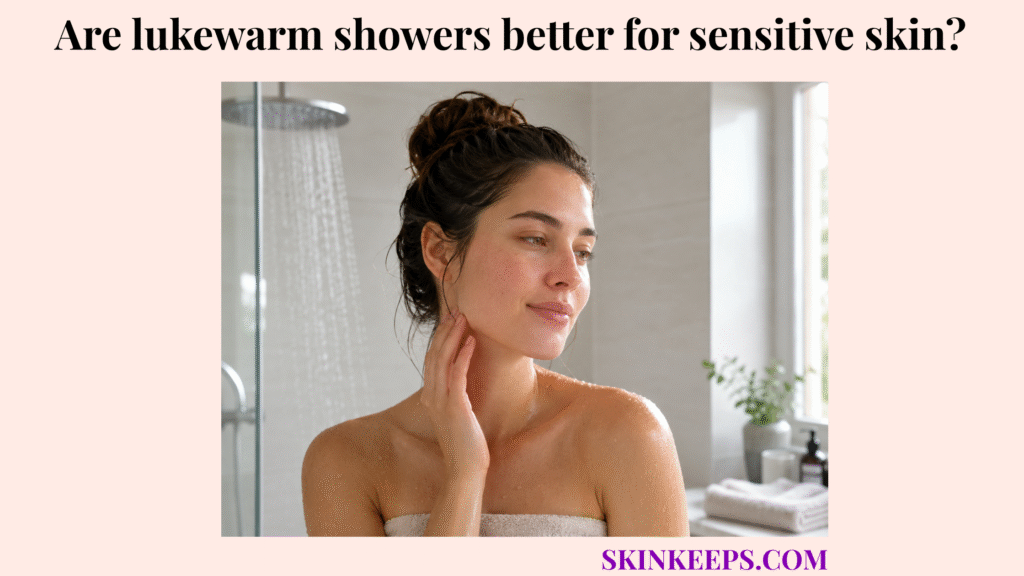
Yes, lukewarm showers are usually better for sensitive skin than hot showers because they are less likely to worsen dryness, tightness, burning, itching, flushing, and barrier discomfort. Hot water can strip surface oils, increase moisture loss, and make sensitive skin feel more reactive after bathing, so the best shower is comfortably warm, not steamy or burning.
This article moves from water temperature to the other shower habits that matter: duration, cleanser contact, towel friction, after-shower moisturizer, flare-up adjustments, symptom tracking, and professional evaluation.
Why Are Lukewarm Showers Better for Sensitive Skin?
Lukewarm showers are better for sensitive skin because they clean the skin without adding the same heat stress as hot or steamy water. Lukewarm showering fits within the broader care tips that help calm and protect sensitive skin because water temperature can either reduce or increase post-shower discomfort.
How Does Lukewarm Water Reduce Temperature Stress?
Lukewarm water reduces temperature stress by avoiding the intense heat that can leave sensitive skin flushed, tight, or uncomfortable after bathing.
Why Does Sensitive Skin Often React Poorly to Hot Water?
Sensitive skin often reacts poorly to hot water because heat can increase dryness, surface discomfort, and post-shower reactivity.
| Shower temperature | Sensitive-skin effect |
|---|---|
| Lukewarm water | Usually gentler and less drying. |
| Hot water | Can worsen tightness, itching, burning, and dryness. |
| Very cold water | May feel uncomfortable or trigger some reactive skin. |
| Steaming shower | Often increases flushing and barrier stress. |
| Sudden temperature changes | May trigger stinging, redness, or discomfort. |
Once lukewarm water is understood as the gentler baseline, the next step is to explain why hot water can create more irritation.
Shower Temperature and Sensitive-Skin Comfort
This visual shows how lukewarm water lowers heat stress while hot or steamy water can increase dryness, tightness, itching, and flushing.
Figure 1. Lukewarm showers support sensitive-skin comfort when paired with shorter duration and low-friction care.
How Does Hot Water Irritate Sensitive Skin?
Hot water can irritate sensitive skin by removing surface oils, increasing moisture loss, raising skin heat, and making the barrier feel more vulnerable. This is why sensitive skin may feel tight, itchy, hot, dry, or stingy after a hot shower, especially when a strong cleanser or rough towel is used at the same time.
| Hot-water effect | Possible sensitive-skin reaction |
|---|---|
| Removes surface oils | Dryness and tightness. |
| Increases moisture loss | Flaking or roughness. |
| Raises skin heat | Burning or flushing. |
| Softens barrier too much | More sensitivity after showering. |
| Makes cleansers feel stronger | Stinging or dryness. |
| Encourages longer showers | More irritation exposure. |
Because hot water can be irritating, some readers may assume cold showers are required, but sensitive skin usually needs comfort rather than temperature extremes.
Does Sensitive Skin Need Cold Showers Instead?
No, sensitive skin does not usually need very cold showers instead of hot showers. Cold water may feel refreshing for some people, but very cold water can feel uncomfortable and may trigger tightness, stinging, or temperature reactivity in some sensitive skin.
Better Rule
Choose water that feels comfortably warm without steam, heat, burning, or post-shower tightness.
The most useful target is not an exact number; it is how the skin feels during and after the shower.
How Warm Should a Shower Feel for Sensitive Skin?
A shower for sensitive skin should feel comfortably warm, mild, and non-stinging rather than hot, steamy, or skin-flushing. If the shower leaves the skin itchy, tight, very flushed, overheated, or reactive, the water may be too hot or the shower may be too long.
Comfortable Temperature Clues
- Water feels warm but not hot.
- There is no steam-heavy heat.
- Skin does not turn very flushed.
- There is no burning sensation during showering.
- Tightness does not appear immediately afterward.
- Moisturizer does not sting after drying.
- Skin feels calmer, not more reactive.
- Itching does not increase after showering.
Even when the temperature feels right, shower length still matters because longer water exposure can dry or irritate sensitive skin.
Does Shower Duration Matter for Sensitive Skin?
Yes, shower duration matters because even lukewarm water can irritate sensitive skin when exposure lasts too long. Longer showers can increase dryness, soften the barrier, and make cleanser contact more irritating, so duration is a separate habit from temperature.
| Shower habit | Sensitive-skin concern |
|---|---|
| Short lukewarm shower | Usually lower irritation. |
| Long lukewarm shower | May still increase dryness. |
| Long hot shower | Higher risk of tightness and itching. |
| Repeated daily long showers | Can weaken comfort over time. |
| Frequent washing after sweat | May require gentler cleansing and moisturizing. |
| Lingering under water during a flare | May prolong irritation. |
After temperature and time are controlled, cleanser use becomes the next factor because washing too much can undo the benefit of lukewarm water.
How Should Sensitive Skin Use Cleanser in the Shower?
Sensitive skin should use cleanser in the shower only where and when it is needed, because over-cleansing can increase dryness and irritation. Even when the water is lukewarm, harsh cleansing habits can still leave sensitive skin tight, itchy, or uncomfortable after showering.
| Cleansing habit | Better sensitive-skin direction |
|---|---|
| Scrubbing the whole body daily | Cleanse needed areas more gently. |
| Using cleanser on already irritated skin | Reduce contact if possible. |
| Letting cleanser sit too long | Rinse promptly. |
| Using fragranced body wash | Consider fragrance-free if reactions occur. |
| Washing the face under hot shower water | Use lukewarm water and gentle contact. |
| Cleansing after sweat | Rinse gently instead of aggressive scrubbing. |
Because cleanser contact can influence irritation, the type of shower product also matters.
Are Shower Gels, Soaps, and Body Washes Different for Sensitive Skin?
Yes, shower gels, soaps, and body washes can affect sensitive skin differently because they vary in foam, fragrance, cleansing strength, and after-feel. Because shower products differ in foam, fragrance, and after-feel, the cleanser type for sensitive skin still matters even when the shower temperature is gentle.
| Product type | Sensitive-skin caution |
|---|---|
| Traditional soap bar | May feel drying or tight for some people. |
| Strong foaming body wash | Can leave skin stripped. |
| Fragranced shower gel | Adds optional irritation exposure. |
| Scrub body wash | Adds friction and exfoliation. |
| Gentle cream wash | May suit dry or tight sensitive skin. |
| Low-foam wash | May suit sensitive skin if non-stripping. |
| Oil-based shower cleanser | May help dryness if tolerated. |
Even with a gentle wash, the skin can still become irritated if towel drying adds friction after the shower.
Can Towel Drying Irritate Sensitive Skin After a Shower?
Yes, towel drying can irritate sensitive skin after a shower when rough rubbing adds friction to skin that is already softened by water. Patting dry is usually gentler than rubbing, especially on the face, neck, folds, and areas that are already itchy, flaky, or inflamed.
Low-Friction Towel Tips
- Use a soft towel.
- Pat instead of rub.
- Avoid dragging the towel across irritated areas.
- Do not scrub flakes after showering.
- Avoid rough washcloths during flares.
- Change damp towels regularly.
- Be gentle around the face, neck, and folds.
- Moisturize while skin still feels slightly damp if tolerated.
Once the skin is gently dried, moisturizer can help reduce the tightness and dryness that often follow bathing.
Why Does Moisturizer After a Lukewarm Shower Help Sensitive Skin?
Moisturizer after a lukewarm shower can help sensitive skin by reducing post-shower tightness, dryness, roughness, and itching when the formula is tolerated. After a lukewarm shower, moisturizer ingredients that support sensitive skin may help reduce dryness and tightness if the formula is tolerated.
| After-shower issue | Helpful direction |
|---|---|
| Tight skin | Apply tolerated moisturizer. |
| Flaking | Moisturize instead of scrubbing. |
| Itching after shower | Review heat, cleanser, and moisturizer tolerance. |
| Burning after moisturizer | Barrier may be stressed or formula may not suit. |
| Wind or cold exposure after shower | Protect skin before going outside. |
| Sweat after shower | Avoid overheating and friction. |
When the skin is actively flaring, the same shower habits become even more important because heat and friction can make irritation harder to calm.
Are Lukewarm Showers Helpful During a Sensitive-Skin Flare-Up?
Lukewarm showers may be helpful during a sensitive-skin flare-up because they avoid the extra heat stress that can worsen burning, itching, and visible irritation. During a sensitive skin flare-up, lukewarm water is usually safer than hot water because active irritation can become more reactive to heat and friction.
Flare-Up Shower Adjustments
- Use lukewarm water.
- Keep the shower brief.
- Avoid fragranced washes.
- Avoid scrubs and exfoliating gloves.
- Cleanse only where needed.
- Do not rub irritated areas.
- Pat dry carefully.
- Use a tolerated moisturizer if needed.
- Stop if water itself causes strong burning.
One of the clearest signs that shower habits need adjusting is itching that appears or worsens after bathing.
Can Lukewarm Showers Help Reduce Itching?
Lukewarm showers may help reduce shower-related itching when hot water, dryness, harsh cleanser, or towel friction is contributing to the itch. Lukewarm water is not a cure for every itch, so ongoing itching despite gentler habits may point to another trigger or skin condition.
| Itching pattern | What it may suggest |
|---|---|
| Itching after hot showers only | Heat may be a trigger. |
| Itching after fragranced body wash | Product sensitivity may be involved. |
| Itching after towel rubbing | Friction may contribute. |
| Itching with dry, flaky skin | Moisture loss may be involved. |
| Itching with rash or swelling | Needs more caution. |
| Itching despite gentle showers | Professional evaluation may be needed. |
When lukewarm water reduces itching, it often helps because it supports the broader goal of protecting the skin barrier during bathing.
Do Lukewarm Showers Help Protect the Skin Barrier?
Lukewarm showers can help protect sensitive-skin barrier comfort by reducing temperature stress and limiting post-shower dryness. They work best when paired with short duration, gentle cleanser use, soft drying, and moisturizer when needed.
Barrier-Comfort Shower Checklist
- Keep water comfortably warm.
- Avoid long, steamy showers.
- Use gentle cleanser only as needed.
- Avoid scrubbing tools.
- Rinse cleanser fully.
- Pat dry gently.
- Moisturize dry or tight areas.
- Keep the routine stable after showering.
If the skin still feels reactive after showering, the problem may be one of the common shower mistakes that keeps sensitive skin irritated.
Sensitive-Skin Shower Comfort Framework
This visual connects the full shower habit: temperature, time, cleanser contact, towel friction, and moisturizer support.
Figure 2. Shower comfort depends on the whole habit, not temperature alone.
What Shower Mistakes Commonly Worsen Sensitive Skin?
Common shower mistakes that worsen sensitive skin include hot water, long steamy showers, rough scrubbing, fragranced washes, and towel rubbing. These habits can stack together, so a lukewarm shower may still irritate if cleanser, towel, or after-shower support is wrong for the skin.
| Mistake | Why it backfires |
|---|---|
| Using very hot water | Increases dryness and burning. |
| Taking long steamy showers | Prolongs barrier stress. |
| Scrubbing with rough cloths | Adds friction. |
| Using fragranced body wash during flares | Adds irritation exposure. |
| Washing the face under hot water | Can trigger facial tightness or flushing. |
| Skipping moisturizer despite tightness | Leaves skin unsupported. |
| Using exfoliating gloves daily | Adds repeated mechanical irritation. |
| Rubbing dry with a towel | Irritates softened skin. |
| Ignoring post-shower itching | Misses a repeated trigger pattern. |
The easiest way to prevent these mistakes is to build a simple shower habit that controls temperature, time, cleanser contact, drying, and after-shower support.
How Can Someone Build a Sensitive-Skin Shower Routine Without Overcomplicating It?
Someone can build a sensitive-skin shower routine without overcomplicating it by keeping water lukewarm, showers reasonably brief, cleansing gentle, and drying soft. This is not a full skincare routine; it is a bathing habit structure that reduces avoidable irritation.
Simple Sensitive-Skin Shower Habit Checklist
- Choose lukewarm water.
- Keep showers reasonably brief.
- Avoid steam-heavy heat.
- Use gentle cleanser only where needed.
- Avoid scrubs and harsh tools.
- Rinse thoroughly.
- Pat dry with a soft towel.
- Apply moisturizer if skin feels dry or tight.
- Avoid applying strong actives right after irritation.
- Track whether shower changes reduce symptoms.
If symptoms continue, tracking shower conditions can show whether temperature, cleanser, friction, or after-shower care is the repeated trigger.
How Should Shower-Related Sensitivity Be Tracked?
Shower-related sensitivity should be tracked by recording water temperature, shower length, cleanser use, friction, moisturizer use, and symptoms after bathing. Tracking helps separate a hot-water reaction from a cleanser reaction, towel-friction reaction, shaving reaction, sweat reaction, or moisturizer mismatch.
Shower-Related Sensitivity Tracking Worksheet
- Shower temperature: cool, lukewarm, warm, hot, or steamy.
- Shower duration.
- Cleanser or body wash used.
- Fragrance-free or scented product status.
- Scrub, washcloth, loofah, or exfoliating glove use.
- Areas that felt irritated.
- Symptoms after showering: tightness, itching, burning, stinging, flushing, dryness, bumps, or rash.
- Whether moisturizer was used after showering.
- Whether symptoms improved with lukewarm water.
- Weather, sweat, shaving, or fabric exposure after showering.
- Whether symptoms repeated after similar showers.
- Photos of visible changes if needed.
If tracking shows severe, repeated, spreading, or unresolved symptoms, shower changes alone may not be enough.
When Should Shower-Related Sensitive Skin Reactions Be Professionally Evaluated?
Shower-related sensitive skin reactions should be professionally evaluated when symptoms are severe, persistent, spreading, swollen, blistering, painful, recurring, or interfere with normal bathing. Severe, spreading, swollen, blistering, painful, eye-area, or recurring shower-related reactions are reasons to see a dermatologist.
Professional Evaluation Warning Signs
- Water itself causes strong burning or pain.
- Itching is severe, persistent, or disrupts sleep.
- Rash spreads or repeatedly returns after bathing.
- Skin swells, blisters, oozes, crusts, or bleeds.
- Skin becomes cracked, raw, or infected-looking.
- Eye or eyelid reactions occur.
- Several gentle shower products cause reactions.
- Symptoms continue despite lukewarm water and gentle care.
- Reactions interfere with normal bathing.
- Eczema, dermatitis, allergy, rosacea, infection, or another condition may be involved.
Urgent Safety Note
Breathing difficulty, throat tightness, faintness, or rapid facial, lip, or tongue swelling requires emergency medical care.
After the safety boundary is clear, the article can close by summarizing the temperature, time, cleanser, friction, moisturizer, and tracking framework.
What Should You Remember About Lukewarm Showers and Sensitive Skin?
Lukewarm showers are usually better for sensitive skin because they reduce heat-related dryness, tightness, itching, flushing, and barrier discomfort.
What Should You Remember?
- Lukewarm showers are usually better for sensitive skin than hot showers.
- Hot water can worsen dryness, tightness, itching, flushing, burning, and barrier discomfort.
- Very cold showers are not required and may bother some reactive skin.
- Shower duration still matters, even with lukewarm water.
- Gentle cleanser use matters as much as temperature.
- Fragranced washes, scrubs, loofahs, and rough towels can worsen irritation.
- Pat drying is usually gentler than rubbing.
- A tolerated moisturizer after showering can reduce dryness and tightness.
- During a flare-up, showers should be brief, lukewarm, and low-friction.
- Severe or recurring shower-related reactions need professional evaluation.
Frequently Asked Questions
Are Lukewarm Showers Better Than Hot Showers for Sensitive Skin?
Yes. Lukewarm showers are usually better because hot water can increase dryness, tightness, itching, burning, flushing, and barrier discomfort.
Should Sensitive Skin Take Cold Showers?
Sensitive skin does not usually need very cold showers. Cold water may feel uncomfortable or trigger temperature reactivity in some people. Comfortably warm water is usually a better target.
Why Does Sensitive Skin Itch After a Hot Shower?
Sensitive skin may itch after a hot shower because heat, moisture loss, cleanser strength, or towel friction can make the skin feel dry and reactive.
Should Sensitive Skin Moisturize After a Shower?
Yes, if the skin feels dry, tight, rough, or itchy, a tolerated moisturizer after showering can help support comfort. It should not be continued if it repeatedly burns or causes rash-like irritation.
Can Long Lukewarm Showers Still Irritate Sensitive Skin?
Yes. Even lukewarm water can irritate sensitive skin when the shower is very long or repeated often without moisturizer support.
When Should Shower-Related Itching or Burning Be Checked?
Shower-related itching or burning should be checked if it is severe, persistent, recurring, spreading, associated with swelling or rash, or continues despite lukewarm water and gentle care.
Conclusion
Lukewarm showers are usually better for sensitive skin because they reduce the heat stress that can make skin feel dry, tight, itchy, flushed, burning, or reactive after bathing. Water temperature is the first habit to correct, but shower length, cleanser strength, fragrance exposure, scrubbing tools, and towel friction can still irritate sensitive skin even when the water is not hot.
The most useful shower habit is simple and repeatable: keep water comfortably warm, avoid steam-heavy heat, cleanse gently, pat dry, moisturize when needed, and track whether symptoms improve. If reactions are severe, persistent, spreading, or recurring, professional evaluation is the safer next step. A sensitive-skin shower should leave the skin comfortable, not overheated, tight, itchy, or more reactive than before.
Sources & Evidence
American Academy of Dermatology — Dermatologists’ Tips for Relieving Dry Skin
Supports short showers, warm rather than hot water, gentle cleanser use, pat drying, and moisturizer while skin is damp.
[AAD]American Academy of Dermatology — Face Washing 101
Supports lukewarm water, fingertips instead of rough tools, no scrubbing, pat drying, and moisturizer when skin is dry or itchy.
[AAD]American Academy of Dermatology — Bathing and Shower Tips for Irritated Skin
Supports warm-not-hot water, shorter bathing, gentle cleansing, avoiding scrubbing tools, and moisturizer after bathing.
[AAD]National Eczema Association — Bathing and Moisturizing Guidance
Supports the idea that bathing can help but too much water contact or not moisturizing afterward may worsen dryness and irritation.
[NEA]DermNet — Irritant Contact Dermatitis
Supports water, soaps, detergents, friction, sweating, and heat as irritant factors.
[DermNet]Mayo Clinic — Dry Skin
Supports limiting shower time, using warm rather than hot water, pat drying, and applying moisturizer.
[Mayo Clinic]Peer-Reviewed Review — Water Exposure and Skin Barrier Function
Supports that long water exposure and hot water can negatively affect skin barrier comfort.
[PMC]Disclaimer: This article provides general educational information and does not diagnose or treat irritant contact dermatitis, allergic contact dermatitis, eczema, rosacea, acne, infection, or another skin condition. Stop using clearly irritating products and seek professional advice for severe, persistent, recurrent, spreading, blistering, swollen, oozing, bleeding, painful, or eye-area reactions. Breathing difficulty, throat tightness, faintness, or rapid facial, lip, or tongue swelling requires urgent medical care.