
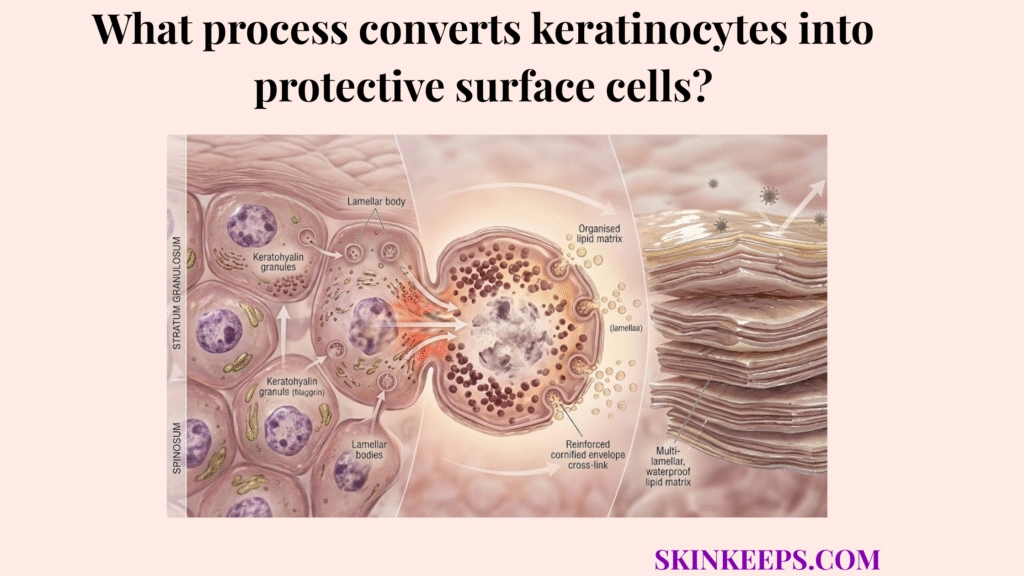
Keratinization is the process in which living epidermal keratinocytes mature into flattened, nucleus-free corneocytes that help form the skin’s protective outer layer. As these cells move upward, they assemble keratin-rich structures and a cornified envelope; nearby extracellular lipids complete the water-resistant barrier.
This guide explains the cell-by-cell transition, the roles of keratin and filaggrin, the granular layer’s lipid release, and practical ways to support normal epidermal maturation. Disrupted differentiation can contribute to scaling or barrier problems, but these signs alone do not identify the underlying cause.
What is keratinization, and how does it convert keratinocytes into surface cells?
Keratinization, or cornification, is the terminal differentiation program that produces corneocytes. Keratinocytes originate in the basal epidermis and mature as they pass through the suprabasal and granular layers. For anatomical context, see how the epidermis fits into the three main skin layers.
How do structural proteins shape keratinocyte maturation?
Structural proteins help differentiating keratinocytes develop the durable internal framework required for the outer skin barrier. Keratin intermediate filaments become more organized and are later bundled as the cells approach cornification.
This progressive reorganization supports mechanical resilience. The resulting corneocyte is flattened and reinforced, rather than being a living cell that simply becomes uniformly hard.
How do keratin fibers support the conversion of keratinocytes into surface cells?
Keratin intermediate filaments provide an internal scaffold that helps epidermal cells withstand routine mechanical stress during maturation.
As keratinocytes mature, their keratin network becomes denser. A study of stratum-corneum structure reports that keratin-filled corneocytes represent about 85% of the total dry weight of this outer layer; this is not a measurement of the protein content of a single cell (Scientific Reports, 2017).
The resilience of this shield depends fundamentally on how keratin filaments are organized in upper epidermal layers, where they create a dense, interlocking matrix.
How does filaggrin support the conversion of keratinocytes into surface cells?
Filaggrin helps aggregate keratin intermediate filaments during terminal differentiation. Its later breakdown also produces amino-acid-derived components of the natural moisturizing factor (NMF), which help corneocytes retain water.
Filaggrin is therefore relevant to both structural maturation and later water handling. These processes involve different stages of its processing; the amounts of NMF present vary by site and physiological conditions (Journal of Clinical Investigation, 2006).
Why is the granular layer essential to cornification?
The stratum granulosum is a critical transition zone. Granular keratinocytes assemble the cornified envelope, process filaggrin, begin organelle breakdown, and release lipid precursors from lamellar bodies at the interface with the developing stratum corneum.
Near the transition to the stratum corneum, nuclei and other organelles are degraded as the cell becomes a corneocyte. To explore this particular step, see why keratinocytes lose their nuclei during maturation.
The cornified envelope forms through the cross-linking of specialized proteins, while lamellar bodies release materials needed to form the extracellular lipid barrier. Explore how the cornified envelope is assembled and which lipids form the barrier matrix. Experimental evidence describes the envelope as a highly cross-linked protein structure (Journal of Cell Science, 1998).
How does healthy maturation differ from disrupted keratinization?
Balanced differentiation supports orderly surface renewal. Some skin conditions involve accelerated turnover, altered maturation, or excess corneocyte retention, but visible scaling or thickening does not by itself reveal which mechanism is responsible.
| Process State | Clinical Pattern | Visible Skin Result |
|---|---|---|
| Healthy Keratinization | Balanced maturation | Smooth, resilient surface |
| Too-Fast Maturation | May involve accelerated turnover or altered differentiation | Scaling or redness in some conditions |
| Too-Slow Maturation | May involve excessive corneocyte retention | Thickening or rough patches in some conditions |
Which ingredients can support the epidermal barrier during maturation?
Some topical ingredients influence epidermal differentiation or support the barrier, but they are not needed by everyone. The most appropriate routine depends on skin condition, tolerance, and whether active treatment is medically indicated.
When can retinoids influence keratinocyte differentiation?
Retinoids act through retinoid-related nuclear signaling pathways and can change epidermal turnover and differentiation. They are used for particular indications, including acne and photoaging, rather than being a universal requirement for healthy keratinization.
Clinical studies report epidermal and stratum-corneum changes after repeated retinoid use, generally evaluated over weeks to months. However, retinoids can cause peeling, burning, and irritation, especially if the barrier is already compromised (Clinical Interventions in Aging, 2006).
How do niacinamide and supportive nutrients help strengthen the final surface-cell barrier?
Niacinamide may support epidermal barrier function through effects on lipid synthesis, while good basic skincare supports hydration and tolerance. It does not replace the biological differentiation program that forms the cornified envelope.
Research on nicotinamide (niacinamide) found increased ceramide and other stratum-corneum lipid biosynthesis, along with improved barrier function under the study conditions (British Journal of Dermatology, 2000). This finding should not be interpreted as a guaranteed result from every cosmetic product.
What are the key takeaways about keratinization?
Keratinization creates corneocytes through coordinated protein organization, loss of nuclei, cornified-envelope formation, and extracellular lipid delivery. Healthy barrier function depends on the integrity of this whole system, not simply on faster surface shedding.
- Keratinization transforms living cells into tough protective shields.
- Keratin, filaggrin, and lipid release are central to this conversion.
- Healthy skin depends on balanced maturation, not just speed.
- Support strategy combines regulation, barrier support, and stability.
How can you support healthy keratinization in daily skincare?
Support normal skin maturation with gentle cleansing, appropriate moisturization, and protection from preventable irritation. Targeted active ingredients should be selected for a specific indication and stopped or reassessed if they cause persistent burning or worsening dryness.
Daily Keratinization Support Protocol
Healthy surface cells form through orderly differentiation and shedding. Stronger exfoliation does not necessarily improve this process, and it can aggravate dryness or irritation.
For everyday care, a gentle fragrance-free cleanser and a moisturizer suited to your skin are useful starting points. The American Academy of Dermatology recommends applying moisturizer after washing while skin remains slightly damp (AAD dry-skin guidance).
If you have persistent scaling, painful cracks, bleeding, or recurrent inflammation, seek professional evaluation rather than assuming that the cause is a slow or fast keratinization cycle.
One Response