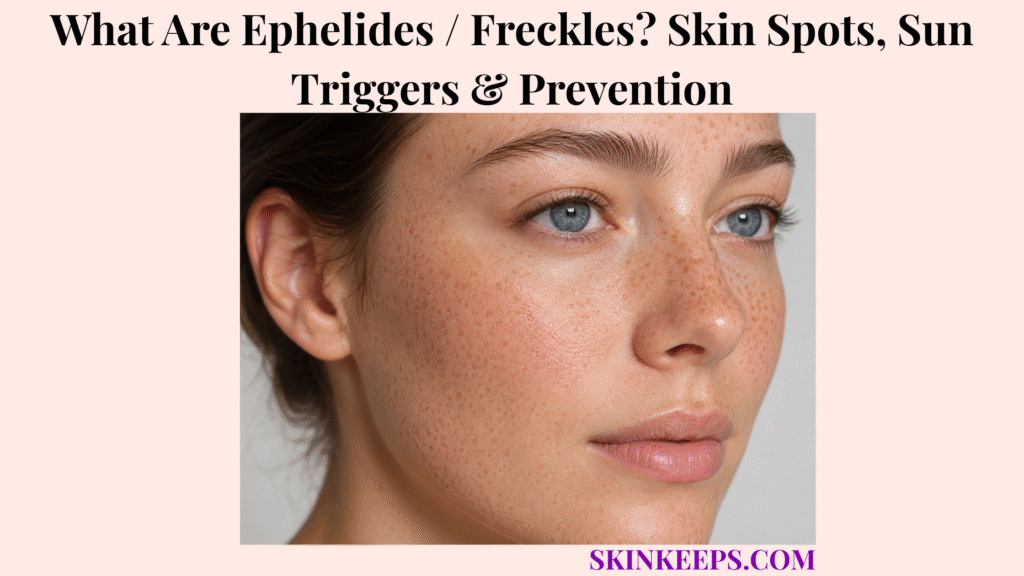
Ephelides are freckles: small, flat, tan-to-brown pigment spots that commonly appear on sun-exposed skin and often become more visible after ultraviolet exposure.
An ephelis means one freckle, while ephelides means multiple freckles. These spots are usually benign, but this page also explains appearance, locations, sun triggers, genetics, similar brown spots, diagnosis, prevention, fading expectations, cosmetic-treatment limits, mistakes, and dermatologist-warning signs.
What Are Ephelides / Freckles?
Ephelides are small, flat pigment macules that develop most often on sun-exposed skin in people with an inherited tendency to freckle.
They form because pigment-producing cells make extra melanin in small localized areas. The spots are usually tan, light brown, golden brown, medium brown, or darker brown depending on skin tone and ultraviolet exposure.
Freckles are not dirt, infection, poor hygiene, or raised skin growths. Their surface normally feels the same as the surrounding skin.
What Does “Ephelis” Mean?
Ephelis is the singular medical term for one freckle, while ephelides is the plural term for multiple freckles.
“Freckles” is the everyday name. A macule means a flat area of changed color that cannot be felt as a bump above the skin.
Are Freckles Dangerous?
Freckles are usually benign and are not skin cancer, but a freckle-like spot that changes should not automatically be dismissed as harmless.
A stable cluster of similar small spots is reassuring. A new, evolving, bleeding, itching, painful, crusted, raised, or unusual spot needs proper assessment because not every brown mark is an ephelis.
Practical rule: Treat a stable cluster of similar freckles with sun protection and monitoring, but diagnose any changing or unusual spot before trying to fade it.
What Do Ephelides / Freckles Look Like?
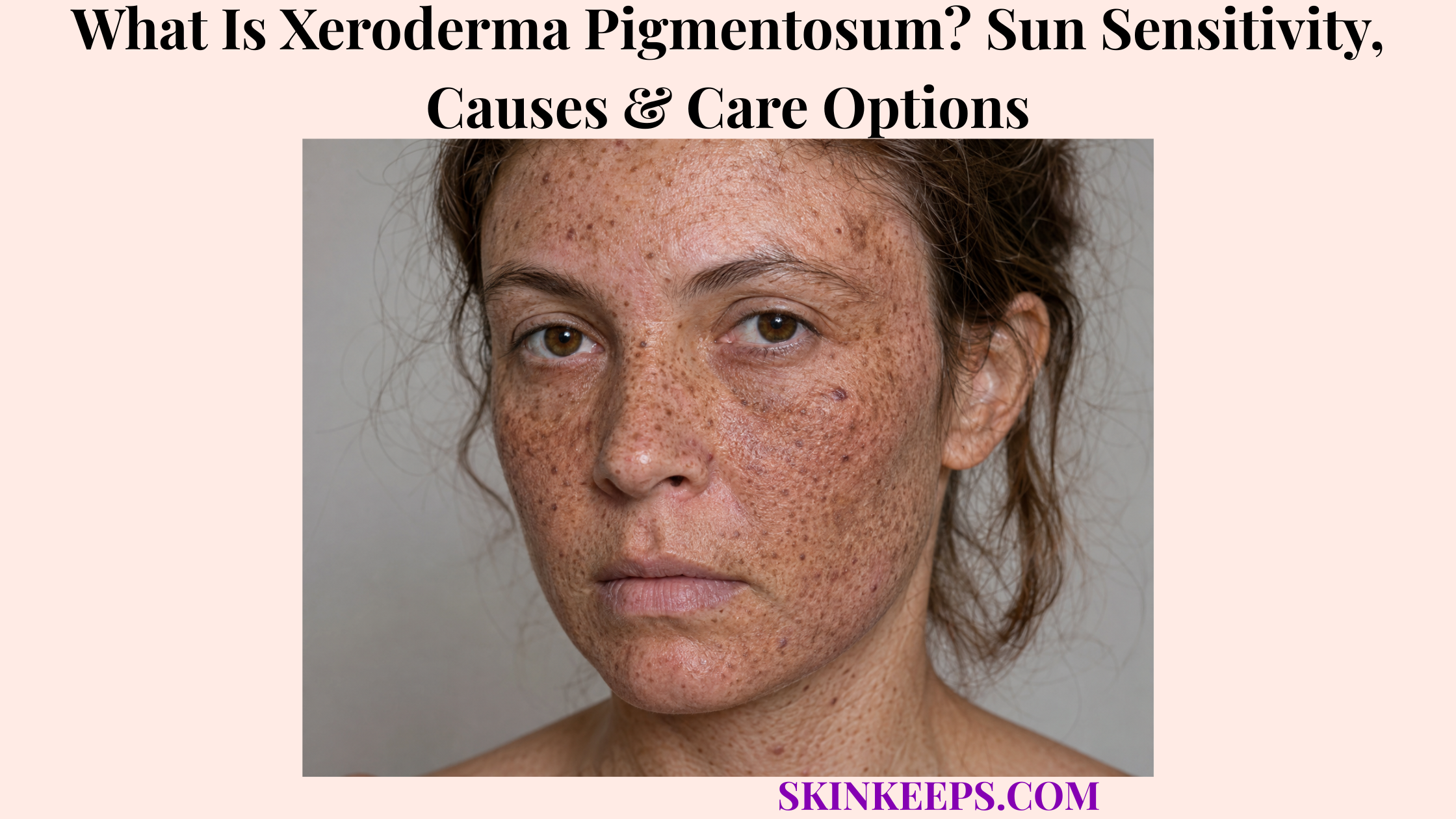
Freckles usually look like small, flat, tan-to-brown spots with soft or poorly defined borders that become more noticeable after sun exposure.
They may be round, oval, or slightly irregular, and many similar spots may cluster across the same sun-exposed area. Nearby freckles can sometimes merge visually into a broader patch.
What Are Common Freckle Features?
Common freckle features include a flat surface, small size, tan-to-brown color, soft borders, summer darkening, and winter fading.
The spots usually remain smooth without scale, crust, bleeding, ulceration, or a firm raised surface. Their color may shift as ultraviolet exposure changes through the year.
How Can Freckles Look on Darker Skin?
On darker skin, freckles may look medium brown, dark brown, brown-gray, or more subtle rather than light tan.
Recognition should not depend on one color description. Pattern, flatness, sun-exposed distribution, seasonal behavior, and whether the spot is changing matter more.
| Feature | Typical Freckle Clue | When to Be Cautious |
|---|---|---|
| Surface | Flat and smooth. | Raised, crusted, bleeding, ulcerated, or sore. |
| Color | Tan, golden brown, medium brown, or darker brown. | Several unusual colors within one spot. |
| Pattern | Many similar small spots. | One spot looks unlike the rest. |
| Border | Soft or poorly defined. | Newly jagged, sharply irregular, or expanding. |
| Season | Darker with higher UV; lighter with lower UV. | Behavior differs from the person’s other spots. |
| Symptoms | Usually no pain, itch, or bleeding. | Itching, pain, tenderness, bleeding, or non-healing change. |
Where Do Freckles Usually Appear?
Freckles usually appear on areas that receive repeated ultraviolet exposure, especially the nose, cheeks, forehead, face, neck, shoulders, arms, hands, upper chest, and upper back.
Children may first develop facial freckles, while repeated incidental sun exposure can make spots more visible on the forearms, backs of the hands, shoulders, chest, or back.
A suspicious pigmented spot can occur outside classic freckle sites, so a lesion on less sun-exposed skin should not be labelled a freckle only because it is brown.
| Body Site | Exposure Pattern | Prevention Focus |
|---|---|---|
| Nose | High direct facial UV exposure. | Broad-brimmed hat and sunscreen. |
| Cheeks / forehead | Daily incidental exposure. | Daily broad-spectrum protection. |
| Shoulders | Often uncovered outdoors. | Protective clothing or sunscreen. |
| Arms / hands | Repeated driving and outdoor exposure. | Cover and reapply outdoors. |
| Upper chest | Exposed by open necklines. | Clothing, shade, and sunscreen. |
| Upper back | Exposed by swimwear or open clothing. | Protective clothing or application help. |
What Causes Ephelides / Freckles?
Freckles develop through an inherited tendency combined with a localized melanin response to ultraviolet light.
Melanocytes are pigment-producing cells. In ephelides, these cells make more melanin than usual in small areas and distribute that pigment to nearby skin cells, creating visible flat spots.
How Do Genes Affect Freckles?
Genes affect freckles by influencing how strongly the skin responds to ultraviolet exposure with localized pigment production.
Family patterns are common. Variants involving the MC1R pathway are linked with many freckles in some fair-skinned or red-haired people, but freckles can also occur in people with darker hair and different genetic backgrounds.
Genetics creates susceptibility; ultraviolet exposure determines how strongly the spots appear at a given time.
How Does Melanin Create Freckles?
Melanin creates freckles when melanocytes produce extra pigment in small localized areas and transfer it to nearby keratinocytes.
Typical ephelides do not form because the skin contains a large new growth of melanocytes. This helps explain why freckles can darken quickly with sun and fade when ultraviolet stimulation is lower.
| Factor | How It Affects Freckles | Practical Meaning |
|---|---|---|
| Inherited tendency | Makes freckling more likely. | Family patterns are common. |
| MC1R context | Linked with many freckles in some people. | One contributor, not the only explanation. |
| Melanocyte activity | Raises local melanin production. | Creates color without a raised bump. |
| Ultraviolet exposure | Darkens existing spots and may reveal more. | Photoprotection is the main preventive action. |
| Skin-tone variation | Changes how color appears. | Use pattern and change, not color alone. |
How Does Sun Exposure Trigger Freckles?
Sun exposure can make freckles darker, more numerous, and more visible because ultraviolet radiation stimulates localized pigment production.
Freckles commonly become stronger during spring or summer, after outdoor activity, or after repeated incidental exposure. They may lighten during winter or when sun exposure is consistently reduced.
Tanning beds also deliver ultraviolet radiation. A tan does not protect freckles or make ultraviolet injury safer.
How Are Freckles Different From Other Brown Spots?
Freckles can resemble solar lentigines, moles, melasma, post-inflammatory hyperpigmentation, café-au-lait spots, atypical nevi, or melanoma warning signs, so behavior and change matter more than the word “brown.”
How Are Freckles Different From Solar Lentigines?
Freckles often fade when ultraviolet exposure is lower, while a lentigo usually persists more steadily through winter.
Solar lentigines are often larger and more sharply defined and may become common after years of sun exposure. Ephelides and lentigines can exist on the same person.
How Are Freckles Different From Moles?
Freckles are flat localized pigment areas, while a mole is a melanocytic growth that may be flat or raised.
Moles do not usually follow the same summer-darkening and winter-fading pattern. Any pigmented growth that evolves should be checked.
How Are Freckles Different From Melasma?
Melasma usually forms larger patchy brown or gray-brown areas, while freckles are typically smaller separate spots.
Melasma often affects the cheeks, forehead, upper lip, nose, or jawline and can involve hormonal, heat, ultraviolet, and visible-light triggers.
How Are Freckles Different From Post-Inflammatory Hyperpigmentation?
Post-inflammatory hyperpigmentation develops after acne, eczema, cuts, burns, bites, procedures, or irritation, while freckles follow a stronger inherited and ultraviolet-response pattern.
Harsh bleaching, scrubbing, or peeling can worsen irritation-related pigment, especially in darker skin tones.
How Are Freckles Different From Café-au-Lait Spots?
Café-au-lait spots are usually larger, uniformly colored patches that may be present from birth or early childhood and do not behave like clusters of seasonal freckles.
A clinician may review multiple large café-au-lait spots in the context of age, number, distribution, and other findings.
How Are Freckles Different From Atypical Nevi or Melanoma Warning Signs?
A dysplastic nevus may be larger, more irregular, or more varied in color than an ordinary mole or freckle.
Melanoma can sometimes resemble a new freckle or age spot, especially when it changes, develops an irregular border, shows several colors, bleeds, itches, hurts, or looks different from the rest.
| Spot Type | Main Clue | Why Confusion Happens | Safer Next Step |
|---|---|---|---|
| Ephelides / freckles | Small, flat, summer darker, winter lighter. | Brown pigment overlap. | Protect from UV and monitor. |
| Solar lentigines | Persist year-round; often sharper borders. | Also linked with sun exposure. | Review if changing or atypical. |
| Mole / nevus | Melanocytic growth; may be raised. | Can be brown and flat. | Use ABCDE and ugly-duckling checks. |
| Melasma | Larger patchy facial pigmentation. | Facial brown color overlap. | Confirm the pigment pattern first. |
| Post-inflammatory pigment | Follows inflammation or injury. | Leaves brown marks. | Treat the trigger and avoid irritation. |
| Café-au-lait spot | Larger uniform patch, often early-life. | Flat brown appearance. | Assess number and context when needed. |
| Suspicious pigmented spot | Evolving, irregular, symptomatic, or different. | May mimic a freckle. | Prompt dermatologist review. |
How Are Ephelides / Freckles Diagnosed?
Freckles are usually diagnosed from their flat appearance, sun-exposed distribution, similarity to nearby spots, seasonal behavior, and history of darkening after ultraviolet exposure.
Typical ephelides usually do not need a biopsy. Diagnosis changes when one spot is atypical, symptomatic, growing, or unlike the rest.
What Does a Dermatologist Check?
A dermatologist checks whether the spots are flat, similarly colored, located on sun-exposed skin, seasonally responsive, and free from suspicious change.
The examination may review symmetry, border, color pattern, surface, symptoms, sunburn history, tanning-bed use, personal or family skin-cancer history, immune suppression, and whether dermoscopy would improve certainty.
When Is Dermoscopy or Biopsy Needed?
Dermoscopy or biopsy may be needed when a pigmented spot is atypical, changing, raised, bleeding, crusted, painful, itchy, non-healing, or difficult to distinguish from another lesion.
Dermoscopy magnifies pigment and structural patterns. Biopsy allows tissue examination when appearance alone cannot safely establish the diagnosis.
Appointment preparation: Bring the date the spot appeared, photos showing change, seasonal behavior, symptoms, sunburn or tanning history, family history, and a list of spots that look different from the rest.
- When the spot first appeared.
- Whether it is new or longstanding.
- Whether it darkens in summer and fades in winter.
- Changes in size, shape, color, surface, or symptoms.
- Photos showing change over time.
- Bleeding, crusting, itching, pain, elevation, or non-healing change.
- Whether it differs from nearby freckles or moles.
- Sunburn and tanning-bed history.
- Personal or family skin-cancer history.
- Many moles, atypical moles, or immune suppression.
- Spots on palms, soles, nails, lips, mouth, genitals, scalp, or less sun-exposed skin.
How Can Freckles Be Prevented From Darkening or Multiplying?
Freckles can be reduced or prevented from darkening by lowering ultraviolet exposure with consistent photoprotection.
Inherited freckling tendency cannot be erased, but preventing repeated ultraviolet stimulation can reduce seasonal darkening and the appearance of additional sun-triggered spots.
What Sun Protection Habits Help Most?
The most useful habits are broad-spectrum SPF 30 or higher sunscreen, reapplication outdoors, shade, protective clothing, a wide-brimmed hat, sunglasses, and avoiding tanning beds.
Protect the nose, cheeks, forehead, ears, neck, shoulders, chest, arms, hands, and upper back because these areas often receive repeated incidental exposure.
Why May Sunscreen Alone Not Be Enough?
Sunscreen helps, but clothing, shade, hats, and reapplication matter because one morning application does not block every ultraviolet exposure throughout the day.
Use enough product, cover all exposed skin, reapply according to exposure and label directions, and use physical barriers when practical. Prevention works better before spots become darker.
- Use broad-spectrum SPF 30 or higher sunscreen.
- Reapply when outdoors and after swimming or heavy sweating.
- Wear a wide-brimmed hat.
- Use UV-protective sunglasses.
- Choose UPF or tightly woven protective clothing.
- Seek shade during strong sunlight.
- Avoid tanning beds.
- Protect the face, shoulders, chest, arms, hands, and upper back.
- Continue protection even when freckles are already present.
Can Freckles Fade or Be Removed?
Freckles often fade when ultraviolet exposure is reduced, but the degree of fading varies and inherited tendency remains.
Sunscreen is better at preventing darkening than erasing existing freckles. Some people choose dermatologist-guided topical medicines, chemical peels, lasers, or light-based treatments after the spots are confirmed to be benign.
Cosmetic treatment can irritate skin or trigger post-inflammatory hyperpigmentation, especially when the treatment is too aggressive for the person’s skin tone or the diagnosis is wrong.
| Goal | Possible Direction | Key Caution |
|---|---|---|
| Prevent darkening | Daily photoprotection. | The most important step. |
| Support seasonal fading | Reduce repeated UV exposure. | Natural fading varies. |
| Camouflage spots | Cosmetic coverage. | Does not change the lesion. |
| Cosmetic lightening | Dermatologist-guided topical, peel, laser, or light options. | Confirm benign diagnosis first. |
| Darker skin tone | Use a pigment-safe plan. | Avoid irritation and PIH. |
| Changing spot | Do not treat cosmetically. | Diagnose before fading. |
What Freckle Care Mistakes Should You Avoid?
The biggest freckle mistake is treating every brown spot as harmless without checking whether it is changing or different from the person’s other spots.
Do not scrub freckles, tan to make them “blend,” use tanning beds, apply harsh bleaching mixtures, or freeze, peel, or laser a suspicious lesion before diagnosis.
Online images cannot reliably distinguish every ephelis, lentigo, mole, or melanoma. A confident cosmetic plan starts with correct identification.
| Mistake | Why It Fails | Better Action |
|---|---|---|
| Calling every brown spot a freckle | Can miss another pigmented lesion. | Check pattern, symptoms, and change. |
| Scrubbing freckles | Irritates skin without changing the cause. | Use gentle care and photoprotection. |
| Intentional tanning | Adds ultraviolet exposure and darkens spots. | Use shade, clothing, and sunscreen. |
| Harsh bleaching | Can cause irritation and PIH. | Use a dermatologist-guided pigment plan. |
| Cosmetic treatment before diagnosis | Can delay recognition of a suspicious lesion. | Diagnose first. |
| Skipping darker-skin checks | Misses palms, soles, nails, mouth, or genital sites. | Check the entire skin surface. |
When Should a Freckle-Like Spot Be Checked by a Dermatologist?
A freckle-like spot should be checked when it is new, changing, asymmetric, irregularly bordered, multi-colored, growing, bleeding, itching, painful, raised, crusted, non-healing, or different from the person’s other spots.
The “ugly duckling” clue means one lesion looks unlike the surrounding spots. That difference may matter even when the lesion is small.
Which ABCDE Signs Matter?
ABCDE warning signs include asymmetry, border irregularity, color variation, a larger or growing diameter, and evolving change.
- A — Asymmetry: one half is unlike the other.
- B — Border: uneven, blurred, jagged, scalloped, or poorly defined edge.
- C — Color: several colors or unusual variation within one spot.
- D — Diameter: larger than nearby spots or increasing in size; suspicious lesions can still be small.
- E — Evolving: change in size, shape, color, elevation, surface, or symptoms.
Which People Should Be More Cautious?
Extra caution is reasonable for people with many freckles, fair or highly sun-sensitive skin, blistering sunburn history, tanning-bed use, many or atypical moles, immune suppression, or a personal or family history of skin cancer.
People with darker skin should also check palms, soles, fingers, toes, nails, lips, mouth, scalp, buttocks, anus, genitals, and other less sun-exposed sites because suspicious lesions can develop there.
Seek dermatologist review if a freckle-like spot is:
- New or newly noticeable.
- Changing in size, shape, color, surface, or symptoms.
- Asymmetric.
- Irregularly bordered.
- Multi-colored.
- Growing or larger than nearby spots.
- Bleeding, itching, painful, or tender.
- Raised, crusted, ulcerated, or non-healing.
- Different from the person’s other spots.
- New in adulthood without a typical freckle pattern.
- On a palm, sole, nail, lip, mouth, genital area, scalp, or less sun-exposed skin.
- Present with immune suppression, many atypical moles, or personal or family skin-cancer history.
What Should You Remember About Ephelides / Freckles?
Ephelides, or freckles, are usually benign sun-responsive pigment spots, but ultraviolet prevention and change monitoring matter because other pigmented lesions can resemble them.
- Ephelis means one freckle; ephelides means multiple freckles.
- Freckles are small, flat, tan-to-brown pigment macules.
- They commonly appear on sun-exposed skin.
- They often darken during higher-UV months and fade when UV exposure falls.
- Genetics and ultraviolet exposure both matter.
- Typical freckles are benign and are not dirt or infection.
- Solar lentigines persist more steadily than ephelides.
- Photoprotection includes sunscreen, shade, clothing, hats, sunglasses, and no tanning beds.
- A new, changing, irregular, symptomatic, or ugly-duckling spot needs dermatologist review.
- Confirm diagnosis before cosmetic fading treatment.
Frequently Asked Questions About Ephelides / Freckles
Are ephelides the same as freckles?
Yes. An ephelis is one freckle, while ephelides are multiple freckles. Freckles are small, flat pigment spots rather than raised growths.
Are freckles caused by the sun?
Freckling tendency is influenced by genetics, while ultraviolet exposure makes freckles darker, more numerous, or more visible by increasing local pigment production.
Do freckles fade in winter?
Many ephelides become more prominent during higher-UV months and fade when ultraviolet exposure is lower. This seasonal behavior helps distinguish freckles from solar lentigines, which tend to persist.
Are freckles cancer?
Typical freckles are benign pigment spots and are not skin cancer. A spot that changes, grows, bleeds, itches, hurts, crusts, or looks different from the rest should be checked rather than assumed to be a freckle.
What is the difference between freckles and sun spots?
Freckles often darken with sun exposure and fade when ultraviolet exposure decreases. Solar lentigines, commonly called sun spots or age spots, usually have sharper borders and persist more steadily through the year.
How can I prevent freckles from getting darker?
Use broad-spectrum SPF 30 or higher sunscreen, reapply outdoors, seek shade, wear a wide-brimmed hat and sunglasses, cover exposed skin with protective clothing, and avoid tanning beds.
Can freckles be removed?
Freckles may lighten when ultraviolet exposure is reduced. Dermatologist-guided topical, peel, laser, or light-based options may fade selected confirmed freckles, but diagnosis should come before cosmetic treatment.
When should a freckle-like spot be checked?
Seek dermatologist review for a new or changing spot, ABCDE warning signs, an ugly-duckling spot, bleeding, itching, pain, crusting, rapid growth, elevation, non-healing change, or a lesion that differs from the person’s other spots.
Sources & Evidence About Ephelides / Freckles
DermNet — Ephelis was used for the ephelis/ephelides definition, inherited tendency, MC1R context, localized melanin increase, sun-exposed distribution, summer prominence, winter fading, clinical diagnosis, and prevention boundaries.
DermNet — Brown Spots and Freckles was used for the difference between ephelides and lentigines, the absence of increased melanocyte numbers in ephelides, clinical diagnosis, dermoscopic surveillance, biopsy boundaries, and brown-spot differentials.
Cleveland Clinic — Freckles was used for patient-friendly appearance, common sun-exposed locations, benign framing, ultraviolet and melanin explanation, prevention, and dermatologist-guided fading options.
American Academy of Dermatology — Melanoma Signs and Symptoms was used for ABCDE warning signs, ugly-duckling change, new freckle-like spots, bleeding, itching, pain, and dermatologist-review guidance.
American Academy of Dermatology — Finding Skin Cancer in Darker Skin Tones was used for warning signs and less sun-exposed locations including palms, soles, nails, mouth, buttocks, anus, and genitals.
American Academy of Dermatology — Practice Safe Sun was used for shade, sun-protective clothing, wide-brimmed hats, sunglasses, broad-spectrum SPF 30 or higher sunscreen, and reapplication guidance.
Educational Disclaimer: This SkinKeeps article is for educational purposes only and does not diagnose or replace medical care. A new, changing, asymmetric, irregularly bordered, multi-colored, growing, bleeding, itching, painful, raised, crusted, non-healing, ugly-duckling, adult-onset, palm-related, sole-related, nail-related, lip-related, mouth-related, genital-related, scalp-related, immune-suppression-associated, skin-cancer-history-associated, or uncertain freckle-like spot should be checked by a qualified healthcare professional or dermatologist. Do not scrub, bleach, peel, freeze, laser, tan, or cosmetically treat a suspicious pigmented spot before proper evaluation.