
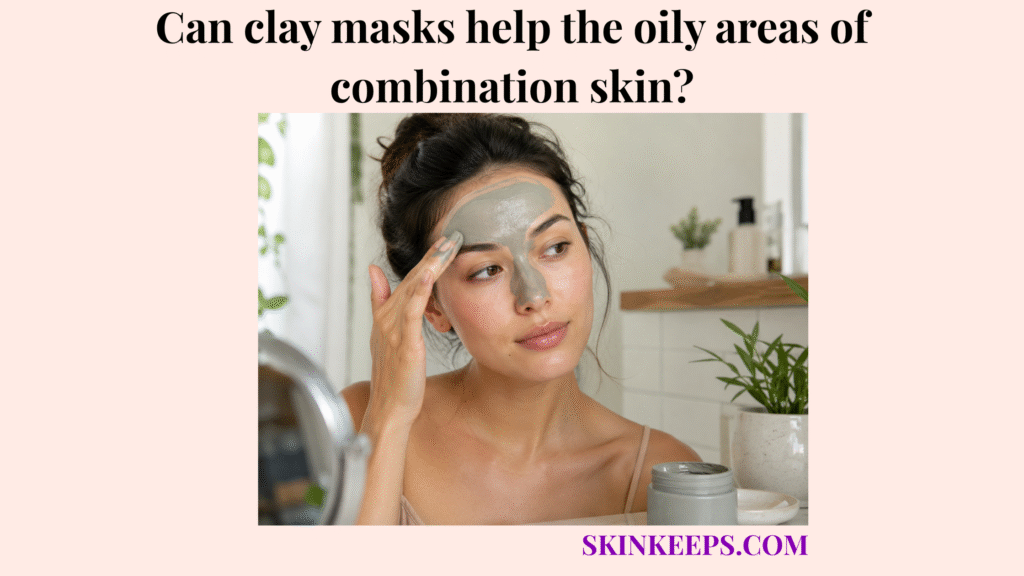
Yes, clay masks can help the oily areas of combination skin temporarily by absorbing excess surface oil and reducing visible shine.
Clay masks may be useful on the forehead, nose, and chin when combination skin feels greasy, congested, or heavy from product buildup. The goal is short-term oil management, not drying the whole face or forcing every zone into the same mask step.
Combination skin should usually use clay masks selectively. Dry cheeks, around-mouth areas, peeling patches, or sensitive zones may become tight, flaky, stingy, or irritated if a clay mask is used too often or applied across the whole face.
Why should combination skin judge clay masks by oil-zone benefit and dry-zone risk?
Combination skin should judge clay masks by oil-zone benefit and dry-zone risk because the same mask can help a greasy T-zone but over-dry cheeks.
Combination skin should judge clay masks by where they help and where they harm. Clay may be useful on oily T-zone areas, but the same mask can over-dry cheeks or irritate areas that already feel tight.
This is why different skin types logic also matters inside one face. Combination skin should not treat the whole face as one oily surface.
| Combination skin zone | Common condition | Clay-mask logic |
|---|---|---|
| Forehead | Shine, sweat, bumps, product buildup | May use clay if oily and not irritated |
| Nose | Oil, blackheads, visible pores | May use clay carefully for temporary oil reduction |
| Chin | Oil, breakouts, residue | May use clay if not peeling from acne products |
| Cheeks | Dryness, tightness, sensitivity | Usually avoid clay or use very cautiously |
| Around mouth | Peeling, stinging, irritation | Avoid clay |
| Jawline | Acne, dryness, friction | Identify pattern before masking |
| Whole face | Mixed oil and dryness | Full-face clay is often too aggressive |
Clay masks should follow the oil, not the face shape.
Figure 1. Clay-mask placement for combination skin should target repeated oil zones and spare cheeks that are dry, tight, or reactive.
How can clay masks help oily areas in combination skin?
Clay masks can help oily areas in combination skin by temporarily absorbing surface oil, reducing visible shine, and making greasy zones feel lighter.
Clay masks can support short-term oily-zone care when the T-zone feels slick or coated. This fits the same zone-safe idea used for treating oily areas without drying cheeks in combination skin: manage oil locally while protecting drier zones.
Clay masks can reduce temporary shine in combination skin
Clay masks can reduce temporary shine in combination skin because clay may absorb excess surface oil on the forehead, nose, or chin.
Forehead, nose, and chin shine may look calmer after a clay mask, but oil can return later. Combination skin should treat this as temporary surface-oil support, not pore shrinking or permanent oil control.
Clay masks can make oily combination skin zones feel cleaner
Clay masks can make oily combination skin zones feel cleaner when the T-zone feels greasy, heavy, or coated from product buildup.
Clay may create a lighter feel on oily zones, especially after sunscreen, makeup, or humid exposure. Gentle cleansing still matters because a mask should not replace basic removal of sweat, residue, and daily buildup.
Clay masks can support oily-zone care before events
Clay masks can support oily-zone care before events when temporary T-zone shine control matters for makeup, photos, or humid conditions.
Occasional pre-event masking may help the T-zone feel less greasy before makeup or photos. It should still be limited to areas that tolerate clay and should not become a daily full-face routine.
| Oily-area concern in combination skin | How clay may help | Limit |
|---|---|---|
| Forehead shine | Temporarily absorbs oil | Oil can return later |
| Greasy nose | Reduces surface oil feel | Does not shrink pores permanently |
| Oily chin | Helps reduce heavy feel | Does not replace acne treatment |
| Makeup sliding | May reduce oil before makeup | Can dry nearby areas |
| Product buildup feeling | Helps oily zone feel cleaner | Cleansing still matters |
| Humid-weather shine | Gives short-term mattifying effect | Overuse can irritate |
Clay masks are short-term oil-management tools, not long-term oil-control cures.
What can clay masks not do for combination skin?
Clay masks cannot permanently control oil, shrink pores, detox skin, cure acne, or replace basic care for combination skin.
Clay can reduce surface-oil feel temporarily, but combination skin still needs gentle cleansing, moisturizer, sunscreen, and targeted care when congestion or acne repeats. A mask is an optional support step, not a medical treatment or full routine replacement.
| Claim to avoid | More accurate statement for combination skin |
|---|---|
| Clay masks shrink pores | Clay may temporarily reduce oil and make pores look less obvious |
| Clay detoxes skin | Skin does not need a mask to detoxify |
| Clay cures acne | Clay may dry surface oil but does not replace acne treatment |
| Clay removes blackheads permanently | Clay may reduce oiliness but clogged pores need broader care |
| Clay balances combination skin alone | Balance also needs cleanser, moisturizer, sunscreen, and targeted care |
| Clay should dry completely | Letting clay crack can make skin tight and irritated |
| Clay works for all zones | Dry cheeks may worsen |
| More clay means less oil | Overuse may cause irritation and tightness |
If the promise sounds permanent, clay is probably being oversold.
Which oily areas of combination skin can use clay masks?
The oily areas of combination skin that can use clay masks are usually the forehead, nose, chin, or oily jawline when those zones are not irritated or peeling.
The T-zone is the common clay-mask area because it often has the most visible shine, surface oil, or heavy product feel. Zone-based placement works best when clay is treated like one of the targeted treatments for the T-zone and cheeks, not as a full-face default.
| Facial area in combination skin | Clay-mask suitability | Application note |
|---|---|---|
| Forehead | Often suitable if oily | Thin layer only where shiny |
| Nose | Often suitable if oily/congested | Avoid over-drying nose corners |
| Chin | Sometimes suitable | Skip if peeling from acne treatment |
| Cheeks | Usually not ideal if dry | Avoid unless cheeks are also oily and tolerant |
| Around mouth | Usually avoid | High peeling and stinging risk |
| Jawline | Depends | Use only if oily, not irritated |
| Temples | Depends on sweat/hair product buildup | Check contact triggers first |
| Whole face | Usually not best | Combination skin usually needs zone masking |
The classic combination skin clay-mask zone is the T-zone, not the entire face.
How often should combination skin use clay masks on oily areas?
Combination skin should use clay masks on oily areas occasionally, often starting around once weekly or less, and reducing use if tightness or flakes appear.
Frequency should be controlled by dryness and irritation, not by oiliness alone. If the cheeks tighten, the mouth area peels, or the T-zone feels shiny but dry after masking, combination skin needs less clay, better placement, or a pause.
| Combination skin pattern | Starting frequency | Where to apply |
|---|---|---|
| Mild oily T-zone | Once weekly or less | T-zone only |
| Very shiny nose | Once weekly to nose/T-zone if tolerated | Nose or T-zone |
| Oily T-zone, dry cheeks | Once weekly or less | Avoid cheeks |
| Sensitive combination skin | Rarely or skip | Patch test first |
| Acne treatment already used | Use less often or skip | Avoid peeling areas |
| Cold/dry weather | Reduce frequency | T-zone only if needed |
| Humid weather | Occasional use may help | Oily areas only |
| Tightness after masking | Reduce or stop | Do not repeat quickly |
For combination skin, clay-mask frequency should be controlled by dryness and tightness, not by oiliness alone.
Figure 2. Safe clay-mask use for combination skin depends on selective placement, early removal, and moisturizer aftercare.
How should combination skin apply clay masks without drying the cheeks?
Combination skin should apply clay masks without drying the cheeks by using a thin layer only on oily zones and removing it before tightness or cracking appears.
Apply clay masks only to oily combination skin zones
Clay masks should be applied only to oily combination skin zones such as the forehead, nose, chin, or other repeatedly greasy areas.
A thin local layer is usually safer than a thick full-face coat. The goal is to treat a repeated greasy area, not to make normal or dry zones feel tighter.
Keep clay masks away from dry cheeks in combination skin
Clay masks should be kept away from dry cheeks in combination skin because oil-absorbing clay can worsen tightness, flakes, or sensitivity.
Dry cheeks, flaky cheeks, sensitive cheeks, around-mouth skin, and eye-adjacent areas usually need moisture support and low-irritation care instead of oil absorption.
Remove clay masks before combination skin feels tight or cracked
Clay masks should be removed before combination skin feels tight, cracked, hot, uncomfortable, or hard to rinse.
Letting clay fully crack can pull comfort from the surface and make rinsing harsher. Gentle rinsing and patting dry are safer than scrubbing a hardened mask off the face.
- Cleanse gently first.
- Apply a thin layer only to oily areas.
- Avoid cheeks if they are dry, tight, or reactive.
- Avoid around-mouth and eye-adjacent areas.
- Do not apply over open, peeling, sunburned, or irritated skin.
- Do not let the mask crack until the skin feels tight.
- Rinse gently without scrubbing.
- Pat dry instead of rubbing.
- Moisturize afterward.
- Use sunscreen during the day as usual.
A clay mask should leave oily areas calmer, not leave the whole face tight.
Which clay-mask ingredients matter for combination skin?
Clay-mask ingredients matter for combination skin because the clay type, added actives, fragrance, and base formula can change dryness and irritation risk.
Ingredient fit should be judged by the full formula and the zone. The same ingredient that feels useful on the oily T-zone may be too drying on cheeks, especially when acids, sulfur, fragrance, essential oils, or alcohol-heavy bases are added.
For broader ingredient context, ingredients that support combination skin balance should be matched by role: oil support where oily, barrier support where dry, and lower-irritation choices where reactive.
| Ingredient or formula type | Possible role in combination skin | Caution |
|---|---|---|
| Kaolin clay | Gentler-feeling oil absorption for some | Can still dry if overused |
| Bentonite clay | Stronger oil-absorbing feel | May be too drying for mixed zones |
| Charcoal | Often used in oil-control masks | Can feel drying depending on formula |
| Salicylic acid | Helps clogged oily zones if tolerated | Can add dryness or peeling |
| Sulfur | May support acne-prone oily areas | Can be drying or irritating |
| Fragrance | Adds scent | Higher irritation risk |
| Essential oils | Marketing appeal | Can irritate reactive zones |
| Alcohol-heavy base | Fast-drying feel | Can worsen tightness |
| Soothing ingredients | May improve comfort | Does not make harsh use safe |
For combination skin, the mask base matters as much as the clay type.
Should combination skin use clay masks instead of exfoliants or acne treatments?
Combination skin should not use clay masks instead of exfoliants or acne treatments when the real issue is clogged pores, inflamed acne, or persistent breakouts.
Clay masks can support oil management, but they do not replace targeted acne care, gentle cleansing, moisturizer, sunscreen, or medical care when symptoms are persistent or painful.
When acids, scrubs, masks, retinoids, or acne products are being combined, the safer next step is usually to review when combination skin should be exfoliated instead of stacking more oil-control steps.
| Oily-area issue in combination skin | Clay mask may help | Better option may be |
|---|---|---|
| Temporary shine | Yes | Blotting, light moisturizer, matte sunscreen |
| Nose blackheads | Limited support | Salicylic acid if tolerated |
| Inflamed pimples | Limited | Acne treatment or dermatology care if severe |
| Forehead bumps | Sometimes | Check sweat, hair products, noncomedogenic products |
| Oily but tight skin | Usually not best | Hydration and gentler cleansing |
| Makeup sliding | Sometimes before makeup | Better sunscreen/primer texture |
| Product residue | Sometimes | Better cleansing method |
| Persistent acne | Not enough alone | Acne plan or professional care |
Clay masks can support oil management, but they should not replace acne care or barrier-safe routine basics.
What should combination skin do after using a clay mask?
Combination skin should moisturize after using a clay mask, using a lighter layer on oily zones and more support on dry cheeks if needed.
Clay absorbs oil, so post-mask comfort matters. A lightweight layer may be enough on the T-zone, while cheeks or around-mouth areas may need a more supportive layer if they feel tight.
The same logic used for how often combination skin should be moisturized applies after masking: oily zones usually need less moisturizer, not zero moisturizer.
- Rinse gently with lukewarm water.
- Avoid scrubbing.
- Pat the skin dry.
- Apply lightweight moisturizer to oily zones.
- Apply more supportive moisturizer to dry cheeks if needed.
- Avoid strong exfoliants the same day if the skin feels tight.
- Avoid retinoids or acne treatments immediately afterward if irritation appears.
- Watch for stinging, redness, flakes, or shiny-tight skin.
- Use sunscreen during daytime routines.
- Reduce frequency if dryness appears.
Clay masks absorb oil, so moisturizer afterward is not optional for many combination skin patterns.
How can combination skin tell if a clay mask is too drying?
Combination skin can tell a clay mask is too drying when cheeks tighten, the T-zone feels shiny but tight, moisturizer stings, or peeling appears.
A mask should leave oily areas less greasy but still comfortable. If combination skin feels hot, stretched, shiny-dry, or stingy afterward, the clay mask may be too strong, too frequent, or placed too widely.
| Sign after clay mask in combination skin | What it may mean | Better response |
|---|---|---|
| Cheeks feel tight | Mask spread too far or skin is too dry | Avoid cheeks next time |
| T-zone feels shiny but tight | Mask may be too drying | Reduce frequency |
| Moisturizer stings | Barrier may be irritated | Stop masking and simplify |
| Around-mouth peeling | Mask or actives reached sensitive area | Avoid that zone |
| Redness appears | Irritation may be present | Stop and monitor |
| Breakouts plus flakes | Over-drying may be worsening balance | Reduce active/mask load |
| Skin feels hot or burning | Product reaction possible | Remove and stop use |
| Makeup clings worse | Dryness increased | Moisturize and pause masks |
A good clay-mask result is less greasy, not stripped.
What mistakes happen when combination skin uses clay masks?
Clay-mask mistakes happen in combination skin when masks are used full-face, used too often, left until cracking, or stacked with too many actives.
Avoid full-face clay masks on combination skin when cheeks are dry
Full-face clay masks can worsen combination skin when dry cheeks, around-mouth areas, or sensitive patches become tighter or more irritated.
Combination skin often needs T-zone-only masking. Clay is not bad for everyone, but it should not be placed on dry zones just because the nose is oily.
Avoid using clay masks too often on combination skin
Using clay masks too often on combination skin can create tightness, flakes, stinging, and shiny-but-dry imbalance.
Daily or repeated masking can push oil-control too far. Occasional use is safer, and tightness after masking is a reason to reduce use instead of repeating quickly.
Avoid letting clay masks fully crack on combination skin
Letting clay masks fully crack on combination skin can pull too much comfort from the skin and leave oily zones tight or irritated.
Remove clay before discomfort, then rinse gently. Scrubbing a cracked mask off can add friction to already tight or irritated skin.
Avoid using clay masks with too many active treatments on combination skin
Clay masks can overwhelm combination skin when they are layered with acids, retinoids, acne cleansers, or spot treatments too close together.
Clay plus multiple actives can make it harder to know which product caused stinging, peeling, or breakouts plus dryness. Separate or reduce strong steps when the skin feels reactive.
| Mistake | Why it hurts combination skin | Better move |
|---|---|---|
| Clay mask full-face | Dries cheeks and mouth area | Apply to T-zone only |
| Daily clay mask | Tightness and irritation rise | Use occasionally |
| Leaving mask until cracking | Skin may feel stripped | Remove before discomfort |
| Clay over peeling skin | Irritation worsens | Skip and moisturize |
| Clay plus acid same day | Over-drying risk | Separate or reduce |
| No moisturizer after clay | Dry zones worsen | Moisturize by zone |
| Scrubbing mask off | Adds friction | Rinse gently |
| Treating acne only with clay | May delay proper acne care | Use appropriate acne plan |
Figure 3. Clay-mask mistakes usually come from treating the whole face like an oily zone instead of separating oil benefit from dry-zone risk.
When should clay-mask problems in combination skin need a dermatologist?
Clay-mask problems in combination skin need a dermatologist when masks cause burning, swelling, cracked patches, bleeding, painful acne, spreading redness, or rash-like irritation.
Clay masks are optional. Combination skin should not keep using a mask that repeatedly causes pain, spreading irritation, bleeding dryness, or worsening acne.
- Clay masks cause burning, swelling, or severe redness.
- Dry patches crack, bleed, burn, or spread.
- Breakouts become painful, deep, cystic, or scarring.
- Peeling continues after stopping clay masks.
- Skin reacts to many gentle products.
- Redness, warmth, or rash-like patches appear.
- Around-mouth irritation keeps returning.
- Oily and dry zones worsen together despite routine simplification.
- The reader suspects acne, eczema, dermatitis, rosacea, allergy, folliculitis, or infection.
Clay masks are optional. Painful acne, bleeding dryness, burning, swelling, or rash-like irritation is not a masking problem to solve at home.
What should you remember about clay masks and combination skin?
The key point is that clay masks can temporarily help oily areas of combination skin, but they should be used selectively and cautiously.
Frequently Asked Questions About Clay Masks and Combination Skin
Can clay masks reduce oil in combination skin?
Yes. Clay masks can temporarily absorb surface oil in oily areas of combination skin, especially the T-zone. They do not permanently stop oil production.
Should combination skin use clay masks on the whole face?
Usually no. Combination skin often does better when clay masks are applied only to oily areas such as the forehead, nose, and chin.
How often should combination skin use a clay mask?
Combination skin should usually start with occasional clay-mask use, such as once weekly or less, and reduce use if tightness, flakes, or irritation appear.
Can clay masks make combination skin worse?
Yes. Clay masks can make combination skin worse if they are used too often, left on too long, applied to dry cheeks, or combined with too many strong actives.
Should I moisturize after a clay mask if my T-zone is oily?
Yes. Use a lightweight moisturizer on oily zones and more support on dry zones. Skipping moisturizer can make combination skin feel tight and unstable.
Conclusion: Clay masks and combination skin
Clay masks can be useful for combination skin when they are treated as a targeted oily-zone support step. They may reduce temporary shine on the forehead, nose, or chin, but they should not be used as a full-face drying tool or a replacement for acne care.
The safest clay-mask plan for combination skin is selective, occasional, and comfort-based. Apply clay only where oil repeats, remove before tightness or cracking, moisturize afterward, and stop if stinging, peeling, burning, or rash-like irritation appears.
Sources & Evidence for clay masks and combination skin
American Academy of Dermatology: Do facial masks work, and should I add one to my skin care routine? — used for the boundary that facial masks may support care but do not replace treatment for skin diseases such as acne or eczema.
American Academy of Dermatology: How to control oily skin — used for oily-skin guidance, oil-free/noncomedogenic product selection, and reducing irritating acid use if irritation appears.
American Academy of Dermatology: Acne skin-care tips — used for gentle cleansing, fingertip application, after-sweat washing, and avoiding harsh scrubbing.
American Academy of Dermatology: 10 skin care habits that can worsen acne — used for warnings about drying products, scrubbing, and moisturizer support when acne-prone skin feels dry.
American Academy of Dermatology: Dermatologists’ tips for relieving dry skin — used for gentle cleansing, moisturizer support, and avoiding harsh drying habits.
American Academy of Dermatology: How to safely exfoliate at home — used for exfoliation caution in dry, sensitive, or acne-prone skin and the need to avoid damaging the skin.
Cleveland Clinic: What is my skin type? — used for combination-skin T-zone and cheek differences.
Skin Research and Technology / PMC: Comprehensive assessment of the efficacy and safety of a clay mask in oily and acne skin — used for evidence that clay masks can have measurable oily-skin benefits while still requiring tolerance-based use.
Educational Disclaimer: This article is for general skin education only and does not diagnose, treat, or replace professional medical advice. If clay masks cause burning, swelling, cracked or bleeding patches, painful acne, scarring, spreading redness, rash-like irritation, or persistent product reactions, consult a qualified dermatologist.