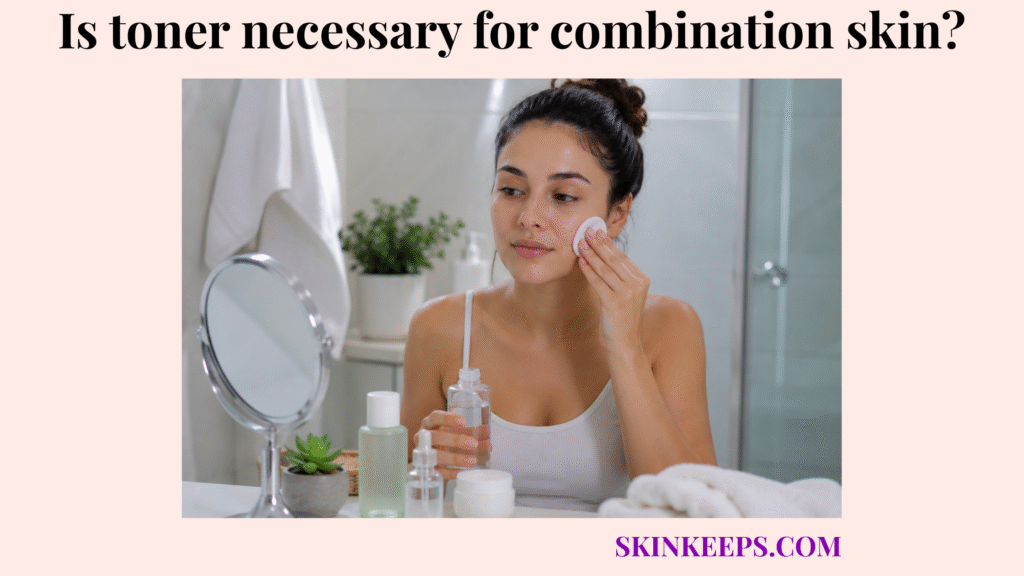
Toner is not usually necessary for combination skin. A simple routine with gentle cleanser, moisturizer, and sunscreen can be enough for combination skin when the oily T-zone and dry or normal cheeks already feel comfortable. Toner becomes useful only when it solves a specific problem, such as tightness after cleansing or congestion in one oily zone.
Combination skin can become more unbalanced if toner is drying, alcohol-heavy, strongly fragranced, overused, or applied everywhere without a reason. A hydrating toner may support tight or dehydrated-feeling areas, and a gentle exfoliating toner may help clogged oily zones if tolerated, but toner should not replace moisturizer or become a mandatory rule.
Why should combination skin judge toner by function instead of routine rules?
Combination skin should judge toner by function because toner is useful only when it solves a real zone-specific need without causing irritation.
Combination skin is not one uniform surface. The T-zone may need oil or congestion support, while the cheeks may need comfort, hydration, or no extra step at all. This is why toner should be judged by comfort, tolerance, and visible need rather than by a routine template.
If a toner does not improve a repeated problem, it may only add cost, irritation risk, and confusion. Readers comparing different skin types should treat toner as optional, especially when a basic routine already keeps each zone comfortable.
| Combination skin question | What it means | Toner decision |
|---|---|---|
| Does the cleanser leave skin comfortable? | Basic cleansing may already work | Toner may be unnecessary |
| Does the T-zone clog or look congested? | A targeted exfoliating toner may help | Use carefully and selectively |
| Do cheeks feel tight after cleansing? | Hydration or barrier support may be needed | Hydrating toner may help, but moisturizer still matters |
| Does toner sting or burn? | Formula may be irritating | Stop or switch |
| Does toner make skin feel squeaky? | It may be too stripping | Avoid drying toner |
| Does toner reduce comfort? | It is not supporting balance | Remove it |
| Does toner add hydration without irritation? | It may be useful | Keep if it fits |
| Is the routine already stable? | No extra step may be needed | Skip toner |
For combination skin, toner should earn its place. It is optional unless it solves a repeated zone-specific problem.
When is toner unnecessary for combination skin?
Toner is unnecessary for combination skin when cleansing, moisturizing, and sunscreen already keep oily and dry zones comfortable.
Skipping toner is acceptable for combination skin. A stable, simple routine is often easier to read because fewer products make it clearer whether the T-zone, cheeks, or around-mouth area is reacting.
If residue, tightness, or makeup removal is the concern, review cleanser type for combination skin before using toner as a second cleanser. Toner should not compensate for a cleanser that is too weak, too stripping, or poorly matched to sunscreen and makeup use.
- The cleanser removes sunscreen, makeup, oil, and sweat without stripping.
- The T-zone is manageable with lightweight moisturizer and sunscreen.
- The cheeks do not feel tight after cleansing.
- Moisturizer and sunscreen layer comfortably.
- Breakouts are not linked to residue or heavy products.
- Skin feels calmer without toner.
- Toner adds stinging, dryness, or redness.
- The routine already works with fewer steps.
Combination skin does not need toner just to be “complete.” A stable simple routine is better than an unnecessary extra step.
When can toner help combination skin?
Toner can help combination skin when it adds hydration, gentle exfoliation, or calming support to a specific zone without stripping another zone.
A toner has a place in combination skin only when its function matches a repeated pattern. Tight cheeks may benefit from light hydration before moisturizer, while a congested nose may tolerate a careful exfoliating toner. If the whole face feels comfortable, toner may add no useful benefit.
| Combination skin concern | Toner type that may help | Caution |
|---|---|---|
| Oily but tight T-zone | Hydrating toner | Still needs moisturizer |
| Dry cheeks after cleansing | Hydrating or calming toner | May be too little alone |
| Nose congestion | Gentle exfoliating toner | Avoid daily overuse |
| Forehead bumps | Exfoliating toner if tolerated | Check hair products and sweat too |
| Cheek sensitivity | Calming fragrance-free toner | Stop if stinging appears |
| Makeup clinging to cheeks | Hydrating toner under moisturizer | Do not replace moisturizer |
| Heavy residue feeling | Better cleansing may be needed first | Toner should not compensate for poor cleanser |
| Humid-weather shine | Lightweight toner may feel comfortable | Avoid harsh astringents |
Toner can help combination skin when it adds hydration, gentle exfoliation, or calming support without stripping or irritating.
Which toner types suit combination skin best?
Toner types that suit combination skin best are gentle, alcohol-free, fragrance-free, and chosen for a clear function such as hydration, calming, or careful exfoliation.
The safest toner direction for combination skin is not the strongest toner. It is the toner that fits the zone, avoids unnecessary irritation, and does not replace the routine steps that already work. Ingredient roles matter, so the same toner may not belong on both oily and dry areas.
Readers choosing between hydrating, calming, acid, or astringent options can use ingredients that support combination skin balance as a guide for humectants, acids, fragrance-free formulas, and alcohol-free choices.
| Toner type | Possible role in combination skin | Main risk |
|---|---|---|
| Hydrating toner | Adds light hydration to tight or oily-but-dehydrated zones | May be too light without moisturizer |
| Calming toner | Supports reactive cheeks if fragrance-free and gentle | Botanical/fragrance ingredients may irritate |
| Exfoliating toner | Helps clogged T-zone or rough texture if tolerated | Can cause peeling, stinging, or barrier stress |
| Astringent toner | Temporarily reduces oily feel | Can over-dry and irritate |
| Alcohol-heavy toner | Often marketed for oil control | Higher risk of tightness and burning |
| Fragrance-heavy toner | Adds scent experience | Higher irritation risk |
| Acid toner | May smooth texture | Needs low frequency and careful placement |
| Essence-style toner | Hydrating support | May overlap with serum or moisturizer |
For combination skin, the safest toner is usually gentle, alcohol-free, fragrance-free, and matched to a clear need.
Should hydrating toner be used for combination skin?
Hydrating toner can be used for combination skin when tight, dry, or oily-but-dehydrated zones need light water comfort before moisturizer.
Hydrating toner may be useful for combination skin because it can add a lightweight comfort step without the heavy feel that some oily zones dislike. It is most useful when the T-zone feels shiny but tight, or when the cheeks feel tight after cleansing.
How hydrating toner can support oily-but-tight combination skin
Hydrating toner can support oily-but-tight combination skin when the T-zone looks shiny but still feels tight, stripped, or uncomfortable.
The forehead, nose, and chin may still need water comfort even when they look oily. A hydrating toner can add a light layer before a lightweight moisturizer, especially when cleansing leaves a tight feeling.
This fits the same logic used for dehydrated combination skin: shine is not proof that the skin has enough comfort. The toner may support hydration, but it should not become the only support step.
How hydrating toner can support dry cheeks in combination skin
Hydrating toner can support dry cheeks in combination skin when cheeks feel tight after cleansing and need extra comfort before moisturizer.
Cheeks, around-mouth skin, and the outer face may appreciate a light water-support layer. If those areas stay flaky, rough, or stingy, hydrating toner is usually not enough by itself.
Why hydrating toner does not replace moisturizer in combination skin
Hydrating toner does not replace moisturizer in combination skin because water-like hydration still needs moisturizer support where dryness or tightness persists.
Toner can sit under moisturizer, but it should not replace dry-zone barrier support. For many readers, how often combination skin should be moisturized matters more than whether toner is added.
| Combination skin sign | Hydrating toner fit | What to pair with |
|---|---|---|
| Oily but tight T-zone | May help | Lightweight moisturizer |
| Dry cheeks after cleansing | May help | Barrier-support moisturizer |
| Makeup clings to cheeks | May help | Moisturizer before makeup |
| Skin feels dehydrated in AC | May help | Moisturizer by zone |
| Whole face comfortable | Optional | No need to add |
| Toner feels sticky | Formula may not suit | Reduce amount or skip |
Hydrating toner can be useful for comfort, but it should not be the only moisturizing step for combination skin.
Should exfoliating toner be used for combination skin?
Exfoliating toner can be used for combination skin only when clogged or rough zones need it and the skin tolerates acids without stinging, peeling, or burning.
Exfoliating toner is a treatment step. It may help a clogged nose, recurring forehead congestion, or bumpy chin texture, but it can destabilize dry cheeks and around-mouth skin if used too often or spread too widely.
How exfoliating toner may help clogged T-zone areas in combination skin
Exfoliating toner may help clogged T-zone areas in combination skin when salicylic acid or other exfoliating ingredients are used carefully on the nose, forehead, or chin.
A clogged T-zone may tolerate a careful acid toner better than dry cheeks do. This is where targeted treatments for the T-zone and cheeks become useful: treat the congested zone, not the whole face by default.
Why exfoliating toner can irritate dry cheeks in combination skin
Exfoliating toner can irritate dry cheeks in combination skin when acids are applied too often, too strongly, or too widely over tight, flaky, or reactive zones.
Dry cheeks, around-mouth skin, and eye-adjacent areas may sting or peel faster than oily areas. If a toner causes burning or repeated peeling, it should be reduced or stopped instead of pushed harder.
How often combination skin should start exfoliating toner
Combination skin should start exfoliating toner at low frequency and careful placement instead of daily full-face use.
Beginners should watch comfort, not just smoothness. Acid toner that creates flakes, stinging, or shiny-but-tight skin is too much for the current routine.
| Combination skin use case | Better approach | Avoid |
|---|---|---|
| Nose blackheads | Apply only to nose/T-zone if tolerated | Full-face daily acid |
| Forehead congestion | Use low frequency | Scrubbing plus acid |
| Chin breakouts | Target carefully | Spreading over dry mouth area |
| Dry cheeks | Skip or avoid cheeks | Acid over flakes |
| Sensitive zones | Patch test or avoid | Strong acid toner |
| Peeling after toner | Reduce or stop | Adding stronger actives |
| Burning after toner | Stop use | Pushing through irritation |
Exfoliating toner is a treatment, not a harmless water step.
Should astringent toner be used for combination skin?
Astringent toner is usually not the best first choice for combination skin because it can reduce oily feel temporarily while drying or irritating other zones.
Astringent toner may make the T-zone feel very clean for a short time, but that clean feeling can become tightness, heat, flakes, or fast-returning shine. If astringent toner is used at all, it should be gentle, limited to oily zones that tolerate it, and removed if comfort declines.
| Astringent toner effect | Why it can harm combination skin | Better option |
|---|---|---|
| Makes T-zone feel very clean | May strip surface comfort | Gentle cleanser and lightweight moisturizer |
| Reduces shine briefly | Oil may return with tightness | Blotting or lighter product texture |
| Stings cheeks | Cheeks may be irritated | Fragrance-free hydrating product |
| Creates squeaky feel | Barrier may be over-stripped | Stop drying toner |
| Causes flakes | Dry zones are destabilized | Barrier support |
| Used daily full-face | Increases imbalance risk | Target only if needed |
If toner makes combination skin feel tight, squeaky, or hot, it is not balancing the skin.
How should toner be applied by area on combination skin?
Toner should be applied by area on combination skin when only the T-zone, cheeks, or another specific zone needs the toner’s function.
Combination skin does not need toner everywhere. Exfoliating toner may belong on the nose or T-zone only, while hydrating toner may belong on tight cheeks only. Some zones may need no toner at all.
| Facial area in combination skin | Toner direction | Caution |
|---|---|---|
| Forehead | Hydrating or gentle exfoliating toner if needed | Avoid over-drying |
| Nose | Exfoliating toner only if clogged and tolerated | Avoid daily harsh use |
| Chin | Target acne/congestion carefully | Keep away from peeling areas |
| Cheeks | Hydrating or calming toner if dry/reactive | Avoid acid/astringent if tight |
| Around mouth | Usually avoid strong toners | Protect from peeling and stinging |
| Jawline | Treat based on acne, friction, or dryness | Do not assume cause |
| Eye-adjacent area | Avoid active toners | High irritation risk |
| Dry patches | Hydrating support only if tolerated | Do not exfoliate flakes aggressively |
Combination skin does not need toner everywhere. Apply toner only where the toner’s function matches the zone’s need.
How often should combination skin use toner?
Combination skin should use toner only as often as the toner type and skin tolerance allow, with exfoliating or astringent toners used more cautiously than hydrating toners.
Frequency should follow toner strength. Hydrating toner may be flexible if it stays comfortable, but acid, exfoliating, or astringent toner should start slowly and remain limited if dryness, burning, peeling, or stinging appears.
| Toner type | Starting frequency for combination skin | Increase only if |
|---|---|---|
| Hydrating toner | Once daily or as needed | No stickiness, stinging, or clogging |
| Calming toner | Once daily or as needed | Reactive areas feel better |
| Exfoliating toner | 1–2 times weekly at first | No dryness, burning, peeling, or stinging |
| Astringent toner | Avoid or use rarely on oily zones only | No tightness or irritation |
| Acid toner | Low frequency only | Skin tolerates it and needs it |
| Fragrance-heavy toner | Usually avoid | Not ideal for reactive zones |
| Alcohol-heavy toner | Usually avoid | Not ideal for balanced care |
Hydrating toner can be flexible. Exfoliating or astringent toner should be limited and watched carefully.
How can combination skin tell if toner is helping?
Combination skin can tell toner is helping when it improves comfort, layering, or congestion without causing tightness, stinging, peeling, or fast-returning shine.
A toner should create a clear benefit that lasts beyond the first refreshing feeling. If the T-zone feels less comfortable later, or the cheeks become tighter after toner, that toner is not helping the mixed-zone pattern.
- The T-zone feels comfortable, not stripped.
- Cheeks feel more comfortable after moisturizer.
- Skin does not sting after toner.
- Dry patches do not worsen.
- Breakouts do not increase where toner is applied.
- Makeup or sunscreen layers better.
- The toner does not make the face feel squeaky.
- The routine feels simpler or more effective.
- The benefit is clear enough to justify the extra step.
A toner that feels refreshing for 30 seconds but creates tightness later is not helping combination skin.
How can combination skin tell if toner should be skipped?
Combination skin should skip toner when toner causes burning, stinging, tightness, peeling, roughness, fast-returning shine, or worse comfort.
Optional products should be easy to remove from a routine. If comfort improves when toner is removed, that toner was not necessary for the current combination skin pattern.
- It stings, burns, or makes skin hot.
- Cheeks become tighter after use.
- Around-mouth peeling gets worse.
- The T-zone feels stripped but becomes shiny quickly.
- Dry patches become rougher.
- Breakouts and peeling appear together.
- Moisturizer stings after toner.
- The toner contains harsh alcohol, strong fragrance, or too many acids for the reader’s tolerance.
- The routine works better without it.
- The reader is only using it because a routine template says to.
Optional products should be easy to remove. If removing toner improves comfort, toner was not necessary.
What mistakes happen when combination skin uses toner?
Toner mistakes happen in combination skin when toner is used as a second cleanser, oil remover, full-face acid step, moisturizer replacement, or mandatory routine rule.
Most toner mistakes come from asking toner to do the wrong job. Toner should not replace cleansing, moisturizer, sunscreen, or targeted treatment, and it should not be spread across every zone when only one zone needs it.
Avoid using toner as a second cleanser for combination skin
Toner should not be used as a second cleanser for combination skin because leftover residue usually means the cleanser or cleansing method needs adjustment.
If sunscreen, makeup, sweat, or residue remains after cleansing, the solution is usually better cleansing, not rubbing toner across the face until a cotton pad looks clean.
Avoid using toner to dry out oily combination skin zones
Toner should not be used to dry out oily combination skin zones because stripping the T-zone can create tightness, irritation, and fast-returning shine.
Oil-control should not mean making the forehead, nose, or chin feel squeaky, hot, or tight. A lighter moisturizer or product texture may be safer than drying toner.
Avoid applying exfoliating toner full-face on combination skin
Exfoliating toner should not be applied full-face on combination skin when only the T-zone is clogged and the cheeks are dry, tight, or reactive.
Acid toner should follow the clogged area. Dry cheeks, around-mouth peeling, and stinging zones usually need protection, not more exfoliation.
Avoid replacing moisturizer with toner on combination skin
Toner should not replace moisturizer in combination skin because light hydration does not give dry zones enough lasting comfort or barrier support.
Hydrating toner may layer under moisturizer, but cheeks, mouth-area dryness, or flaky patches usually need actual moisturizer support.
| Mistake | Why it hurts combination skin | Better move |
|---|---|---|
| Alcohol-heavy toner daily | Tightness and irritation may worsen | Use gentle hydrating option or skip |
| Acid toner full-face | Dry zones may peel | Apply only where needed |
| Toner instead of moisturizer | Dry zones stay under-supported | Moisturize by zone |
| Toner as makeup remover | Residue may remain | Cleanse properly |
| Astringent on cheeks | Cheeks may become rough or red | Keep oil-control local |
| Using toner after every wash despite stinging | Barrier stress increases | Stop and simplify |
| Layering multiple toners | Irritation risk rises | Use one clear-function step |
| Believing toner closes pores | Creates unrealistic expectations | Focus on comfort and tolerance |
When should toner problems in combination skin need a dermatologist?
Toner problems in combination skin need a dermatologist when toner causes burning, swelling, cracking, bleeding, painful acne, spreading redness, or rash-like irritation.
Toner irritation should not be pushed through. Persistent burning, swelling, cracking, bleeding, deep acne, scarring, or rash-like changes may need professional evaluation, especially if a simple toner-free routine does not improve comfort.
- Toner causes burning, swelling, or severe redness.
- Dry patches crack, bleed, burn, or spread.
- Breakouts become painful, deep, cystic, or scarring.
- Peeling continues after stopping exfoliating toner.
- Skin reacts to many gentle products.
- Around-mouth irritation keeps returning.
- Redness, warmth, or rash-like patches appear.
- The reader suspects acne, eczema, dermatitis, rosacea, allergy, folliculitis, or infection.
- A simple toner-free routine does not improve comfort.
Toner irritation should not be pushed through. Persistent burning, spreading, bleeding, or scarring symptoms need professional evaluation.
What should you remember about toner and combination skin?
The key point is that toner is usually optional for combination skin and should be used only when it solves a clear zone-specific need.
- Toner is usually optional for combination skin.
- A good cleanser, moisturizer, and sunscreen may be enough.
- Toner should solve a specific problem.
- Hydrating toner may help tight or dehydrated-feeling zones.
- Exfoliating toner may help clogged T-zone areas if tolerated.
- Astringent toner can over-dry combination skin.
- Alcohol-heavy and fragrance-heavy toners can irritate dry or sensitive zones.
- Toner does not replace moisturizer.
- Toner should not be used just to make the routine feel complete.
- Apply toner by zone when needed.
- Start exfoliating toners slowly.
- Stop toner if it causes burning, tightness, peeling, or rash-like redness.
- Seek help for painful acne, cracking, bleeding, swelling, spreading irritation, or persistent reactions.
Frequently Asked Questions About Toner and Combination Skin
Does combination skin need toner every day?
No. Combination skin does not need toner every day unless the toner clearly helps and does not irritate. Many people can skip toner completely.
Is hydrating toner good for combination skin?
Hydrating toner can be good for combination skin if it helps tight or dehydrated-feeling zones. It should still be followed with moisturizer when dryness is present.
Is exfoliating toner good for combination skin?
Exfoliating toner can help clogged oily zones in combination skin if tolerated, but it should be used carefully. Dry cheeks, peeling areas, and sensitive zones may react badly.
Should toner be used only on the T-zone?
Sometimes. If the toner is for oil, congestion, or exfoliation, it may belong only on the T-zone. Hydrating toner may be used more broadly if all zones tolerate it.
What kind of toner should combination skin avoid?
Combination skin should be cautious with alcohol-heavy, fragrance-heavy, harsh astringent, or strong acid toners, especially if cheeks are dry or reactive.
Conclusion About Toner and Combination Skin
Toner is not usually necessary for combination skin. It can be useful when it has a clear job, such as adding light hydration to tight zones or providing careful exfoliation on clogged T-zone areas, but it should never be treated as a mandatory step.
The safest toner decision for combination skin is simple: keep toner if it improves comfort without irritation, use it only where needed, and remove it if the skin feels tighter, hotter, rougher, or more reactive. A calm, stable routine matters more than adding extra steps.
Sources & Evidence for Toner and Combination Skin
Cleveland Clinic skin-type guidance was used to support the combination-skin zone distinction between oilier T-zone areas and drier or normal cheeks.
American Academy of Dermatology face-washing guidance was used to support gentle cleansing, lukewarm water, fingertip application, avoiding scrubbing, and moisturizing when skin feels dry or itchy.
American Academy of Dermatology product-order guidance was used to keep toner in context as an optional step around cleanser, treatment, moisturizer, sunscreen, and makeup rather than a required core product.
American Academy of Dermatology oily-skin guidance was used to support oil-free or noncomedogenic product selection and reducing exfoliating-acid use if irritation appears.
American Academy of Dermatology dry-skin guidance was used to support fragrance-free products, avoiding harsh products, and protecting dry or sensitive zones.
American Academy of Dermatology product-testing guidance was used to support testing new skincare products and stopping products that trigger negative reactions.
Dermatology Times toner and astringent discussions were used to support the distinction between toners, astringents, alcohol-heavy products, and acid-containing toner formats.
American Academy of Dermatology exfoliation guidance was used to support cautious exfoliating-toner use, moisturizing after exfoliation, and avoiding exfoliation over irritated or damaged skin.
Educational Disclaimer About Toner and Combination Skin
Educational Disclaimer: This article is for general skin education only and does not diagnose, treat, or replace professional medical advice. If toner causes burning, swelling, cracked or bleeding patches, painful acne, scarring, spreading redness, rash-like irritation, or persistent product reactions, consult a qualified dermatologist.