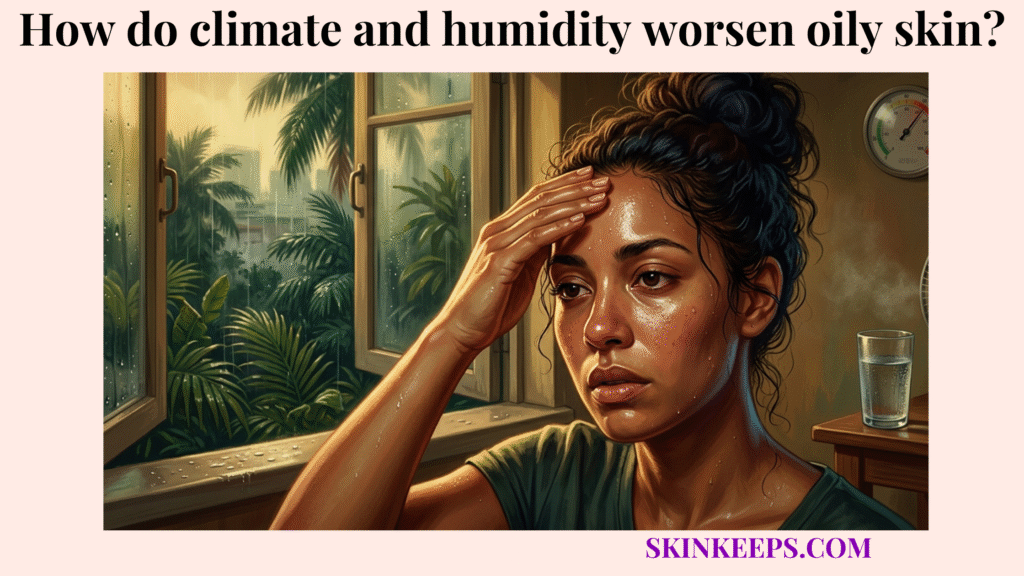
Climate and humidity worsen oily skin by changing how surface oil, sweat, and skin hydration behave in different environmental conditions. This means the same sebaceous baseline can look greasier in summer, tighter in winter, and less predictable when humidity shifts quickly.
This guideline explains how heat increases oil visibility, how humidity reduces sweat evaporation, why cold or dry air can create oily-but-tight skin, and how seasonal routine mistakes make climate-reactive oiliness harder to manage. It also shows how product textures and ingredients should shift between hot-humid and cold-dry conditions.
Why does hot weather make oily skin look worse?
Hot weather makes oily skin look worse because warmer skin can increase sebum mobility, spread surface oil more widely, and make light reflection more visible. This heat effect changes how oil appears on the surface rather than rewriting the biological baseline of the sebaceous glands. The result is more visible shine, especially in oil-prone areas such as the forehead, nose, and chin. Understanding that environmental heat acts as an amplifier rather than a root cause helps readers manage oily skin more effectively.
Controlled forehead-temperature research found that a 1°C local temperature change produced a sebum-excretion-rate change of roughly 10%. This number supports the idea that local temperature can influence measured sebum behavior, but it should not be written as a universal daily rule for every climate or every person. The mechanism is best treated as heat amplification of visible oil behavior. [OUP Academic]
How warmer temperatures make surface sebum spread more easily
Warmer temperatures make surface sebum spread more easily by increasing the mobility of the lipid film already present on the skin. This mobility allows oil to move beyond the follicular opening and cover nearby surface texture. The broader spread makes shine easier to see under light.
Why oily skin often looks shinier in hot conditions
Oily skin often looks shinier in hot conditions because a wider surface oil film reflects more light across the face. The increased surface spread directly connects to how oily skin facial shine becomes highly noticeable in warm environments. The broader reflection makes the complexion appear far glossier than it would in cool weather.
Why heat changes oil visibility more than it changes skin type itself
Heat changes oil visibility more than it changes skin type itself because it mainly amplifies existing sebum behavior at the surface. This amplification happens without permanently altering the underlying genetic or hormonal baseline. The person remains the same skin type, but their environment makes the output much more obvious.
How does heat change the way surface oil behaves on oily skin?
Heat changes the way surface oil behaves on oily skin by making the lipid film feel more mobile, more spreadable, and more visibly reflective. This increased spread can enlarge the shiny area even if the person’s baseline skin type has not changed. The explanation connects surface spread to visible shine, not to permanent gland change.
The T-zone often looks oilier faster in heat because it is already a high-oil facial zone. Heat can make oil emerging from this zone spread more visibly across nearby skin. The deeper production process belongs in oily skin sebum production because this section stays focused on climate behavior rather than gland biology.
How heat can lower the feel of sebum thickness and increase spread
Heat can lower the feel of sebum thickness and increase spread by making surface oil less resistant to movement across the stratum corneum. This lower resistance allows the lipids to glide more smoothly. The smooth glide creates a wider, thinner coating over the epidermis.
How more mobile surface oil creates a larger shiny area
More mobile surface oil creates a larger shiny area by spreading beyond the original oil-prone points of the face. This movement carries lipids outward toward the cheeks or jawline. The expanded coverage translates into a broader visual reflection.
Why the T-zone often looks oilier faster in hot weather
The T-zone often looks oilier faster in hot weather because central facial areas usually show stronger sebaceous activity and more visible surface oil. This pre-existing volume provides more material for the heat to act upon. The combination guarantees that the center of the face shines earliest and brightest.
| Climate Factor | What Happens on the Skin | Common Visible Result |
|---|---|---|
| Higher temperature | Surface oil becomes more mobile | More shine |
| Warmer skin surface | Sebum spreads more easily | Greasier-looking surface |
| More sweating conditions | Oil and moisture coexist on the face | Heavier, slicker feel |
| Repeated daytime heat exposure | Surface oil returns and spreads again | Harder midday oil control |
How does humidity make oily skin feel heavier and look shinier?
Humidity makes oily skin feel heavier and look shinier by reducing sweat evaporation and leaving more moisture on top of existing surface oil. High humidity reduces evaporative cooling because sweat evaporates less efficiently into already moisture-rich air. This explains the damp, slick feeling without needing to claim that humidity directly forces sebaceous glands to produce more oil. [PMC]
Sweat and sebum together can make oily skin feel more coated. This coated feeling happens because water-based moisture and lipid-based oil remain on the surface at the same time. The result is a slicker surface that can feel heavier than oil alone.
How reduced sweat evaporation changes the feel of oily skin
Reduced sweat evaporation changes the feel of oily skin by keeping moisture on the surface longer than it would stay in drier air. This lingering moisture prevents the skin from returning to a dry, comfortable resting state. The constant dampness makes the face feel persistently weighed down.
How sweat and sebum together increase surface slickness
Sweat and sebum together increase surface slickness because water-based moisture and lipid-based oil remain layered on the skin at the same time. This mixture produces an uncomfortably slippery texture. The slippery texture feels significantly heavier than natural sebaceous output alone.
Why humid weather makes oily skin feel more coated and less fresh
Humid weather makes oily skin feel more coated and less fresh because sweat, oil, and residue clear less comfortably from the surface. This persistent buildup leaves the complexion looking exhausted. The complexion lacks the clean clarity associated with a freshly washed face.
| Humid-Weather Effect | What Happens | Common Result |
|---|---|---|
| Sweat evaporates less efficiently | More moisture remains on the skin | Damp, heavy feel |
| Sebum and sweat coexist | Surface looks more reflective | Shinier complexion |
| Daily residue feels heavier | Oil, sweat, and product films accumulate | More congestion-prone feel |
Why can cold or dry weather still make oily skin harder to manage?
Cold weather or dry air can make oily skin harder to manage because oil level and water balance are different skin functions. A person may still produce surface oil while the stratum corneum feels tight from low-humidity stress. This creates the common oily-but-dehydrated feeling.
TEWL is the measurement of water lost across the stratum corneum and is used to assess skin-barrier integrity. Low-humidity or ultra-low-humidity environments can alter TEWL and skin hydration over time, so dry-weather oily skin should be treated as a barrier-comfort problem as well as an oil problem. This is the accurate version of the dry-air paradox. [CDC / Stacks]
How dry air can leave oily skin dehydrated
Dry air can leave oily skin dehydrated by challenging the water balance of the stratum corneum even when surface oil is still present. This environmental stress pulls water away from the upper skin layers. The water loss reduces cellular flexibility and barrier comfort.
Why oily skin can feel tight and greasy at the same time
Oily skin can feel tight and greasy at the same time because surface sebum and epidermal water balance are separate conditions. The glands deposit oil on the outside while the tissue underneath lacks sufficient moisture. This creates a confusing sensory mismatch for the user.
Why winter oil problems often reflect barrier stress as well as sebum
Winter oil problems often reflect barrier stress as well as sebum because cold outdoor air and heated indoor air can reduce comfort and tolerance. This climate combination irritates the outer layer of the skin. The irritation makes typical oil-control routines feel far too harsh.
| Climate Pattern | Main Skin Issue | Common Oily-Skin Experience |
|---|---|---|
| Hot and humid | More visible shine and sweat retention | Greasy, slick, heavy surface feel |
| Cold and dry | More dehydration and barrier discomfort | Tight but still oily-feeling skin |
| Indoor heated air | Lower comfort and water-balance stress | Oily yet uncomfortable skin |
What seasonal skincare mistakes make climate-reactive oily skin worse?
Seasonal skincare mistakes make climate-reactive oily skin worse when routines stay fixed while temperature, humidity, sweat, and skin comfort change. Summer heat may require lighter textures, while cold or dry weather may require more hydration support. The wrong routine usually fails because it keeps treating last season’s skin instead of today’s surface condition.
Harsh cleansing is one of the easiest seasonal mistakes to overdo. The American Academy of Dermatology warns that harsh face wash can irritate oily skin and trigger increased oil production, which supports gentler cleansing even when humidity makes the face feel slick. This explains why exploring the topic of over-washing oily skin clarifies that harsh scrubbing is a climate-reactive mistake rather than a solution. [AAD]
Why summer over-stripping can worsen climate-related oiliness
Summer over-stripping can worsen climate-related oiliness by irritating the barrier while surface oil and sweat continue to return. This aggressive washing removes necessary protective lipids alongside the sweat. The resulting barrier stress leaves the skin inflamed and shiny.
Why heavy winter products can feel too occlusive in humid weather
Heavy winter products can feel too occlusive in humid weather because richer textures may trap sweat, oil, and product film on the surface. This trapped layer restricts normal surface evaporation. The restriction quickly leads to a congested, uncomfortable complexion.
Why refusing to increase hydration in dry weather can backfire on oily skin
Refusing to increase hydration in dry weather can backfire on oily skin because low-humidity stress can make the skin feel tight even when it still looks shiny. This refusal deprives the barrier of much-needed water. The lack of water amplifies tightness and sensory discomfort.
| Mistake | Why It Happens | Likely Result |
|---|---|---|
| Using harsh cleansers more often in summer | Trying to remove extra shine | Irritated, still-oily skin |
| Keeping rich winter creams in humid weather | Not adjusting product texture | Heavier feel or congestion-prone surface |
| Keeping a summer oil-control routine in winter | Not adjusting for dryness | Tight, dehydrated, oily-feeling skin |
| Skipping moisturizer in all seasons | Fear of more oil | Poor barrier comfort and unstable tolerance |
Which product textures and ingredients fit different climates for oily skin?
Product textures fit climate-reactive oily skin when they match the current balance between oil, sweat, and dryness. Hot, humid weather usually favors lightweight gels, fluid lotions, and oil-control support. Cold or dry weather often needs more humectant and barrier support without jumping immediately to heavy occlusion.
Ingredient choices should follow the same climate logic. Niacinamide and salicylic acid can support visible oil control and congestion management, while humectants and ceramides support dry-weather comfort. A deeper ingredient comparison can be explored through oily skin active ingredients when readers need to choose between BHA and oil-control actives. Additionally, dry-weather hydration decisions can connect to selecting a proper oily skin moisturizer to provide non-heavy water-balance support.
Which textures work better in hot and humid weather
Textures that work better in hot and humid weather include lightweight gels, fluid lotions, and non-comedogenic finishes that do not add a heavy surface film. These airy formats absorb cleanly without suffocating the skin. The clean absorption prevents the suffocating feeling often experienced in July or August.
Which textures work better in cold and dry weather
Textures that work better in cold and dry weather include light lotions, humectant-rich formulas, and barrier-supporting emulsions when the skin feels tight. These slightly more supportive formats reinforce the skin’s moisture retention. The reinforcement prevents the aching tightness of a dry winter day.
Which ingredients help oily skin stay balanced across seasonal changes
Ingredients that help oily skin stay balanced across seasonal changes include niacinamide, salicylic acid, humectants, and barrier-supporting lipids used according to climate and tolerance. These ingredients should be swapped or adjusted based on daily feedback. The flexibility ensures the routine always meets the skin’s present requirements.
| Climate Condition | Best Texture | Useful Ingredient Focus |
|---|---|---|
| Hot and humid | Lightweight gels, oil-free fluids | Niacinamide, salicylic acid, mattifying support |
| Warm and moderately humid | Light lotion-gels | Balanced hydration and oil control |
| Cold and dry | Light lotions or barrier-supporting emulsions | Humectants, ceramides, gentle barrier support |
| Indoor-heated winter air | Non-heavy but more supportive moisturizers | Humectants plus light lipid support |
How should a daily routine adapt oily skin to changing climate and humidity?
A daily routine should adapt oily skin to changing climate and humidity by adjusting cleanser intensity, moisturizer texture, and active use according to weather and skin feel. This adaptation does not require replacing the whole routine every day; it means changing the pressure of oil control and hydration support when the environment changes. The full maintenance protocol can continue through oily skin care tips after the reader understands why climate changes surface behavior.
Hot-weather habits should reduce shine without repeated stripping, while dry-weather habits should support hydration without smothering the skin. Midday blotting can remove surface oil in humidity without another full cleanse. Dry-weather hydration can reduce tightness while preserving oil control.
What hot-weather habits help oily skin stay more comfortable
Hot-weather habits that help oily skin stay more comfortable include gentle cleansing, lightweight product textures, and midday oil control without repeated washing. This strategy removes excess shine physically using blotting papers instead of harsh soaps. The physical removal keeps the barrier intact while managing the visible reflection.
What dry-weather habits help oily skin avoid dehydration
Dry-weather habits that help oily skin avoid dehydration include reducing unnecessary stripping and increasing lightweight hydration support. This support focuses on trapping water in the stratum corneum to maintain flexibility. The maintained flexibility completely prevents the dreaded tight-yet-shiny sensation.
Why daily weather adaptation works better than using one fixed oily-skin routine year-round
Daily weather adaptation works better than using one fixed oily-skin routine year-round because sebum spread, sweat retention, and water balance change with the environment. This responsive approach treats the skin as a dynamic organ. The dynamic care guarantees better comfort across all twelve months of the year.
Daily Climate Management for Oily Skin
FAQs
How do climate and humidity worsen oily skin?
Climate and humidity worsen oily skin by changing how oil, sweat, and hydration behave on the surface. Heat can make oil spread more visibly, humidity can keep sweat on the skin longer, and dry air can make oily skin feel tight or dehydrated.
Why is oily skin worse in hot weather?
Oily skin often looks worse in hot weather because surface oil becomes more mobile and reflective. Controlled temperature research also found sebum excretion-rate changes of about 10% per 1°C of local skin temperature change.
Does humidity make skin produce more oil?
Humidity should not be described as a universal direct sebum-production trigger. It more clearly reduces sweat evaporation, which can make oily skin feel heavier, slicker, and more coated.
Why does oily skin feel tight in winter?
Oily skin can feel tight in winter because oil and water balance are different. The skin may still produce sebum while low humidity and indoor heating reduce comfort and make the stratum corneum feel dehydrated.
Should oily skin use moisturizer in humid weather?
Yes, oily skin may still need moisturizer in humid weather, but the texture should usually be lighter. Gel creams, fluid lotions, or non-comedogenic moisturizers often fit better than heavy occlusive textures.
Should oily skin use richer products in dry weather?
Oily skin may need more hydration and barrier support in dry weather, but that does not always mean very heavy creams. The best texture depends on tightness, congestion, comfort, and current oil output.
Can climate change my skin type permanently?
Climate usually changes how oily skin behaves and feels, not the underlying skin type itself. Heat, humidity, and dry air act as amplifiers that change visibility, slickness, and comfort.
What is the best routine for oily skin in humid weather?
The best humid-weather routine uses gentle cleansing, lightweight moisturizer, non-comedogenic sunscreen, optional niacinamide or salicylic acid, and blotting instead of repeated washing.
Conclusion
Climate and humidity worsen oily skin mainly by amplifying surface oil behavior, sweat retention, and water-balance stress. Hot, humid weather usually makes oily skin look shinier and feel slicker, while cold or dry weather can create tight, dehydrated discomfort beneath surface oil.
The best routine changes texture and intensity with the environment instead of treating every season the same way. Climate-reactive oily skin needs adaptation, not stronger stripping.