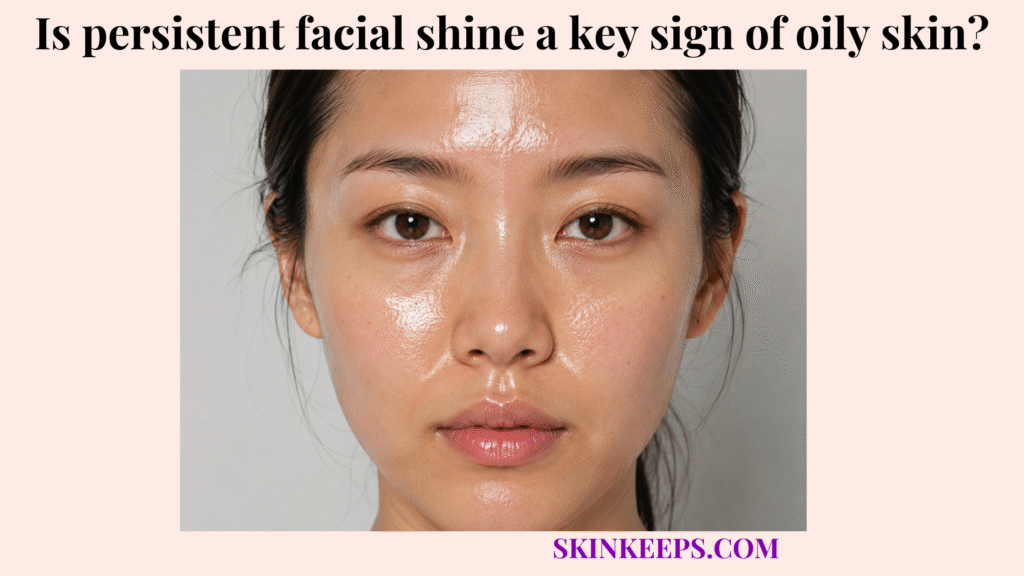
Yes, persistent facial shine is a key sign of oily skin when the shine returns repeatedly from sebum rather than appearing only from sweat, skincare, or makeup. This repeated shine matters because true oiliness creates a greasy surface film that keeps reappearing after cleansing or blotting.
This guideline explains how persistent facial shine develops, why sebum increases light reflection, how oily shine differs from glow or sweat, and why harsh cleansing can make shine harder to control. It also explains which safe tools and ingredient categories can reduce visible shine without damaging the barrier.
Why is persistent facial shine a common sign of oily skin?
Persistent facial shine is a common sign of oily skin because sebaceous glands continuously release surface lipids that create a reflective film on the stratum corneum. These surface lipids spread across the stratum corneum and create a reflective film. The reflective film makes the face look shiny even when the skin has not recently received skincare or makeup.
Persistent shine becomes more meaningful when it appears with other oily-skin signs. Those signs include greasy feel, visible pores, blackheads, or recurring T-zone oiliness. The complete pattern is what makes shine a useful clue among the broader signs of oily skin.
How excess surface sebum makes oily skin look shinier
Excess surface sebum makes oily skin look shinier by forming a lipid-rich layer that reflects more light from the epidermal surface. This lipid-rich layer reflects light more strongly than a matte, low-oil surface. The stronger reflection is what the user sees as facial shine.
Why repeated shine is more suggestive of oily skin than occasional shine
Repeated shine is more suggestive of oily skin than occasional shine because it reflects ongoing sebaceous activity rather than a temporary environmental or cosmetic effect. This ongoing sebaceous activity ensures the lipid layer replaces itself after removal. The continuous replacement separates a naturally greasy surface from a brief, one-time product glow.
How does surface sebum create persistent facial shine in oily skin?
Surface sebum creates persistent facial shine in oily skin by forming a liquid lipid film that increases light reflection across the skin surface. This liquid lipid film spreads across small surface irregularities. The spreading changes how light reflects from the stratum corneum. The stronger reflection makes the complexion look shinier, especially on the forehead, nose, and chin.
Oily or seborrheic skin is associated with sebum production above 1.5 mg/10 cm² every 3 hours. This higher output explains why shine can return after cleansing or blotting. The timing varies by person, but the repeated return of shine supports an oily-skin pattern. [PMC]
How surface oil changes light reflection on the skin
Surface oil changes light reflection on the skin by creating a smoother lipid film over the stratum corneum. This smoother lipid film reflects incoming light more directly toward the observer. The direct reflection causes the specific visual intensity associated with a greasy face.
Why a smoother oil film makes facial shine look more obvious
A smoother oil film makes facial shine look more obvious because it concentrates reflection across the most oil-prone areas of the face. These oil-prone areas usually include the T-zone, where sebaceous glands are most active. The localized activity makes the central face appear significantly shinier than the outer cheeks.
How persistent sebum return makes shine reappear throughout the day
Persistent sebum return makes shine reappear throughout the day because surface oil is replaced after cleansing, blotting, or makeup wear. This surface oil replacement happens because sebaceous glands continue producing oil continuously. The continuous production means shine control requires ongoing, gentle management rather than a single harsh wash.
| Mechanism | What Happens Biologically | Visible Result |
|---|---|---|
| Excess sebum output | More oil reaches the skin surface | Shine becomes easier to see |
| Surface oil film | Sebum spreads across the stratum corneum | Light reflects more strongly |
| Repeated oil return | Shine comes back after cleansing | Oily skin looks persistently shiny |
| T-zone concentration | Oil output is strongest in central facial areas | Shine is most obvious on forehead, nose, and chin |
How does persistent facial shine differ from glow, sweat, or product sheen?
Persistent facial shine differs from glow, sweat, or product sheen because oily shine feels greasy, returns from follicles, and usually concentrates in sebaceous facial zones. This sebum source creates a slick or greasy feel that sweat and product glow do not always share. The greasy feel helps separate oily shine from moisture-based shine.
Oily shine also differs by timing and location. This timing pattern appears when shine returns after cleansing and gathers in the T-zone. The same location pattern helps the reader avoid confusing product glow with true oil production.
How hydrated glow differs from persistent facial shine
Hydrated glow differs from persistent facial shine because it looks softer and less greasy than a sebum-heavy surface film. This hydrated glow represents smooth light diffusion from well-moisturized skin. The smooth diffusion lacks the heavy, slick texture that characterizes true sebaceous output.
How sweat differs from persistent facial shine
Sweat differs from persistent facial shine because sweat is watery, temperature-driven, and usually linked to heat, stress, or physical exertion. This watery moisture sits in droplets rather than forming a thick lipid film. The watery feel provides a clear tactile distinction from a greasy surface.
How skincare or makeup sheen differs from persistent facial shine
Skincare or makeup sheen differs from persistent facial shine because it appears after product application rather than gradually returning from sebaceous output. This product application leaves a superficial film from moisturizers, sunscreens, or primers. The superficial film is evident immediately, whereas follicular oil builds up slowly over hours.
| Surface Appearance | What It Looks Like | Main Source | How It Differs From Oily Shine |
|---|---|---|---|
| Hydrated glow | Soft, even radiance | Smooth surface hydration and light diffusion | Usually less greasy and less T-zone dominant |
| Sweat | Wet or damp surface | Heat, stress, or exertion | Feels watery and appears with triggers |
| Product sheen | Cosmetic or sunscreen reflectivity | Topical product film | Linked to recent application |
| Oily shine | Greasy, persistent reflection | Sebum from sebaceous glands | Returns repeatedly and often centers in the T-zone |
Which conditions make persistent facial shine look worse?
Heat, humidity, sweat, and stress can make persistent facial shine look worse by increasing surface spread, visible reflection, or sebaceous activity. Heat and humidity can make facial shine look worse by changing how surface oil spreads. This surface oil spread makes reflection broader and more visible. The broader reflection can make the same amount of sebum look more intense.
Older controlled physiology work reported that sebum excretion rate measurements changed on the order of 10% per 1°C with local temperature variation. This finding should be used as measurement-context evidence, not as a universal daily rule. The practical point is that hotter conditions can make oiliness look more visible. [PubMed]
How heat and humidity make persistent facial shine more obvious
Heat and humidity make persistent facial shine more obvious by helping surface oil spread across a wider area of the face. This wider spread happens because warmer temperatures lower the viscosity of the sebum. The lower viscosity allows the lipid film to coat the epidermis more quickly.
How sweat can spread surface oil and intensify facial shine
Sweat can spread surface oil and intensify facial shine when watery moisture mixes with sebum and increases surface reflection. This moisture mixture creates a highly reflective sheen across the skin. The combined sheen amplifies the visual impact of the existing oiliness.
How stress-related oil increase can worsen persistent facial shine
Stress-related oil increase can worsen persistent facial shine when physiological stress makes the skin appear oilier than its usual baseline. This physiological stress can trigger hormonal signals that influence sebaceous gland behavior. The altered behavior may temporarily elevate oil output and resulting shine.
Why can over-washing make persistent facial shine worse?
Over-washing can make persistent facial shine worse when harsh cleansing irritates the barrier and leaves oily skin tight, dehydrated, or harder to regulate. Over-washing can worsen persistent shine when cleansing becomes harsh instead of balanced. This harsh cleansing removes surface oil but can also irritate the barrier. The irritated barrier may feel tight while oil still returns later. To avoid this cycle, it is crucial to recognize the dangers of over-washing oily skin.
The American Academy of Dermatology notes that face wash that is too harsh can irritate oily skin and trigger increased oil production. This guidance supports avoiding alcohol-based or overly stripping cleansers. The safer goal is to remove excess oil without turning shine control into barrier stress. [AAD]
How harsh cleansing disrupts barrier balance in oily skin
Harsh cleansing disrupts barrier disruption in oily skin by removing surface oil too aggressively and increasing irritation risk. This aggressive removal stresses the acid mantle and strips essential barrier lipids. The resulting barrier stress can make the skin sensitive and dehydrated while doing nothing to stop internal oil production.
Why stripping the skin can increase visible shine later in the day
Stripping the skin can increase visible shine later in the day when the surface becomes tight, irritated, and still capable of producing oil. This capability remains because sebaceous glands function independently of surface dryness. The returning oil sits on top of dehydrated skin, creating a visibly compromised texture.
Why tight, squeaky-clean skin is not a sign of proper shine control
Tight, squeaky-clean skin is not a sign of proper shine control because tightness usually signals barrier stress rather than balanced oil management. This tightness indicates that the stratum corneum lacks water and flexible lipids. The lack of flexibility makes the skin feel uncomfortable long before the shine inevitably returns.
Which ingredients and tools help reduce persistent facial shine safely?
Ingredients and tools such as niacinamide, salicylic acid, blotting papers, and mattifying powders can reduce persistent facial shine safely when they control oil without damaging the barrier. Niacinamide and salicylic acid reduce shine through different pathways. Niacinamide supports visible oil control over time, while salicylic acid helps reduce congestion that can make oiliness look heavier. This difference matters because persistent shine may involve both surface oil and pore buildup, making oily skin active ingredients highly useful when chosen correctly.
Topical 2% niacinamide has been studied for facial sebum production in clinical research. Reviews also discuss 2–5% niacinamide in relation to sebaceous activity, but formula performance and tolerance can vary. The safest wording is that niacinamide can support visible oil control rather than permanently suppressing sebum. [PubMed]
How niacinamide helps reduce persistent facial shine over time
Niacinamide helps reduce persistent facial shine over time by supporting better visible oil control and improving routine tolerance. This visible oil control reduces the thick lipid film that causes excessive reflection. The reduced reflection helps the complexion look more balanced throughout the day.
How salicylic acid helps reduce oil-related surface congestion that worsens shine
Salicylic acid helps reduce oil-related surface congestion that worsens shine because its oil-soluble structure can work inside sebum-rich pores. This oil-soluble structure breaks down trapped debris and smooths the follicular opening. The smoother opening reduces the heavy, clogged texture that often accompanies intense shine.
How blotting papers and mattifying powders reduce persistent facial shine instantly
Blotting papers and mattifying powders reduce persistent facial shine instantly by removing or diffusing the surface oil film that reflects light. Using blotting papers for oily skin lifts surface oil physically without requiring repeated washing. Mattifying powders act optically by diffusing light, which immediately softens the appearance of greasiness.
How should a daily routine manage persistent facial shine without stripping oily skin?
A daily routine should manage persistent facial shine without stripping oily skin by combining gentle cleanser formulations, lightweight hydration, targeted actives, and midday oil control. A shine-control routine works best when it removes oil without creating tightness. This balance depends on gentle cleansing, lightweight hydration, and products that do not leave a heavy film. The routine should make shine less intense without making the skin feel stripped. For practical steps, exploring oily skin care tips provides a structured approach to daily maintenance.
Dermatologists recommend gentle foaming face wash and oil-free products for oily skin. This recommendation supports a routine that manages shine without harsh alcohol-based cleansing. A routine based on gentle removal and lightweight product texture protects the barrier while reducing surface reflection. [AAD]
What a morning routine should include to reduce persistent facial shine
A morning routine should reduce persistent facial shine by removing overnight oil, adding lightweight hydration, and using sunscreen that does not add heavy surface gloss. This morning oil removal requires a gentle cleanser that respects the acid mantle. Adding a proper oily skin sunscreen ensures daily UV protection without making facial shine look heavier.
Morning Checklist
What a midday routine should include to control persistent facial shine
A midday routine should control persistent facial shine by using blotting papers or mattifying powder instead of repeatedly washing the face. This midday control focuses on physical removal and optical diffusion. The physical removal lifts excess sebum safely, preserving the morning skincare layers underneath.
Midday Checklist
What an evening routine should include to manage persistent facial shine gently
An evening routine should manage persistent facial shine gently by removing sunscreen, makeup, sweat, and daytime sebum without over-cleansing. This evening removal prepares the skin for targeted nighttime actives. The targeted actives, like salicylic acid, can then work efficiently on a clean, balanced surface.
Evening Checklist
| Daily Facial-Shine Checklist |
|---|
| Check whether shine returns repeatedly after cleansing. |
| Compare shine with sweat, glow, or product sheen before assuming oiliness. |
| Control midday shine with blotting instead of repeated washing. |
| Use lightweight hydration rather than skipping moisturizer. |
| Add niacinamide or salicylic acid only when appropriate. |
| Judge progress by less intense shine, not total dryness. |
| Stop any routine that creates tightness, stinging, or flaking. |
FAQs
Is persistent facial shine a key sign of oily skin?
Yes, persistent facial shine is a key sign of oily skin when it returns repeatedly and feels greasy. It becomes more meaningful when it appears with T-zone oiliness, visible pores, blackheads, or clogged pores.
Why does oily skin look shiny?
Oily skin looks shiny because sebum spreads across the skin surface and reflects light. This surface oil film makes the face look glossier than balanced or dry skin, especially on the forehead, nose, and chin.
How can I tell oily shine from sweat?
Oily shine usually feels greasy or slippery, while sweat feels watery and appears after heat, stress, or exercise. Oily shine also tends to return in the same facial zones after cleansing.
How can I tell oily shine from product glow?
Product glow usually appears soon after applying moisturizer, sunscreen, primer, or makeup. Oily shine develops from sebaceous output and often returns gradually from the T-zone as the day continues.
Can over-washing make facial shine worse?
Over-washing can make facial shine harder to manage when harsh cleansing irritates the barrier. Tight, squeaky-clean skin is not good oil control because surface oil can still return while the barrier feels stressed.
Does niacinamide reduce facial shine?
Niacinamide can support visible oil control over time, and 2% niacinamide has been studied for facial sebum measurements. Results depend on formula quality, routine consistency, and skin tolerance.
Do blotting papers help oily shine?
Blotting papers can reduce oily shine quickly by lifting surface oil from shiny areas. They are useful for midday control because they reduce reflection without requiring repeated washing.
Should oily skin still use moisturizer?
Yes, oily skin still needs lightweight hydration because oil and water are different. Skipping moisturizer can leave the skin uncomfortable, while lightweight hydration supports barrier comfort without adding heavy grease.
Conclusion
Persistent facial shine is a key oily-skin sign when it repeatedly returns as greasy sebum-based reflection. Persistent facial shine points to oily skin when it comes back after cleansing, feels greasy, and concentrates in the T-zone. The goal is to reduce visible shine without stripping the barrier.
Healthy shine control lowers excess reflection without forcing the skin into dryness. By understanding these mechanisms, readers can maintain a balanced, comfortable routine that works with their skin rather than against it.