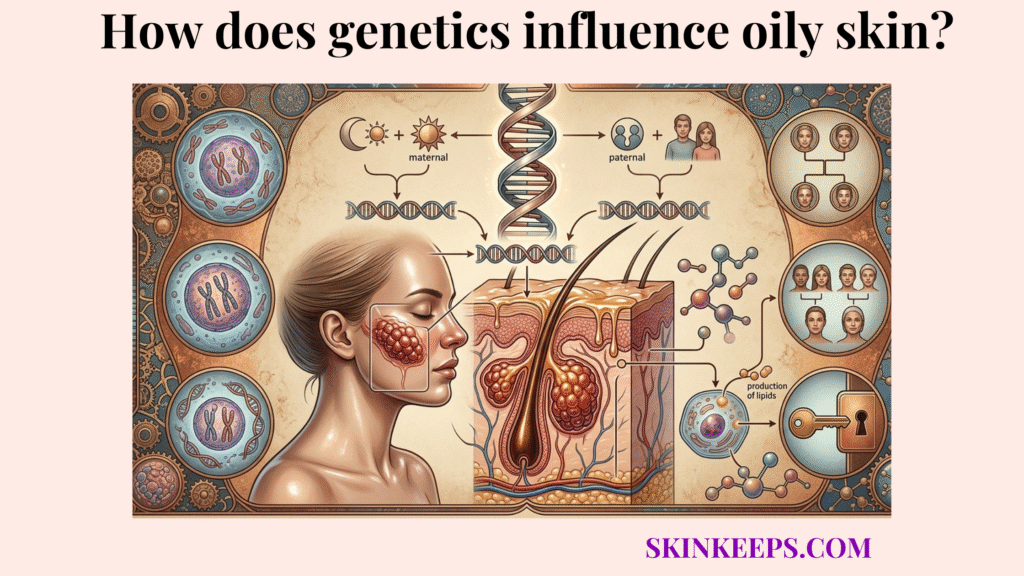
Genetics influence oily skin by shaping a person’s baseline sebaceous tendency, hormone responsiveness, and likelihood of showing visible oil-prone traits such as shine or more noticeable pores. This inherited tendency means oiliness can appear even when cleansing habits are appropriate and surface hygiene is consistent.
This guideline explains how inherited biology affects sebaceous activity, why normal hormone levels can still produce oily skin in some people, how genetics interact with pore visibility, and why management works better than trying to erase a sebaceous baseline. It places genetic influence inside the broader biology of the skin rather than treating oiliness as a hygiene failure.
Why is oily skin often an inherited trait?
Oily skin is often an inherited trait because genetics can influence baseline sebaceous behavior and the way skin responds to internal signals. This inherited influence helps explain why oiliness may appear across several relatives while still varying in severity from person to person. The wider page on oily skin causes should be reviewed because genetic tendency is one cause among several, not the only driver.
Twin research supports that sebum excretion is under genetic control, while environmental factors can modify the clinical outcome. A later twin/family study estimated cheek sebum secretion heritability at 0.21 (95% CI 0.16–0.26), which supports inherited influence but not a fully deterministic model. This means genetics matter, but they do not explain every difference in oiliness by themselves. [PubMed]
How genetics help set baseline sebaceous gland activity
Genetics help set baseline sebaceous gland activity by influencing how strongly a person tends to produce and express surface oil. This inherited tendency can make surface oil appear more easily even before climate or routine changes amplify it. The cellular mechanism behind that baseline can be explored further through oily skin sebum production.
Why oily skin can run in families without being identical in severity
Oily skin can run in families without being identical in severity because inherited tendency interacts with age, hormones, climate, stress, and skincare habits. This inherited tendency gives relatives a shared sebaceous direction rather than an exact replica of skin behavior. The shared direction means siblings may both have oily skin, but their daily shine levels will still vary based on lifestyle modifiers.
Why inherited oily skin is not a hygiene problem
Inherited oily skin is not a hygiene problem because sebaceous output begins inside the gland before surface oil ever reaches the skin. This sebaceous output means that cleansing only removes surface oil temporarily. Cleansing does not change the internal baseline, so oil will naturally return without indicating that the skin is dirty.
How does genetics influence sebaceous gland activity in oily skin?
Genetics influence sebaceous gland activity in oily skin by affecting baseline gland behavior, lipid output tendency, and responsiveness to later hormonal signals. This inherited baseline becomes more visible when hormonal changes increase sebaceous activity during puberty or other life stages. The same baseline explains why two people can experience the same hormone shift but show different oil levels.
Inherited tendency differs from temporary oiliness because the baseline remains present even when visible oil fluctuates. Temporary oiliness can rise with humidity, stress, or product changes, while inherited tendency describes the person’s usual oil-prone direction. The distinction prevents the article from treating every oily day as proof of fixed genetic severity.
How inherited skin biology can influence gland activity and oil output
Inherited skin biology can influence gland activity and oil output by shaping a person’s usual sebaceous response pattern. This usual response pattern dictates how consistently the sebocytes accumulate and release lipids. The steady lipid release forms the biological foundation of an oil-prone complexion.
Why some people appear biologically more oil-prone from adolescence onward
Some people appear biologically more oil-prone from adolescence onward because inherited sebaceous tendency becomes more visible when puberty-related hormones rise. This hormonal rise acts as a reveal stage for the existing genetic predisposition. The revealed predisposition establishes a new, shinier skin normal for the individual.
How inherited sebaceous tendency differs from temporary oiliness
Inherited sebaceous tendency differs from temporary oiliness because it describes a baseline direction, while visible oil levels can still vary with daily conditions. This baseline direction means the skin will naturally lean toward oiliness. Daily modifiers like heat or stress simply amplify that lean into a noticeable shine.
| Inherited Factor | Possible Effect | Visible Result |
|---|---|---|
| Higher baseline sebaceous tendency | More oil reaches the surface more easily | More frequent shine or greasiness |
| Stronger oil-prone response | Oil breakthrough appears sooner under triggers | Persistent oily appearance |
| Family pattern of oiliness or acne | Similar sebaceous behavior across relatives | Earlier or more noticeable oiliness |
| Inherited structure plus oil output | Oiliness combines with facial architecture | More obvious central-face texture |
How can inherited hormone sensitivity make skin oilier?
Inherited hormonal sensitivity can make skin oilier when sebaceous glands respond strongly to normal circulating androgen signals. This local responsiveness means oiliness may appear even when blood-hormone levels are not unusually high. The focused guide on oily skin hormones helps separate hormone sensitivity from hormone disorder.
Inherited sensitivity differs from temporary hormone-related oiliness because one describes a baseline response pattern and the other describes a short-lived shift. A person with an oil-prone baseline may still notice extra shine around puberty, cycle changes, or stress. Those temporary changes reveal the tendency more clearly without replacing the underlying predisposition.
How androgen responsiveness affects sebaceous gland behavior
Androgen responsiveness affects sebaceous gland behavior by changing how strongly gland cells react to hormone signals. This strong reaction happens at the androgen receptors inside the tissue. The resulting activity boosts lipid production directly at the source.
Why oily skin can occur even when hormone levels are not unusually high
Oily skin can occur even when hormone levels are not unusually high because local gland sensitivity can amplify the effect of normal androgen signaling. This amplified effect ensures the glands produce excess oil despite ordinary systemic conditions. The localized nature of the response keeps the issue primarily cosmetic rather than systemic.
How inherited sensitivity differs from temporary hormone-related oiliness
Inherited sensitivity differs from temporary hormone-related oiliness because inherited sensitivity shapes the baseline, while temporary shifts change the intensity for a limited period. These temporary shifts occur during specific events like menstrual cycles. The baseline sensitivity remains long after the temporary event passes.
How can genetics influence pore visibility in oily skin?
Genetics can influence pore visibility in oily skin indirectly through baseline skin structure, but sebum output is the stronger source-supported mechanism in this section. A facial-pore study found enlarged pore size to be associated with increased sebum output, age, and male sex. This means genetically oil-prone readers who also notice pore prominence may benefit from the focused guide on oily skin enlarged pores. [PubMed]
Regional pore visibility also varies because sebaceous gland density differs across body sites. A primary skin-lipid study reports that sebaceous gland density is especially high on the scalp and forehead, where it reaches 400–900 glands/cm². This regional density explains why central facial oiliness can look stronger without claiming that the asymmetry itself is inherited. [PMC]
How inherited oiliness can make pores look more noticeable
Inherited oiliness can make pores look more noticeable when a stronger sebaceous baseline increases the amount of visible oil moving through follicular openings. This oil movement fills the pores and increases their visual contrast against the surrounding skin. The heightened contrast makes the follicular openings stand out clearly.
Why pore visibility often reflects both oil flow and skin structure
Pore visibility often reflects both oil flow and skin structure because surface appearance is shaped by more than one factor. While high sebum output contributes significantly, age, sex, and natural tissue elasticity also play a role. Combining these factors creates the final, visible pore size.
Why genetically oil-prone skin may still vary by facial region
Genetically oil-prone skin may still vary by facial region because sebaceous gland density and androgen susceptibility differ across the face. The T-zone naturally hosts a higher concentration of active glands than the outer cheeks. This anatomical arrangement guarantees that the center of the face will look oilier.
| Factor | How It Contributes | Common Visible Effect |
|---|---|---|
| More surface oil | Increases pore contrast and prominence | Larger-looking T-zone pores |
| Recurrent congestion | Keeps follicles visibly textured | Rougher pore appearance |
| Family oil pattern | Shared sebaceous tendency across relatives | Familiar shine or texture tendency |
| Regional gland density | Central facial zones produce more visible oil | More noticeable central-face texture |
Why is trying to “cure” inherited oily skin the wrong goal?
Trying to cure inherited oily skin is the wrong goal because genetics influence a baseline tendency rather than a removable surface defect. This baseline tendency can still be managed through routine, ingredients, and trigger control. The problem begins when management turns into aggressive stripping instead of stable regulation.
Harsh cleansing does not remove genetic tendency because it only strips surface oil temporarily. This temporary stripping can irritate the barrier and make oil control harder to maintain. The safer goal is steady management for oily skin, not forced dryness.
Why inherited oily skin can usually be managed, not erased
Inherited oily skin can usually be managed, not erased, because routines can reduce visible shine and congestion without deleting the underlying tendency. This visible improvement relies on consistent daily habits. Consistent habits ensure the skin looks clear without promising a biological impossibility.
Why harsh cleansing does not remove genetic oil tendency
Harsh cleansing does not remove genetic oil tendency because it removes surface lipids temporarily without changing the sebaceous baseline. This temporary removal often damages the skin barrier in the process. The damaged barrier inevitably feels dry while the genetic oil output continues uninterrupted.
Why over-stripping often makes inherited oily skin harder to manage
Over-stripping often makes inherited oily skin harder to manage because barrier irritation can leave the skin tight, dehydrated, and still visibly oily. This dual state of dryness and grease creates severe physical discomfort. Maintaining a healthy acid mantle prevents this frustrating contradiction.
Which ingredients help manage inherited oily skin without over-stripping it?
Niacinamide can help manage inherited oily skin by reducing measured surface oiliness over time. A controlled study found that topical 2% niacinamide may lower sebum excretion rate in Japanese subjects and casual sebum level in Caucasian subjects. Readers who want a broader comparison of oil-control options can continue through oily skin active ingredients after understanding that ingredients manage expression rather than erase genetic tendency. [PubMed]
Salicylic acid supports inherited oily skin by reducing oil-related buildup inside follicles. This pore-clearing action matters because genetically oil-prone skin may also show recurring congestion. Lightweight, non-comedogenic products support comfort without adding heavy residue.
How niacinamide helps reduce visible oiliness over time
Niacinamide helps reduce visible oiliness over time by lowering measured surface oil parameters in some studied users. This visible oil control reduces the heavy shine that often frustrates oil-prone individuals. Applying 2% niacinamide consistently supports a more balanced daily appearance.
How salicylic acid helps inherited oily skin stay clearer and less congested
Salicylic acid helps inherited oily skin stay clearer and less congested because its oil-soluble action targets buildup inside sebum-rich follicles. This BHA safely breaks down the debris that leads to blackheads. Consistent congestion support prevents the skin from looking rough and bumpy.
Why lightweight non-comedogenic hydration still matters in oily skin
Lightweight non-comedogenic hydration still matters in oily skin because oil production and water balance are separate barrier needs. This water balance ensures the skin remains soft and flexible. Proper hydration prevents the tight, uncomfortable feeling that often accompanies oil-control routines.
| Ingredient or Category | Main Role | Best Fit |
|---|---|---|
| Niacinamide | Helps reduce visible oiliness | Daily oil-management support |
| Salicylic acid / BHA | Helps reduce oily congestion and clogged pores | Oil-prone, texture-prone skin |
| Lightweight moisturizers | Support hydration without heavy residue | Oily but dehydration-prone skin |
| Matte non-comedogenic products | Reduce visible shine | Daytime appearance control |
How should a daily routine manage inherited oily skin?
A daily routine should manage inherited oily skin by using gentle cleansing, lightweight hydration, and consistent shine control instead of aggressive oil removal. This routine approach works because inherited tendency responds better to steady management than repeated stripping. Readers who want the full practical system can continue with oily skin care tips after understanding the genetic baseline.
The American Academy of Dermatology recommends gentle foaming cleanser, oil-free or non-comedogenic products, and avoidance of harsh or alcohol-based cleansers for oily skin. This guidance supports routines that manage visible oil without creating unnecessary irritation. The same logic is especially useful for inherited oil-prone skin because it prevents overcorrection from becoming the main problem. [AAD]
What cleansing habits suit inherited oily skin best
The cleansing habits that suit inherited oily skin best are gentle habits that remove excess surface oil without leaving the barrier tight or irritated. This gentle removal clears the daily shine without stripping away vital moisture. Prioritizing barrier comfort ensures the skin remains healthy while effectively managing oiliness.
How lightweight hydration supports inherited oily skin
Lightweight hydration supports inherited oily skin by maintaining comfort and water balance without adding heavy residue. This careful water balance keeps the stratum corneum flexible. The resulting flexibility feels significantly better than a tight, dehydrated surface.
Why consistency works better than aggressive oil removal
Consistency works better than aggressive oil removal because inherited oil tendency is managed through steady control, not sporadic attempts at total dryness. This repeated routine value establishes a calm, predictable skin environment. The predictable environment naturally reduces frustrating swings in surface oiliness.
Daily Management Checklist for Inherited Oily Skin
FAQs
Is oily skin genetic?
Oily skin can have a genetic component because genetics influence sebum-related traits and baseline sebaceous behavior. Genetics affect tendency, but environment, hormones, age, and skincare still change how oiliness appears.
Does oily skin run in families?
Oily skin can run in families because relatives may share sebaceous tendencies and hormone responsiveness. Family resemblance does not mean every relative will show the same severity.
Can genetics make skin oily even with normal hormone levels?
Yes, inherited hormone sensitivity can make sebaceous glands respond strongly to normal androgen signals. This means oily skin does not automatically prove that systemic hormone levels are abnormal.
Is inherited oily skin permanent?
Inherited oily skin reflects a baseline tendency, not a fixed daily oil level. Visible oiliness can still change with age, hormones, climate, stress, and routine.
Can genetics make pores look larger?
Genetics may influence baseline skin structure, while increased sebum output is a well-supported contributor to larger-looking pores. Pore visibility usually reflects more than one factor.
Can harsh cleansing cure genetic oily skin?
No, harsh cleansing cannot cure inherited oily skin because it removes surface oil temporarily without changing the sebaceous baseline. It can also irritate the barrier and make oil control harder.
Does niacinamide help genetically oily skin?
Niacinamide can help manage visible oiliness, and topical 2% niacinamide has evidence for lowering measured facial sebum parameters in studied groups. It manages expression; it does not erase genetic tendency.
What is the best goal for inherited oily skin?
The best goal is stable management rather than permanent erasure. Gentle cleansing, lightweight hydration, congestion control, and realistic shine management usually work better than aggressive stripping.
Conclusion
Genetics influence oily skin by shaping sebaceous tendency, not by locking the skin into one unchangeable state. Inherited biology can make oily skin more likely, but it does not remove the value of routine, ingredients, or trigger control. The most effective strategy is to manage the baseline gently instead of trying to erase it.
Genetic oiliness is best handled with precision, not punishment. At SkinKeeps, we clarify these biological mechanisms so readers can confidently implement barrier-safe management.