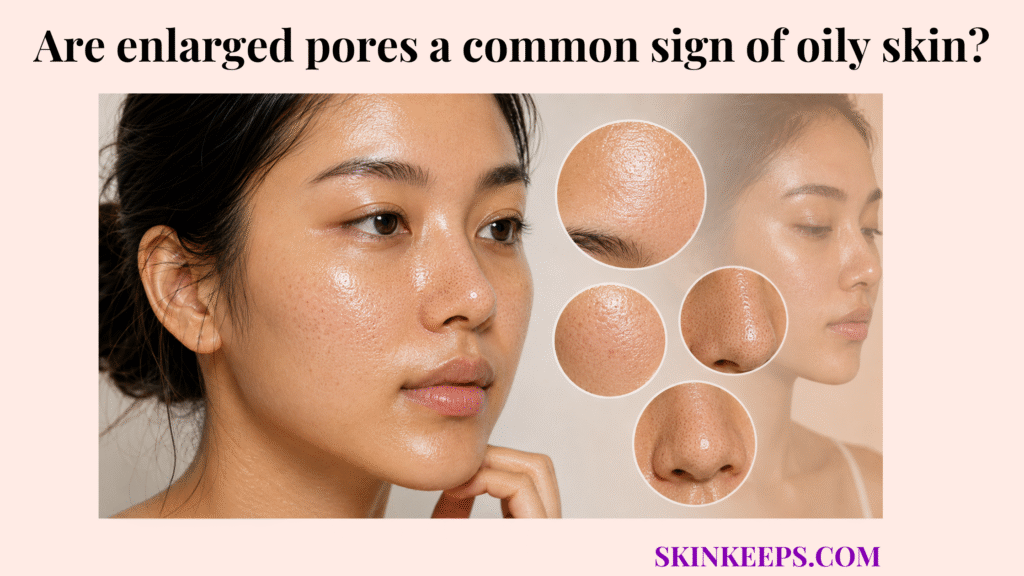
Yes, enlarged-looking pores are a common sign of oily skin because higher sebum output can make follicular openings appear more visible, especially in the T-zone. This pore visibility becomes more meaningful when it appears together with shine, greasiness, blackheads, or recurring congestion.
This guideline explains why enlarged pores often appear with oily skin, how sebum and dead-cell buildup make pores look wider, where oily pores are usually most visible, and how to separate oil-related pores from age-related pores. It also corrects pore-opening myths and explains realistic pore refinement without promising permanent pore erasure.
Why are enlarged pores a common sign of oily skin?
Enlarged pores are a common sign of oily skin because higher sebum output is associated with more visible follicular openings. This pore visibility becomes more diagnostic when evaluating oily skin characteristics alongside persistent shine and greasy surface feel. The combination of pores, shine, and greasiness points more strongly toward a sebaceous pattern than pore size alone. Enlarged-looking pores are easier to interpret when the reader first understands the broader biology of oily skin as a sebum-driven skin type.
A study on facial pores reported that enlarged pore size is associated with increased sebum output, age, and male sex. This association means oily skin can make pores look more prominent without making pore size the only diagnostic clue. The same finding supports using pore visibility as one sign inside a wider oily-skin assessment. [PubMed]
How excess sebum makes pores look more prominent in oily skin
Excess sebum makes pores look more prominent in oily skin by filling follicular openings with oil and debris that increase surface visibility. This follicular filling occurs as oil and dead cells collect inside the follicular canal. The collected oil and debris can make the pore opening look darker or wider. The increased contrast makes the pore easier to see without actually distending every pore wall.
Why repeated oil flow and congestion can keep oily pores visibly enlarged
Repeated oil flow and congestion can keep oily pores visibly enlarged by making follicular openings look consistently filled, shiny, or darkened. This consistent filling creates a repeated pattern rather than a permanent structural guarantee. The pattern often presents as blackheads or closed comedones that signal ongoing buildup. Maintaining clear openings requires managing this buildup before it darkens.
How does excess sebum make enlarged pores more visible in oily skin?
Excess sebum makes enlarged pores more visible in oily skin by collecting inside follicular openings and increasing shine, contrast, and congestion around the pore. This oil accumulation changes the surface around the pore by increasing shine and contrast. The increased contrast can make the pore look deeper or wider than surrounding skin, especially since oily skin facial shine can make these openings stand out more clearly under light.
Sebum becomes more visible when it mixes with keratinized cells inside the pore. This mixture can form an open comedone when it reaches the surface. The open comedone darkens through oxidation and makes the pore appear more obvious.
How internal sebum volume changes the appearance of pore openings
Internal sebum volume changes the appearance of pore openings by adding visible bulk inside the follicular canal. This visible bulk fills the space without forcing the walls to stretch outward in every case. The filled space may make pores appear wider simply by highlighting their borders. This highlighting effect is directly tied to internal follicular volume rather than structural damage.
How sebum and dead-cell buildup make oily pores look wider and darker
Sebum and dead-cell buildup make oily pores look wider and darker when the mixture forms open comedones at the follicular surface. These open comedones are widely recognized as blackheads. The darkening mechanism happens through oxidation when the trapped debris meets the air. This oxidized debris makes the pore look far more prominent than an empty follicular opening.
| Mechanism | What Happens Biologically | Visible Effect |
|---|---|---|
| Higher sebum output | More oil moves through follicles | Pores look more noticeable |
| Sebum retention | Oil collects inside the follicle opening | Pores look wider or shinier |
| Keratin buildup | Dead cells mix with oil | Pores look congested |
| Open comedones | Oxidized debris darkens the opening | Pores look deeper and more obvious |
Where are enlarged pores most visible in oily skin?
Enlarged pores are most visible in the T-zone of oily skin because the forehead, nose, and chin usually show stronger sebaceous activity than the outer cheeks. This T-zone activity makes the nose, forehead, and chin more likely to show shine and visible pore openings. The same pattern explains why oily pores often appear less obvious on the outer cheeks.
Sebaceous gland density can be high in facial regions, with anatomical references describing areas such as the forehead in the range of 400–900 glands/cm². This high-density range should be used as a general anatomical reference rather than a fixed number for every T-zone. The source helps explain why the center of the face is often more oil-prone. [PMC]
Why the T-zone shows enlarged pores more clearly in oily skin
The T-zone shows enlarged pores more clearly in oily skin because sebum, shine, and follicular congestion often concentrate across the forehead, nose, and chin. This concentration occurs because regional oily skin sebum production naturally dominates the central face. The repeated oil visibility across these observation zones creates a recognizable diagnostic map. The map highlights where congestion management is needed most.
Why oily pores are usually more visible on the nose, forehead, and inner cheeks
Oily pores are usually more visible on the nose, forehead, and inner cheeks because these areas often sit closest to high-sebum facial zones. The inner cheeks act as a border zone where central oil production transitions outward. This proximity explains why pores here often look larger than those near the jawline. The observational difference provides useful clues during a facial assessment.
| Facial Area | Typical Pore Visibility | Why It Matters |
|---|---|---|
| Nose | Very common | Strong oil visibility and blackhead tendency |
| Forehead | Common | Frequent shine and surface oil concentration |
| Chin | Common | Oil and congestion may collect here |
| Inner cheeks | Variable | Pores may look larger near the T-zone border |
| Outer cheeks | Usually lower | Pore prominence is often less oil-driven here |
How do enlarged oily pores differ from age-related pores?
Enlarged oily pores differ from age-related pores because oily pores are driven mainly by sebum and congestion, while age-related pores are influenced by collagen loss and skin laxity. Oily pores become more visible when sebum and debris increase contrast inside follicular openings. This oil-related contrast often appears with shine, blackheads, or congestion.
Age-related pores become more visible when surrounding skin support weakens. This weaker support can change how pores sit in the skin surface. The age-related pattern often appears with laxity, texture aging, and collagen degradation rather than oiliness alone.
How oily pores usually look rounder and more congestion-prone
Oily pores usually look rounder and more congestion-prone because sebum and keratin buildup collect inside the ostial openings. This collection usually preserves a circular shape at the surface while filling the space with debris. The presence of oily skin blackheads and breakouts offers visual clues that the pore issue is oil-related. These supporting clues confirm the sebaceous nature of the opening.
How aging pores usually look more elongated and lax
Aging pores may look more elongated or lax because collagen loss and reduced skin support can change the surrounding pore structure. This collagen support normally keeps the follicular walls tight and upright. When the support diminishes, gravity and tissue laxity can pull the openings into a less supported shape. The resulting appearance is often more oval and less dependent on oil.
Why oil-related enlarged pores and collagen-loss pores should not be confused
Oil-related enlarged pores and collagen-loss pores should not be confused because one pattern is mainly congestion-driven while the other is mainly support-driven. The differing drivers require different management logic to improve appearance. Oil-driven pores benefit from clearing follicular buildup and regulating shine. Support-driven pores require protecting dermal collagen and maintaining skin resilience.
| Feature | Oily Enlarged Pores | Age-Related Pores |
|---|---|---|
| Main driver | Excess sebum and congestion | Collagen loss and skin laxity |
| Common shape | Often rounder | Often more elongated or less supported |
| Main location | T-zone dominant | Can become more noticeable on cheeks |
| Associated signs | Shine, blackheads, congestion | Laxity, thinning, texture aging |
| Refinement logic | Clear congestion and reduce oil buildup | Support dermal structure and protect collagen |
What myths cause confusion about enlarged pores in oily skin?
Myths cause confusion about enlarged pores in oily skin by treating pores like muscles that can open, close, shrink permanently, or disappear with temperature changes. Pore myths confuse oily skin by promising structural changes that topical temperature cannot deliver. This confusion happens because heat, cold, and astringents can change surface feel without changing the follicular opening permanently. The difference between temporary feel and true structure is essential for realistic pore care.
Harsh astringents may make pores look tighter for a short time by drying the surface. This short-term tightness does not remove sebum output or follicular congestion. The same dryness can irritate oily skin and make the surface less comfortable.
Why pores do not open with heat or close with cold water
Pores do not open with heat or close with cold water because they are follicular openings, not muscle-controlled structures. Heat may soften sebum and debris to make cleansing easier. Cold water may temporarily reduce surface redness or swelling. However, neither temperature change alters the structural size of the pore permanently.
Why harsh astringents do not truly shrink oily pores
Harsh astringents do not truly shrink oily pores because they dry the surface without correcting the follicular buildup that makes pores look prominent. This surface drying often relies on alcohol-based toners that strip essential barrier lipids. The stripping action creates a tight sensation that mimics refinement. Unfortunately, this temporary optical change can leave the skin vulnerable to irritation.
Why temporary tightness is not the same as real pore refinement
Temporary tightness is not the same as real pore refinement because tight-feeling skin can still contain sebum-filled, congested follicular openings. Tightness is a sensory response to surface dryness, which is not the same as follicular clarity. True refinement requires safely clearing the debris inside the pore. Focusing on this practical clarity prevents chasing impossible structural changes.
| Myth | Reality |
|---|---|
| Hot water opens pores | Heat may soften debris, but it does not mechanically open pores |
| Cold water closes pores | Cold may reduce redness briefly, but it does not shrink pore structure |
| Alcohol toners erase pores | They may temporarily dry the surface, but they do not remove follicular congestion |
| Scrubbing harder makes pores smaller | Over-scrubbing can irritate skin and make texture look worse |
| Pores can disappear | Pores are normal structures and can only look less visible |
Which ingredients help oily enlarged pores look less visible?
Ingredients help oily enlarged pores look less visible when they reduce follicular congestion, regulate visible oiliness, and support smoother cell turnover. Ingredients make oily enlarged pores look less visible by reducing congestion inside follicular openings. This congestion reduction matters because pores look larger when oil and keratin remain trapped. The visual improvement comes from clearer openings, not from erasing the pore structure.
Topical 2% niacinamide has been studied for facial sebum production in clinical skin research. This evidence supports niacinamide as a useful ingredient category for visible oil control. The ingredient should still be introduced gradually because tolerance varies by formula and skin condition. [PubMed]
When describing salicylic acid, niacinamide, and retinoids as pore-refining categories, guide the reader toward oily skin active ingredients for a deeper breakdown of which actives match oil, congestion, and texture concerns.
How salicylic acid helps clear oily pore congestion
Salicylic acid helps clear oily pore congestion because its oil-soluble structure allows it to work inside sebum-rich follicular openings. This BHA penetrates the lipid environment to break down trapped debris. While 2% salicylic acid is a common leave-on strength in many oily skin active ingredients, overuse can irritate the barrier. Gradual application based on personal tolerance is recommended for safe congestion relief.
How niacinamide helps reduce excess oil and improve pore appearance
Niacinamide helps reduce excess oil appearance and improve pore appearance by supporting better visible oil control over time. This visible oil regulation reduces the constant flow of sebum that makes pores look wider. As the surface shine decreases, the follicular openings often appear less pronounced. This gentle regulation works without promising a complete shutdown of sebum production.
How retinoids help normalize buildup around enlarged oily pores
Retinoids help normalize buildup around enlarged oily pores by supporting more regular cell turnover around the follicular opening. This turnover support prevents dead cells from sticking inside the pore and forming comedones. The normalized shedding keeps the opening clearer and less congested. However, retinoids can irritate the skin if overused, requiring careful introduction.
| Ingredient | Main Action | Best Target |
|---|---|---|
| Salicylic acid / BHA | Oil-soluble exfoliation inside pores | Congestion and blackheads |
| Niacinamide | Supports visible oil regulation | Shine and pore appearance |
| Retinoids | Support turnover around follicles | Texture and recurrent buildup |
| Non-comedogenic moisturizer | Supports comfort without heavy residue | Barrier balance during pore care |
| Lightweight sunscreen | Protects skin without heavy occlusion | Daily UV protection |
How should a daily routine manage enlarged pores in oily skin?
A daily routine should manage enlarged pores in oily skin by keeping sebum, dead-cell buildup, and pore-clogging product residue under consistent control. A daily routine manages enlarged oily pores by keeping follicular buildup under control. This buildup control depends on gentle cleansing, non-comedogenic product choices, and targeted congestion care. The result is clearer-looking pores rather than pore erasure.
The American Academy of Dermatology advises oily-skin users to choose a gentle foaming face wash and avoid harsh or alcohol-based cleansers. This guidance supports a routine that removes excess surface oil without irritating the barrier. The same routine logic helps enlarged oily pores look clearer by reducing avoidable residue and congestion. [American Academy of Dermatology]
What daily cleansing habits help keep oily pores clearer
Daily cleansing habits help keep oily pores clearer by removing excess surface oil without stripping the skin barrier. Gentle cleansing washes away daily sebum and debris before it can oxidize inside the pore. This consistent removal prevents the buildup that stretches the visual boundaries of the opening. Maintaining barrier comfort during cleansing ensures the skin remains healthy.
How regular congestion control helps enlarged pores look less prominent
Regular congestion control helps enlarged pores look less prominent by preventing blackheads and keratin buildup from darkening the follicular opening. This prevention keeps the pore opening visually clear and less obvious. By stopping the comedogenic cascade early, the pores retain a refined appearance. Clearer-looking pores are the realistic result of this proactive management.
Why heavy pore-clogging products can worsen enlarged pores in oily skin
Heavy pore-clogging products can worsen enlarged pores in oily skin by increasing residue and congestion around sebum-prone follicles. This product residue adds unnecessary bulk inside the pore opening. Switching to non-comedogenic oily skin product formulations provides hydration without trapping oil. Lighter textures reduce congestion risk while still supporting the skin barrier.
Daily Management Checklist
Exploring comprehensive oily skin care tips provides the next practical step for readers who need a full daily routine after understanding enlarged pore visibility.
FAQs
Are enlarged pores a common sign of oily skin?
Yes, enlarged-looking pores are a common sign of oily skin, especially when they appear with persistent shine, greasiness, blackheads, or recurring congestion. Pore visibility alone is not enough, but it becomes meaningful when it repeats with other oily-skin signs.
Why does oily skin make pores look larger?
Oily skin makes pores look larger because excess sebum can collect inside follicular openings. This oil collection increases shine, contrast, and congestion around the pore, which makes the opening look wider or more noticeable.
Do pores open and close?
No, pores do not open and close like doors because they are follicular openings, not muscle-controlled structures. Heat may soften debris, and cold may reduce redness, but neither changes pore structure permanently.
Are oily pores different from aging pores?
Yes, oily pores are usually linked with sebum, blackheads, and congestion, while aging pores are more linked with collagen loss, laxity, and reduced tissue support. The two patterns can overlap, but they do not mean the same thing.
Can salicylic acid make pores look smaller?
Salicylic acid can make pores look smaller by reducing congestion inside oily follicles. The pore itself does not disappear, but the opening may look clearer and less prominent when oil and keratin buildup decrease.
Does niacinamide help enlarged pores?
Niacinamide can support better visible oil control, which may improve the appearance of enlarged oily pores over time. Its effect depends on formula strength, tolerance, routine consistency, and whether congestion is also being managed.
Can enlarged pores be permanently erased?
No, enlarged pores cannot be permanently erased because pores are normal skin structures. Their appearance can be refined by reducing congestion, protecting collagen, avoiding irritation, and using non-comedogenic products.
Where are oily enlarged pores most visible?
Oily enlarged pores are usually most visible on the nose, forehead, chin, and inner cheeks. These areas often sit within or near the T-zone, where sebum and shine tend to appear more strongly.
Conclusion
Enlarged pores are a common oily-skin sign when they appear with shine, greasiness, and recurring congestion. Enlarged oily pores look more visible because sebum and dead-cell buildup increase contrast inside follicular openings.
The goal is not to erase pores, but to keep them clearer and less congested using targeted ingredients and a non-comedogenic routine. At SkinKeeps, we believe clearer pores are realistic; pore erasure is not.