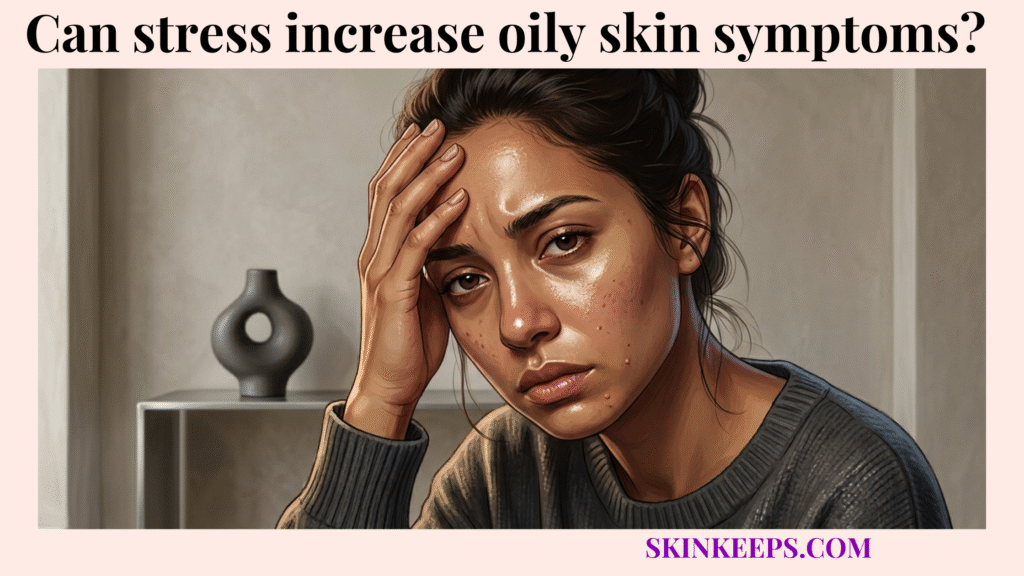
Yes, stress can increase oily-skin symptoms in some people by influencing neuroendocrine skin signaling, acne-prone inflammation, and the way oiliness feels during flare periods. This overlap is why an oil-prone complexion may feel harder to control during deadlines, poor sleep, emotional strain, or high-pressure routines.
This guideline explains how stress signals interact with sebaceous glands, why stress flares can feel oilier or more inflamed, why panic-washing usually makes control worse, and which ingredients can manage visible symptoms without damaging the barrier. It treats stress as one modifier inside the broader map of physiological causes, not as the only reason an oily profile exists.
How does stress signaling increase sebum production?
Stress signaling can influence sebum production by activating neuroendocrine pathways that interact with sebaceous glands, although measured sebum quantity does not increase in every study. Laboratory research found that CRH was biologically active on human sebocytes and influenced sebaceous lipid synthesis, which supports a plausible stress-to-sebaceous pathway. This mechanism should be framed as biological plausibility, not as proof that every stress episode produces more oil. [PMC]
Clinical stress data require caution because acne can worsen without a measurable sebum increase. A prospective adolescent study found stress associated with acne severity, but psychological stress did not appear to affect sebum production quantity. This means stress-related oily-skin symptoms may involve inflammation, acne-prone behavior, routine disruption, or perceived slickness in addition to sebum itself. [PubMed]
How the brain–skin stress axis influences sebaceous glands
The brain-skin axis influences sebaceous glands by connecting psychological stress with local skin mediators that can change sebocyte behavior. These mediators can interact with sebocytes and surrounding inflammatory pathways. The interaction helps explain why stress may worsen oily-skin symptoms even when it is not the only cause, a concept explored fully in oily skin causes.
How CRH and related stress signals can promote sebaceous activity
CRH and related stress signals can promote sebaceous activity by interacting with sebocyte pathways involved in lipid synthesis and local inflammation. Corticotropin-releasing hormone (CRH) acts on specific receptors within the sebaceous gland to modulate cell behavior. This biological modulation reveals how the skin processes systemic stress without guaranteeing a highly visible oil increase in every real-world user.
Why stress can worsen oiliness without being the only cause of oily skin
Stress can worsen oiliness without being the only cause of oily skin because it acts on an existing sebaceous baseline rather than creating the skin type from nothing. This modifier role means genetics and underlying biology remain the primary drivers. Exploring oily skin hormones clarifies how stress overlaps with androgens and related pathways to amplify baseline traits.
| Stress-Related Factor | What It Does | Possible Skin Effect |
|---|---|---|
| CRH and neuroendocrine signaling | May influence sebocyte behavior | More noticeable oiliness in susceptible skin |
| Stress-related androgen signaling | Can interact with oil-gland pathways | More shine or acne-prone congestion |
| Chronic stress load | May sustain inflammatory and behavioral triggers | Harder-to-control oily skin symptoms |
| Routine disruption | Leads to poor sleep, inconsistent cleansing, or panic-washing | More unstable skin behavior |
Why can stress-related oily skin feel worse than ordinary shine?
Stress-related oily skin can feel worse than ordinary shine because oiliness may overlap with inflammation, irritation, sweat, and barrier function discomfort. This overlap makes oily skin feel more reactive than a normal oily day. The visible result may be more shine, more redness, or a heavier skin feel.
The AAD states that stress can worsen acne and that stress-related hormones can stimulate oil glands and hair follicles. This patient-facing guidance supports explaining why acne-prone skin may flare during stressful periods. The claim should still be balanced with the clinical sebum-measurement nuance from stress research. [AAD]
How stress can make oily skin feel greasier or more reactive
Stress can make oily skin feel greasier or more reactive when baseline oiliness overlaps with inflammation, sweat, or disrupted routine habits. This symptom stacking creates a sensation of heaviness across the stratum corneum. The combined symptoms easily convince users that their oil production has skyrocketed, even if surface moisture and irritation are the main culprits.
Why stress-related oiliness is often paired with redness or tenderness
Stress-related oiliness is often paired with redness or tenderness because stress-sensitive skin can show inflammatory flare behavior at the same time as surface shine. This inflammatory flare behavior introduces local immune responses around the follicles. The mild immune activity generates the warm, tender feeling often experienced during high-pressure weeks.
Why stressed oily skin may feel both shiny and irritated at the same time
Stressed oily skin may feel both shiny and irritated at the same time because surface oil and barrier discomfort can exist together. This oily-yet-irritated state occurs when the lipid film coats a functionally compromised epidermis. Recognizing this dual state prevents the user from assuming the skin simply needs harsher cleansing.
How can stress-related oiliness increase breakout risk?
Stress-related oiliness can increase breakout risk in acne-prone skin when oiliness, inflammation, follicular clogging, and stress behaviors overlap. This overlap matters because acne-prone follicles are already vulnerable to sebum, dead-cell buildup, and C. acnes-related inflammation. Stress can make the visible flare more obvious without being the only acne cause.
The stress-acne connection is better supported than a universal stress-sebum connection. The adolescent stress study found a significant association between stress and acne severity even though sebum production did not differ significantly between high-stress and low-stress conditions. This means the article should explain breakout risk as a multi-factor flare, not only as extra oil. [PubMed]
How stress-related oiliness increases pore-clogging potential
Stress-related oiliness can increase pore-clogging potential when surface oil combines with dead-cell buildup in acne-prone follicles. This congestion traps shedding cells and lipids tightly within the pore. The resulting blockage establishes the physical foundation for a new blemish.
Why inflammation makes stress flare-ups more noticeable
Inflammation makes stress flare-ups more noticeable because red, tender lesions are easier to see and feel than quiet clogged pores. This visibility and discomfort draw immediate attention to the affected area. The sudden prominence explains why stress flares often feel exceptionally aggressive.
Why stress can worsen acne in already acne-prone skin
Stress can worsen acne in already acne-prone skin because inflammation, hormone-related signaling, and routine disruption can intensify an existing breakout tendency. This existing tendency relies on hyperkeratinization and baseline C. acnes activity. The added stress burden simply pushes these simmering factors into an active, visible lesion.
| Feature | Baseline Oily Skin | Stress-Flare Oily Skin |
|---|---|---|
| Shine | More routine | Often more noticeable or harder to control |
| Skin feel | Greasy or slick | Greasy plus more reactive |
| Breakout tendency | Depends on baseline acne risk | May worsen in acne-prone skin |
| Redness or tenderness | Variable | More likely during flare periods |
What mistakes make stress-triggered oily skin worse?
Mistakes make stress-triggered oily skin worse when panic-washing, harsh cleansers, or skipped hydration add barrier irritation to an already reactive flare. This extra irritation can make the skin feel tighter, redder, and less comfortable while oiliness still returns. The common habit of over-washing oily skin belongs here because stressed users often try to cleanse away a problem that is partly internal.
AAD recommends gentle foaming cleanser for oily skin and warns that face wash that is too harsh can irritate the skin and trigger increased oil production. This supports gentle cleansing during stress flares instead of repeated stripping. The goal is to reduce surface oil without adding barrier stress. [AAD]
Why panic-washing can irritate stressed oily skin
Panic-washing can irritate stressed oily skin by adding repeated cleansing and friction to a barrier that may already feel reactive. This repeated cleansing removes necessary protective lipids alongside the excess shine. The resulting irritation leaves the epidermis far more vulnerable to subsequent inflammation.
Why over-drying products often make oil control harder
Over-drying products often make oil control harder because they reduce comfort and increase irritation without stopping internal stress signaling. This surface dryness coexists uncomfortably with the ongoing sebaceous output. Managing the skin becomes significantly more frustrating when the barrier feels actively distressed.
Why skipping moisturizer can leave stressed oily skin less stable
Skipping moisturizer can leave stressed oily skin less stable because oiliness and water balance are separate barrier needs. This water balance must be maintained to keep the stratum corneum flexible and comfortable. Applying an appropriate oily skin moisturizer provides lightweight hydration that supports a reactive barrier during a stressful flare.
| Mistake | What It Causes | Likely Result |
|---|---|---|
| Repeated harsh cleansing | Barrier irritation | Oily yet irritated skin |
| Alcohol-heavy toners | Surface dryness and stress | Temporary dryness with continued oiliness |
| Over-scrubbing | More irritation | More redness and less control |
| Skipping hydration | Poor barrier comfort | Shiny but uncomfortable skin |
Which ingredients help manage stress-related oily skin symptoms?
Ingredients that help manage stress-related oily skin symptoms should reduce visible oiliness, congestion, redness, and barrier discomfort without claiming to stop stress hormones. Niacinamide can support stress-related oily skin by improving visible oil control and barrier comfort. A controlled study found that topical 2% niacinamide may reduce measured facial sebum parameters in studied groups, which makes it a realistic oil-support ingredient. The broader comparison of niacinamide, BHA, and other actives belongs inside oily skin active ingredients because this page should not become a full ingredient encyclopedia. [PubMed]
Salicylic acid can help when stress flares include clogged pores or comedonal buildup. Lightweight humectants can help when stress-related routines leave the skin tight, uncomfortable, or over-cleansed. These ingredients manage visible consequences on the skin; they do not switch off CRH, cortisol, or systemic stress.
How niacinamide helps support oil control and calmer-looking skin
Niacinamide helps support oil control and calmer-looking skin by improving measured surface oil parameters and supporting barrier comfort. This barrier comfort mitigates the visible redness often associated with high-pressure weeks. Consistent use assists in maintaining a more balanced, resilient complexion.
How salicylic acid helps reduce stress-related pore congestion
Salicylic acid helps reduce stress-related pore congestion by supporting exfoliation inside oil-prone, clogged-pore patterns. This BHA penetrates the lipid-rich follicle to dissolve cellular buildup smoothly. Careful, non-excessive application prevents this active from irritating the already reactive tissue.
Which lightweight soothing hydrators support stressed oily skin
Lightweight soothing hydrators support stressed oily skin by improving water comfort without adding a heavy surface film. Ingredients like glycerin and hyaluronic acid effectively bind moisture to the upper layers of the epidermis. This non-comedogenic hydration eases the tight sensation caused by stress-induced barrier disruption.
| Ingredient or Category | Main Role | Best Fit |
|---|---|---|
| Niacinamide | Helps reduce visible oiliness and support calmer-looking skin | Daily support |
| Salicylic acid / BHA | Helps reduce congestion and clogged pores | Stress flares with breakout tendency |
| Lightweight humectants | Support hydration without heaviness | Oily but irritated skin |
| Soothing barrier-support formulas | Reduce discomfort | Reactive oily-skin periods |
How should a daily routine manage stress-driven oily skin?
A daily routine should manage stress-driven oily skin by combining gentle skincare, symptom tracking, and realistic stress-support habits. Gentle skincare limits irritation, while symptom tracking shows whether oiliness repeatedly follows stress, sleep loss, deadlines, or routine disruption. The full daily structure can continue through oily skin care tips once the reader understands the stress-specific flare pattern.
Stress-management habits support skin control by reducing avoidable flare triggers and improving routine consistency. Sleep, movement, and relaxation practices cannot switch off skin stress pathways on command, but they can reduce the behaviors and physiological strain that make acne-prone oily skin harder to manage. The practical goal is steadier control, not perfect dryness.
Which daily skincare habits help stressed oily skin stay more stable
Daily skincare habits that help stressed oily skin stay more stable include gentle cleansing, lightweight hydration, and careful use of oil-control actives. This careful approach prevents adding chemical trauma to a biologically stressed barrier. A minimalist, non-comedogenic routine reliably navigates the turbulence of a stress flare.
Which stress-management habits support better skin control
Stress-management habits support better skin control by reducing routine disruption and helping the body recover from repeated stress load. Prioritizing adequate sleep and regular movement effectively grounds the body’s overall regulatory systems. These supportive habits indirectly foster a more predictable, calmer skin environment over time.
Why consistency works better than aggressive oil removal during stress periods
Consistency works better than aggressive oil removal during stress periods because reactive skin usually needs predictability more than harsh correction. This predictability allows the barrier to recover from acute flare signals gracefully. Steady maintenance ultimately ensures smoother skin without inflicting additional inflammatory damage.
Daily Management of Stress-Related Oily Skin
FAQs
Can stress increase oily skin symptoms?
Yes, stress can increase oily-skin symptoms in some people by affecting neuroendocrine skin signaling, acne-prone inflammation, and flare behavior. The evidence is stronger for stress worsening acne than for stress universally increasing sebum quantity.
Does stress directly increase sebum production?
Stress may influence sebaceous pathways through CRH and related mediators, but direct sebum increase is not consistent in all clinical studies. One adolescent study found stress-related acne worsening without a significant change in sebum quantity.
Why does my face feel oilier when I am stressed?
Your face may feel oilier when stress overlaps with shine, sweat, inflammation, poor sleep, or routine disruption. The feeling can be real even when the cause is not only increased sebum.
Can stress cause acne flare-ups?
Stress can worsen acne in acne-prone people. AAD states that stress-related hormones can stimulate oil glands and hair follicles, while clinical research also links stress with acne severity.
Why does panic-washing make stressed oily skin worse?
Panic-washing can irritate the barrier and make the skin feel tight, red, and reactive while oiliness still returns. Gentle cleansing is safer than repeated stripping.
Does niacinamide help stress-related oily skin?
Niacinamide can support visible oil control and barrier comfort. The most direct sebum-related clinical evidence uses 2% niacinamide, not a guaranteed 2–5% range for every formula.
Does salicylic acid help stress breakouts?
Salicylic acid can help if stress flares include clogged pores or comedonal buildup. It should be introduced carefully because overuse can irritate already reactive skin.
Can skincare stop stress hormones?
No, skincare cannot switch off CRH, cortisol, or systemic stress hormones. Skincare can manage visible effects such as shine, congestion, redness, and barrier discomfort.
Conclusion
Stress can worsen oily-skin symptoms, but it should be treated as a flare amplifier rather than the only cause of oiliness. Stress may influence sebaceous signaling, acne-prone inflammation, and the way oily skin feels during high-pressure periods. The best response is gentle, consistent care plus stress-pattern tracking, not panic-washing or aggressive drying.
Stress-related oily skin needs calmer management, not stronger punishment. At SkinKeeps, we explain these biological responses so readers can support their skin thoughtfully during difficult weeks.