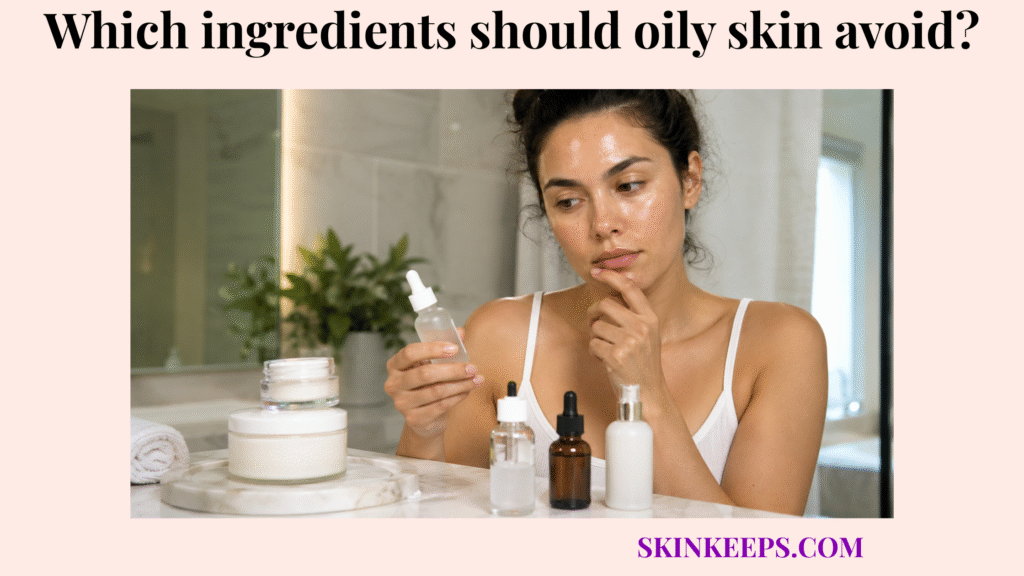
Oily skin should avoid or limit ingredients that clog pores, add heavy residue, over-strip the barrier, or trigger irritation. This matters because oily skin already has higher visible sebum activity, so the wrong ingredient category can make shine, congestion, tightness, or breakouts feel harder to control.
This guide explains which ingredient categories are most likely to overload oily skin, which drying ingredients can make the barrier less stable, which helpful actives should be limited when irritation appears, and how to read product labels before buying products.
Which clogging ingredients should oily skin avoid first?
Oily skin should avoid clogging ingredients first when those ingredients leave heavy residue, increase pore congestion, or make the skin feel coated. This clogging risk is not only about one ingredient name; it is also about how rich, waxy, or occlusive the full formula feels on oily zones. When heavy residue sits on top of sebum, pores can look darker, texture can feel rougher, and breakouts may become easier to trigger.
Natural ingredients are not automatically safer for oily skin. A rich plant oil, thick butter, or waxy balm can still feel too heavy when the skin is already producing visible oil. Readers who need help choosing lighter product vehicles can use the product formulations for oily skin guide after identifying which ingredient categories feel too heavy.
Why heavy butters can overload oily pores
Heavy butters can overload oily pores because their dense texture can sit on top of existing sebum and increase the feeling of surface congestion. Shea butter, cocoa butter, and mango butter are not automatically wrong for every person, but they may feel too rich when used across the full face. Oily skin often tolerates richer ingredients better as targeted support for dry patches rather than as a default all-over layer.
Why rich plant oils may feel too greasy on oily skin
Rich plant oils may feel too greasy on oily skin because they add another lipid layer to a surface that already has visible sebum. The issue is not that every oil is harmful; the issue is whether the oil leaves shine, residue, or congestion after repeated use. Lightweight, oil-free, or non-comedogenic directions are often better starting points when full-face oils make the skin feel coated.
Why comedogenic residue matters more than “natural” marketing
Comedogenic residue matters more than “natural” marketing because oily skin reacts to how a formula behaves on the pore surface, not to whether the ingredient sounds botanical. A natural balm can still feel heavy, and a plain lightweight lotion can still be the more comfortable option. Oily skin should judge products by comfort, shine, congestion, and tolerance rather than ingredient storytelling alone.
| Ingredient Category | Risk for Oily Skin | Better Direction |
|---|---|---|
| Heavy butters | Can feel thick and congesting | Lightweight gel or fluid textures |
| Rich facial oils | May add extra grease | Oil-free hydration |
| Wax-heavy balms | Can leave heavy residue | Non-comedogenic moisturizers |
| Thick occlusives | May overload oily zones | Spot-use only if needed |
Which drying ingredients can make oily skin worse?
Drying ingredients can make oily skin worse when they remove surface comfort too aggressively and leave the barrier tight, irritated, or unstable. This drying effect matters because oily skin can still become dehydrated or reactive under the surface. When a product creates tightness quickly, that matte result is not automatically healthy oil control.
Alcohol-heavy products and strong astringents are common examples of drying formulas that may backfire. They can feel satisfying at first because shine drops quickly, but the skin may later feel tight, stingy, or less predictable. When this happens, oily skin should move toward alcohol-free and barrier-respecting formulas.
Why alcohol-heavy products can irritate oily skin
Alcohol-heavy products can irritate oily skin because they may create fast surface dryness while reducing comfort and product tolerance. Denatured alcohol or SD alcohol can be drying when a formula depends on that quick-evaporating feel, but not all alcohols behave the same way. Fatty alcohols used for texture are different from harsh alcohol-heavy finishes, so the real warning sign is tightness, stinging, or irritation after use.
Why astringents often create tightness instead of balance
Astringents often create tightness instead of balance because they focus on drying the surface rather than supporting stable oil control. Tight skin is not a success signal for oily skin; it can mean the surface has been pushed past comfort. Irritated oily skin may still look shiny later, which makes the cycle feel confusing unless the routine becomes gentler.
Why “matte immediately” is not always healthy oil control
“Matte immediately” is not always healthy oil control because a fast-drying finish can hide barrier stress beneath a temporarily shine-free surface. Matte formulas can be useful when they are gentle, lightweight, and comfortable. The problem is the matte-at-all-costs approach, where oil reduction comes with stinging, flakes, burning, or persistent tightness.
Which harsh cleansing ingredients should oily skin avoid?
Oily skin should avoid harsh cleansing ingredients when they leave the face squeaky, tight, irritated, or shiny again soon after washing. This cleanser harshness matters because oil removal and barrier stripping are not the same thing. A good cleanser removes buildup while leaving the skin comfortable enough to tolerate the rest of the routine.
Harsh soaps, alcohol-heavy cleansers, and overly aggressive high-foam formulas can make oily skin feel clean for a short time but unstable afterward. The oily skin cleanser type guide can help with cleanser selection, while this page stays focused on ingredient patterns that oily skin should avoid or limit.
Why harsh alkaline soaps can over-strip oily skin
Harsh alkaline soaps can over-strip oily skin because they may remove more surface lipid than the barrier can comfortably tolerate. The face can feel squeaky after washing, but that squeaky finish often signals over-cleansing rather than better skin health. Oily skin needs enough cleansing to remove buildup without turning every wash into barrier stress.
Why strong high-foam cleansers can leave oily skin tight
Strong high-foam cleansers can leave oily skin tight when their surfactant system removes too much surface oil too quickly. Foam itself is not automatically bad, and many gentle cleansers foam lightly. The important test is the after-feel: comfortable, clean skin is safer than a stripped finish that looks matte for a moment and then feels irritated.
Why cleanser harshness matters more than foam level
Cleanser harshness matters more than foam level because oily skin can tolerate some foam but may not tolerate a stripped, squeaky, irritated finish. A mild gel or gentle foaming cleanser can work well when it cleans without leaving the barrier uncomfortable. If a cleanser makes the face feel tight every time, the formula is probably too aggressive for daily use.
| Ingredient Pattern | What It Does | Oily-Skin Result |
|---|---|---|
| Harsh soap base | Over-cleans surface lipids | Tight but still shiny skin |
| Alcohol-heavy cleanser | Dries and irritates | Less stable oil control |
| Strong stripping surfactants | Removes too much oil too fast | Barrier stress |
| Abrasive scrub cleanser | Adds friction to cleansing | Redness or irritation risk |
Which active ingredients should oily skin limit instead of fully avoid?
Oily skin should limit active ingredients instead of fully avoiding them when those actives help oiliness or acne but start causing dryness, stinging, peeling, or tightness. This distinction is important because ingredients like salicylic acid, benzoyl peroxide, and retinoids can be useful for oily or acne-prone skin. The problem starts when multiple strong actives are stacked too quickly.
Helpful actives should match the main concern. Salicylic acid fits clogged oily pores, benzoyl peroxide fits inflamed acne, and retinoids fit recurrent congestion or acne-prone texture. The active ingredients for oily skin guide can handle benefits in more detail, while this page explains when those same actives should be limited.
Why salicylic acid should be limited if skin becomes dry or irritated
Salicylic acid should be limited if skin becomes dry or irritated because an oil-clearing active can still over-stress the barrier when used too often. Oily skin may benefit from pore-focused exfoliation, but tolerance still matters. If the skin starts peeling, stinging, or feeling tight, the routine should reduce active pressure instead of adding more oil-control products.
Why glycolic and lactic acids can over-exfoliate oily skin
Glycolic and lactic acids can over-exfoliate oily skin when surface smoothing turns into stinging, peeling, redness, or an overly shiny stripped look. This problem is more likely when acids appear in several products at once. Readers noticing these irritation signs can use the over-exfoliating oily skin guide to understand when exfoliation has gone too far.
Why benzoyl peroxide and retinoids need slow introduction
Benzoyl peroxide and retinoids need slow introduction because acne-focused actives can irritate oily skin when the barrier is not given time to adapt. These ingredients can be useful, but they should not be treated as a reason to overload the routine. Slow, tolerance-based use is safer than stacking multiple strong products and hoping oily skin can handle them.
| Active Ingredient | Helps With | Limit When |
|---|---|---|
| Salicylic acid | Clogged oily pores | Stinging, peeling, tightness |
| Glycolic acid | Roughness and dullness | Burning or over-smooth shine |
| Lactic acid | Gentle surface smoothing | Irritation appears |
| Benzoyl peroxide | Inflamed acne | Dryness or redness worsens |
| Retinoids | Recurrent clogging | Barrier becomes sensitive |
Which fragrance ingredients can irritate oily skin?
Fragrance ingredients can irritate oily skin when the skin is already reactive, acne-prone, over-cleansed, or barrier-stressed. This irritation risk matters because oily skin is not automatically strong just because it produces more sebum. When fragrance causes stinging, redness, or discomfort, fragrance-free formulas are usually the safer direction.
Essential oils are not automatically safer than synthetic fragrance. A product can sound botanical and still irritate sensitive oily skin. The label should be judged by how the skin responds, not by whether the scent source sounds natural.
Why fragrance can worsen reactive oily skin
Fragrance can worsen reactive oily skin because added scent compounds may trigger discomfort without providing a necessary oil-control benefit. Scent can make a product feel more pleasant, but it does not help the skin manage sebum, congestion, or barrier stress. If oily skin stings easily, fragrance-free formulas are usually the cleaner starting point.
Why essential oils are not automatically safe for oily skin
Essential oils are not automatically safe for oily skin because natural aromatic compounds can still irritate a stressed or acne-prone barrier. Natural scent is still scent, and botanical language does not remove irritation risk. Oily skin should treat essential oils as tolerance-dependent rather than automatically gentle.
Why fragrance-free formulas are safer when oily skin is irritated
Fragrance-free formulas are safer when oily skin is irritated because they remove a common non-essential trigger from an already reactive routine. This does not mean every person with oily skin must avoid fragrance forever. It means fragrance should be one of the first things to simplify when the skin feels stingy, red, itchy, or unusually sensitive.
How should oily skin read ingredient labels before buying products?
Oily skin should read ingredient labels by looking for low-residue, oil-free, non-comedogenic, alcohol-free, and fragrance-free directions when congestion or irritation is a concern. These label cues do not guarantee perfect tolerance, but they help narrow the risk before buying. The final test is still how the skin feels after repeated use.
Ingredient labels should also be read as a routine stack, not as isolated products. A single acid cleanser may be tolerable, but an acid cleanser, exfoliating toner, retinoid, and drying acne treatment in the same routine may become too much. When tightness appears, the routine needs fewer irritants, not more oil-control pressure.
Why oil-free and non-comedogenic labels matter
Oil-free and non-comedogenic labels matter because they help oily skin avoid formulas that add extra grease or increase pore-clogging risk. These labels are not guarantees, but they are useful filters when the skin is prone to shine, clogged pores, or breakouts. The best product is still the one that feels lightweight and does not make congestion worse over time.
Why alcohol-free matters for irritated oily skin
Alcohol-free matters for irritated oily skin because it reduces the chance of choosing a formula that dries the surface too aggressively. This is especially important when the skin already feels tight, stingy, or reactive. If a product repeatedly creates discomfort, the label should be simplified instead of made stronger.
Why lightweight texture claims should match the ingredient list
Lightweight texture claims should match the ingredient list because a product can market itself as light while still relying on waxy, oily, or heavily occlusive components. Texture words are helpful, but they should not replace ingredient awareness. A gel, fluid, serum, or light lotion direction is usually a better starting point when full-face products feel heavy.
Ingredient Label Checklist for Oily Skin
What should oily skin remember about ingredients to avoid?
The main point to remember is that oily skin should avoid ingredients that clog, strip, irritate, or overload the surface, while limiting helpful actives when tolerance drops. This keeps the focus on skin response instead of fear-based ingredient rules. The goal is controlled oil and comfortable skin, not a damaged matte surface.
Final Takeaways
- Oily skin should avoid ingredients that clog, strip, irritate, or overload the surface.
- Heavy butters, rich oils, wax-heavy balms, and thick occlusives can feel too heavy on oily zones.
- Alcohol-heavy products and strong astringents can make oily skin feel tight, irritated, or unstable.
- Harsh cleansing ingredients can remove too much surface comfort even when oil returns later.
- Helpful actives such as salicylic acid, glycolic acid, lactic acid, benzoyl peroxide, and retinoids should be limited when stinging, peeling, tightness, or redness appears.
- Fragrance and essential oils are not necessary for oil control and may irritate reactive oily skin.
- Oil-free, non-comedogenic, alcohol-free, fragrance-free, and lightweight formulas are safer starting points for many oily-skin routines.
- The goal is controlled oil and comfortable skin, not a damaged matte surface.
FAQs
Should oily skin avoid all oils?
Oily skin does not need to avoid every oil, but it should be careful with rich, heavy, or residue-prone oils that make the face feel greasier or more congested.
Are natural oils good for oily skin?
Natural oils are not automatically good for oily skin because the skin responds to texture, residue, and pore tolerance, not only to whether an ingredient is natural.
Should oily skin avoid alcohol in skincare?
Oily skin should avoid alcohol-heavy formulas when they cause tightness, stinging, dryness, or irritation, especially in cleansers, toners, and astringents.
Are exfoliating acids bad for oily skin?
Exfoliating acids are not automatically bad for oily skin, but they should be limited when the skin becomes red, tight, peeling, stingy, or unusually sensitive.
Should oily skin avoid fragrance?
Oily skin should avoid fragrance when the skin is reactive, acne-prone, irritated, or stinging because fragrance adds irritation risk without helping oil control.
Are essential oils safe for oily skin?
Essential oils are not automatically safe for oily skin because natural aromatic compounds can still irritate the barrier or worsen sensitivity.
What labels should oily skin look for?
Oily skin should often look for oil-free, non-comedogenic, alcohol-free, fragrance-free, lightweight, gel, fluid, serum, or light lotion directions.
Conclusion
Oily skin should avoid or limit ingredients based on how they affect congestion, irritation, stripping, and residue rather than judging ingredients by marketing claims alone. Heavy butters, rich oils, waxy balms, alcohol-heavy products, harsh cleansers, fragrance, essential oils, and overused actives can all create problems when they overload or irritate the skin.
The strongest approach is to choose lightweight, oil-free, non-comedogenic, and barrier-respecting formulas that manage oil without damaging comfort. For broader routine decisions after ingredient filtering, the oily skin care tips guide can help connect product choice with daily habits.