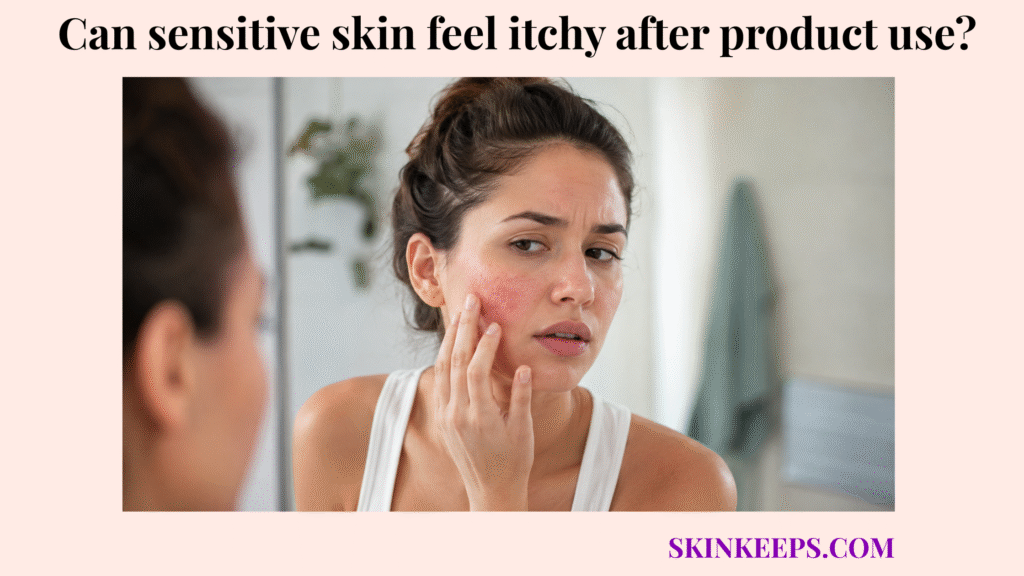
Yes, sensitive skin can feel itchy after product use when a formula irritates the skin barrier, dries the surface, triggers a sensitivity reaction, or contains an ingredient the skin does not tolerate.
Itching may happen after cleansers, moisturizers, sunscreen, makeup, fragrance, exfoliating acids, retinoids, preservatives, alcohol-heavy products, or multiple new products used together. This article explains why product-related itching happens, which products commonly trigger it, how to separate irritation from allergy-like patterns, how itching differs from stinging and burning, how to identify product-pattern clues, what to do immediately, what mistakes to avoid, how to reintroduce products, how to track reactions, and when to seek professional evaluation.
Why Does Sensitive Skin Become Itchy After Using Certain Products?
Sensitive skin becomes itchy after using certain products when the formula irritates the barrier, dries the surface, or triggers a poorly tolerated contact reaction. Product-related itching should be interpreted inside the broader pattern of sensitive skin, where barrier weakness, trigger response, and product intolerance can lower comfort.
Itching is a product-triggered discomfort signal, not a diagnosis. The strongest clue is whether the itch follows a repeatable product, ingredient, timing, or application-area pattern.
How Product Irritation Contributes to Sensitive Skin Itching
Product irritation contributes to sensitive skin itching when ingredients such as fragrance, alcohol, exfoliating acids, retinoids, preservatives, or harsh cleansing agents exceed the skin’s tolerance. Itching can occur soon after use or after repeated exposure to a formula the skin does not tolerate well.
Cleansers, moisturizers, sunscreen, makeup, and active ingredients can all be involved. The presence of itching does not automatically mean allergy.
Why a Weakened Skin Barrier Increases Itch Sensitivity
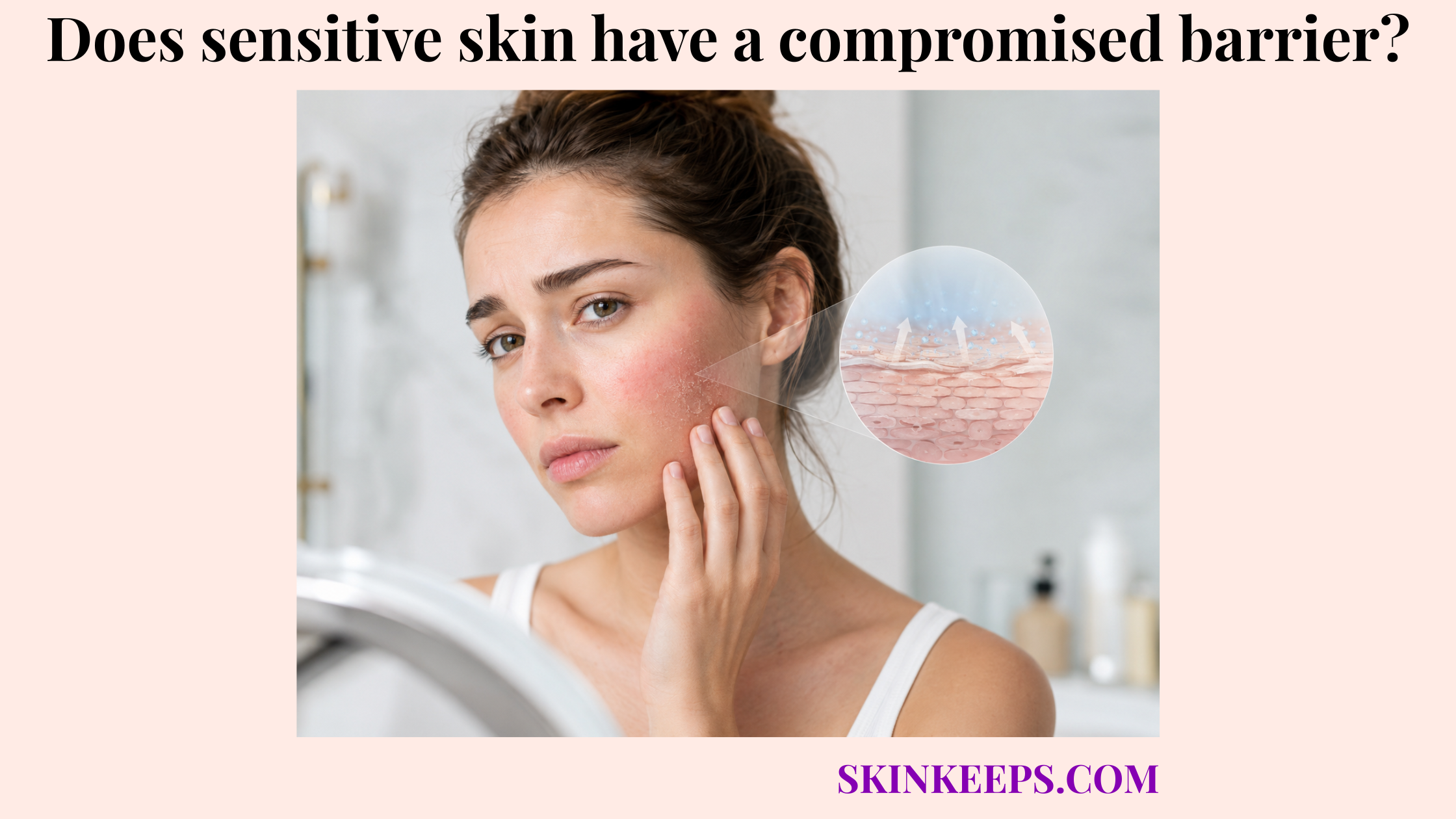
A weakened skin barrier increases itch sensitivity because the outer layer becomes easier to dry, irritate, and disturb after product contact. Product-related itching often begins with barrier behavior, especially when sensitive skin has a compromised barrier that reacts quickly to formulas.
Dryness, peeling, tightness, stinging, burning, and itchy discomfort can overlap when the barrier is stressed. The barrier pattern matters, but this section should not become a full barrier article.
| Itching Pattern | What It May Suggest |
|---|---|
| Brief itch after one product | Mild irritation or poor tolerance. |
| Itch after cleanser | Barrier disruption or cleanser sensitivity. |
| Itch after moisturizer | Formula incompatibility or barrier stress. |
| Itch after sunscreen or makeup | Ingredient intolerance or contact irritation. |
| Itch with visible irritation | Inflammatory response may be present. |
| Itch with swelling or rash | Possible dermatitis or allergy-like reaction. |
Which Skincare Products Are More Likely to Trigger Itching in Sensitive Skin?
Skincare products more likely to trigger itching in sensitive skin include fragrance-heavy products, harsh cleansers, alcohol-rich formulas, strong exfoliants, retinoids, sunscreen, makeup, and some moisturizers. Product category matters because skincare ingredients can commonly irritate sensitive skin when fragrance, actives, preservatives, or harsh formulas are poorly tolerated.
Product category alone is not enough. Formula strength, barrier condition, frequency, and combinations matter, and multiple new products introduced together make the real trigger harder to identify.
| Product Type | Why It May Trigger Itching |
|---|---|
| Fragrance-heavy products | Frequent source of irritation or allergy-like reactions. |
| Harsh cleansers | Can weaken the skin barrier. |
| Alcohol-rich formulas | May increase dryness and discomfort. |
| Strong exfoliants | Can overstimulate or disrupt sensitive skin. |
| Retinoids | May contribute to irritation, dryness, and peeling. |
| Sunscreens | Certain filters or inactive ingredients may not be tolerated. |
| Makeup products | Preservatives, pigments, fragrance, or texture agents may trigger reactions. |
| Moisturizers | Some formulations may not suit sensitive or already irritated skin. |
Does Itching in Sensitive Skin Usually Indicate Irritation or Allergy?
Itching in sensitive skin may indicate irritation, barrier disruption, or an allergy-like pattern, but the difference depends on timing, location, severity, rash, swelling, spread, and recurrence. This comparison is for pattern recognition, not diagnosis.
Irritation is often more barrier- or harshness-driven. An allergy-like pattern becomes more concerning when itching is intense, rash-like, swollen, spreading, or returns after repeated exposure.
| Feature | Irritation Pattern | Allergy-Like Pattern |
|---|---|---|
| Timing | Often appears soon after use. | May occur after repeated exposure. |
| Sensation | Itching with dryness or discomfort. | Intense itching with rash or swelling. |
| Location | Often limited to contact areas. | May extend beyond application sites. |
| Trigger | Barrier disruption or harsh ingredients. | Specific ingredient sensitivity may be involved. |
| Recommended action | Stop the product and simplify care. | Seek professional advice if severe, spreading, or recurrent. |
What Other Sensitive Skin Symptoms Can Occur Alongside Itching?
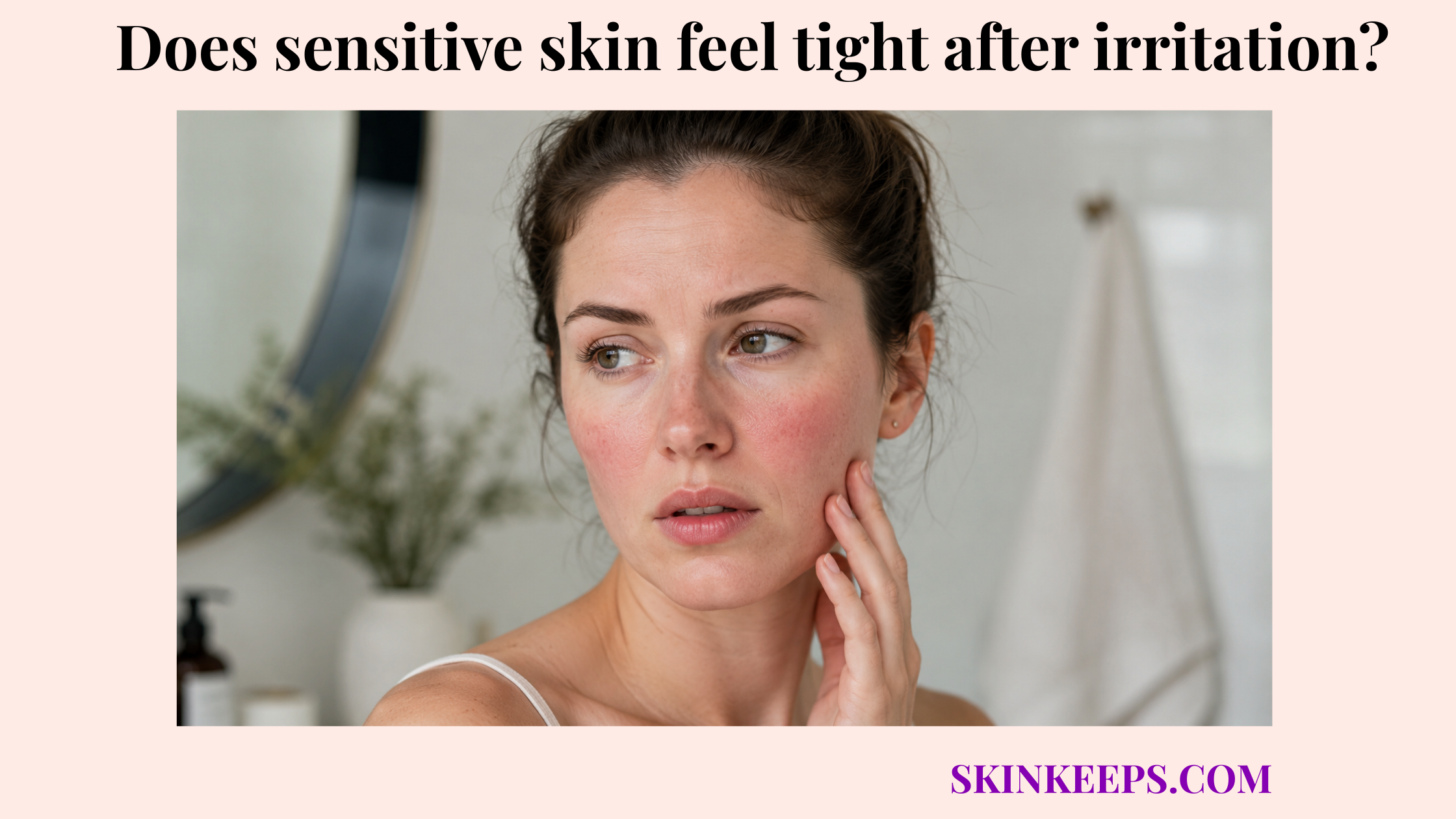
Other sensitive skin symptoms can occur alongside itching, including stinging, burning, tightness, tenderness, dryness, peeling, redness, darker irritation, bumps, or rash-like changes. Itching belongs to the wider sensory group of sensitive skin discomfort, alongside stinging, burning, tightness, heat, tenderness, and rawness.
Burning is more concerning than mild itch or tightness because it feels hotter, deeper, and more painful. Itching with heat or pain needs a stricter boundary because sensitive skin can burn after certain products when formulas exceed barrier tolerance.
| Symptom | What It Feels Like | What It May Indicate |
|---|---|---|
| Itching | Urge to scratch. | Irritation, sensitivity, or allergy-like response. |
| Stinging | Sharp discomfort. | Barrier vulnerability or product intolerance. |
| Burning | Hot or painful sensation. | Stronger irritation response. |
| Tightness | Dry, stretched feeling. | Moisture loss or barrier discomfort. |
| Tenderness | Soreness to touch. | Inflammation, friction, or overexposure. |
Can Sensitive Skin Itching Be Confused With Acne-Related Reactions?
Sensitive skin itching can be confused with acne-related reactions when itchy bumps appear after a product, but itching is more often linked with irritation, sensitivity, or rash-like response than typical acne development. Acne can overlap, but itchy bumps should not automatically be treated as clogged pores.
Acne commonly involves clogged pores and inflammatory lesions. Product itching often involves discomfort, dryness, peeling, rash-like texture, or contact-area timing. Itching should also be separated from stinging as a common sensitive-skin sign because itching creates an urge to scratch while stinging feels sharper and pricklier.
Acne Confusion Key Distinctions
- Acne commonly involves clogged pores and inflammatory lesions.
- Sensitive skin itching often appears with discomfort, dryness, peeling, or rash-like changes.
- Itchy bumps after a product may be irritation, allergy-like reaction, acne overlap, or another condition.
- Persistent itching after product use should not automatically be assumed to be acne-related.
- Strong acne products can worsen itching if the barrier is already irritated.
What Signs Suggest That a Skincare Product Is Causing the Itching?
A skincare product may be causing the itching when the sensation begins after application, appears where the product was used, returns after reuse, or improves after stopping the suspected product. This is pattern recognition, not diagnosis.
Frequency matters too. Itching that worsens as use increases or appears after multiple active ingredients were introduced together is stronger evidence than one isolated uncomfortable day.
Product-Pattern Checklist
How Should Sensitive Skin Be Managed When Itching Develops After Product Use?
Sensitive skin should be managed by stopping the suspected product, avoiding scratching, simplifying care, and pausing potentially irritating actives when itching develops after product use. If symptoms intensify while the product is still on the skin, gentle rinsing with cool or lukewarm water may reduce exposure.
The first response should reduce friction and confusion. Adding new products immediately can hide the trigger and make the reaction harder to interpret.
Immediate Response Checklist
What Habits Can Worsen Itching in Sensitive Skin?
Habits that worsen itching in sensitive skin usually add friction, heat, fragrance, product overload, or continued exposure to the suspected trigger. Scratching is especially risky because it can increase irritation and barrier damage.
Assuming every itchy bump is acne can also backfire. It may delay trigger removal and push the skin toward stronger actives when the barrier needs calming.
| Mistake | Why It May Worsen Symptoms |
|---|---|
| Scratching the skin | Can increase irritation and barrier damage. |
| Continuing the triggering product | May prolong or intensify the reaction. |
| Adding multiple new products | Makes identifying triggers difficult. |
| Using very hot water | Can intensify dryness and itching. |
| Applying heavily fragranced products | May increase sensitivity or allergy-like reactions. |
| Assuming all itchy bumps are acne | Can delay appropriate response. |
| Frequently changing routines | May destabilize sensitive skin further. |
How Can People With Sensitive Skin Safely Return to Products After Itching Improves?
People with sensitive skin should return to products after itching improves by restarting slowly, using one product at a time, and watching for the same itch pattern after reuse. Reintroduction should not begin while the skin is still itchy, swollen, rash-like, or worsening.
A simplified routine comes first, then cautious reintroduction. Patch testing can help when a product history includes repeated itching, rash-like changes, or unclear triggers.
| Reintroduction Step | Purpose |
|---|---|
| Wait until symptoms have resolved | Reduces the chance of restarting irritation. |
| Restart with a simplified routine | Gives the skin fewer possible triggers. |
| Introduce one product at a time | Keeps the reaction source easier to identify. |
| Consider patch testing when appropriate | Checks for a smaller-area reaction before wider use. |
| Avoid combining several active ingredients initially | Reduces stacked irritation. |
| Use products less frequently at first | Tests tolerance more cautiously. |
| Stop use if itching returns | Treats repeat itch as useful evidence. |
| Keep notes about reactions and timing | Builds a clearer product-pattern record. |
How Can Sensitive Skin Reactions Involving Itching Be Tracked Effectively?
Sensitive skin reactions involving itching can be tracked by recording the product, product category, application site, timing, severity, duration, other symptoms, simultaneous products, and whether itching returned after reuse. Tracking is pattern recognition, not diagnosis.
Photos are useful only if visible changes appear. The key is to connect product use, timing, location, and repeat reaction before switching many products at once.
Itch Tracking Checklist
When Should Itching in Sensitive Skin Be Evaluated by a Healthcare Professional?
Itching in sensitive skin should be evaluated by a healthcare professional when it is persistent, worsening, intense, sleep-disrupting, spreading, eye-area related, swollen, blistering, oozing, crusted, painful, or repeatedly triggered by multiple products. These patterns are beyond simple product annoyance.
Professional review becomes important when sensitive skin needs a dermatologist instead of repeated product guessing. Evaluation helps separate ordinary irritation from dermatitis, allergy, eczema, infection, acne, folliculitis, rosacea, or another concern.
Professional Evaluation Warning Signs
What Are the Key Points to Remember About Itching in Sensitive Skin After Product Use?
Sensitive skin can become itchy after product use, and the most useful clue is whether the itch follows a repeatable product, ingredient, timing, or application-area pattern. Product-related itching should not automatically be attributed to acne or allergy without context.
Final Takeaways
- Sensitive skin can become itchy after using certain products.
- Itching often reflects irritation, barrier disruption, dryness, or poor product tolerance.
- Product-related itching may occur alongside stinging, burning, tightness, peeling, or rash-like changes.
- Product-related itching should not automatically be attributed to acne.
- Simplifying the skincare routine and removing potential triggers are important first steps.
- Persistent, severe, sleep-disrupting, spreading, swollen, blistering, oozing, or eye-area symptoms warrant professional evaluation.
Frequently Asked Questions
Is Itching After Skincare Normal for Sensitive Skin?
Itching after skincare can happen in sensitive skin, but repeated, intense, rash-like, swollen, or spreading itch should not be treated as normal. One mild itch after one product may reflect irritation, but repeat itching after the same product suggests poor tolerance or a product reaction pattern.
Why Does Moisturizer Make My Sensitive Skin Itch?
Moisturizer may make sensitive skin itch when the barrier is already irritated, the formula does not suit the skin, or the product contains an ingredient the skin poorly tolerates. Repeated itching means the product or barrier condition needs reassessment.
Can Sunscreen or Makeup Make Sensitive Skin Itchy?
Sunscreen or makeup can make sensitive skin itchy when filters, preservatives, pigments, fragrance, texture agents, or formula weight do not suit the skin. Timing, location, and repeat reaction matter more than one isolated itch.
Is Itching After Products Allergy or Irritation?
Itching after products may reflect irritation, barrier disruption, or an allergy-like pattern, and the distinction depends on rash, swelling, spread, timing, and recurrence. Professional evaluation is safer when itch is intense, spreading, swollen, blistering, oozing, crusted, or repeatedly triggered.
Are Itchy Bumps on Sensitive Skin Acne?
Itchy bumps on sensitive skin are not automatically acne because itching often points toward irritation, product reaction, or rash-like sensitivity. Acne can overlap, but product timing, itch, rash, swelling, dryness, and contact-area pattern matter.
When Should Product-Related Itching Be Checked?
Product-related itching should be checked when it is persistent, sleep-disrupting, spreading, swollen, blistering, oozing, crusted, eye-area related, painful, or repeatedly triggered by multiple products. Evaluation helps separate ordinary irritation from dermatitis, allergy, eczema, infection, acne, folliculitis, rosacea, or another concern.
Conclusion
Sensitive skin can feel itchy after product use when a formula irritates the barrier, dries the surface, or contains an ingredient the skin does not tolerate. Cleansers, moisturizers, sunscreen, makeup, fragrance, exfoliating acids, retinoids, preservatives, alcohol-rich formulas, and product combinations can all create product-related itching in reactive skin.
Itching is a clue, not a diagnosis. If itching is persistent, intense, sleep-disrupting, spreading, swollen, blistering, oozing, crusted, eye-area related, painful, or repeatedly triggered by multiple products, professional evaluation is safer than repeated product guessing.