
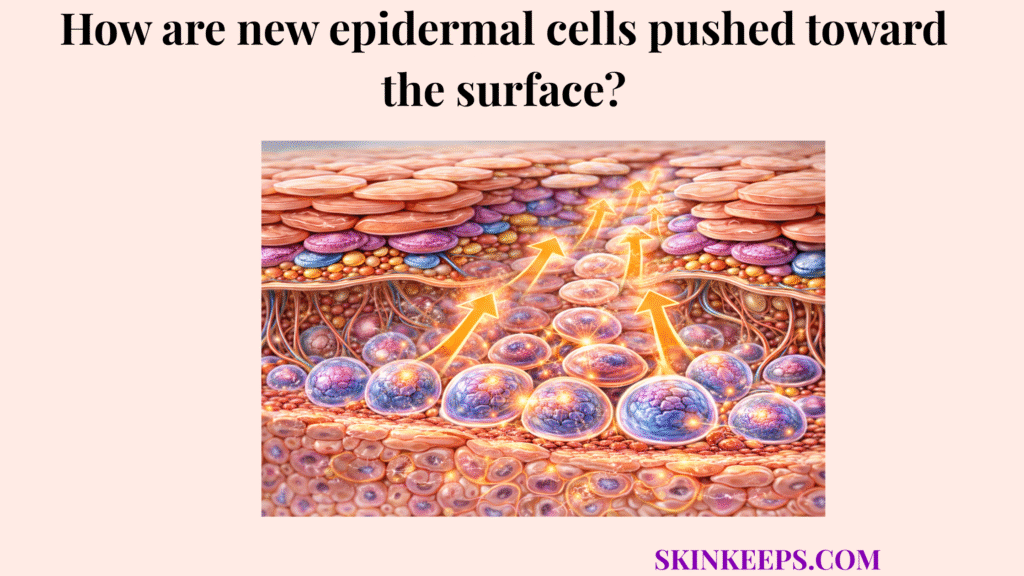
New epidermal cells reach the skin surface through a coordinated process of basal-cell division, upward movement, and differentiation. Keratinocytes are produced in the stratum basale, enter the layers above, gradually mature into corneocytes, and are eventually shed. Cell production contributes to tissue renewal, but movement is not simply a mechanical shove from each new division.
This ongoing renewal maintains the outer barrier, which reduces water loss and protects the body. The pace of renewal varies with age, skin site, and health; dullness or roughness alone cannot tell you how quickly your basal cells are dividing.
This guide explains where epidermal renewal begins, how cell-cell attachments and keratinization shape the upward pathway, what aging may change, and which gentle skincare habits are supported by evidence.
What is the biological engine that ensures new epidermal cells are pushed toward the surface?
The stratum basale is the main source of new keratinocytes in the interfollicular epidermis. Basal stem and progenitor cells proliferate, while selected daughter cells leave the basal compartment and begin differentiation toward the surface.
Basal-cell production sustains the layers above, but the process also depends on cell-fate signals and changes in attachment and differentiation. For a closer look at the source cells, see how basal keratinocytes participate in epidermal cell division. Research describes a carefully regulated balance of proliferation and differentiation, not unlimited cell production. [Making an Epidermis, 2009]
Think of the basal layer as the starting point of a replacement pathway. Its essential role is to maintain a supply of cells while the epidermis preserves normal thickness, structure, and barrier function.
Why are new epidermal cells pushed toward the surface instead of staying in place?
Cells move out of the basal compartment because epidermal tissue continually renews while remaining organized in layers. As some basal cells divide and others commit to differentiation, maturing keratinocytes occupy suprabasal positions and ultimately form the stratum corneum.
This is a regulated sequence involving tissue organization, adhesion, and differentiation rather than a purely one-way pressure system. The related explanation of how the stratum basale supports continuous epidermal renewal helps place upward movement in the full turnover cycle. A review of skin repair describes basal-cell division followed by movement into suprabasal layers. [Skin Repair Review, 2016]
The visible end point is a flattened corneocyte at the surface. Once these cells complete their barrier role, they are released through the normal shedding process called desquamation.
How Does Basal Cell Division Contribute to Epidermal Upward Movement?
Basal mitosis contributes new cells to the epidermis, but it does not create a measurable, universal “upward pressure” that alone explains migration. Cell position and fate are coordinated by proliferation, attachment changes, and differentiation within a multilayered tissue.
The “epidermal escalator” is a useful teaching analogy: cells enter at the bottom, mature during their journey, and leave the surface. It should not be interpreted as a rigid conveyor belt or a series of individual cells physically shoving their neighbors.
In healthy epidermis, new cell production is balanced by terminal differentiation and shedding. Too much or too little activity in any part of this system can affect tissue architecture, depending on the underlying condition.
How Does Cell Production Contribute to Upward Movement?
Each basal division can add to the supply of replacement keratinocytes. Some daughter cells retain proliferative potential, while others eventually leave the basal layer; these changes contribute to the movement of cells into higher epidermal strata.
Cellular turnover is regulated through local signals and cell-fate decisions. Published replacement-rate estimates depend on study methods, body site, and population, so no single numerical rate should be treated as universal.
How do cellular attachments guide the upward path?
Desmosomes help neighboring keratinocytes remain mechanically connected while the tissue undergoes renewal and differentiation. They are specialized cell-cell junctions connected to the keratin cytoskeleton. [Epidermal Architecture Review, 2012]
These attachments support tissue cohesion and resistance to mechanical stress. They are not miniature motors that pull cells upward, and their composition changes as keratinocytes mature through epidermal layers.
| Component | Role in epidermal renewal | Why it matters |
|---|---|---|
| Basal-cell division | Supplies replacement keratinocytes | Maintains tissue renewal |
| Desmosomes | Provide cell-cell adhesion | Supports tissue cohesion |
| Differentiation | Changes cell structure and function | Produces surface corneocytes |
How does keratinization help new epidermal cells pushed toward the surface survive the journey?
Keratinization, also called cornification during terminal differentiation, transforms living keratinocytes into flattened corneocytes capable of forming the outer barrier. Cells accumulate structural proteins, develop a cornified envelope, and ultimately lose their nuclei and other organelles.
Upward movement and maturation are linked but distinct processes. For the structural changes, read how keratinization converts keratinocytes into protective surface cells. The process creates a specialized barrier, rather than making the cells “survive” indefinitely.
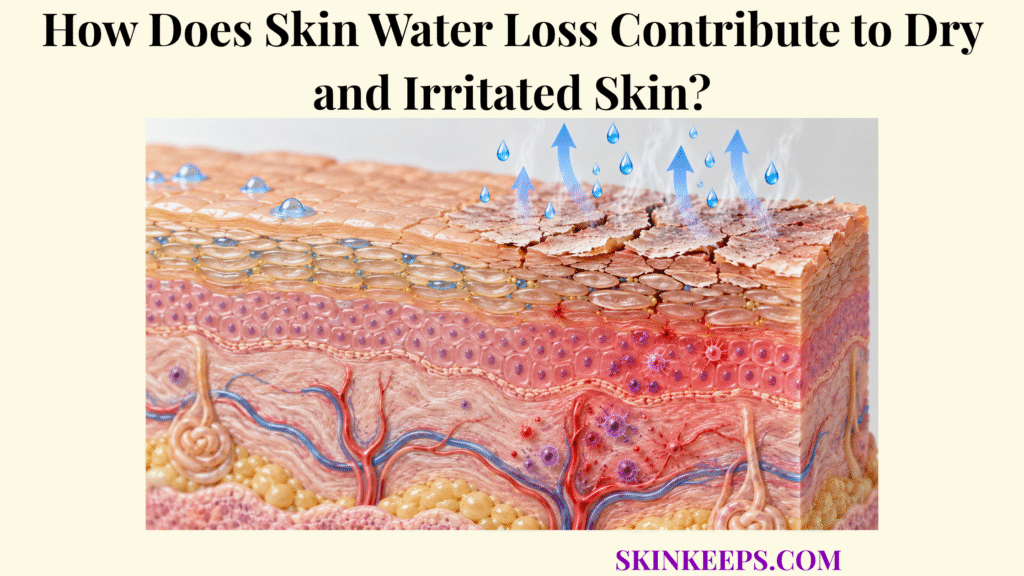
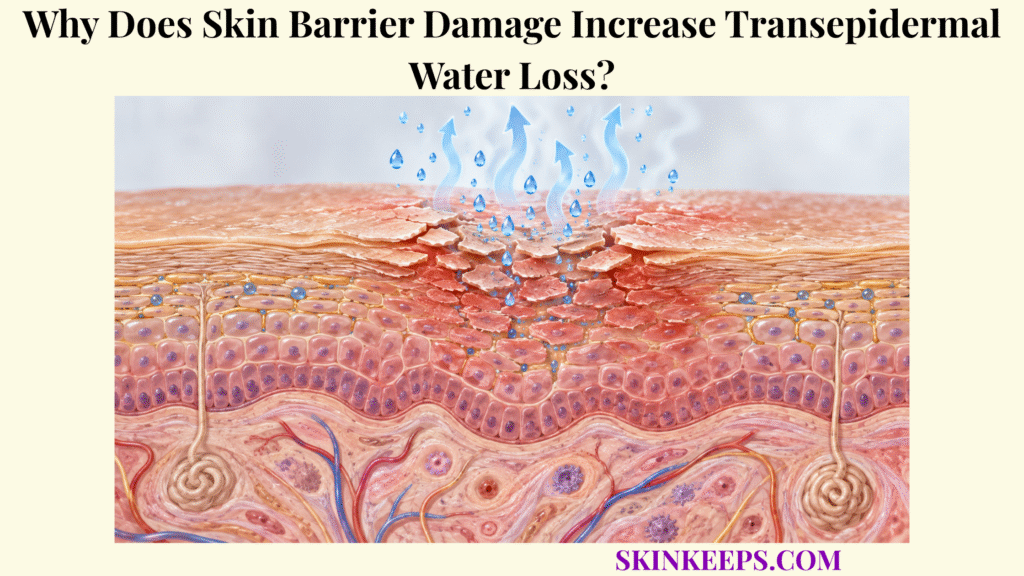
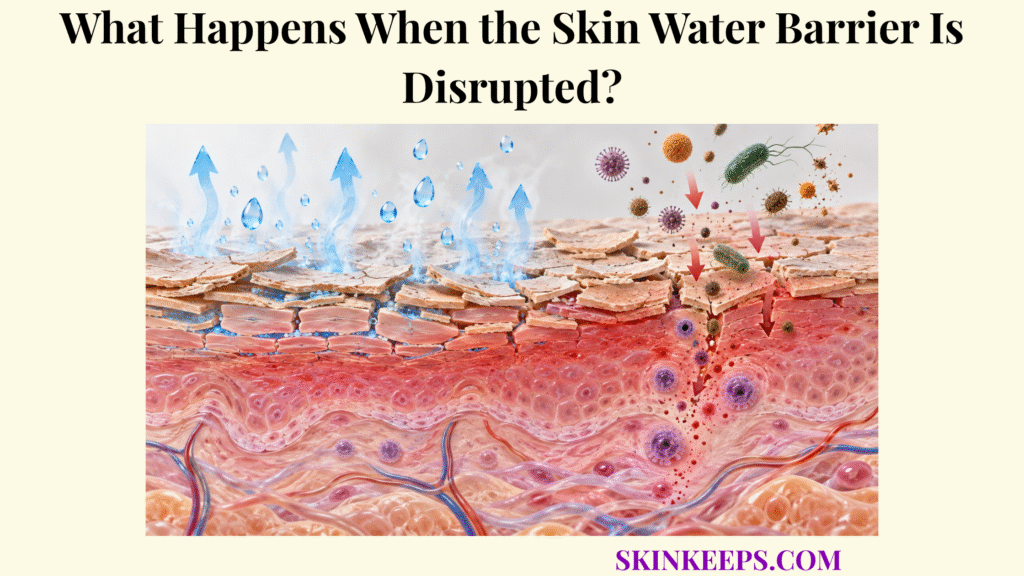
At the surface, mature corneocytes help limit water evaporation together with intercellular lipids form the stratum corneum. Water retention depends on the whole barrier system, not on the migration speed alone.
Which Skin Changes May Occur Alongside Altered Surface Renewal?
Dullness, surface roughness, and flaking may occur when desquamation, hydration, or barrier function is altered. However, these signs cannot establish that epidermal cells are migrating too slowly.
Dryness, irritation, acne, environmental exposure, and some inflammatory skin disorders can also affect appearance and texture. Self-assessing “migration speed” from the mirror or a skincare checklist is not scientifically reliable.
If a change is persistent, painful, inflamed, cracking, or worsening, a dermatologist can assess the cause. The appropriate approach depends on the skin condition rather than an assumed failure of the epidermal escalator.
| Skin change | What it may mean |
|---|---|
| Dull tone | May be associated with dryness, sun exposure, or uneven surface texture. |
| Rough texture | May reflect dry skin, irritation, or altered shedding, among other causes. |
| Flaking | Can occur with dry or inflamed skin; not proof of slow migration. |
| Persistent marks | Fading varies with inflammation, pigment changes, and other factors. |
When Should You Adjust Your Routine or Seek Help for Persistent Texture Changes?
Support the skin when persistent roughness, dryness, or irritation affects comfort, but avoid assuming that every texture concern reflects delayed cell migration. Begin with gentle cleansing, moisturizer, and sun protection.
Seek medical guidance if symptoms worsen or do not improve with gentle care. Strong exfoliants or retinoids should not be added automatically just because the skin looks dull.
When do early signs suggest epidermal migration needs support?
Mild roughness or reduced radiance is common and nonspecific. It may relate to dryness, environmental factors, or normal variation in the outer skin.
Action: Use a gentle cleanser, moisturize consistently, and avoid excessive exfoliation while observing changes.
When do moderate signs suggest new epidermal cells are not being pushed toward the surface efficiently enough?
More persistent roughness or visible flaking warrants attention to the barrier and routine. Post-inflammatory marks can take time to fade for reasons other than cell migration speed.
Action: Review irritating products and consider professional advice before introducing stronger treatments.
When Do Persistent or Severe Symptoms Need Medical Advice?
If roughness is persistent with redness, cracking, bleeding, pain, spreading rash, or recurrent inflammation, a skin condition may require assessment rather than an increasingly intensive cosmetic routine.
Action: Consult a qualified dermatologist, especially when the skin does not respond to basic supportive care.
How does youthful skin compare to aging skin in how new epidermal cells are pushed toward the surface?
Some studies associate aging with changes in epidermal proliferation, differentiation, and turnover. However, the pace varies widely, and slower turnover does not mean that every older person will have visibly dull or rough skin.
A review of skin aging describes age-related changes in epidermal proliferative capacity, the dermal-epidermal junction, and barrier recovery. These patterns are influenced by both intrinsic aging and external exposures; a single turnover duration should not be assigned to all adults. [Skin Aging Review, 2022]
Which Skincare Habits Support Normal Epidermal Renewal and Barrier Comfort?
Daily care can support a comfortable, functioning skin barrier, while certain active ingredients can improve specific concerns such as acne or photoaging. No cosmetic routine is proven to “speed up” every step of upward keratinocyte movement.
A practical approach combines gentle cleansing, moisturizer, and appropriate sun protection. When skin feels dry or reactive, understanding the ceramide-rich epidermal barrier lipid matrix helps explain why protecting the surface is important.
What Can Chemical Exfoliants Do at the Skin Surface?
Chemical exfoliants act mainly on the outer stratum corneum by encouraging the removal of dead surface cells. They do not directly push living keratinocytes upward from the basal layer.
Exfoliating too often, or using strong products on irritated skin, may worsen dryness and sensitivity. For some skin types, avoiding exfoliation altogether during a barrier-recovery phase is appropriate.
How Do Retinoids Affect Epidermal Biology?
Topical retinoids can influence keratinocyte differentiation and epidermal biology, and some have evidence for treating acne or photoaging. Their effects depend on the formulation and the individual; they are not a universal treatment for “slow cell migration.” Clinical reviews document both potential benefits and irritation. [Retinoids Clinical Review, 2006]
Retinoids may cause peeling, burning, or redness, particularly when introduced too quickly. Use only when appropriate, follow product or clinician instructions, and avoid retinoids during pregnancy. A dermatologist can help assess suitability. [American Academy of Dermatology]
How do supportive routines keep upward migration more consistent?
A simple, low-irritation routine helps preserve barrier comfort while the epidermis carries out normal renewal. Moisturizers may reduce dryness and help limit unnecessary irritation, but are not proven to accelerate basal-cell migration.
Introduce new active products cautiously, avoid stacking multiple irritants, and stop an irritating product when needed. Consistency matters more than trying to force a specific turnover rate.
| Concern | Possible contributing factors | Practical next step |
|---|---|---|
| Persistent dryness | Barrier disruption, low humidity, irritants | Gentle cleansing and moisturizer |
| Rough surface | Dryness or altered shedding | Avoid aggressive exfoliation; reassess |
| Irritation | Active-product overuse or skin condition | Simplify routine; seek advice if persistent |
What are the key takeaways about how new epidermal cells are pushed toward the surface?
The essential mechanisms are basal-cell renewal, regulated cell-fate changes, upward differentiation, corneocyte formation, and eventual shedding. Cell crowding can be part of tissue dynamics, but a literal mechanical “push” does not explain the process on its own.
- Basal-cell division helps maintain the supply of replacement keratinocytes.
- Upward differentiation, cell-cell adhesion, and cornification produce a functional outer barrier.
- Skin texture changes alone cannot establish an individual turnover rate.
- Gentle care, sun protection, and appropriately selected treatments support skin health.
What daily steps can you take to support how new epidermal cells are pushed toward the surface?
For a practical daily routine, gently cleanse, moisturize based on skin needs, and use a broad-spectrum, water-resistant SPF 30 or higher when outdoors. Reapply sunscreen as directed; protection reduces UV injury rather than guaranteeing a particular renewal speed. [AAD Sunscreen Guidance]
Self-Assessment Checklist: Daily Habits
A healthy-looking surface depends on normal epidermal renewal and a well-functioning barrier—not on aggressive exfoliation or continual attempts to increase cell turnover.
Choose products for a specific concern, use them carefully, and seek professional assessment if persistent or unusual symptoms do not improve.
The goal is to support the skin’s natural renewal system, not to force it to work faster.
2 Responses