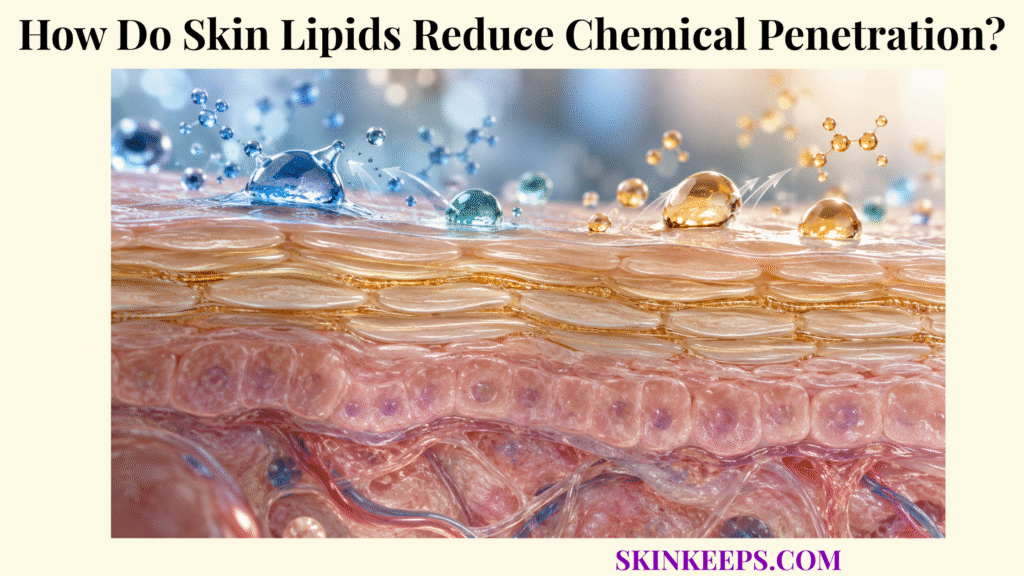
Skin lipids reduce chemical penetration by forming the organized extracellular matrix of the stratum corneum, where ceramides, cholesterol, and free fatty acids create a low-permeability pathway that slows the partitioning and diffusion of many external molecules toward living skin.
This barrier works selectively rather than absolutely: penetration varies with lipid organization, molecular size, lipophilicity, ionization, solubility, concentration, vehicle, exposure time, hydration, and barrier integrity. Lipids reduce chemical penetration; they do not make skin universally impermeable.
Where Do Skin Lipids Form the Chemical Barrier?
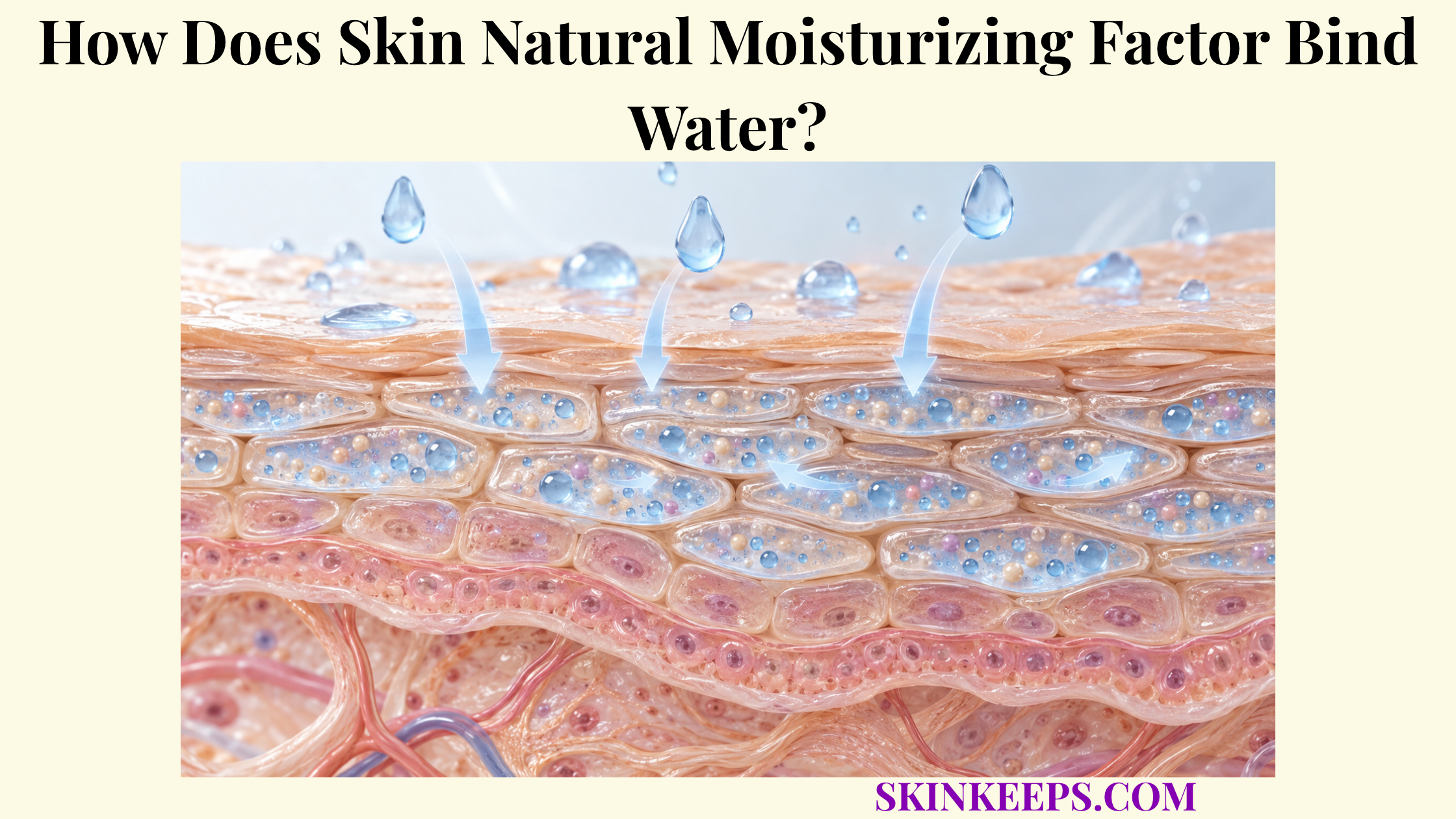
Skin lipids form the chemical permeability barrier mainly in the extracellular spaces of the stratum corneum, where ceramides, cholesterol, and free fatty acids assemble around corneocytes into highly organized lamellar structures.
Where Are Skin Barrier Lipids Located?
Barrier lipids are concentrated between stratum-corneum corneocytes rather than functioning primarily as a superficial oil coating on top of the skin. This architecture places the lipid matrix inside the outer epidermal barrier itself, where it contributes to skin barrier protection and provides the lipid-specific mechanism within broader skin resistance to chemical and mechanical injury.
Intercellular lipid matrix: the highly organized extracellular lipid system occupying the spaces between stratum-corneum corneocytes.
Lipid lamella: an ordered layered arrangement of stratum-corneum lipid molecules.
Which Skin Lipids Form the Chemical Barrier?
Ceramides, cholesterol, and free fatty acids form the major extracellular lipid classes responsible for stratum-corneum permeability control. Ceramides contribute strongly to hydrophobic structure and lamellar packing, cholesterol modifies phase behavior and organization, and free fatty acids contribute to dense lipid packing and barrier architecture. None of these classes acts as a complete barrier by itself.
Surface sebum is chemically different and should not be confused with the extracellular stratum-corneum lipids that dominate passive permeability control. The barrier depends on coordinated lipid classes integrated with corneocyte structures.
Why Does Skin Lipid Organization Matter as Much as Composition?
Chemical resistance depends on how barrier lipids are packed and arranged into lamellae, because disordered lipids permit molecular movement differently from densely organized barrier structures even when the same general lipid classes are present.
Ceramide subclasses, lipid chain length, the distribution of long and very-long chains, lamellar arrangement, lateral packing, and extracellular lipid processing all influence permeability. Lipid quantity alone therefore cannot define barrier quality.
| Barrier structure | Location | Main contribution to chemical resistance |
|---|---|---|
| Corneocytes | Cellular units of stratum corneum | Provide structural and protein-rich obstacles |
| Corneocyte lipid envelope | Bound to outer corneocyte surface | Creates an interface between cells and extracellular lipids |
| Ceramides | Extracellular lipid matrix | Major components of the ordered permeability barrier |
| Cholesterol | Extracellular lipid matrix | Modulates lipid organization and phase behavior |
| Free fatty acids | Extracellular lipid matrix | Contribute dense molecular packing and barrier organization |
| Lipid lamellae | Between corneocytes | Form the dominant continuous diffusion-resistant extracellular pathway |
Chemical resistance depends on coordinated corneocyte and lipid architecture, but the extracellular lipid matrix provides the major continuous pathway controlling passive molecular movement.
How Do Skin Lipids Slow Chemical Diffusion?
Skin lipids slow chemical diffusion by forcing external molecules to partition into and then migrate through densely organized extracellular lipid layers before they can reach the more aqueous viable epidermis below.
What Does Chemical Partitioning Into Skin Lipids Mean?
Partitioning occurs when an external molecule transfers from its original vehicle into the stratum-corneum environment according to its relative affinity for those two phases. A chemical therefore must not merely have affinity for lipid; it also must be thermodynamically available to leave the air, water, product, solvent, or other vehicle that delivered it to the skin.
Partitioning: transfer of a chemical from one phase into another, such as from an exposure vehicle into the stratum corneum.
Thermodynamic activity: a high-level way of describing how strongly a chemical is driven to leave its current formulation and enter another phase.
How Does Chemical Diffusion Through Skin Lipids Occur?
After entering the barrier, molecules diffuse through the tortuous lipid-dominated stratum-corneum pathway at rates determined by molecular mobility, barrier organization, and the concentration gradient driving movement toward deeper tissue. The stratum corneum barrier therefore acts as a rate-limiting environment rather than a perfectly sealed wall.
Diffusion: movement of molecules through tissue driven by molecular motion and concentration differences.
Flux: the amount of a substance moving across a defined skin area per unit time.
At a high level: flux rises with favorable partitioning, diffusivity, and chemical driving force—and falls as effective barrier resistance increases.
Why Does Skin Lipid Resistance Reduce but Not Eliminate Chemical Movement?
The lipid matrix greatly increases resistance to molecular movement but remains selectively permeable, allowing different chemicals to cross at widely different rates rather than creating absolute impermeability. Passive transport can also include transcellular contributions and appendage-associated routes through follicles or ducts, depending on the molecule and exposure context.
How Do Skin Lipids Seal Spaces Between Corneocytes?
Skin lipids “seal” spaces between corneocytes by occupying the extracellular domains with continuous organized lamellae that eliminate easy aqueous gaps and force molecules through a long, chemically selective diffusion pathway.
How Does the Brick-and-Mortar Model Explain Skin Lipids?
The brick-and-mortar model describes corneocytes as structural “bricks” surrounded by extracellular lipid “mortar,” but the lipid mortar is actually a highly organized molecular lamellar system rather than simple oil or glue. The analogy is useful for orientation, yet it does not fully represent corneocyte lipid envelopes, ceramide diversity, lateral packing, or appendageal transport.
Why Are Continuous Skin Lipid Layers Important?
Continuity matters because an external molecule cannot simply pass through empty intercellular spaces; it encounters lipid-rich domains throughout the extracellular pathway. This is why the intercellular lipid matrix is described as the dominant continuous passive pathway rather than the only possible route through skin.
How Do Skin Intercellular Lipids Restrict Bypass Routes?
Intercellular lipids reduce simple extracellular bypass by filling and organizing the domains between corneocytes, increasing the tortuosity and physicochemical resistance of the route toward living epidermis. This location is easiest to understand within the broader map of skin epidermal barrier structures, while the deeper lipid-specific architecture belongs to the skin intercellular lipids mechanism.
The word seal is educational shorthand. Extracellular lipid lamellae create a continuous, highly resistant diffusion environment; they do not produce a perfectly watertight barrier with zero molecular pathways.
How Do Skin Lipids Resist Different Chemical Properties?
Skin lipids resist different chemicals to different degrees because molecular size, lipophilicity, polarity, ionization, solubility, concentration, and vehicle determine how readily a substance partitions into and moves through the stratum corneum.
How Do Lipophilic Chemicals Interact With Skin Lipids?
Lipophilic chemicals can partition readily into the lipid-rich stratum corneum, but high lipid affinity does not automatically produce high total penetration because the molecule must also diffuse through the matrix and eventually partition into more aqueous deeper tissue.
Passive skin permeation therefore depends on a balance between lipid affinity and the ability to leave the stratum corneum for more aqueous deeper tissue. Extremely lipophilic molecules can show strong stratum-corneum retention, so “more lipophilic” is not a linear synonym for “more penetrating.”
How Do Hydrophilic or Ionized Chemicals Interact With Skin Lipids?
Strongly hydrophilic or charged molecules often partition poorly into intact stratum-corneum lipids, which restricts passive permeation, although small size, barrier damage, vehicle effects, high exposure, and alternative routes can modify this resistance.
Ionization changes both lipid affinity and aqueous solubility. The non-ionized form of many molecules partitions more readily into a lipid-rich phase, but the exact result depends on chemical structure, pKa, local pH, concentration, and vehicle.
Why Does Molecular Size Affect Skin Lipid Permeability?
Larger molecules generally diffuse more slowly through intact stratum-corneum architecture because molecular mobility tends to decrease as size and structural complexity increase. The often-cited “500-Dalton rule” arose from dermal and transdermal delivery observations and should be treated as an empirical heuristic—not a chemical-safety threshold. No single molecular-weight cutoff defines whether an external chemical can or cannot cross skin.
How Do Concentration and Vehicle Change Chemical Penetration?
Higher chemical activity or concentration can increase the driving force for penetration, while the exposure vehicle can change solubility, partitioning, hydration, lipid organization, and release of the chemical into skin. Saturation, evaporation, formulation effects, and barrier injury can all prevent concentration from acting as a simple standalone predictor.
| Chemical property | Interaction with lipid barrier | Relative penetration tendency |
|---|---|---|
| Small molecular size | Greater molecular mobility | Often favors passive penetration when other properties also fit |
| Large molecular size | Lower diffusional mobility | Generally reduces passive penetration |
| Moderate lipophilicity | Can partition into SC and still transfer toward aqueous tissue | Often favorable for transcutaneous movement |
| Very high lipophilicity | Strong SC affinity and retention | Entry may be good while onward transfer becomes limiting |
| Strong hydrophilicity | Poor partitioning into hydrophobic lipid matrix | Often limits intact-skin permeation |
| Strong ionization | Usually lowers affinity for lipid domains | Often reduces passive lipid-pathway penetration |
| Higher concentration/activity | Greater driving force | Can increase flux if other conditions remain comparable |
| Penetration-enhancing vehicle | Changes partitioning, hydration, release, or barrier structure | Can increase penetration substantially |
| Damaged lipid barrier | Lower structural resistance | Can increase entry of otherwise restricted chemicals |
These are directional tendencies rather than universal rankings; actual penetration reflects the combined chemical, vehicle, exposure, anatomical-site, hydration, and barrier conditions.
What Disrupts Skin Lipids and Increases Chemical Penetration?
Skin lipids can become less effective when solvents, irritating surfactants, repeated wet work, inflammation, or other barrier damage extracts, fluidizes, reorganizes, or prevents normal replacement of the extracellular lipid matrix.
How Can Solvents Disrupt Skin Lipids?
Selected organic solvents can increase permeability by extracting barrier lipids or changing their molecular organization, thereby lowering resistance to subsequent or continuing chemical movement. Acetone is often used experimentally as a lipid-extraction model, but solvents differ markedly in chemistry, volatility, tissue interactions, and disruption potency.
How Can Detergents and Surfactants Disrupt Skin Lipids?
Sufficiently irritating surfactants can interact with both stratum-corneum lipids and proteins, producing lipid extraction, structural disorganization, swelling, and increased permeability. Sodium lauryl sulfate is a common experimental irritant, but its behavior should not be generalized to every cleanser or surfactant system.
Can Repeated Washing Weaken Skin Lipid Integrity?
Repeated wet work or frequent exposure to irritating detergent systems can weaken lipid integrity when disruption repeatedly occurs faster than normal epidermal barrier-repair mechanisms restore organized extracellular lipids. Ordinary cleansing is not equivalent to destructive exposure, and normal washing should not be described as automatically removing the lipid barrier.
How Can Inflammation Alter Skin Lipid Organization?
Persistent inflammatory signaling can alter keratinocyte differentiation, lipid synthesis, ceramide profiles, and extracellular processing, reducing normal lipid organization in several inflammatory barrier disorders. Those disease-specific lipid patterns require their own clinical context and should not be inferred from dryness or permeability symptoms alone.
How Does Existing Barrier Damage Increase Chemical Entry?
Existing barrier damage can increase chemical entry by creating a less organized diffusion pathway with reduced lipid resistance, although the magnitude of the increase differs substantially among chemicals. This is a structural consequence of skin barrier disruption, not a universal multiplier that affects every substance equally.
What Happens When Skin Lipid Barrier Function Weakens?
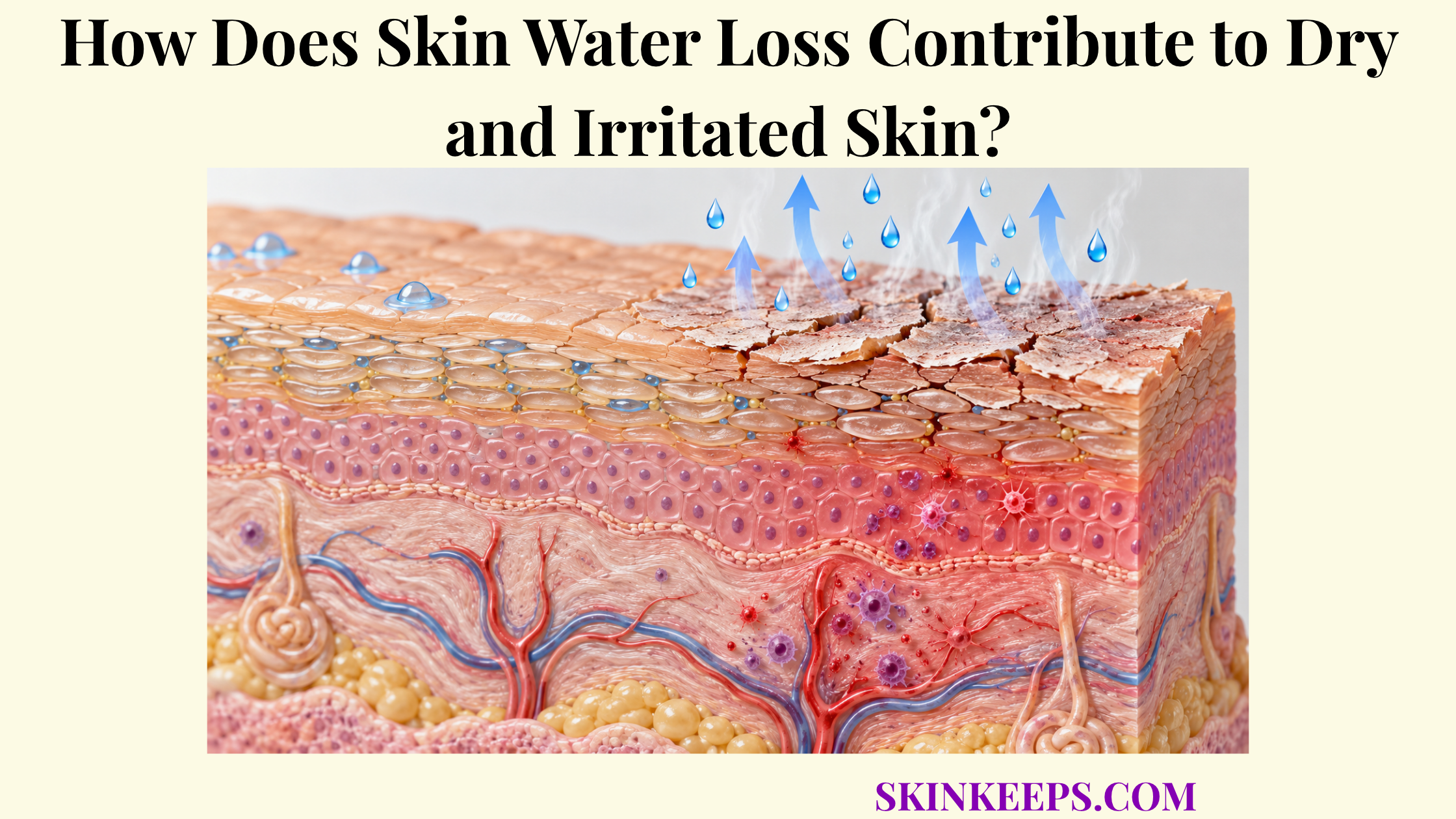
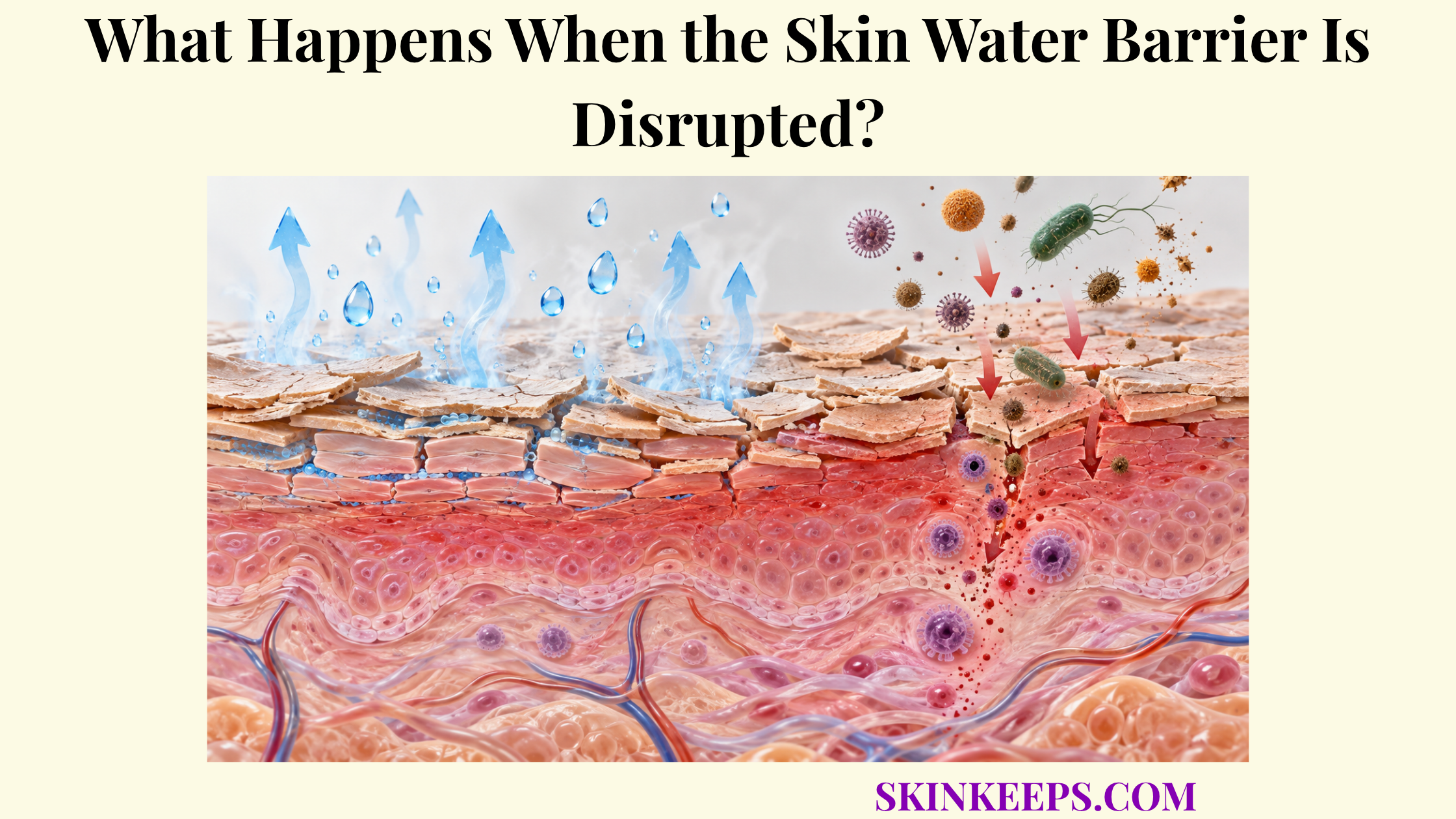
When skin lipid barrier function weakens, permeability rises in both directions: external substances can reach viable tissue more readily while water escapes more easily through the stratum corneum.
Why Does Weakened Skin Lipid Function Increase Chemical Penetration?
Disorganized or depleted extracellular lipids reduce the resistance encountered during partitioning and diffusion, allowing selected external molecules to cross the stratum corneum more readily. The degree of change remains chemical-specific because penetration still depends on size, ionization, lipid–water affinity, concentration, vehicle, and exposure conditions.
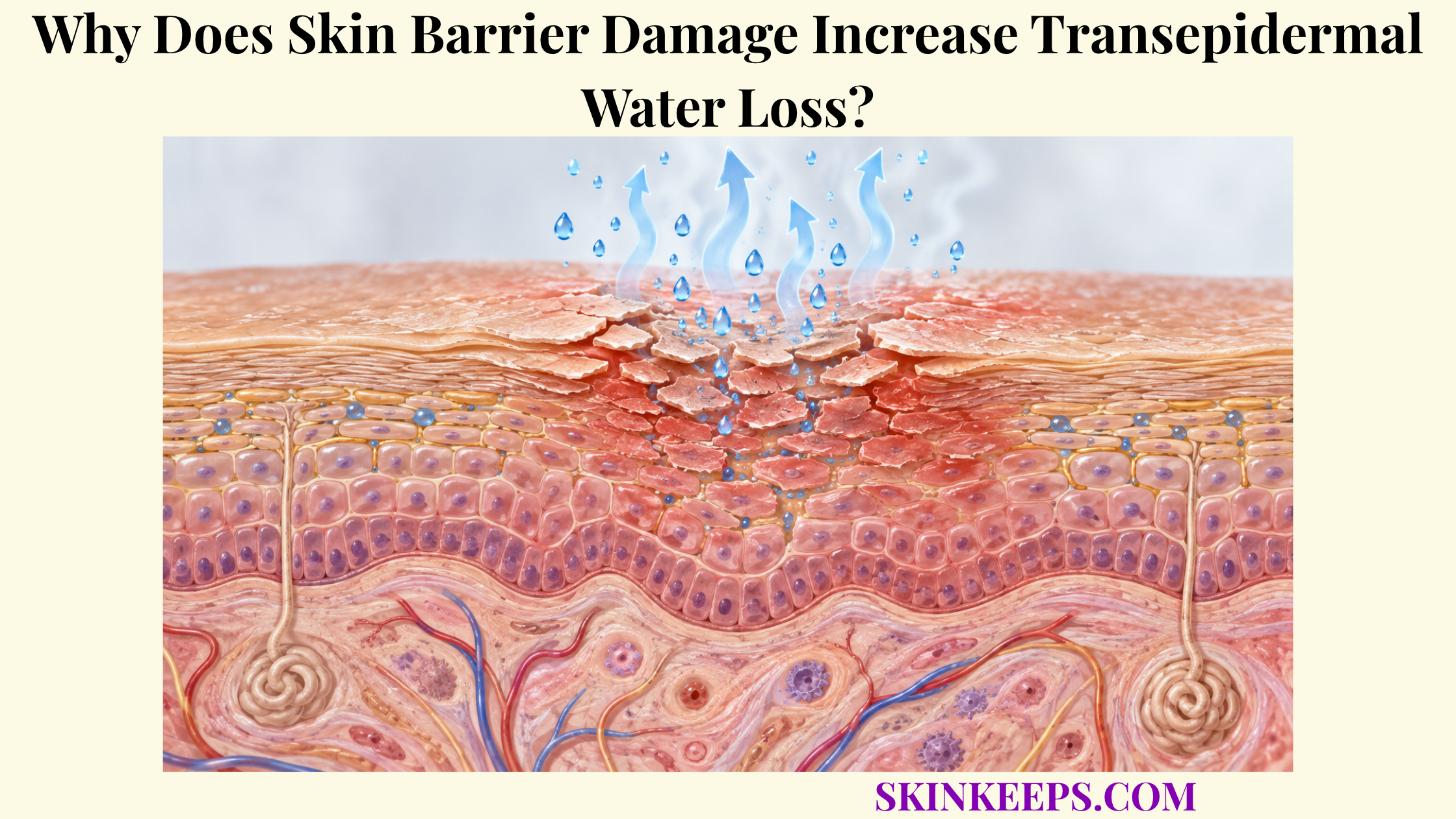
Why Does Skin Lipid Damage Increase Transepidermal Water Loss?
The same extracellular lipid matrix that restricts chemical entry also limits passive water escape, so disruption can increase transepidermal water loss and reduce stratum-corneum hydration. This two-directional permeability role is central to the skin water barrier: outside-to-inside chemical resistance and inside-to-outside water retention arise from the same fundamental barrier architecture.
How Can Skin Lipid Damage Increase Irritant Exposure?
Greater permeability can increase contact between external irritants and viable keratinocytes, potentially triggering cellular stress and inflammatory signaling when the exposure is sufficiently irritating. Increased penetration does not automatically mean visible dermatitis, toxicity, or systemic absorption; the biological result still depends on the substance and delivered dose.
How Can Chemical Damage Amplify Skin Lipid Barrier Failure?
Chemical exposure can create a feedback loop when lipid disruption increases permeability, allowing continued exposure to penetrate more effectively and potentially produce additional barrier injury. The loop is conditional rather than inevitable: the chemical, concentration, duration, repetition, vehicle, and starting barrier state determine whether disruption progresses.
What Are the Key Takeaways About Skin Lipids and Chemical Penetration?
The key fact about skin lipids and chemical penetration is that organized extracellular lipids create the main continuous permeability pathway through the stratum corneum, so chemical entry depends on both the integrity of that matrix and the physicochemical properties of the substance attempting to cross it.
Ceramides, cholesterol, and free fatty acids reduce molecular flux by forming organized lamellae, but no one lipid, molecular property, or exposure variable predicts penetration alone. The barrier is selective, dynamic, and finite; normal skin lipids reduce exposure but do not substitute for chemical-safety controls or appropriate protective equipment.
- Skin lipids form the extracellular permeability matrix of the stratum corneum.
- Ceramides, cholesterol, and free fatty acids are the major lipid classes.
- Lipid organization matters, not just the total amount of lipid.
- Lipid lamellae form the dominant continuous passive pathway through the intercellular stratum corneum.
- Chemical penetration requires partitioning and diffusion.
- Molecular size affects diffusion, but no single molecular-weight cutoff defines safety.
- Lipophilicity influences entry into the lipid barrier, but greater lipophilicity does not always mean greater total penetration.
- Hydrophilic and ionized chemicals generally partition less readily into intact lipid-rich stratum corneum.
- Concentration and chemical activity affect the driving force for penetration.
- The exposure vehicle can strongly change penetration.
- Skin lipids do not block every chemical equally.
- Solvents and irritating surfactants can disrupt lipid organization under appropriate exposure conditions.
- Repeated wet work can impair barrier recovery when exposure exceeds repair capacity.
- Inflammation can modify lipid synthesis and organization.
- Lipid-barrier weakness increases both chemical permeability and water loss.
- Skin lipid resistance reduces exposure; it does not replace chemical-safety controls or PPE.
What Common Questions Do People Ask About Skin Lipids and Chemical Penetration?
Common questions about skin lipids focus on whether ceramides block chemicals, whether lipophilic substances penetrate more easily, why solvents increase permeability, and why lipid damage also makes skin lose more water.
Are Ceramides the Only Skin Lipids That Block Chemical Penetration?
No. Ceramides are critical components, but normal permeability control depends on coordinated ceramides, cholesterol, free fatty acids, corneocyte structures, and the molecular organization of the entire stratum-corneum matrix.
Do Lipophilic Chemicals Always Penetrate Skin More Easily?
No. Lipophilicity can improve partitioning into the stratum corneum, but a molecule must also diffuse through the barrier and transfer into deeper, more aqueous tissue, so extremely high lipid affinity can sometimes increase retention rather than total passage.
Can Water-Soluble Chemicals Penetrate the Skin?
Yes, under some conditions. Strong hydrophilicity often limits passive partitioning into intact stratum-corneum lipids, but molecular size, ionization, concentration, vehicle, appendageal routes, and barrier damage can modify penetration.
Why Can Solvents Increase Chemical Penetration?
Selected solvents can extract or reorganize stratum-corneum lipids and alter proteins, reducing the structural resistance that normally slows chemical diffusion; the magnitude of this effect depends on the specific solvent and exposure.
Why Does Damage to Skin Lipids Cause Both Chemical Penetration and Water Loss?
The same organized extracellular lipid matrix controls permeability in both directions, so disruption can allow more external molecules to enter while also permitting more internal water to escape as transepidermal water loss.
Sources & Evidence
S1 — The Skin Barrier: An Extraordinary Interface With an Exceptional Lipid Organization
Stratum-corneum barrier location; ceramides, cholesterol and free fatty acids; lamellar organization; chain-length and packing effects.
S2 — Using Molecular Simulation to Understand the Skin Barrier
Corneocytes plus lipid lamellae; continuous extracellular pathway; molecular diffusion; molecular organization and permeability.
S3 — Lipids and the Permeability and Antimicrobial Barriers of the Skin
Major stratum-corneum lipid classes; intercellular lipid control of permeability; distinction from surface sebum.
S4 — The Role of Ceramides in Disruption of the Cutaneous Permeability Barrier
Ceramide composition, chain length, lipid organization, permeability disruption and water-retention consequences.
S5 — Penetration Through the Skin Barrier
Fickian penetration framework; skin integrity and anatomical site; size, solubility, ionization, lipophilicity and vehicle effects.
S6 — Solute–Vehicle–Skin Interactions and Their Contribution to Pharmacokinetics of Skin Delivery
Partitioning from vehicle; thermodynamic activity; diffusion; solute–vehicle–skin interactions and release into skin.
S7 — Irritant Contact Dermatitis — a Review
Solvents, detergents, wet work, concentration and duration; physicochemical irritancy and barrier disruption.
S8 — Transepidermal Water Loss: Environment and Pollution — A Systematic Review
TEWL as a measure related to stratum-corneum water-barrier integrity and context-dependent interpretation.
Medical note: This page explains normal skin-permeability physiology and does not diagnose chemical burns, dermatitis, or “lipid deficiency.” For an actual hazardous chemical exposure, follow the product SDS or authoritative emergency instructions and do not rely on intact skin for protection. Seek prompt or urgent medical care for significant blistering, worsening pain, spreading swelling, corrosive exposure, eye or facial exposure, extensive injury, or systemic symptoms.